Product Lifecycle, Meaning and Stages in PLC

Product Life Cycle (PLC) is an important concept in Principles of Marketing that explains the stages through which a product passes from its introduction in the market to its final decline. Every product has a limited life span, and during this life span, its sales, profits, competition, and marketing strategies change. Understanding the product life cycle helps marketers plan product development, pricing, promotion, and distribution strategies effectively. The concept of PLC provides a systematic framework for managing products in a dynamic and competitive market environment.

Meaning of Product Life Cycle

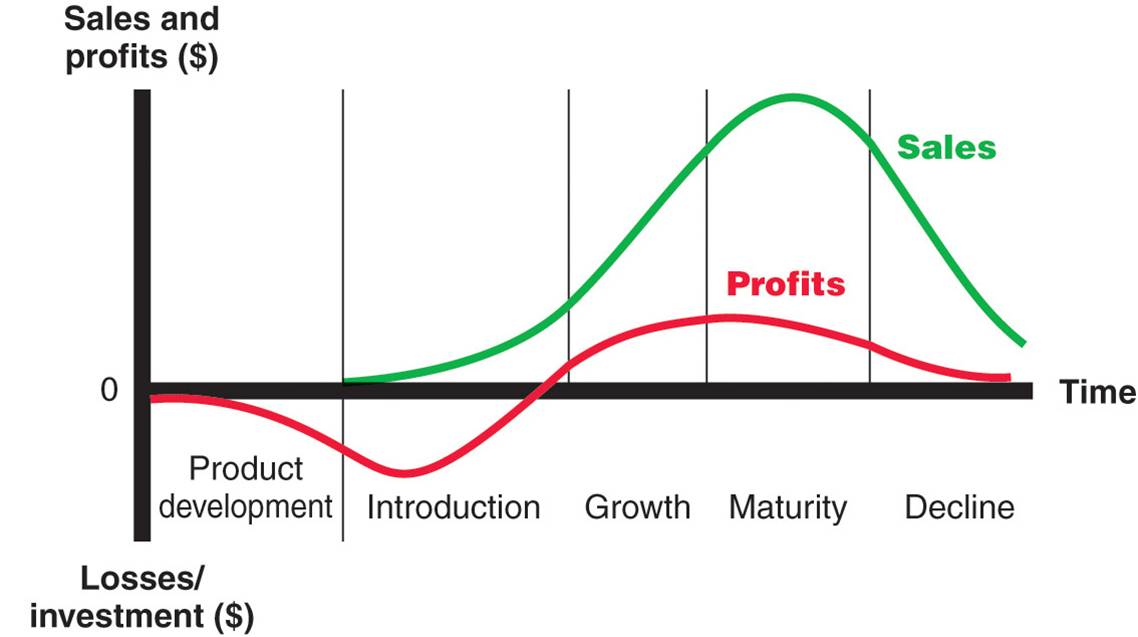
Product Life Cycle refers to the pattern of sales and profits experienced by a product over time. It represents the journey of a product from its launch to its withdrawal from the market. Just like human beings, products are born, grow, mature, and eventually decline. Although the length of each stage may vary from product to product, most products generally pass through five stages: Introduction, Growth, Maturity, and Decline. Each stage has distinct characteristics and requires different marketing strategies.
Product-Life-Cycle-Stages

Stages of Product Life Cycle

1. Introduction Stage

The introduction stage is the first stage of the product life cycle, where a new product is launched in the market. During this stage, sales growth is slow because the product is new and customers are not fully aware of its existence. Heavy expenditure is incurred on advertising, promotion, product development, and distribution. Profits are usually low or negative due to high initial costs and low sales volume.

The main objective should be to create product awareness and trial.

In this stage, competition is limited or absent as the product is unique. Pricing strategies may vary—firms may adopt skimming pricing to recover high costs or penetration pricing to gain quick market acceptance. Promotion focuses on creating awareness, educating consumers, and encouraging trial purchases. Distribution channels are limited, and the product is available only in selected markets. The success of the introduction stage depends largely on effective promotion and product acceptance.

2. Growth Stage

The growth stage is characterized by a rapid increase in sales as the product gains acceptance among consumers. Customer awareness increases, repeat purchases occur, and new customers are attracted. Profits rise significantly due to higher sales volume and reduced cost per unit. During this stage, competitors enter the market with similar or improved versions of the product.

The main objective in the growth stage is to maximise the market share.

Marketing strategies in the growth stage focus on improving product quality, adding new features, expanding distribution channels, and strengthening brand image. Prices may be reduced slightly to attract price-sensitive customers and face competition. Promotional activities shift from creating awareness to building brand preference and differentiation. The growth stage is crucial for establishing a strong market position and maximizing long-term profitability.

3. Maturity Stage

The maturity stage is the longest stage of the product life cycle. During this stage, sales growth slows down as the product reaches maximum market penetration. The market becomes saturated, and competition becomes intense. Many competitors offer similar products, leading to price competition and reduced profit margins.

The company’s main objective should be to maximise profit while defending the market share.

Firms adopt various strategies to extend the maturity stage, such as product modification, market modification, and marketing mix modification. Product modification includes improving quality, design, packaging, or adding new features. Market modification involves finding new uses, new markets, or new customer segments. Promotional strategies focus on brand loyalty, reminders, and sales promotion schemes. Although profits start declining, effective strategies can help sustain sales and profitability.

4. Decline Stage

The decline stage is the final stage of the product life cycle. During this stage, sales and profits decline sharply due to technological advancements, changing consumer preferences, availability of substitutes, or market saturation. Some competitors exit the market, while others continue with limited offerings.

Marketing strategies during the decline stage include harvesting, divesting, or discontinuing the product. Firms may reduce promotional expenditure, cut costs, and focus on niche markets. Alternatively, companies may rejuvenate the product through innovation or repositioning. The decline stage requires careful decision-making to minimize losses and allocate resources efficiently.
Product-Life-Cycle-Strategies-and-Characteristics-998x1024

Marketing Strategies at Different Product Life Cycle (PLC) Stages

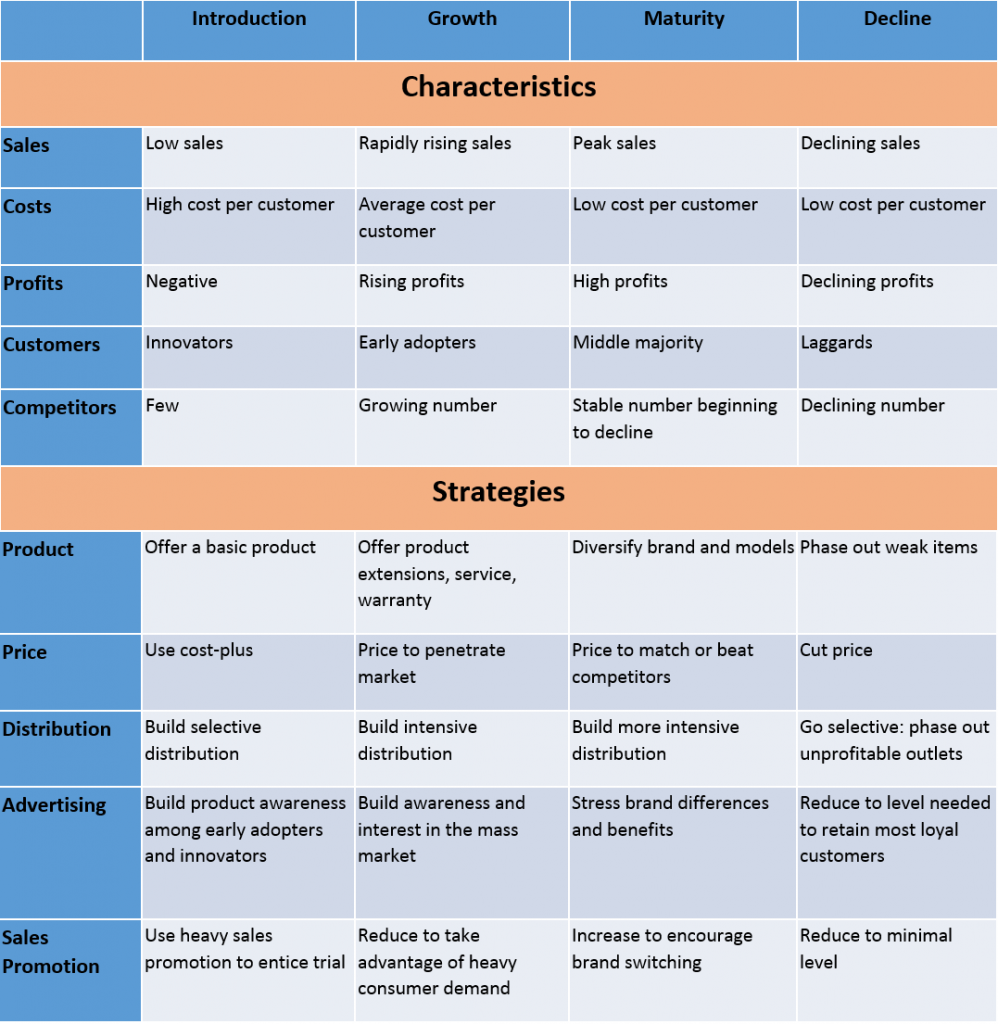
Marketing strategies vary at each stage of the Product Life Cycle because market conditions, competition, sales volume, and consumer behavior change over time. To achieve maximum effectiveness, firms must align their product, price, place, and promotion strategies with the specific stage of the PLC. The major marketing strategies at different PLC stages are explained below.

1. Introduction Stage

At the introduction stage, the product is new to the market and consumer awareness is low. The main objective of marketing is to create awareness and encourage trial purchases.

  • Product Strategy

The product is introduced in its basic form with limited varieties. Emphasis is placed on quality and uniqueness.

  • Price Strategy

Firms may adopt skimming pricing to recover high development costs or penetration pricing to attract more customers quickly.

  • Place Strategy

Distribution is limited and selective. The product is available in selected markets and outlets.

  • Promotion Strategy

Promotion is informative in nature. Heavy advertising, product demonstrations, free samples, and personal selling are used to educate consumers.

2. Growth Stage

In the growth stage, sales increase rapidly due to rising consumer acceptance and increasing competition. The objective is to build brand preference and expand market share.

  • Product Strategy

Product improvements, new features, and additional models are introduced to differentiate from competitors.

  • Price Strategy

Prices may be reduced slightly to attract price-sensitive customers and meet competition.

  • Place Strategy

Distribution channels are expanded to reach a wider market. Product availability increases.

  • Promotion Strategy

Promotion becomes persuasive. Advertising focuses on brand image, superiority, and customer benefits.

3. Maturity Stage

The maturity stage is marked by intense competition, market saturation, and slowing sales growth. The objective is to maintain market share and extend product life.

  • Product Strategy

Product modification, quality improvement, new packaging, and value-added features are introduced.

  • Price Strategy

Competitive pricing, discounts, and allowances are used to retain customers.

  • Place Strategy

Distribution becomes intensive. Firms strengthen relationships with intermediaries.

  • Promotion Strategy

Promotion focuses on reminder advertising, sales promotion schemes, and brand loyalty programs.

4. Decline Stage

In the decline stage, sales and profits decline due to technological changes, substitutes, or changing consumer preferences. The objective is to minimize losses.

  • Product Strategy

Firms may discontinue weak products or focus on profitable variants.

  • Price Strategy

Prices may be reduced to clear stock or maintained for niche markets.

  • Place Strategy

Distribution is reduced and unprofitable outlets are eliminated.

  • Promotion Strategy

Promotional expenditure is minimized. Only selective promotion is undertaken.

Marketing Strategies at Different PLC Stages

PLC Stage Sales & Profits Product Strategy Price Strategy Place (Distribution) Promotion Strategy
Introduction Low sales, low/negative profits Basic product, limited variants Skimming / Penetration Selective, limited outlets Informative advertising, awareness creation
Growth Rapidly increasing sales, rising profits Improved quality, new features, variants Competitive pricing Expanded channels, wider market reach Persuasive advertising, brand building
Maturity Peak sales, declining profits Product modification, better packaging Competitive pricing, discounts Intensive distribution Reminder advertising, sales promotion
Decline Falling sales and profits Product elimination or niche focus Reduced or stable niche pricing Reduced channels Minimal promotion, cost control

Advantages of Product Life Cycle (PLC)

  • Helps in Effective Product Planning

The Product Life Cycle concept helps marketers plan products effectively at different stages. By identifying whether a product is in the introduction, growth, maturity, or decline stage, firms can decide necessary changes in product features, quality, packaging, and branding. Proper product planning reduces chances of failure and ensures that products meet changing customer needs throughout their life span.

  • Supports Better Marketing Strategy Formulation

PLC assists marketers in designing suitable marketing strategies for each stage of a product’s life. Pricing, promotion, and distribution strategies differ at every stage. For example, informative promotion is used in the introduction stage, while persuasive promotion is used in the growth stage. Thus, PLC ensures the right marketing mix is applied at the right time.

  • Helps in Sales and Demand Forecasting

The product life cycle helps firms forecast future sales and demand patterns. By studying past and present sales trends, marketers can predict future performance. Accurate forecasting helps in production planning, inventory control, and resource allocation. This reduces uncertainty and enables firms to prepare for market changes in advance.

  • Assists in Cost Control and Profit Planning

PLC helps organizations control costs and plan profits effectively. During the introduction stage, firms accept low or negative profits, while in the growth and maturity stages, they aim to maximize profits. In the decline stage, cost-cutting strategies are adopted. Thus, PLC enables better financial planning and efficient use of resources.

  • Aids in Product Modification and Innovation

The PLC concept encourages continuous product improvement and innovation. When a product enters the maturity stage, firms modify features, design, or packaging to extend its life. Innovation helps in meeting changing consumer preferences and facing competition. PLC ensures that firms do not rely on outdated products for long periods.

  • Helps in Managing Competition

PLC helps firms understand the level of competition at different stages. Competition is low in the introduction stage but increases in the growth and maturity stages. By knowing the intensity of competition, firms can adopt defensive or aggressive strategies. This improves competitive strength and market position.

  • Supports Product Portfolio Management

The product life cycle helps firms manage a balanced product portfolio. Companies usually have products at different PLC stages. Profits from mature products can be used to support new products in the introduction stage. This balance ensures steady income, reduces risk, and supports long-term business stability.

  • Guides Product Withdrawal Decisions

PLC helps firms decide the right time to discontinue or withdraw a product. When a product enters the decline stage and becomes unprofitable, firms can drop it and divert resources to new opportunities. This prevents unnecessary losses and improves overall efficiency and performance of the organization.

Limitations of Product Life Cycle (PLC)

  • Difficulty in Identifying Exact Stage

One major limitation of the Product Life Cycle concept is the difficulty in identifying the exact stage of a product. Sales patterns are not always clear, and stages may overlap. Managers may misjudge whether a product is in growth or maturity, leading to incorrect marketing decisions and ineffective strategies.

  • Not Applicable to All Products

The PLC concept does not apply uniformly to all products. Some products may not follow a clear life cycle pattern, while others may remain in one stage for a long time. Fashion products, fads, and seasonal goods often have unpredictable life cycles, limiting the usefulness of the PLC model.

  • Uncertainty in Duration of Stages

The length of each stage of the product life cycle cannot be predicted accurately. Some products may experience rapid growth and quick decline, while others may remain in the maturity stage for many years. This uncertainty makes long-term planning difficult for marketers.

  • External Factors Affect the Life Cycle

External factors such as technological changes, government policies, economic conditions, and competition can alter the product life cycle. Sudden innovations or regulatory changes may shorten or extend a product’s life unexpectedly. The PLC concept does not fully consider these uncontrollable environmental factors.

  • Overemphasis on Sales and Profits

The PLC concept mainly focuses on sales and profit trends and ignores other important factors such as customer satisfaction, brand equity, and market relationships. A product with low sales may still be strategically important for brand image or customer retention, which PLC may overlook.

  • Reactive Rather Than Predictive

PLC is more descriptive than predictive in nature. It explains what has happened to a product rather than accurately predicting future performance. Managers often use PLC after changes occur, which may result in delayed responses to market challenges.

  • Ignores Marketing Efforts Impact

The PLC model assumes that products naturally move through stages, but it does not fully recognize the impact of marketing efforts. Aggressive promotion, repositioning, or innovation can significantly change a product’s life cycle. Thus, PLC may underestimate the role of managerial decisions.

  • Difficult to Use in Strategic Decisions

Due to its generalized nature, PLC may not provide clear guidance for strategic decision-making. Different products within the same category may be at different stages. Relying solely on PLC can lead to oversimplified strategies and poor decision-making.

Product Mix, Meaning, Elements and Strategy

Product Mix refers to the complete range of products that a company offers for sale to its customers. It includes all product lines and individual products that a company markets, showcasing variety in terms of size, design, functionality, or price. The product mix is characterized by four key dimensions: width (the number of product lines), length (the total number of products), depth (the variety within each product line), and consistency (how closely related the product lines are). A well-balanced product mix allows companies to meet diverse customer needs and expand market reach.

Elements of Product Mix

Elements of the Product mix. refer to the various components that make up a company’s range of products. These elements help a business manage its products and create a comprehensive strategy for satisfying customer needs and driving profitability. The main elements of the product mix are Product line, Product width, Product length, Product depth, and Product consistency.

1. Product Line

Product line is a group of related products that a company offers under a single brand. These products usually share similar characteristics, cater to the same target market, or serve similar purposes. For example, a company that produces personal care items may have separate product lines for hair care, skincare, and hygiene products.

  • Example: Apple’s product lines include iPhones, iPads, MacBooks, and Apple Watches

2. Product Width

Product width refers to the number of different product lines that a company offers. A wider product mix means a company has a diverse range of product lines, while a narrower mix indicates fewer product lines. A broad product width allows companies to cater to various customer segments, reduce market risk, and create cross-selling opportunities.

  • Example: Procter & Gamble has a wide product mix, offering a variety of product lines including beauty, grooming, health care, and household cleaning.

3. Product Length

Product length is the total number of individual products or items offered across all product lines. This includes all variants within each product line. The length helps companies assess the variety of products they offer within each product line.

  • Example: In the beverage category, Coca-Cola offers a long product line, with products such as Coke, Diet Coke, Coke Zero, Sprite, and Fanta.

4. Product Depth

Product depth refers to the number of variations offered within a single product line. Variations can include different sizes, flavors, colors, designs, or any other features that differentiate products within a line. Greater product depth allows companies to meet diverse customer preferences and capture niche markets.

  • Example: Colgate offers various toothpaste options in terms of flavors, packaging sizes, and specific benefits (e.g., whitening, cavity protection, sensitivity relief).

5. Product Consistency

Product consistency refers to how closely related the product lines are in terms of use, production requirements, distribution channels, or branding. High consistency means the products are closely related, while low consistency indicates a mix of unrelated products.

  • Example: A company like PepsiCo has a relatively consistent product mix focused on beverages and snacks, while a conglomerate like General Electric has a low consistency with products ranging from jet engines to medical devices.

Example of Product Mix.: in Table

Here’s a table that illustrates an example of a Product Mix. for a hypothetical company, including various product lines and their respective products:

Element Description Example
Product Line A group of related products offered by a company under one brand, sharing similar characteristics. Apple’s product lines include iPhones, iPads, MacBooks, and Apple Watches.
Product Width The number of different product lines a company offers. Procter & Gamble offers product lines in beauty, grooming, health care, and household cleaning.
Product Length The total number of individual products or items offered across all product lines. Coca-Cola’s beverage category includes Coke, Diet Coke, Coke Zero, Sprite, and Fanta.
Product Depth The number of variations offered within a single product line (e.g., sizes, flavors, colors). Colgate offers toothpaste in various sizes, flavors, and specific benefits like whitening or sensitivity relief.
Product Consistency How closely related product lines are in terms of use, production, distribution, or branding. PepsiCo focuses on beverages and snacks (high consistency), while General Electric offers diverse products like jet engines and medical devices (low consistency).

Product Mix Strategies

Product Mix Strategies are techniques companies use to manage and optimize their range of products to better meet customer needs and improve market performance. These strategies help in deciding what products to introduce, modify, or discontinue.

  • Expansion

A company adds new product lines or variants to its product mix. This strategy is used when a company wants to diversify its offerings, target new market segments, or increase sales volume.

  • Contraction

Also known as product line pruning, this strategy involves reducing the number of products or product lines. Companies use this when certain products become unprofitable or when they want to focus on their core products.

  • Product Modification

Company makes improvements or changes to existing products, such as adding new features, improving quality, or updating design. This strategy helps keep products competitive and relevant in the market.

  • Diversification

Company enters new markets or introduces entirely new product categories. It can be related or unrelated diversification, depending on whether the new products are similar or different from the existing lines.

  • Product Differentiation

This strategy focuses on making a product stand out from competitors’ offerings by highlighting its unique features, branding, or design. It aims to create a competitive advantage and attract specific customer segments.

  • Trading Up (Upward Stretching)

Company adds higher-end, more premium products to its product line to target more affluent customers. This strategy helps elevate the brand and capture a more profitable segment of the market.

  • Trading Down (Downward Stretching)

Company introduces lower-priced products to appeal to a broader audience or to compete with lower-cost competitors. This can help companies gain market share in a more price-sensitive segment.

  • Line Filling

Company adds new products within its existing range to fill gaps in the product line. This prevents competitors from exploiting these gaps and helps the company meet customer demands more effectively.

  • Product Line Extension

This involves expanding a particular product line by adding more variants, such as different sizes, flavors, or features. It helps attract different customer preferences within the same product line.

  • Cannibalization Management

This strategy ensures that new products introduced do not negatively affect the sales of the company’s existing products. Companies need to carefully manage product mix to avoid overlap and sales losses.

Product Line, Meaning, Working, Product Line Extension, Features, Types, Benefits, and Challenges

Product Line refers to a group of related products offered by a company that share similar characteristics, target the same market, or serve a similar purpose. These products typically fall under a single brand and are marketed together, allowing companies to leverage their branding and promotional strategies effectively. For example, a beverage company might have a product line that includes various types of soft drinks, juices, and bottled water. By managing product lines strategically, businesses can meet diverse customer needs while optimizing their overall product mix.

How Product Lines Work?

Product lines play a crucial role in a company’s overall marketing strategy by grouping related products to meet specific customer needs.

  • Definition and Structure

Product line is a collection of products that are related in terms of their functions, target market, or marketing strategy. Companies organize their offerings into product lines to streamline management and marketing efforts.

  • Target Market Identification

Each product line is designed to cater to a specific segment of the market. By understanding the needs and preferences of target customers, businesses can develop products within the line that appeal directly to that audience.

  • Branding and Positioning

Products within a line often share a common brand name and identity. This creates brand recognition and loyalty, making it easier for customers to associate new products with established ones. Positioning the entire line effectively can enhance overall brand perception.

  • Product Variations

Companies can offer variations within a product line to address different consumer preferences. These variations may include differences in size, flavor, features, or packaging. For example, a snack brand might offer different flavors or health-focused options within its chip product line.

  • Cross-Promotion

Having a well-defined product line allows for cross-promotion of products. For example, if a company launches a new flavor of chips, it can promote it alongside other products in the same line, encouraging customers to try multiple offerings.

  • Economies of Scale

By producing a range of products within the same line, companies can benefit from economies of scale in production, distribution, and marketing. Shared resources can lead to cost savings and improved efficiency.

  • Flexibility and Adaptation

Product lines provide flexibility for companies to adapt to changing market trends and consumer preferences. Businesses can introduce new products, retire underperforming ones, or make adjustments based on feedback from the target market.

  • Performance Evaluation

Companies can evaluate the performance of a product line as a whole, assessing sales, market share, and profitability. This analysis helps in making strategic decisions about resource allocation, marketing efforts, and future product development.

  • Market Expansion

Successful product lines can serve as a foundation for market expansion. Companies can introduce entirely new lines based on the success of existing products, leveraging brand equity and consumer loyalty.

  • Lifecycle Management

Each product line goes through a lifecycle, from introduction to growth, maturity, and decline. Companies must actively manage their product lines by innovating, repositioning, or phasing out products to maximize profitability.

Product Line Extension

Product Line Extension refers to the strategy of adding new products to an existing product line to attract a larger customer base or to meet the evolving needs of consumers. This approach allows companies to leverage their established brand equity and customer loyalty while expanding their offerings.

Key Features of Product Line Extension

  • Broadened Range of Products

Product line extension involves introducing variations or new items that are related to the existing products in the line. For instance, a yogurt brand might add new flavors, low-fat options, or plant-based varieties to its product line.

  • Utilization of Brand Equity

By extending a well-known product line, companies can capitalize on the recognition and trust established with their existing products. This can lead to quicker acceptance of new products by consumers.

  • Meeting Diverse Customer Needs

Product line extensions can address different consumer preferences, demographics, and market segments. For example, a beverage company may introduce a new energy drink variant to cater to health-conscious consumers.

  • Increased Market Share

By offering a wider variety of products, companies can capture a larger share of the market and reduce competition. This is particularly effective in crowded markets where differentiation is crucial.

  • Reduced Risk of New Product Failure

Launching a product extension under an established brand is generally less risky than introducing an entirely new brand. Consumers are more likely to try a new product from a brand they already trust.

Types of Product Line Extensions

1. New Flavors or Varieties: Adding different flavors or styles to an existing product. For example, a snack brand may introduce sweet and spicy versions of its chips.

2. Size Variations: Offering products in different sizes, such as single-serving or family-size packages, to meet varying consumption needs.

3. Healthier Options: Introducing low-calorie, organic, or gluten-free versions of existing products to cater to health-conscious consumers.

4. Targeting New Demographics: Developing products aimed at different age groups, lifestyles, or interests, such as a kids’ version of a popular cereal.

5. Seasonal or Limited Editions: Launching special edition products tied to seasons, holidays, or events to stimulate interest and drive sales.

Benefits of Product Line Extension:

1. Increased Sales Potential: A broader product range can lead to higher overall sales, as customers may purchase multiple items from the same line.

2. Enhanced Brand Loyalty: By continuously offering new options, companies can maintain customer interest and encourage repeat purchases.

3. Efficient Use of Resources: Companies can utilize existing marketing strategies, distribution channels, and production processes to launch new products, reducing costs.

4. Competitive Advantage: A diverse product line can help a company stand out in a competitive marketplace by offering more choices to consumers.

Challenges of Product Line Extension

  • Brand Dilution

If not managed properly, extending a product line can dilute brand identity. Consumers may become confused about what the brand stands for if there are too many unrelated products.

  • Cannibalization

New products may compete with existing ones, potentially leading to a decline in sales of the original products.

  • Quality Control

Maintaining consistent quality across an extended product line can be challenging, especially when introducing new variants.

  • Market Research Needs

Thorough market research is necessary to ensure that the new products meet consumer needs and preferences. Failure to do so can result in unsuccessful product launches.

Examples of Product Line Extension

  • Coca-Cola

The introduction of Diet Coke and Coca-Cola Zero Sugar expanded the original Coca-Cola product line to cater to health-conscious consumers.

  • Lay’s

Lay’s offers a variety of flavors and limited-edition chips, including spicy, exotic, and local flavors to appeal to different tastes.

  • Oreo

Oreo cookies have been extended to include various flavors (like birthday cake and red velvet) and formats (such as Oreo Thins and Mega Stuf).

  • Nike

Nike has expanded its line of athletic shoes to include specialized versions for different sports, lifestyles, and even collaborations with celebrities.

  • Procter & Gamble

P&G has extended its Tide brand to include Tide Pods, Tide Free & Gentle, and other variants, addressing various laundry needs.

Market Segmentation, Basis of Market Segmentation

Market Segmentation is a critical marketing strategy that involves dividing a broad target market into smaller, more manageable segments based on shared characteristics. This process enables businesses to tailor their marketing efforts to meet the specific needs of different consumer groups. The basis of market segmentation can be categorized into several key criteria, including demographic, geographic, psychographic, and behavioral factors.

Demographic Segmentation:

Demographic segmentation is one of the most common bases for segmenting a market. It divides consumers based on demographic factors such as:

  • Age:

Different age groups have distinct needs and preferences. For instance, products aimed at teenagers, such as trendy clothing, will differ significantly from those aimed at older adults, like retirement planning services.

  • Gender:

Men and women often have different buying behaviors and preferences. Marketers can tailor their messages and products accordingly. For example, beauty and grooming products are often marketed differently to men and women.

  • Income:

Consumer purchasing power varies significantly across different income levels. Luxury brands typically target higher-income segments, while budget-friendly products are designed for lower-income consumers.

  • Education Level:

Education can influence consumer preferences and behavior. For instance, products requiring technical knowledge might be marketed to more educated consumers.

  • Family Size and Lifecycle:

Family structures influence purchasing decisions. Marketers can create products that cater to single individuals, couples, or families with children.

Geographic Segmentation:

Geographic segmentation divides the market based on geographic boundaries. Factors influencing this type of segmentation include:

  • Region:

Different regions may have distinct cultural, economic, and climatic conditions that affect consumer behavior. For example, winter clothing is more relevant in colder regions compared to warmer ones.

  • Urban vs. Rural:

Consumer needs and behaviors can vary significantly between urban and rural areas. Urban consumers might prefer convenience products, while rural consumers might favor traditional, locally sourced goods.

  • Climate:

Climate can influence product usage and preferences. For instance, summer clothing and outdoor equipment may be marketed differently in tropical regions than in colder climates.

Psychographic Segmentation:

Psychographic segmentation focuses on the psychological aspects of consumer behavior, including values, interests, lifestyles, and personality traits. Key factors:

  • Lifestyle:

Consumers’ lifestyles influence their purchasing decisions. For instance, health-conscious consumers might be targeted with organic food products and fitness-related services.

  • Personality:

Different personality traits can affect consumer preferences. Brands often position themselves to resonate with certain personality types. For example, adventurous brands may appeal to thrill-seekers.

  • Values and Beliefs:

Consumers’ values and beliefs significantly impact their buying behavior. Brands that align with specific values, such as sustainability or social responsibility, can attract consumers who prioritize these attributes.

Behavioral Segmentation:

Behavioral segmentation divides the market based on consumer behaviors and interactions with a product or brand. Factors influencing behavioral segmentation:

  • Purchase Occasion:

Consumers may buy products based on specific occasions, such as holidays, birthdays, or back-to-school season. Marketers can create campaigns that align with these occasions to boost sales.

  • Benefits Sought:

Different consumers seek different benefits from the same product. For example, in the toothpaste market, some consumers may prioritize whitening, while others may focus on cavity protection.

  • Usage Rate:

Consumers can be segmented based on their usage patterns. Heavy users, moderate users, and light users may all have different needs and responses to marketing efforts.

  • Loyalty Status:

Consumers exhibit varying degrees of brand loyalty. Marketers can target brand advocates with loyalty programs while trying to convert occasional buyers into loyal customers.

Technological Segmentation:

With the rise of digital marketing, technological segmentation has emerged as an important basis. This involves categorizing consumers based on their technology usage and preferences:

  • Device Usage:

Consumers may prefer different devices (smartphones, tablets, laptops) for accessing information and making purchases. Marketers can optimize their content for specific devices.

  • Digital Behavior:

Online consumer behavior, such as browsing habits and social media engagement, can provide insights into segmentation. Marketers can tailor their strategies based on how consumers interact with digital platforms.

Firmographic Segmentation (for B2B Markets):

In B2B (business-to-business) marketing, firms can be segmented based on organizational characteristics:

  • Industry:

Businesses in different industries have unique needs and challenges. For instance, software solutions for healthcare providers will differ from those designed for retail businesses.

  • Company Size:

The size of a business influences purchasing decisions. Large enterprises may require more complex solutions compared to small businesses.

  • Location:

Geographical factors also play a role in B2B segmentation, with regional market dynamics impacting business decisions.

  • Business Model:

Companies can be categorized based on their operational models (B2B, B2C, C2C), influencing how products or services are marketed.

Multi-Dimensional Segmentation:

Increasingly, businesses are adopting multi-dimensional segmentation approaches that combine various bases to create more refined segments. This method acknowledges that consumers may belong to multiple segments simultaneously. For example, a company may target health-conscious, urban consumers with high incomes who prioritize convenience. By utilizing a multi-dimensional approach, marketers can create highly tailored campaigns that resonate with specific audience segments.

Marketing Mix, Meaning, Characteristics and Elements of Marketing mix

Marketing Mix. refers to the combination of key elements that businesses use to promote and sell their products or services effectively. Traditionally known as the 4 Ps—Product, Price, Place, and Promotion—the marketing mix helps companies develop a strategic plan to meet consumer needs, maximize profitability, and differentiate their offerings in the market. The mix has evolved to include additional Ps such as People, Process, and Physical Evidence, especially in service industries, addressing both tangible and intangible aspects of marketing to ensure a comprehensive approach to customer satisfaction and business success.

Determining the Marketing-Mix

The purpose of determining the marketing mix is to meet the needs and wants of customers in the most efficient and cost-effective way. Since customer preferences and external factors evolve over time, the marketing mix must also change and remain flexible. As a dynamic concept, the marketing mix cannot be static. According to Philip Kotler, “Marketing mix represents the setting of the firm’s marketing decision variables at a particular point in time.”

The process of determining the marketing mix, or making marketing decisions, involves the following steps:

  • Identification

The first step is to identify the target customers to whom the company intends to sell its products or services. This involves pinpointing the market segment most likely to purchase and benefit from the offering.

  • Analysis

Once the target market is identified, the next step is to analyze the needs, desires, and behaviors of these customers. Market research is employed to gather information on the size, location, buying power, and motivations of the target audience. Additionally, an understanding of competitive forces, dealer behavior, and relevant government regulations is essential for shaping the marketing mix.

  • Design

Based on the insights gained through identification and analysis, the next step is to design an appropriate mix of the 4 Ps: Product, Price, Promotion, and Place (distribution). This step involves not only determining each element of the marketing mix but also ensuring proper integration and alignment of all components to create a cohesive strategy that reinforces one another.

  • Testing

Before full implementation, it is beneficial to test the designed marketing mix on a small scale with a select group of customers. By gauging their reactions, the company can determine whether adjustments are needed to improve the effectiveness of the mix.

  • Adoption

Once any necessary modifications are made, the marketing mix is officially adopted and implemented. The company must continuously monitor and evaluate its effectiveness, adapting to any changes in the business environment or customer preferences over time. Regular updates ensure the marketing mix remains relevant and effective.

Characteristics/Features/Nature of Marketing Mix

  • Customer-Centric

The marketing mix revolves around understanding and meeting the needs of the target customer. Each element is designed to appeal to customer preferences, ensuring satisfaction and fostering loyalty. A deep understanding of customer behavior, preferences, and expectations is essential.

  • Interdependent Elements

The components of the marketing mix are not isolated; they are interdependent and work together to create a cohesive strategy. For example, pricing decisions can impact promotion strategies, and distribution choices can influence product development.

  • Dynamic and Flexible

The marketing mix is dynamic, meaning it must evolve as market conditions, customer preferences, competition, and technology change. Companies must regularly review and adjust their marketing mix to stay competitive and relevant.

  • Adaptable to Market Conditions

The marketing mix needs to adapt to different market environments, such as economic fluctuations, political changes, and cultural shifts. For example, a company may need to modify its pricing strategy during a recession or alter its promotion methods for different cultural markets.

  • Blends Traditional and Modern Approaches

Today’s marketing mix blends traditional (product, price, place, promotion) and modern components, such as digital marketing, customer experiences, and sustainability practices. This allows businesses to reach broader and more diverse audiences through multiple channels.

  • Focus on Differentiation

One of the key characteristics of the marketing mix is the focus on differentiating the product or service from competitors. This could be through product features, pricing strategies, promotional tactics, or unique distribution methods, allowing the company to create a competitive advantage.

  • Balance Between Customer Needs and Business Objectives

While the marketing mix is centered around customer satisfaction, it also considers the company’s business goals, such as profitability, market share, and brand positioning. The marketing mix aims to find the balance between these two priorities.

  • Product-Specific

The marketing mix is tailored to specific products or services. Each product or service may require a unique combination of the marketing mix elements, depending on factors like the target market, competition, and industry trends.

  • Helps in Decision-Making

The marketing mix provides a structured framework for businesses to make marketing decisions. By breaking down the 4 Ps, managers can make informed choices about how to allocate resources, what strategies to pursue, and how to engage with customers.

  • Supports Competitive Positioning

An effective marketing mix helps a company position itself against competitors. By optimizing elements such as product features, pricing strategies, and distribution channels, businesses can position their brand and offerings in a way that distinguishes them from competitors.

  • Affects All Aspects of Marketing

The marketing mix touches every aspect of marketing—from product development to customer engagement. It influences decisions related to market research, advertising campaigns, pricing models, and distribution channels, ensuring a consistent and integrated marketing effort.

  • Emphasizes Customer Experience

Beyond the traditional focus on product and price, today’s marketing mix increasingly emphasizes the overall customer experience. This includes not just the quality of the product, but also the process of purchasing, customer service, and post-purchase support.

Elements of Marketing Mix:

  • Product

The product element refers to the tangible goods or intangible services that a business offers to meet the needs or desires of its target market. It includes decisions regarding the design, features, quality, variety, and functionality of the product or service. Effective product strategies focus on ensuring that the product provides value, meets customer expectations, and differentiates itself from competitors. Products must be continuously improved and adapted to evolving customer needs and preferences.

  • Price

Price is the amount of money customers must pay to obtain the product or service. It plays a crucial role in determining the perceived value of the product. Pricing strategies include competitive pricing, discount pricing, psychological pricing, and value-based pricing, among others. The goal is to set a price that aligns with the target market’s willingness to pay while maintaining profitability for the business. Factors such as production costs, competitor prices, and market demand influence pricing decisions.

  • Place

Place refers to the distribution channels through which the product reaches the customer. This includes the locations, intermediaries, and logistics involved in making the product available. Companies must ensure that their products are accessible to the target audience through physical stores, online platforms, or a combination of both. Effective placement strategies also consider factors such as market reach, geographic location, and convenience for customers.

  • Promotion

Promotion encompasses all the activities that communicate the product’s benefits and persuade customers to make a purchase. This element involves advertising, sales promotions, public relations, direct marketing, and digital marketing tactics. The purpose of promotion is to increase brand awareness, drive consumer interest, and encourage sales. Companies use various promotional tools, including social media, email campaigns, TV ads, and discounts, to engage customers and keep the product top of mind.

  • People

People refer to the employees, customers, and other stakeholders who interact with the product or service. In service industries, the customer experience is heavily influenced by the behavior and attitudes of employees, as they are often the face of the brand. Companies focus on training employees, maintaining strong customer relationships, and creating a positive experience for both employees and customers.

  • Process

The process element refers to the procedures, mechanisms, and flow of activities by which services are consumed. It includes the steps involved in service delivery, such as customer service interactions, payment methods, and after-sales support. Businesses must streamline processes to ensure efficiency, consistency, and customer satisfaction. A smooth process can greatly enhance customer loyalty and contribute to the overall success of the business.

  • Physical Evidence

Physical evidence is particularly important for service-based industries where the product cannot be physically touched or seen. It includes the physical environment, branding, and any tangible components that help customers evaluate the service experience. Examples include the layout of a retail store, the website interface, packaging, and brochures. Providing strong physical evidence helps customers feel more confident about the service and strengthens the brand’s credibility.

Meaning and Concepts of Marketing

Marketing can be defined as the action or business of promoting and selling products or services, including market research and advertising. According to the American Marketing Association (AMA), marketing is the activity, set of institutions, and processes for creating, communicating, delivering, and exchanging offerings that have value for customers, clients, partners, and society at large. This definition emphasizes the multi-faceted nature of marketing, highlighting its role in creating value and fostering relationships.

Concept of Marketing:

  • Production Concept

The production concept is based on the idea that “consumers will favor products that are readily available and highly affordable.” This approach is one of the oldest orientations in marketing management and guides sellers in their strategies. However, companies that adopt this perspective risk becoming too focused on their operational efficiencies, potentially losing sight of the ultimate goal: meeting consumer needs. This narrow focus can lead to marketing myopia, where management emphasizes production and distribution efficiencies without considering customer preferences or market demands.

  • Product Concept

Product concept asserts that consumers will prefer products that offer superior quality, performance, and innovative features. Under this concept, marketing strategies emphasize continuous product improvement. While product quality is crucial, an exclusive focus on enhancing the company’s offerings can also lead to marketing myopia. For instance, consider a company that manufactures high-quality floppy disks. While these disks may excel in quality, customers today may require alternatives for data storage, such as USB flash drives, SD memory cards, or portable hard drives. Therefore, the company should shift its focus from perfecting floppy disks to addressing customers’ broader data storage needs.

  • Selling Concept

Selling concept posits that “consumers will not purchase enough of a firm’s products unless significant selling and promotional efforts are undertaken.” In this framework, management prioritizes creating sales transactions over fostering long-term, profitable customer relationships. Essentially, the goal is to sell what the company produces rather than developing products that align with market demands. This aggressive selling strategy carries substantial risks, as it assumes that customers can be persuaded to buy a product, even if they initially do not like it. Often, this is a flawed and costly assumption. The selling concept is typically applied to unsought goods—products that consumers do not think about purchasing, such as insurance or blood donations. Companies in these sectors must excel at identifying prospects and effectively communicating the benefits of their offerings.

  • Marketing Concept

The marketing concept emphasizes that “achieving organizational goals depends on understanding the needs and wants of target markets and delivering the desired satisfactions more effectively than competitors.” This approach adopts a “customer-first” mentality, placing customer focus and value at the core of sales and profit generation. The marketing concept embodies a customer-centered philosophy that encourages businesses to “sense and respond” to market demands. Rather than seeking the right customers for existing products, the objective is to identify and develop the right products for the customer base. The marketing concept and the selling concept represent two opposing philosophies in marketing.

  • Societal Marketing Concept

Societal marketing concept raises important questions about whether the traditional marketing concept adequately addresses potential conflicts between short-term consumer desires and long-term societal welfare. It asserts that “marketing strategies should deliver value to customers while maintaining or improving the well-being of both consumers and society.” This concept advocates for sustainable marketing practices that are socially and environmentally responsible, meeting current consumer and business needs while preserving or enhancing the ability of future generations to meet their own. In response to urgent issues like global warming, companies are increasingly recognizing the need to implement societal marketing principles, either fully or partially, as they reassess their resource usage and impact on society.

error: Content is protected !!