Finance, Introduction, Meaning, Definitions, Objectives, Types and Source of Finance

Finance is the management of money, investments, and other financial instruments. It involves acquiring, allocating, and utilizing funds efficiently to achieve financial stability and growth. Finance plays a crucial role in both personal and business decision-making, ensuring optimal resource allocation. It is broadly classified into Public Finance, Corporate Finance, and Personal Finance. Financial management involves planning, budgeting, investing, risk assessment, and financial control to maximize profitability and minimize risks. With globalization and technological advancements, finance has evolved into a dynamic field, integrating digital payments, fintech, and blockchain. Effective financial management is essential for economic stability and sustainable development.

Meaning of Finance

Finance refers to the study and management of money, investments, and other financial instruments. It encompasses the processes of acquiring funds, allocating resources, and ensuring their optimal use to achieve organizational or personal objectives. Finance is not limited to handling money alone; it also involves planning, controlling, and monitoring the financial activities of a business or individual to maintain liquidity, solvency, and profitability. In simple terms, finance is the art and science of managing money effectively.

Definitions of Finance

  • According to Solomon Ezra: “Finance is the function of providing funds for the business and managing the flow of money in and out of the business.”Explanation: This definition emphasizes finance as a source of funds and its utilization in business operations.
  • According to Weston and Brigham: “Finance is the activity concerned with the procurement, allocation, and control of financial resources.”Explanation: This highlights three key aspects: raising funds, using them efficiently, and controlling their flow.
  • According to I.M. Pandey: “Finance is the art and science of managing money.”Explanation: This concise definition captures the dual nature of finance – as a skill (art) and as a systematic discipline (science).
  • According to George R. Terry: “Finance is the process of acquiring and using funds.”Explanation: This definition stresses the two main functions of finance: acquisition of funds and their application.

Objectives of Finance:

  • Profit Maximization

The primary objective of finance is to maximize profit by ensuring efficient utilization of financial resources. Businesses aim to increase revenue while minimizing costs to achieve higher profitability. This is crucial for business survival, growth, and investor confidence. However, focusing solely on profit may overlook risks, sustainability, and ethical considerations. A balanced approach, including long-term financial planning and risk assessment, ensures sustainable profit generation. Companies must maintain operational efficiency, cost control, and revenue growth while adhering to ethical financial practices for consistent success.

  • Wealth Maximization

Wealth maximization focuses on increasing shareholder value by maximizing the market price of shares. Unlike profit maximization, which emphasizes short-term gains, wealth maximization considers long-term benefits by accounting for investment risks and returns. It ensures financial stability by prioritizing sustainable growth, risk diversification, and strategic decision-making. This approach attracts investors, boosts market credibility, and enhances financial health. By integrating financial planning, asset allocation, and risk management, organizations can optimize resources to increase shareholders’ wealth, leading to long-term business expansion and economic sustainability.

  • Efficient Fund Utilization

Finance aims to allocate and utilize funds efficiently to maximize returns while minimizing waste. Effective fund utilization ensures that financial resources are directed towards profitable investments, operational efficiency, and business expansion. It involves capital budgeting, working capital management, and cost control to optimize financial performance. Mismanagement of funds can lead to financial distress, liquidity crises, and operational inefficiencies. Proper financial planning, strategic investment, and budgetary controls help organizations maintain a balance between revenue generation and expenditure, ensuring long-term financial stability and growth.

  • Liquidity Management

Maintaining sufficient liquidity is essential for meeting short-term obligations and ensuring smooth business operations. Liquidity management involves balancing cash inflows and outflows to prevent financial crises and avoid excessive idle cash. Companies must manage working capital, monitor cash reserves, and optimize credit policies to ensure operational efficiency. Insufficient liquidity can lead to financial distress, while excessive liquidity may result in underutilized resources. By maintaining an optimal cash balance and investing in liquid assets, businesses can meet their obligations while enhancing financial flexibility and stability.

  • Risk Management

Risk is inherent in financial activities, making risk management a crucial financial objective. Businesses must identify, assess, and mitigate financial risks such as market fluctuations, credit defaults, operational failures, and economic downturns. Risk management strategies include diversification, hedging, insurance, and financial derivatives to minimize potential losses. Proper risk assessment ensures business continuity, protects investments, and enhances decision-making. A proactive approach to financial risk management helps organizations adapt to uncertainties, maintain financial stability, and achieve long-term growth by securing assets and minimizing unforeseen financial disruptions.

  • Capital Structure Optimization

A well-balanced capital structure ensures financial stability by maintaining an optimal mix of debt and equity. The right capital structure minimizes the cost of capital, enhances profitability, and reduces financial risk. Businesses must assess their financial needs and select appropriate funding sources to support operations and expansion. Excessive debt increases financial risk, while excessive equity dilutes ownership. By optimizing the capital structure, companies can maintain financial health, improve creditworthiness, and maximize shareholder returns while ensuring business sustainability and operational efficiency.

  • Cost Reduction and Control

Controlling and reducing costs is vital for financial sustainability and profitability. Financial management involves budgeting, expense monitoring, and cost-cutting measures to optimize operations. Effective cost management ensures competitive pricing, improves profit margins, and enhances overall financial efficiency. Businesses implement lean practices, automation, and process improvements to minimize wastage and maximize resource utilization. By maintaining financial discipline and continuously evaluating expenses, organizations can reduce unnecessary expenditures, enhance financial performance, and achieve long-term success without compromising on quality or productivity.

  • Economic Growth and Sustainability

Finance plays a crucial role in economic development by supporting business expansion, job creation, and wealth generation. Sustainable financial practices ensure long-term growth while minimizing environmental and social risks. Companies must integrate ethical finance, corporate social responsibility (CSR), and green investments into their financial strategies. Responsible financial management promotes stability, attracts socially responsible investors, and enhances brand reputation. By aligning financial goals with sustainability initiatives, businesses contribute to overall economic progress, environmental conservation, and long-term societal well-being while ensuring financial security and resilience.

Types of Finance:

  • Personal Finance

Personal finance involves managing an individual’s financial activities, including income, expenses, savings, investments, and debt management. It focuses on financial planning for short-term needs and long-term goals like retirement, education, and homeownership. Key elements include budgeting, tax planning, insurance, and investment in assets like stocks, bonds, and real estate. Proper personal finance management ensures financial stability, reduces financial stress, and helps individuals achieve financial independence. With the rise of digital banking and fintech, managing personal finances has become more accessible through mobile apps and online financial tools.

  • Corporate Finance

Corporate finance deals with the financial activities of businesses, focusing on capital investment, funding, financial planning, and risk management. It involves decisions related to capital structure, working capital management, and investment strategies to maximize profitability and shareholder value. Companies raise funds through equity, debt, or hybrid instruments to support growth and expansion. Corporate finance also includes mergers, acquisitions, and dividend policies. Effective corporate finance management ensures financial stability, operational efficiency, and competitive advantage, allowing businesses to thrive in dynamic market conditions and achieve sustainable long-term growth.

  • Public Finance

Public finance refers to the management of a government’s revenue, expenditures, and debt. It involves taxation, government spending, budget formulation, and fiscal policies aimed at promoting economic growth and stability. Public finance ensures the provision of essential public services such as healthcare, education, infrastructure, and social security. Governments use various financial tools, including bonds, grants, and subsidies, to manage public resources effectively. Sound public finance management is crucial for maintaining economic stability, reducing income inequality, and ensuring long-term national development by balancing public expenditures with revenue generation.

  • International Finance

International finance focuses on financial transactions and capital movements across countries. It deals with foreign exchange markets, global investments, international trade finance, and cross-border financial regulations. Key aspects include exchange rate fluctuations, foreign direct investment (FDI), balance of payments, and multinational corporate finance. International financial institutions like the International Monetary Fund (IMF) and the World Bank play a crucial role in maintaining global financial stability. With globalization, international finance has become essential for businesses and governments in managing foreign currency risks and expanding into global markets.

  • Development Finance

Development finance focuses on funding projects that promote economic and social development, particularly in underdeveloped and developing countries. It includes financial support for infrastructure, healthcare, education, and poverty alleviation programs. Development finance institutions (DFIs) and international organizations provide loans, grants, and technical assistance to support sustainable growth. Governments, NGOs, and private investors collaborate to finance projects that enhance living standards and economic stability. Effective development finance strategies help bridge financial gaps, stimulate entrepreneurship, and create employment opportunities, ultimately fostering long-term economic progress and reducing inequality.

  • Investment Finance

Investment finance involves managing funds for wealth creation through various financial instruments such as stocks, bonds, mutual funds, and real estate. It includes portfolio management, risk assessment, and asset allocation to maximize returns. Investment finance plays a key role in capital markets, providing liquidity and funding for businesses. Individual and institutional investors use investment finance strategies to diversify risks and achieve financial goals. With advancements in technology, digital investment platforms and robo-advisors have made investment finance more accessible, enabling informed decision-making and efficient management of financial assets.

  • Microfinance

Microfinance provides small financial services, including loans, savings, and insurance, to low-income individuals and small businesses that lack access to traditional banking. It plays a crucial role in poverty alleviation by enabling entrepreneurs to start and expand businesses. Microfinance institutions (MFIs) offer credit without collateral, empowering financially excluded communities. It promotes financial inclusion, women’s empowerment, and economic development. Despite challenges like high-interest rates and repayment risks, microfinance continues to support self-sufficiency and social progress, bridging financial gaps and fostering entrepreneurship in rural and underserved regions.

  • Green Finance

Green finance focuses on funding environmentally sustainable projects and businesses that promote climate resilience and clean energy. It includes investments in renewable energy, energy efficiency, waste management, and sustainable agriculture. Financial instruments like green bonds, carbon credits, and ESG (Environmental, Social, and Governance) funds support eco-friendly initiatives. Green finance helps combat climate change by encouraging businesses and governments to adopt sustainable practices. By integrating environmental considerations into financial decisions, green finance promotes responsible investments, enhances sustainability, and contributes to a greener, more resilient global economy.

Source of Finance

  • Equity Capital

Equity capital refers to funds raised by a company by issuing shares to the public or private investors. Shareholders who provide equity capital become part-owners of the business and are entitled to dividends and voting rights. It is a permanent source of finance and does not require repayment, making it suitable for long-term investments. However, it may dilute control of the original owners.

  • Preference Shares

Preference shares are a hybrid form of finance that provides shareholders with a fixed dividend before equity shareholders. They usually do not carry voting rights but are less risky for investors because dividends are prioritized. Companies use preference shares to raise funds without giving up significant control while ensuring a steady financial inflow for long-term or medium-term projects.

  • Retained Earnings

Retained earnings are profits that a company retains instead of distributing them as dividends. This internal source of finance is cost-free and strengthens the company’s financial base. It is ideal for expansion, modernization, or working capital requirements. Relying on retained earnings reduces dependence on external financing, but excessive retention may dissatisfy shareholders expecting higher dividends.

  • Debentures

Debentures are long-term debt instruments issued by companies to borrow money from the public or institutions. They carry a fixed interest rate and must be repaid after a specified period. Debentures do not dilute ownership but create a fixed financial obligation. They are useful for raising large sums for long-term projects while maintaining managerial control.

  • Bank Loans

Bank loans are a common external source of finance where funds are borrowed for a fixed period at a predetermined interest rate. Loans can be short-term, medium-term, or long-term, depending on the need. Banks may require collateral or guarantees. Loans provide quick access to funds but involve interest payments and financial discipline to meet repayment schedules.

  • Trade Credit

Trade credit is a short-term source of finance offered by suppliers, allowing businesses to purchase goods or services and pay later. It helps maintain liquidity and manage working capital efficiently. Trade credit is interest-free if paid within the agreed period. It is widely used in day-to-day operations but excessive reliance may strain supplier relationships or creditworthiness.

  • Lease Financing

Lease financing involves acquiring assets through leasing rather than purchasing them outright. It provides access to modern equipment without heavy initial investment. Lease payments are considered an operating expense, which may offer tax benefits. This source is useful for companies with limited capital but may cost more in the long run compared to outright purchase.

  • Public Deposits

Companies can raise finance by accepting deposits from the public, which are repayable after a fixed period along with interest. It is a cheaper source compared to bank loans and does not dilute ownership. Public deposits are regulated by government guidelines, and trustworthiness of the company is crucial to attract investors. They are commonly used for short-term working capital needs.

  • Venture Capital

Venture capital is financing provided by investors to startups or small businesses with high growth potential. Investors take an equity stake in return for funding. It is suitable for innovative projects that may not qualify for traditional financing. Venture capitalists also offer managerial expertise but expect high returns and exit strategies within a stipulated time.

  • Government Grants and Subsidies

Governments provide grants, subsidies, or soft loans to promote certain industries or sectors. This non-repayable or low-cost finance encourages business growth and reduces financial burden. It is especially helpful for new enterprises, research, and infrastructure development. Eligibility conditions and compliance with government regulations are mandatory, limiting unrestricted use.
Scope of Financial Management

Financial Management refers to the strategic planning, organizing, directing, and controlling of financial resources to achieve an organization’s objectives efficiently. It involves financial planning, investment decisions, capital structure management, risk management, and working capital management. The primary goal is to maximize shareholder value while ensuring financial stability and profitability. Financial management also ensures effective allocation of funds, cost control, and regulatory compliance. By making informed financial decisions, businesses can optimize resources, enhance profitability, minimize risks, and achieve sustainable growth in a competitive economic environment.

Scope of Financial Management:

  • Financial Planning and Forecasting

Financial planning involves setting short-term and long-term financial goals, estimating capital requirements, and determining fund allocation. It ensures the availability of adequate funds for operational and strategic needs while maintaining financial stability. Forecasting helps predict future financial performance based on historical data, market trends, and economic conditions. Effective financial planning minimizes uncertainties, optimizes resource utilization, and aligns financial strategies with business objectives. By anticipating potential risks and opportunities, organizations can make informed decisions, enhance profitability, and ensure sustainable growth in a competitive environment.

  • Investment Decision and Capital Budgeting

Investment decisions involve selecting the best assets or projects to invest in, aiming for maximum returns with minimal risks. Capital budgeting is a key aspect of investment decision-making, evaluating long-term investments like infrastructure, machinery, or expansion projects. Techniques such as Net Present Value (NPV), Internal Rate of Return (IRR), and Payback Period help assess the feasibility and profitability of investments. Sound investment decisions ensure optimal capital utilization, business expansion, and enhanced shareholder value. By prioritizing projects with high returns and lower risks, organizations can achieve sustainable financial growth and competitive advantage.

  • Capital Structure and Financing Decisions

Capital structure management involves determining the right mix of debt and equity to finance business operations effectively. Organizations must decide whether to raise funds through equity (shares), debt (loans and bonds), or a combination of both. Financing decisions impact the cost of capital, financial risk, and overall business stability. A balanced capital structure minimizes financial risk, reduces the cost of financing, and enhances profitability. By analyzing factors like interest rates, market conditions, and business risks, financial managers ensure optimal funding sources that align with the company’s financial objectives and long-term sustainability.

  • Working Capital Management

Working capital management ensures that a company has sufficient short-term assets to cover its short-term liabilities. It involves managing cash, accounts receivable, accounts payable, and inventory to maintain liquidity and operational efficiency. Proper working capital management prevents cash shortages, reduces financial stress, and enhances business stability. Techniques such as just-in-time inventory, efficient credit management, and cash flow forecasting help optimize working capital. By maintaining the right balance between assets and liabilities, organizations can improve financial flexibility, reduce borrowing costs, and ensure smooth day-to-day operations.

  • Risk Management and Financial Control

Financial risk management involves identifying, analyzing, and mitigating risks related to market fluctuations, credit defaults, and operational uncertainties. Techniques like hedging, diversification, and insurance help organizations safeguard their financial health. Financial control mechanisms, including internal audits, compliance checks, and regulatory reporting, ensure transparency and accountability. Effective risk management minimizes financial losses, enhances investor confidence, and ensures regulatory compliance. By implementing strong financial controls, organizations can prevent fraud, improve decision-making, and strengthen their overall financial position, ensuring long-term stability and sustainable business growth.

  • Profit Allocation and Dividend Decisions

Organizations must decide how to distribute profits between reinvestment and dividend payments to shareholders. Dividend decisions impact investor confidence and market valuation. Companies may choose stable, irregular, or residual dividend policies based on financial performance, growth opportunities, and shareholder expectations. A well-structured dividend policy attracts potential investors, enhances financial stability, and maintains stock market trust. By balancing profit reinvestment and shareholder returns, businesses ensure sustained growth while keeping investors satisfied, strengthening their financial position, and achieving long-term profitability and market competitiveness.

Capital Budgeting, Introductions, Meaning, Definitions, Example, Objectives, Significance, Features, Need and Process

Capital Budgeting is the process of evaluating and selecting long-term investment projects that align with a company’s financial goals. It involves analyzing potential investments in fixed assets, such as new plants, machinery, or expansion projects, to determine their profitability and feasibility. Businesses use techniques like Net Present Value (NPV), Internal Rate of Return (IRR), and Payback Period to assess investment decisions. Effective capital budgeting ensures optimal resource allocation, minimizes financial risks, and maximizes shareholder value. By carefully planning capital expenditures, organizations can achieve sustainable growth and maintain a competitive edge in the market.

Meaning of Capital Budgeting

Capital budgeting is the process of planning, evaluating, and selecting long-term investment projects that require large amounts of funds and yield benefits over several years. It involves decisions related to investment in fixed assets such as land, buildings, machinery, plant expansion, research and development, and new product lines.

Since capital investments involve huge costs, long gestation periods, and irreversible commitments, careful analysis is essential. Capital budgeting helps management assess the expected returns, risk, and feasibility of proposed projects. The main objective of capital budgeting is to maximize the wealth of shareholders by selecting projects that provide returns greater than the cost of capital while ensuring optimal utilization of financial resources.

Definitions of Capital Budgeting

1. R. C. Osborn

“Capital budgeting is the process of long-term planning for making and financing proposed capital outlays.”

2. Charles T. Horngren

“Capital budgeting is concerned with the allocation of firm’s scarce resources among available market opportunities.”

3. Weston and Brigham

“Capital budgeting is the process of analyzing potential additions to fixed assets which are expected to produce benefits over a period of time.”

4. Lynch

“Capital budgeting is the process of evaluating and selecting long-term investments consistent with the firm’s goal of maximizing owners’ wealth.”

5. Gitman

“Capital budgeting is the process of evaluating and selecting long-term investments that are consistent with the firm’s goal of maximizing shareholder value.”

Example of Capital Budgeting

  • Expansion of Production Facility

A manufacturing company plans to expand its production facility by purchasing new machinery. The company evaluates the investment using Net Present Value (NPV) and Internal Rate of Return (IRR) to determine profitability. If the projected cash flows exceed the initial cost and meet the desired return rate, the expansion is approved. This decision helps increase production capacity, reduce costs per unit, and improve overall efficiency, ensuring long-term growth and competitiveness in the market.

  • Launching a New Product Line

A consumer goods company considers launching a new product line. The management conducts a capital budgeting analysis to assess development costs, market potential, and expected revenue. Using techniques like Payback Period and Profitability Index, the company determines if the project is financially viable. If the expected returns justify the investment, the new product is introduced. This decision helps diversify the company’s portfolio, capture new market segments, and boost overall revenue and brand recognition.

  • Investment in Renewable Energy

A company plans to install solar panels to reduce electricity costs and promote sustainability. The investment requires a significant upfront cost but offers long-term savings through reduced energy expenses. By applying NPV and IRR methods, the company evaluates whether the project’s future cash flows outweigh initial costs. If the return is positive, the investment is approved. This decision not only lowers operational expenses but also enhances the company’s corporate social responsibility (CSR) image and sustainability efforts.

  • Acquisition of a Competitor

A large retail chain considers acquiring a smaller competitor to expand its market presence. Before finalizing the acquisition, the company conducts a capital budgeting analysis, assessing the competitor’s financial health, potential synergies, and projected returns. Using methods like Discounted Cash Flow (DCF) and IRR, the company determines if the acquisition is a profitable investment. If the expected benefits outweigh costs, the deal is completed. This strategic move helps increase market share, enhance economies of scale, and improve overall profitability.

Objectives of Capital Budgeting

  • Maximization of Shareholders’ Wealth

The primary objective of capital budgeting is to maximize shareholders’ wealth by selecting investment projects that generate returns higher than the firm’s cost of capital. Proper evaluation ensures that funds are invested in profitable projects, leading to increased earnings, higher dividends, and improved market value of shares. Sound capital budgeting decisions strengthen investor confidence and contribute to the long-term financial success of the organization.

  • Efficient Allocation of Financial Resources

Capital budgeting ensures the effective and optimal utilization of limited financial resources by allocating funds to the most productive investment opportunities. Since capital is scarce, projects are evaluated and ranked based on expected returns, risk, and strategic importance. This prevents wastage of funds and ensures maximum benefit from investments, thereby improving operational efficiency and supporting sustainable business growth.

  • Long-Term Growth and Expansion

Another important objective of capital budgeting is to promote long-term growth and expansion of the business. Investments in new machinery, plants, technology, and product development help firms increase production capacity and enter new markets. Capital budgeting ensures that such expansion plans are financially viable and strategically sound, enabling firms to maintain competitiveness and achieve steady growth over time.

  • Minimization of Investment Risk

Capital budgeting helps minimize investment risk by systematically evaluating proposed projects using scientific techniques such as NPV, IRR, and risk analysis. It assesses future cash flows, uncertainty, and potential losses before committing large funds. By carefully analyzing risk-return relationships, management can avoid unprofitable or risky investments and ensure that projects contribute positively to the firm’s financial stability.

  • Effective Planning and Control

Capital budgeting acts as a tool for effective financial planning and control. It helps management estimate future capital requirements, forecast cash flows, and plan investments efficiently. Once projects are approved, they serve as benchmarks for performance evaluation. Comparing actual results with expected outcomes allows management to exercise control, take corrective actions, and maintain financial discipline.

  • Coordination Among Departments

Capital budgeting promotes coordination among various departments such as finance, production, marketing, and research. Investment decisions require collective inputs, ensuring that projects align with organizational goals. This coordination avoids duplication of efforts and conflicting priorities, ensuring smooth implementation of projects. It also helps integrate long-term strategic planning with day-to-day operational activities.

  • Competitive Advantage and Technological Advancement

Capital budgeting enables firms to invest in advanced technology, automation, and innovation, helping them gain a competitive edge in the market. Evaluating such investments ensures adoption of cost-effective and efficient technologies. Technological advancements improve productivity, reduce costs, enhance product quality, and strengthen the firm’s ability to compete effectively in a dynamic business environment.

  • Enhancement of Corporate Value and Reputation

Sound capital budgeting decisions enhance the overall value and reputation of the firm. Profitable investments improve financial performance, stability, and growth prospects. This builds confidence among investors, lenders, and other stakeholders. A firm known for prudent investment decisions enjoys easier access to capital, better market image, and long-term sustainability.

Significance of Capital Budgeting

  • Facilitates Long-Term Investment Decisions

Capital budgeting plays a vital role in evaluating long-term investment decisions that involve heavy capital expenditure. Since such decisions affect the firm’s operations and profitability for many years, capital budgeting ensures careful assessment of costs, benefits, and risks. It helps management choose projects that support long-term objectives and avoid unprofitable or risky investments that may harm the firm’s financial position.

  • Maximizes Profitability and Shareholders’ Wealth

One of the major significances of capital budgeting is the maximization of profitability and shareholders’ wealth. By selecting projects with higher returns than the cost of capital, the firm increases earnings and market value. Efficient capital budgeting leads to higher dividends, improved share prices, and enhanced investor confidence, contributing to the overall growth and stability of the organization.

  • Ensures Optimal Utilization of Scarce Resources

Capital resources are limited, and capital budgeting ensures their optimal utilization. By evaluating and ranking projects based on profitability, risk, and strategic relevance, management can allocate funds to the most productive investments. This prevents wastage of financial resources and ensures that available capital is used efficiently to generate maximum benefits for the organization.

  • Reduces Investment Risk and Uncertainty

Capital budgeting involves systematic analysis of future cash flows, uncertainties, and risks associated with investment projects. Techniques such as Net Present Value and Internal Rate of Return help in assessing project feasibility. This scientific approach reduces the chances of losses and enables management to make informed decisions, thereby minimizing the overall investment risk faced by the firm.

  • Improves Financial Planning and Control

Capital budgeting contributes significantly to financial planning and control by estimating future capital requirements and expected cash flows. Once projects are approved, they serve as performance benchmarks. Comparing actual outcomes with planned results helps management exercise control, identify deviations, and take corrective measures, ensuring better financial discipline and efficiency.

  • Supports Strategic and Expansion Decisions

Capital budgeting supports major strategic decisions such as expansion, diversification, modernization, and replacement of assets. It ensures that such decisions are aligned with the firm’s long-term objectives and financial capacity. Proper evaluation helps firms expand operations confidently while maintaining stability, competitiveness, and sustainable growth.

  • Enhances Coordination Among Departments

Capital budgeting promotes coordination among various departments like finance, production, marketing, and research. Investment decisions require collective inputs, ensuring feasibility and alignment with organizational goals. This coordination avoids duplication of efforts, reduces conflicts, and ensures smooth execution of investment projects across the organization.

  • Strengthens Market Image and Creditworthiness

Firms that follow systematic capital budgeting practices develop a reputation for sound financial management. This improves their market image and enhances creditworthiness. Investors and lenders view such firms as reliable and stable, making it easier to raise funds on favorable terms and ensuring long-term sustainability.

Features of Capital Budgeting

  • Long-Term Investment Decision

Capital budgeting focuses on long-term investment decisions that impact a company’s financial health for years. These investments include purchasing new machinery, expanding production facilities, or launching new products. Since these decisions require substantial capital, businesses must carefully analyze risks, returns, and cash flow projections. Poor investment choices can lead to financial losses, while well-planned investments enhance profitability and sustainability. Capital budgeting ensures that funds are allocated to projects that maximize shareholder value and align with the company’s strategic goals, making it a crucial aspect of financial planning and decision-making.

  • Involves Large Capital Expenditure

Capital budgeting decisions require significant financial resources due to the high costs associated with acquiring fixed assets, such as land, equipment, or technology upgrades. These expenditures are irreversible and cannot be recovered easily if the investment fails. Businesses must carefully evaluate each investment’s feasibility using techniques like Net Present Value (NPV), Internal Rate of Return (IRR), and Payback Period. Proper capital budgeting ensures that funds are not wasted on unprofitable ventures, helping the organization maintain financial stability and optimize its capital structure for long-term growth and sustainability.

  • Irreversible Nature of Investments

Capital budgeting decisions involve long-term investments that, once made, are difficult to reverse without incurring significant losses. Fixed asset purchases, infrastructure development, or mergers and acquisitions require careful analysis, as selling or modifying these assets later can be costly and complex. Businesses must thoroughly evaluate risk factors, projected cash flows, and market conditions before committing to such investments. The irreversible nature of capital expenditures makes capital budgeting a critical process to ensure financial stability, strategic alignment, and efficient resource allocation for sustainable business operations and profitability.

  • Risk and Uncertainty Involvement

Capital budgeting decisions are subject to high levels of risk and uncertainty due to changing market conditions, economic fluctuations, and technological advancements. Businesses must analyze factors such as inflation, interest rates, competition, and regulatory changes when evaluating investment projects. Techniques like sensitivity analysis and scenario analysis help assess potential risks and their impact on expected returns. Since capital investments are long-term commitments, predicting future cash flows accurately is challenging. Effective capital budgeting requires thorough research and risk management strategies to minimize uncertainties and enhance decision-making for sustainable financial growth.

  • Evaluation of Future Cash Flows

Capital budgeting involves forecasting and analyzing future cash flows from an investment to determine its feasibility. Since these investments typically yield returns over several years, accurate estimation of cash inflows and outflows is crucial. Businesses use financial models like Discounted Cash Flow (DCF) analysis, Net Present Value (NPV), and Internal Rate of Return (IRR) to assess profitability. Errors in cash flow projections can lead to poor investment decisions. By thoroughly evaluating expected revenues, operating costs, and potential risks, companies can make informed choices that maximize financial returns and ensure long-term success.

  • Focus on Profitability and Growth

Capital budgeting aims to invest in projects that enhance business profitability and long-term growth. Companies analyze investment options to ensure they generate positive returns, improve efficiency, and strengthen market position. Choosing the right projects leads to increased production capacity, cost savings, and competitive advantage. Methods like Payback Period, Profitability Index, and IRR help assess the financial viability of projects. A well-executed capital budgeting process ensures optimal utilization of funds, balancing risks and rewards to maximize shareholder wealth while achieving sustainable development and financial stability in an ever-changing business environment.

Need of Capital Budgeting

  • Large Investment Requirement

Capital budgeting is needed because investment in fixed assets such as land, machinery, buildings, and technology requires huge capital outlay. Such investments cannot be reversed easily once made. Therefore, careful evaluation is essential to ensure that funds are invested in projects that yield long-term benefits and do not create financial burden for the organization.

  • Long-Term Commitment of Funds

Capital expenditure decisions involve long-term commitment of funds, often for many years. Since capital once invested remains locked for a long period, improper decisions can adversely affect liquidity and profitability. Capital budgeting ensures that long-term funds are invested wisely and generate adequate returns over the life of the project.

  • Limited Availability of Financial Resources

Financial resources are always scarce and must be used judiciously. Capital budgeting helps management prioritize investment projects and allocate limited funds to the most profitable opportunities. This ensures optimum utilization of capital and avoids wastage of resources on low-return or risky projects.

  • High Degree of Risk and Uncertainty

Future cash flows from capital investments are uncertain and subject to risks such as market changes, technological obsolescence, and economic fluctuations. Capital budgeting techniques help evaluate risk and uncertainty by estimating future returns and analyzing feasibility. This reduces chances of financial losses and improves decision quality.

  • Impact on Profitability and Growth

Capital budgeting decisions have a direct impact on the firm’s profitability and growth. Investment in the right projects improves production capacity, efficiency, and market competitiveness. Wrong decisions can lead to poor performance and financial distress. Hence, capital budgeting is essential to ensure sustainable growth and profitability.

  • Irreversibility of Investment Decisions

Most capital investments are irreversible or difficult to reverse without heavy losses. Once machinery or plant is installed, it cannot be easily sold or converted into cash. Capital budgeting ensures thorough evaluation before committing funds, reducing the risk of irreversible losses.

  • Strategic Importance

Capital budgeting is needed to support strategic decisions such as expansion, modernization, diversification, and replacement of assets. These decisions determine the long-term direction of the firm. Proper capital budgeting ensures alignment between investment decisions and organizational objectives.

  • Improved Financial Planning and Control

Capital budgeting aids in effective financial planning by forecasting capital needs and expected returns. It also helps in performance evaluation by comparing actual results with planned estimates. This improves control, accountability, and financial discipline within the organization.

Importance of Capital Budgeting

  • Ensures Sound Investment Decisions

Capital budgeting is important because it helps management take sound and rational investment decisions. Since capital investments involve large funds and long-term commitment, careful evaluation is essential. Capital budgeting techniques analyze costs, returns, and risks to ensure that only financially viable projects are selected, thereby avoiding costly mistakes.

  • Maximizes Shareholders’ Wealth

One of the key importance of capital budgeting lies in its ability to maximize shareholders’ wealth. By selecting projects that yield returns higher than the cost of capital, the firm enhances profitability and market value. Efficient capital budgeting leads to higher dividends and appreciation in share prices, increasing investors’ confidence in the company.

  • Optimal Utilization of Financial Resources

Capital budgeting ensures effective utilization of limited financial resources. It helps management prioritize projects and allocate funds to investments that offer the highest returns. This avoids wastage of funds and ensures that scarce capital is invested in the most productive and profitable opportunities.

  • Supports Long-Term Growth and Expansion

Capital budgeting plays a vital role in supporting long-term growth and expansion plans of a firm. Investments in new machinery, technology, and infrastructure help increase production capacity and market reach. Proper evaluation ensures that expansion projects are financially feasible and contribute to sustainable growth.

  • Reduces Risk and Uncertainty

Future returns from capital investments are uncertain. Capital budgeting helps reduce risk by using scientific techniques such as NPV and IRR to assess project feasibility. This systematic analysis minimizes the chances of losses and helps management make informed decisions under uncertainty.

  • Improves Financial Planning and Control

Capital budgeting is essential for effective financial planning and control. It helps forecast future capital requirements and expected cash flows. Approved projects serve as benchmarks for performance evaluation, enabling management to compare actual results with planned outcomes and take corrective actions when necessary.

  • Enhances Coordination Among Departments

Capital budgeting encourages coordination among various departments such as finance, production, marketing, and research. Investment decisions require inputs from all functional areas, ensuring that projects align with organizational goals. This improves efficiency and smooth execution of investment plans.

  • Strengthens Market Image and Creditworthiness

A firm that follows systematic capital budgeting practices gains a strong market image and improved creditworthiness. Investors and lenders view such firms as financially disciplined and stable. This makes it easier to raise funds at favorable terms and supports long-term sustainability.

Process of Capital Budgeting

The extent to which the capital budgeting process needs to be formalized and systematic procedures established depends on the size of the organization, number of projects to be considered, direct financial benefit of each project considered by itself, the composition of the firm’s existing assets and management’s desire to change that composition, timing of expenditures associated with the that are finally accepted.

Step 1. Planning

The capital budgeting process begins with the identification of potential investment opportunities. The opportunity then enters the planning phase when the potential effect on the firm’s fortunes is assessed and the ability of the management of the firm to exploit the opportunity is determined. Opportunities having little merit are rejected and promising opportunities are advanced in the form of a proposal to enter the evaluation phase.

Step 2. Evaluation

This phase involves the determination of proposal and its investments, inflows and outflows. Investment appraisal techniques, ranging from the simple pay back method and accounting rate of return to the more sophisticated discounted cash flow techniques, are used to appraise the proposals. The technique selected should be the one that enables the manager to make the best decision in the light of prevailing circumstances.

Step 3. Selection

Considering the returns and risk associated with the individual project as well as the cost of capital to the organization, the organization will choose among projects so as to maximize shareholders wealth.

Step 4. Implementation

When the final selection has been made, the firm must acquire the necessary funds, purchase the assets, and begin the implementation of the project.

Step 5. Control

The progress of the project is monitored with the aid of feedback reports. These reports will include capital expenditure progress reports, performance reports comparing actual performance against plans set and post completion audits.

Step 6. Review

When a project terminates, or even before, the organization should review the entire project to explain its success or failure. This phase may have implication for forms planning and evaluation procedures. Further, the review may produce ideas for new proposal to be undertaken in the future.

Source of Finance

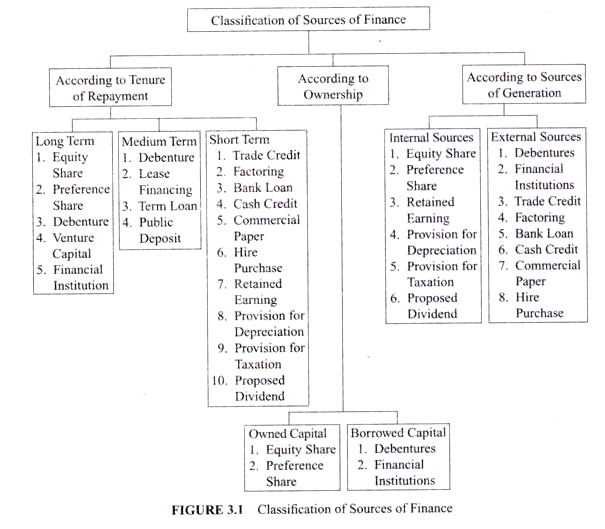
Sources of finance refer to the various ways a business or individual can obtain funds to meet operational, investment, or expansion needs. These sources are broadly classified into internal and external sources. Internal sources include retained earnings, depreciation funds, and asset sales, which do not require external borrowing. External sources include equity financing (issuing shares), debt financing (loans, bonds), and government grants. Short-term sources like trade credit and bank overdrafts help manage working capital, while long-term sources like venture capital and public deposits support growth. The choice of finance depends on factors like cost, risk, and repayment terms. A balanced mix ensures financial stability, minimizes risk, and enhances business sustainability.

A firm can obtain funds from a variety of sources (see Figure 3.1), which may be classified as follows:

  1. Long-term Sources:

A firm needs funds to purchase fixed assets such as land, plant & machinery, furniture, etc. These assets should be purchased from those funds which have a longer maturity repayment period. The capital required for purchasing these assets is known as fixed capital. So funds required for fixed capital must be financed using long-term sources of finance.

  1. Medium-term Sources:

Funds required for say, a heavy advertisement campaign, the benefit of which lasts for more than one accounting period, should be financed through medium-term sources of finance. In other words expenditure that results in deferred revenue should be financed through medium-term sources.

  1. Short-term Sources:

Funds required for meeting day-to-day expenses, i.e. revenue expenditure or working capital should be financed from short-term sources whose maturity period is one year or less.

  1. Owned Capital:

Owned capital represents equity capital, retained earnings and preference capital. Equity share has a perpetual life and are entitled to the residual income of the firm but the equity shareholders have the right to control the affairs of the business because they enjoy the voting rights.

  1. Borrowed Capital:

Borrowed capital represents debentures, term loans, public deposits, borrow­ings from bank, etc. These are contractual in nature. They are entitled to get a fixed rate of interest irrespective of profit and are to be repaid on a fixed date.

  1. Internal Sources:

If the funds are created internally, i.e. without using debt, such sources can be termed as internal sources. Examples of such could be: Ploughing back of profits, provision for depreciation, etc.

  1. External Sources:

If funds are re-used through the sources which create some obligation to the firm, such sources can be termed as external sources, e.g. lease financing, hire purchase, etc..

Financial Planning, Meaning, Objectives, Needs, Steps and Importance

Financial Planning is the process of estimating the capital required for a business and determining its sources. It involves forecasting future financial needs, preparing policies related to procurement, investment, and administration of funds. It ensures that adequate funds are available at the right time and used efficiently for achieving business objectives. Financial planning aims to balance financial resources with the company’s long-term and short-term requirements.

Financial Planning is the process of setting financial goals, developing strategies, and managing resources to achieve business objectives efficiently. It involves budgeting, forecasting, investment planning, risk assessment, and fund allocation. Proper financial planning ensures liquidity, profitability, and business growth while minimizing financial risks. It helps organizations optimize capital usage, control costs, and make informed financial decisions. In India, businesses follow structured financial planning to comply with regulatory requirements and maximize shareholder value. By aligning financial strategies with market conditions and organizational goals, financial planning ensures long-term stability, operational efficiency, and sustainable business success in a competitive environment.

Objectives of Financial Planning

  • Ensuring Adequate Funds Availability

One of the primary objectives of financial planning is to ensure that sufficient funds are available for business operations and expansion. Organizations need funds for working capital, investments, and growth opportunities. A well-structured financial plan identifies funding requirements in advance, helping businesses secure capital through equity, debt, or retained earnings. Proper financial planning ensures a steady cash flow, prevents liquidity crises, and maintains business stability. By forecasting financial needs accurately, companies can avoid financial shortages and ensure smooth operational continuity.

  • Optimal Utilization of Financial Resources

Financial planning aims to allocate resources efficiently to maximize profitability and reduce wastage. Organizations must ensure that funds are invested in high-yield projects and used productively. This includes managing capital expenditure, operational costs, and investments to achieve financial efficiency. Effective financial planning prevents underutilization or overutilization of resources, ensuring that funds are used where they generate the best returns. By optimizing financial resources, businesses can enhance their financial stability, improve productivity, and achieve long-term growth while minimizing unnecessary expenditures.

  • Maintaining Liquidity and Financial Stability

A key objective of financial planning is to ensure adequate liquidity for smooth business operations. Liquidity management involves maintaining a balance between current assets and liabilities to meet short-term financial obligations. Without proper financial planning, businesses may face cash flow shortages, leading to operational disruptions or financial distress. By forecasting cash inflows and outflows, financial planning helps organizations maintain a healthy liquidity position. This ensures timely payments to suppliers, employees, and creditors, preventing financial instability and fostering business sustainability.

  • Reducing Financial Risks and Uncertainties

Financial planning helps mitigate risks related to market fluctuations, economic downturns, and unexpected financial crises. Businesses face uncertainties such as inflation, changing interest rates, or global financial instability. A well-structured financial plan includes risk assessment and contingency measures to safeguard against potential financial losses. Techniques like diversification, insurance, and hedging are incorporated into financial planning to manage risks effectively. By reducing financial uncertainties, companies can protect their assets, ensure operational continuity, and maintain investor confidence in their financial stability.

  • Enhancing Profitability and Growth

One of the fundamental objectives of financial planning is to boost profitability and drive business growth. Proper planning ensures that funds are invested in high-return projects and cost-effective operations. Businesses set financial goals to increase revenue, minimize costs, and enhance profit margins. Through financial forecasting and budgeting, companies can identify opportunities for expansion and innovation. By aligning financial strategies with business objectives, financial planning supports long-term profitability and competitive advantage in a dynamic business environment.

  • Facilitating Capital Structure Management

Financial planning determines the right mix of debt and equity to finance business operations. A well-balanced capital structure reduces the cost of capital while maintaining financial stability. Organizations need to decide the proportion of funds to be raised through equity, loans, or retained earnings. Financial planning helps businesses evaluate borrowing options, interest rates, and repayment capabilities to maintain financial health. Proper capital structure management ensures that companies can meet their financial obligations without excessive debt burdens or dilution of ownership.

  • Ensuring Business Expansion and Sustainability

Financial planning supports long-term business growth by allocating resources for expansion strategies such as entering new markets, launching new products, or upgrading technology. A company’s sustainability depends on continuous financial planning that aligns investment decisions with future business goals. By setting financial targets and securing necessary funding, organizations can sustain their growth momentum. Proper financial planning also helps businesses adapt to economic changes, technological advancements, and market trends, ensuring their long-term viability and success in a competitive landscape.

  • Enhancing Investor Confidence and Market Reputation

Investors and stakeholders seek financial transparency and strategic financial management before investing in a business. A well-structured financial plan demonstrates a company’s financial stability, growth potential, and ability to generate returns. By ensuring timely financial reporting, risk management, and profitability, financial planning enhances investor trust. It also strengthens the company’s market reputation, making it easier to attract new investments and business opportunities. A financially sound organization can maintain strong stakeholder relationships and sustain its credibility in the competitive market environment.

Need of Financial Planning

  • Ensures Adequate Funds

Financial planning helps a business determine the amount of funds required for starting and running operations. It estimates expenses such as purchase of assets, payment of wages and operating costs. By forecasting financial needs in advance, the firm avoids shortage of funds that may interrupt production and business activities. Adequate availability of funds enables smooth functioning of operations and helps management concentrate on productivity, growth and achievement of organizational objectives without financial stress.

  • Avoids Excess Funds

Financial planning not only prevents shortage of funds but also avoids excess funds. Idle funds do not generate income and increase the cost of capital for the organization. Through proper estimation and budgeting, the finance manager raises only the necessary amount of capital. Efficient use of funds improves profitability and financial efficiency. Therefore, financial planning helps in maintaining an optimum level of funds and ensures that resources are neither wasted nor misused in the business.

  • Helps in Proper Investment

Financial planning assists management in selecting suitable investment opportunities. It provides information about available funds and future financial commitments, enabling managers to invest wisely in profitable projects. The firm can evaluate various investment alternatives and choose those giving maximum returns with minimum risk. Proper investment decisions increase productivity and earning capacity of the business. Thus, financial planning ensures that funds are allocated to the most productive uses, supporting long-term growth and financial stability.

  • Facilitates Business Expansion

A business aims to grow and expand over time. Financial planning helps in estimating future capital requirements for expansion such as opening new branches, introducing new products, or increasing production capacity. By forecasting future financial needs, the firm can arrange funds in advance through appropriate sources. This prevents delays in expansion activities. Hence, financial planning supports continuous development and enables the organization to take advantage of profitable opportunities in the market at the right time.

  • Maintains Proper Cash Flow

Financial planning helps in controlling cash inflows and outflows within the business. It ensures that sufficient cash is available to meet day-to-day expenses like wages, salaries, and operating costs. Proper planning prevents liquidity problems and avoids situations where the firm cannot pay its obligations on time. By maintaining a balanced cash flow, the company strengthens its financial position and improves its goodwill and creditworthiness in the market.

  • Reduces Financial Risk

Uncertainty is a common feature of business. Financial planning helps in predicting possible financial problems and taking precautionary measures. By analyzing future conditions, the firm can prepare for economic changes, price fluctuations and unexpected expenses. It provides a safety margin and reduces dependence on emergency borrowings. As a result, financial planning minimizes financial risk and protects the organization from losses, thereby ensuring stability and continuity of business operations.

  • Helps in Coordination and Control

Financial planning promotes coordination among different departments such as production, marketing and human resources. Every department requires funds to perform its activities, and planning allocates funds according to priorities. It also establishes financial targets and standards for performance evaluation. By comparing actual performance with planned performance, management can take corrective actions. Therefore, financial planning acts as a tool of financial control and improves managerial efficiency within the organization.

  • Increases Profitability

Financial planning contributes to higher profitability by ensuring efficient utilization of resources. Proper allocation of funds, cost control and avoidance of wastage reduce unnecessary expenses. It helps the firm invest in profitable projects and maintain an optimum capital structure. As a result, the organization earns higher returns and improves shareholders’ wealth. Thus, financial planning plays a vital role in achieving the ultimate objective of the business, which is maximizing profitability and financial success.

Steps in Financial Planning

Step 1. Assessing Financial Needs

The first step in financial planning is to identify the financial needs of the business. This involves understanding the purpose for which funds are required—such as starting operations, expanding capacity, purchasing assets, or meeting working capital requirements. A thorough needs assessment considers both short-term and long-term financial demands. It also takes into account internal and external factors influencing fund requirements. Proper identification of needs ensures that planning begins with clarity, avoiding both shortages and excesses of funds.

Step 2. Setting Financial Objectives

Once financial needs are assessed, the next step is to set clear, realistic financial objectives. These objectives may include maximizing profits, ensuring liquidity, reducing costs, improving return on investment, or maintaining solvency. Financial objectives must align with the overall goals of the business. Setting clearly defined goals helps management plan effectively and measure progress over time. These objectives act as guiding principles that direct financial decisions and strategies, ensuring the organization maintains a stable and progressive financial posture.

Step 3. Estimating the Volume of Funds Required

This step involves calculating how much money the business will need to achieve its objectives. The estimation includes both fixed capital requirements—such as land, buildings, and machinery—and working capital needs for day-to-day operations. Factors like production levels, credit policies, and operating cycles influence the amount of required funds. A realistic estimate prevents situations of underfunding, which hampers operations, or overfunding, which increases financial costs. Accurate estimation forms the foundation for all future financial decisions.

Step 4. Determining Sources of Finance

After estimating the fund requirement, the organization must identify suitable sources of finance. These may include equity, preference capital, debentures, bank loans, retained earnings, public deposits, or trade credit. Choosing appropriate sources depends on the cost of funds, risk, control considerations, and repayment capacity. A balanced mix of short-term and long-term sources is necessary to maintain financial stability. Careful selection helps minimize financial costs, maintain flexibility, and ensure the business can fund its plans without undue stress.

Step 5. Developing Financial Policies

This step involves drafting policies regarding procurement, investment, and management of funds. Policies may include guidelines on capital structure, debt-equity ratio, dividend distribution, credit terms, and cash management. Financial policies ensure consistency, transparency, and discipline in financial decisions. They help avoid impulsive decisions and provide a framework within which managers operate. Effective financial policies support long-term financial health and ensure that the company maintains a well-organized approach to planning and managing finances.

Step 6. Preparing Financial Plans

A financial plan outlines how the business will acquire and use funds over a certain period. It includes projected financial statements, such as cash flow statements, income statements, and balance sheets. The plan specifies when funds will be needed and how they will be allocated to various activities. A well-prepared financial plan ensures coordination among departments and aligns financial resources with business strategies. It also helps predict potential financial challenges and prepares the firm for future uncertainties.

Step 7. Implementing the Financial Plan

Implementation involves putting the financial plan into action. This includes acquiring funds from selected sources and allocating them to various business activities. Effective implementation requires coordination, timely decision-making, and continuous supervision. Management must ensure that funds are used efficiently and according to the plan. Implementation also involves communicating financial roles and responsibilities across departments. Successful execution converts financial strategies into practical results and supports the overall growth of the business.

Step 8. Reviewing and Monitoring the Plan

The final step is continuous review and monitoring of the financial plan to track performance and identify deviations. This includes comparing actual financial performance with planned targets and analyzing reasons for differences. Monitoring helps identify financial weaknesses, inefficiencies, or changing market conditions that require adjustments. Regular review ensures that the business stays on track and adapts strategies when needed. This step makes financial planning a dynamic and ongoing process that supports long-term sustainability.

Importance of Financial Planning

  • Ensures Financial Stability

Financial planning helps businesses maintain financial stability by ensuring a steady cash flow and proper fund allocation. It prevents liquidity crises and enables companies to meet their short-term and long-term financial obligations. By forecasting revenues and expenses, organizations can prepare for financial uncertainties and avoid financial distress. A stable financial position allows businesses to operate smoothly, manage debts effectively, and withstand economic fluctuations. Proper financial planning builds a strong foundation for sustainable growth and long-term financial success.

  • Optimizes Resource Allocation

Financial planning ensures the efficient allocation of resources by prioritizing investments and expenditures. Businesses need to allocate funds wisely to maximize returns and minimize wastage. Proper financial planning helps organizations decide where to invest, how much to spend, and when to cut costs. By optimizing the use of financial resources, companies can improve productivity and profitability. Effective financial planning also prevents underutilization or overutilization of funds, ensuring that financial resources are directed toward the most strategic areas of business growth.

  • Minimizes Financial Risks

Every business faces financial risks such as market fluctuations, inflation, interest rate changes, and economic downturns. Financial planning helps organizations identify, assess, and manage these risks effectively. By incorporating risk management strategies like diversification, hedging, and insurance, businesses can safeguard their financial health. A well-prepared financial plan includes contingency measures to handle unexpected financial challenges. This proactive approach minimizes potential losses and ensures business continuity, giving organizations the confidence to make strategic financial decisions.

  • Aids in Business Growth and Expansion

Financial planning plays a crucial role in business expansion by securing funds for growth opportunities. Whether a company wants to launch new products, enter new markets, or invest in technology, proper financial planning ensures the availability of necessary capital. Businesses need long-term financial strategies to scale operations without financial strain. By analyzing market trends, forecasting future earnings, and planning investments, organizations can expand sustainably. Effective financial planning supports innovation and competitive advantage, enabling businesses to grow successfully.

  • Improves Profitability and Cost Control

A key benefit of financial planning is enhancing profitability through effective cost management. By analyzing financial data, businesses can identify areas where expenses can be reduced without compromising efficiency. Budgeting, financial forecasting, and expense monitoring help organizations control unnecessary costs and improve profit margins. Financial planning also ensures that funds are allocated to high-return investments, leading to increased profitability. Through strategic cost control, companies can achieve financial efficiency while maintaining product quality and operational excellence.

  • Facilitates Decision-Making

Sound financial planning provides businesses with accurate financial data and insights, enabling informed decision-making. Companies need to make critical financial decisions regarding investments, capital structure, pricing, and resource allocation. Financial planning helps businesses evaluate different financial scenarios and choose the best course of action. By analyzing financial statements, market trends, and risk factors, organizations can make data-driven decisions that align with their long-term objectives. This strategic approach minimizes uncertainty and enhances overall business performance.

  • Ensures Compliance with Financial Regulations

Businesses must comply with various financial laws, taxation policies, and regulatory requirements. Financial planning helps organizations stay updated with legal obligations and avoid penalties or legal complications. In India, companies must adhere to regulations set by SEBI, RBI, and tax authorities. A well-structured financial plan ensures timely tax payments, accurate financial reporting, and compliance with corporate governance standards. Proper financial planning also enhances transparency and accountability, strengthening investor confidence and market reputation.

  • Builds Investor and Stakeholder Confidence

Investors and stakeholders seek financial stability, transparency, and growth potential before investing in a business. Financial planning enhances investor confidence by demonstrating a company’s financial health and long-term sustainability. Proper financial management ensures timely financial reporting, risk mitigation, and efficient fund utilization. Businesses with well-defined financial plans attract investors, secure funding, and establish credibility in the market. A strong financial plan reassures stakeholders about the company’s financial future, fostering long-term partnerships and business growth opportunities.

error: Content is protected !!