Law of Diminishing Marginal utility

Law of Diminishing Marginal Utility states that as a person consumes additional units of a good or service, the satisfaction (utility) derived from each successive unit decreases, assuming all other factors remain constant. Initially, the first few units provide significant satisfaction, but as consumption increases, the utility of each extra unit diminishes. For example, the first slice of pizza may bring great joy, but by the fifth or sixth slice, the additional satisfaction reduces. This principle underlies consumer behavior and helps explain demand curves, as consumers are less willing to pay the same price for additional units of a product.

Assumptions:

Following are the assumptions of the law of diminishing marginal utility.

  1. The utility is measurable and a person can express the utility derived from a commodity in qualitative terms such as 2 units, 4 units and 7 units etc.
  2. A rational consumer aims at the maximization of his utility.
  3. It is necessary that a standard unit of measurement is constant
  4. A commodity is being taken continuously. Any gap between the consumption of a commodity should be suitable.
  5. There should be proper units of a good consumed by the consumer.
  6. It is assumed that various units of commodity homogeneous in characteristics.
  7. The taste of the consumer remains same during the consumption o the successive units of commodity.
  8. Income of the consumer remains constant during the operation of the law of diminishing marginal utility.
  9. It is assumed that the commodity is divisible.
  • There should be not change in fashion. For example, if there is a fashion of lifted shirts, then the consumer may have no utility in open shirts.
  • It is assumed that the prices of the substitutes do not change. For example, the demand for CNG increases due to rise in the prices of petroleum and these price changes effect the utility of CNG.

Explanation with Schedule and Diagram:

We assume that a man is very thirsty. He takes the glasses of water successively. The marginal utility of the successive glasses of water decreases, ultimately, he reaches the point of satiety. After this point the marginal utility becomes negative, if he is forced further to take a glass of water. The behavior of the consumer is indicated in the following schedule:

Units of commodity Marginal utility Total utility
1st glass 10 10
2nd glass 8 18
3rd glass 6 24
4th glass 4 28
5th glass 2 30
6th glass 0 30
7th glass -2 28

On taking the 1st glass of water, the consumer gets 10 units of utility, because he is very thirsty. When he takes 2nd glass of water, his marginal utility goes down to 8 units because his thirst has been partly satisfied. This process continues until the marginal utility drops down to zero which is the saturation point. By taking the seventh glass of water, the marginal utility becomes negative because the thirst of the consumer has already been fully satisfied.

The law of diminishing marginal utility can be explained by the following diagram drawn with the help of above schedule:

9.1.png

In the above figure, the marginal utility of different glasses of water is measured on the y-axis and the units (glasses of water) on X-axis. With the help of the schedule, the points A, B, C, D, E, F and G are derived by the different combinations of units of the commodity (glasses of water) and the marginal utility gained by different units of commodity. By joining these points, we get the marginal utility curve. The marginal utility curve has the downward negative slope. It intersects the X-axis at the point of 6th unit of the commodity. At this point “F” the marginal utility becomes zero. When the MU curve goes beyond this point, the MU becomes negative. So there is an inverse functional relationship between the units of a commodity and the marginal utility of that commodity.

Exceptions or Limitations:

The limitations or exceptions of the law of diminishing marginal utility are as follows:

  1. The law does not hold well in the rare collections. For example, collection of ancient coins, stamps etc.
  2. The law is not fully applicable to money. The marginal utility of money declines with richness but never falls to zero.
  3. It does not apply to the knowledge, art and innovations.
  4. The law is not applicable for precious goods.
  5. Historical things are also included in exceptions to the law.
  6. Law does not operate if consumer behaves in irrational manner. For example, drunkard is said to enjoy each successive peg more than the previous one.
  7. Man is fond of beauty and decoration. He gets more satisfaction by getting the above merits of the commodities.
  8. If a dress comes in fashion, its utility goes up. On the other hand its utility goes down if it goes out of fashion.
  9. The utility increases due to demonstration. It is a natural element.

Importance of the Law of Diminishing Marginal Utility:

  1. By purchasing more of a commodity the marginal utility decreases. Due to this behaviour, the consumer cuts his expenditures to that commodity.
  2. In the field of public finance, this law has a practical application, imposing a heavier burden on the rich people.
  3. This law is the base of some other economic laws such as law of demand, elasticity of demand, consumer surplus and the law of substitution etc.
  4. The value of commodity falls by increasing the supply of a commodity. It forms a basis of the theory of value. In this way prices are determined

Equi Marginal Utility

Equi-Marginal Principle (also known as the principle of equal marginal utility or the law of equi-marginal utility) is a fundamental concept in economics that helps individuals and businesses maximize satisfaction or profit. According to this principle, resources should be allocated in such a way that the marginal utility or marginal returns from each resource are equal across all possible uses.

In other words, whether a consumer is trying to maximize their utility or a firm is trying to maximize profit, they will distribute their limited resources (money, labor, time, etc.) among various alternatives so that the additional (marginal) benefit derived from the last unit of resource used in each alternative is equal.

Key Elements of the Equi-Marginal Principle:

  1. Marginal Utility:

Marginal utility refers to the additional satisfaction or benefit that a person receives from consuming an additional unit of a good or service. As more of a good is consumed, the marginal utility usually decreases, a concept known as diminishing marginal utility.

  1. Marginal Productivity/Returns:

In business, marginal productivity or marginal returns refer to the additional output that can be obtained by using an additional unit of input. Like marginal utility, marginal returns also generally diminish as more units of input are added.

  1. Optimization:

The equi-marginal principle is about optimization. Consumers aim to allocate their resources (income) in such a way that the marginal utility per unit of money spent is equal for all goods. Similarly, firms allocate inputs like labor and capital to maximize profit, ensuring that the marginal returns from each input are equal across all uses.

Formula for the Equi-Marginal Principle

For consumers: The formula for maximizing utility using the equi-marginal principle is as follows:

8.2

Example: Allocation of Consumer Budget

Let’s assume a consumer has a budget of $100 to spend on two goods, A and B. The consumer’s goal is to allocate their budget in such a way that the total utility derived from consuming both goods is maximized.

Table of Marginal Utility and Price:

Units Consumed Marginal Utility of A (MUA​) Price of A (PA​) MUA​/PA​ Marginal Utility of B (MUB​) Price of B (PB​) MUB​/PB​
1 20 $10 2 24 $8 3
2 18 $10 1.8 20 $8 2.5
3 16 $10 1.6 16 $8 2
4 14 $10 1.4 12 $8 1.5
5 12 $10 1.2 8 $8 1

From the table, we can see the marginal utility per dollar spent on each good for various levels of consumption.

Allocation Process:

  1. Initially, the consumer will compare the MU/P ratios for both goods.
  2. The consumer will spend their first dollar on Good B because it provides a higher marginal utility per dollar (3) than Good A (2).
  3. After consuming the first unit of Good B, the consumer will compare the MU/P ratios again. Since MUB/PB=2.5 is still higher than MUA/PA=2, the consumer will purchase another unit of Good B.
  4. This process will continue until the MU/P ratios for both goods are equal or the consumer’s budget is exhausted.

In this case, the consumer might end up purchasing 2 units of Good A and 3 units of Good B, at which point the marginal utility per dollar for both goods becomes approximately equal, maximizing their total utility.

Example: Firm’s Input Allocation

Let’s assume a firm has two inputs: labor (L) and capital (K). The firm wants to allocate these inputs to maximize profit, with the marginal product and cost data as follows:

Input Marginal Product of Labor (MPL​) Cost of Labor (CL) MPL​/CL​ Marginal Product of Capital (MPK​) Cost of Capital (CK​) MPK​/CK​
1 50 $10 5 80 $20 4
2 40 $10 4 70 $20 3.5
3 30 $10 3 60 $20 3
4 20 $10 2 50 $20 2.5
5 10 $10 1 40 $20 2

The firm’s goal is to allocate labor and capital in such a way that the marginal product per unit of cost is equal for both inputs.

Allocation Process:

  1. Initially, the firm compares the MP/C ratios for labor and capital.
  2. The firm will allocate its first dollar towards labor, where MPL/CL=5 is greater than MPK/CK=4.
  3. After allocating more resources, the firm will continue comparing the ratios.
  4. The firm will keep allocating resources until the marginal product per unit cost for both labor and capital is equal.

In this case, the optimal allocation would involve using 2 units of labor and 1 unit of capital, where the marginal products per unit cost are equal (4), maximizing the firm’s profit.

Importance of the Equi-Marginal Principle:

  • Efficient Allocation:

The equi-marginal principle ensures the efficient allocation of resources, whether for consumers aiming to maximize utility or firms aiming to maximize profit. By allocating resources where they provide the highest marginal benefit, both individuals and businesses can make the best possible use of their limited resources.

  • Economic Decision-Making:

This principle is a key component of rational decision-making in economics. It helps in determining the optimal quantity of goods to consume, the best mix of inputs to use in production, or even the best way to allocate time among different activities.

  • Flexibility:

The equi-marginal principle can be applied across various fields of economics, from consumer theory and production theory to cost minimization and utility maximization.

Explanation of the Law:

In order to get maximum satisfaction out of the funds we have, we carefully weigh the satisfaction obtained from each rupee ‘had we spend If we find that a rupee spent in one direction has greater utility than in another, we shall go on spending money on the former commodity, till the satisfaction derived from the last rupee spent in the two cases is equal.

It other words, we substitute some units of the commodity of greater utility tor some units of the commodity of less utility. The result of this substitution will be that the marginal utility of the former will fall and that of the latter will rise, till the two marginal utilities are equalized. That is why the law is also called the Law of Substitution or the Law of equimarginal Utility.

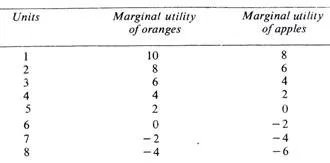
Suppose apples and oranges are the two commodities to be purchased. Suppose further that we have got seven rupees to spend. Let us spend three rupees on oranges and four rupees on apples. What is the result? The utility of the 3rd unit of oranges is 6 and that of the 4th unit of apples is 2. As the marginal utility of oranges is higher, we should buy more of oranges and less of apples. Let us substitute one orange for one apple so that we buy four oranges and three apples.

Now the marginal utility of both oranges and apples is the same, i.e., 4. This arrangement yields maximum satisfaction. The total utility of 4 oranges would be 10 + 8 + 6 + 4 = 28 and of three apples 8 + 6 + 4= 18 which gives us a total utility of 46. The satisfaction given by 4 oranges and 3 apples at one rupee each is greater than could be obtained by any other combination of apples and oranges. In no other case does this utility amount to 46. We may take some other combinations and see.

We thus come to the conclusion that we obtain maximum satisfaction when we equalize marginal utilities by substituting some units of the more useful for the less useful commodity. We can illustrate this principle with the help of a diagram.

Diagrammatic Representation:

In the two figures given below, OX and OY are the two axes. On X-axis OX are represented the units of money and on the Y-axis marginal utilities. Suppose a person has 7 rupees to spend on apples and oranges whose diminishing marginal utilities are shown by the two curves AP and OR respectively.

The consumer will gain maximum satisfaction if he spends OM money (3 rupees) on apples and OM’ money (4 rupees) on oranges because in this situation the marginal utilities of the two are equal (PM = P’M’). Any other combination will give less total satisfaction.

Let the purchase spend MN money (one rupee) more on apples and the same amount of money, N’M'( = MN) less on oranges. The diagram shows a loss of utility represented by the shaded area LN’M’P’ and a gain of PMNE utility. As MN = N’M’ and PM=P’M’, it is proved that the area LN’M’P’ (loss of utility from reduced consumption of oranges) is bigger than PMNE (gain of utility from increased consumption of apples). Hence the total utility of this new combination is less.

We then, conclude that no other combination of apples and oranges gives as great a satisfaction to the consumer as when PM = P’M’, i.e., where the marginal utilities of apples and oranges purchased are equal, with given amour, of money at our disposal.

Limitations of the Law of Equi-marginal Utility

Like other economic laws, the law of equimarginal utility too has certain limitations or exceptions. The following are the main exception.

(i) Ignorance

If the consumer is ignorant or blindly follows custom or fashion, he will make a wrong use of money. On account of his ignorance he may not know where the utility is greater and where less. Thus, ignorance may prevent him from making a rational use of money. Hence, his satisfaction may not be the maximum, because the marginal utilities from his expenditure can­not be equalised due to ignorance.

(ii) Inefficient Organisation

In the same manner, an incompetent organ­iser of business will fail to achieve the best results from the units of land, labour and capital that he employs. This is so because he may not be able to divert expenditure to more profitable channels from the less profitable ones.

(iii) Unlimited Resources

The law has obviously no place where this resources are unlimited, as for example, is the case with the free gifts of nature. In such cases, there is no need of diverting expenditure from one direction to another.

(iv) Hold of Custom and Fashion

A consumer may be in the strong clutches of custom, or is inclined to be a slave of fashion. In that case, he will not be able to derive maximum satisfaction out of his expenditure, because he cannot give up the consumption of such commodities. This is specially true of the conventional necessaries like dress or when a man is addicted to some into­xicant.

(v) Frequent Changes in Prices

Frequent changes in prices of different goods render the observance of the law very difficult. The consumer may not be able to make the necessary adjustments in his expenditure in a constantly changing price situation.

Key differences between Micro economics and Macro economics

Micro Economics

Microeconomics studies the behavior and decision-making processes of individual consumers and firms. It focuses on how they allocate scarce resources to maximize utility and profit, respectively. Key concepts include supply and demand, market equilibrium, elasticity, and marginal analysis. Microeconomics examines how factors such as price changes, consumer preferences, and production costs affect the choices of buyers and sellers. It also explores market structures—like perfect competition, monopoly, and oligopoly—and their impact on pricing and output. By analyzing these components, microeconomics helps understand how markets function and how individual decisions influence economic outcomes.

Features of Micro Economics:

  1. Individual Decision-Making

Microeconomics centers on how individuals and firms make choices regarding the allocation of their limited resources. It examines consumer behavior, including how preferences and budget constraints influence purchasing decisions, and firm behavior, focusing on production choices and cost management. This feature helps understand the rationale behind personal and business decisions.

  1. Supply and Demand Analysis

A fundamental feature of microeconomics is the study of supply and demand. It explores how these forces interact to determine prices and quantities in individual markets. Demand refers to consumer willingness and ability to purchase goods, while supply pertains to the quantity producers are willing to offer. The equilibrium point, where supply equals demand, is crucial for understanding market dynamics.

  1. Price Mechanism

Microeconomics investigates how prices are determined in various market structures. It looks at how changes in supply and demand affect prices and how prices signal to producers and consumers about resource allocation. The price mechanism helps in understanding how markets clear and how resources are efficiently allocated based on market signals.

  1. Elasticity

Elasticity measures how sensitive the quantity demanded or supplied of a good is to changes in price or other factors. Microeconomics studies price elasticity of demand, income elasticity, and cross-price elasticity, which helps determine how changes in prices, consumer income, or the prices of related goods affect market behavior.

  1. Market Structures

Microeconomics analyzes different market structures, including perfect competition, monopoly, monopolistic competition, and oligopoly. Each structure has unique characteristics regarding the number of firms, product differentiation, and pricing power. Understanding these structures helps explain variations in market outcomes and competitive strategies.

  1. Marginal Analysis

Marginal analysis is a key feature where decisions are made based on marginal changes. It involves examining the additional benefit (marginal benefit) and additional cost (marginal cost) of a decision to determine the optimal level of production or consumption. This analysis helps in maximizing profit or utility.

  1. Consumer Theory

Consumer theory explores how individuals make consumption choices to maximize their utility given their budget constraints. It involves analyzing indifference curves and budget constraints to understand how consumers allocate their income among various goods and services to achieve the highest satisfaction.

  1. Production and Costs

Microeconomics examines how firms produce goods and services and the associated costs. It includes the study of production functions, which describe the relationship between input factors and output, and cost structures, such as fixed and variable costs. This feature helps in understanding how firms optimize production and manage costs to maximize profit.

Macro Economics

Macroeconomics examines the economy as a whole, focusing on aggregate phenomena and large-scale economic factors. Key concepts include Gross Domestic Product (GDP), inflation, unemployment, and national income. It explores how these aggregate variables interact and influence each other, and assesses the overall health and performance of an economy. Macroeconomics also studies fiscal and monetary policies—such as government spending, taxation, and central bank interest rates—and their impact on economic growth, stability, and employment. By analyzing these broad economic indicators, macroeconomics aims to understand and manage economic fluctuations and promote overall economic well-being.

Features of Macro Economics:

  1. Aggregate Indicators

Macroeconomics examines aggregate indicators such as Gross Domestic Product (GDP), inflation rate, unemployment rate, and national income. These indicators provide a comprehensive view of the overall economic performance and health, helping policymakers and economists understand economic trends and conditions.

  1. Economic Growth

A central focus of macroeconomics is understanding and promoting economic growth. It analyzes factors that contribute to increases in a country’s productive capacity over time, such as technological advancements, capital accumulation, and improvements in labor productivity. Economic growth is crucial for improving living standards and fostering long-term prosperity.

  1. Business Cycles

Macroeconomics studies business cycles, which are the fluctuations in economic activity over time, characterized by periods of expansion and contraction. It investigates the causes and effects of these cycles, including their impact on employment, investment, and economic output. Understanding business cycles helps in forecasting economic conditions and formulating stabilization policies.

  1. Monetary Policy

Monetary policy is a key aspect of macroeconomics, involving the management of the money supply and interest rates by central banks. It aims to control inflation, stabilize currency, and promote economic growth. Tools such as open market operations, discount rates, and reserve requirements are used to influence economic activity and achieve policy goals.

  1. Fiscal Policy

Fiscal policy involves government spending and taxation decisions. Macroeconomics analyzes how these policies affect the economy, including their impact on aggregate demand, public debt, and overall economic stability. Fiscal policy is used to manage economic fluctuations, stimulate growth during recessions, and address budgetary imbalances.

  1. International Trade and Finance

Macroeconomics explores the impact of international trade and finance on the domestic economy. It examines trade balances, exchange rates, and capital flows between countries. Understanding these factors helps in analyzing the effects of global economic interactions on domestic economic conditions and formulating trade and monetary policies.

  1. Inflation and Deflation

Macroeconomics studies inflation, the general rise in price levels, and deflation, the general fall in price levels. It analyzes their causes, effects, and consequences for the economy, including their impact on purchasing power, interest rates, and economic stability. Managing inflation and deflation is crucial for maintaining economic stability and growth.

  1. Unemployment

Unemployment is a major focus of macroeconomics, which examines its types, causes, and effects on the economy. It studies the relationship between unemployment rates and economic performance, including the impact on productivity and social welfare. Policymakers use macroeconomic analysis to develop strategies for reducing unemployment and supporting labor market stability.

Key differences between Micro Economics and Macro Economics

Aspect Microeconomics Macroeconomics
Focus Individual Economy-wide
Scope Narrow Broad
Units of Analysis Firms/Consumers Aggregate Variables
Decision-Making Firm/Individual Government/Economy
Market Structures Various Overall
Price Determination Market Prices General Price Levels
Economic Growth Not Primary Central
Unemployment Not Direct Central
Inflation Not Direct Central
Government Role Limited Significant
Policy Tools Business Strategies Fiscal/Monetary
Economic Fluctuations Not Central Business Cycles
Resource Allocation Firm-Level Economy-Wide
Income Distribution Individual/Household National
Trade and Global Factors Limited Extensive

Cooperatives Company, Features, Types, Advantages and Disadvantages

Co-operative Organization is an association of persons, usually of limited means, who have vol­untarily joined together to achieve a common eco­nomic end through the formation of a democrati­cally controlled organization, making equitable dis­tributions to the capital required, and accepting a fair share of risk and benefits of the undertaking.

The word ‘co-operation’ stands for the idea of living together and working together. Cooperation is a form of business organization the only sys­tem of voluntary organization suitable for poorer people. It is an organization wherein persons vol­untarily associate together as human beings on a basis of equality, for the promotion of economic in­terests of themselves.

Characteristics/Features of Cooperative Organization:

  1. Voluntary Association

A cooperative so­ciety is a voluntary association of persons and not of capital. Any person can join a cooperative soci­ety of his free will and can leave it at any time. When he leaves, he can withdraw his capital from the so­ciety. He cannot transfer his share to another person.

The voluntary character of the cooperative as­sociation has two implications:

(i) None will be denied the right to become a member and

(ii) The cooperative society will not compete anybody to become a member.

  1. Spirit of Cooperation

The spirit of coop­eration works under the motto, ‘each for all and all for each.’ This means that every member of a co­operative organization shall work in the general interest of the organization as a whole and not for his self-interest. Under cooperation, service is of supreme importance and self-interest is of second­ary importance.

  1. Democratic Management

An individual member is considered not as a capitalist but as a human being and under cooperation, economic equality is fully ensured by a general rule—one man one vote. Whether one contributes 50 rupees or 100 rupees as share capital, all enjoy equal rights and equal duties. A person having only one share can even become the president of cooperative society.

  1. Capital

Capital of a cooperative society is raised from members through share capital. Coop­eratives are formed by relatively poorer sections of society; share capital is usually very limited. Since it is a part of govt. policy to encourage coopera­tives, a cooperative society can increase its capital by taking loans from the State and Central Coop­erative Banks.

  1. Fixed Return on Capital

In a cooperative organization, we do not have the dividend hunting element. In a consumers’ cooperative store, return on capital is fixed and it is usually not more than 12 p.c. per annum. The surplus profits are distrib­uted in the form of bonus but it is directly connected with the amount of purchases by the member in one year.

  1. Cash Sale

In a cooperative organization “cash and carry system” is a universal feature. In the absence of adequate capital, grant of credit is not possible. Cash sales also avoided risk of loss due to bad debts and it could also encourage the habit of thrift among the members.

  1. Moral Emphasis

A cooperative organization generally originates in the poorer section of population; hence more emphasis is laid on the de­velopment of moral character of the individual member. The absence of capital is compensated by honesty, integrity and loyalty. Under cooperation, honesty is regarded as the best security. Thus co­operation prepares a band of honest and selfless workers for the good of humanity.

  1. Corporate Status

A cooperative associa­tion has to be registered under the separate legisla­tion—Cooperative Societies Act. Every society must have at least 10 members. Registration is desirable. It gives a separate legal status to all cooperative organizations just like a company. It also gives ex­emptions and privileges under the Act.

Types of Cooperatives Company:

  1. Cooperative Credit Societies

Cooperative Credit Societies are voluntary associations of peo­ple with moderate means formed with the object of extending short-term financial accommodation to them and developing the habit of thrift among them.

Germany is the birth place of credit coopera­tion. Credit cooperation was born in the middle of the 19th century. Rural credit cooperative societies were started in the villages to solve the problem of agricultural finance.

The village societies were fed­erated into central cooperative banks and central cooperative banks federated into the apex of state cooperative banks. Thus rural cooperative finance has a federal structure like a pyramid. The primary society is the base. The central bank in the middle and the apex bank in the top of the structure. The members of the primary society are villagers.

In the similar manner urban cooperative credit societies were started in India. These urban coop­erative banks look after the financial needs of arti­sans and labour population of the towns. These urban cooperative banks are based on limited li­ability while the village cooperative societies are based on unlimited liability.

National Bank for Agriculture and Rural De­velopment (NABARD) has been established with an Authorised Capital of Rs. 500 crores. It will act as an Apex Agricultural Bank for disbursement of agricultural credit and for implementation of the programme of integrated rural development. It is jointly owned by the Central Govt. and the Reserve Bank of India.

  1. Consumers’ Cooperative Societies

28 Rochedale Pioneers in Manchester in UK laid the foundation for the Consumers’ Cooperative Move­ment in 1844 and paved the way for a peaceful revo­lution. The Rochedale Pioneers who were mainly weavers, set an example by collective purchasing and distribution of consumer goods at bazar rates and for cash price and by declaration of bonus at the end of the year on the purchase made.

Their example has brought a revolution in the purchase and sale of consumer goods by eliminating profit motive and introducing in its place service motive. In India, consumers’ cooperatives have re­ceived impetus from the govt, attempts to check rise in prices of consumer goods.

  1. Producers’ Cooperatives

It is said that the birth of Producers’ Cooperatives took place in France in the middle of 19th century. But it did not make satisfactory progress.

Producers’ Cooperatives, also known as indus­trial cooperatives, are voluntary associations of small producers formed with the object of elimi­nating the capitalist class from the system of in­dustrial production. These societies produce goods for meeting the requirements of consumers. Some­times their production may be sold to outsiders at a profit.

There are two types of producers’ cooperatives. In the first type, producer-members produce indi­vidually and not as employees of the society. The society supplies raw materials, chemicals, tools and equipment’s to the members. The members are sup­posed to sell their individual products to the soci­ety.

In the second type of such societies, the member-producers are treated as employees of the soci­ety and are paid wages for their work.

  1. Housing Cooperatives

Housing coopera­tives are formed by persons who are interested in making houses of their own. Such societies are formed mostly in urban areas. Through these soci­eties persons who want to have their own houses secure financial assistance.

  1. Cooperative Farming Societies

The coop­erative farming societies are basically agricultural cooperatives formed for the purpose of achieving the benefits of large scale farming and maximizing agricultural output. Such societies are encouraged in India to overcome the difficulties of subdivision and fragmentation of holdings in the country.

Advantages of Cooperatives Company:

  • Economical Operations:

The operation of a cooperative society is quite economical due to elimination of middlemen and the voluntary services provided by its members.

  • Open Membership:

Membership in a cooperative organisation is open to all people having a common interest. A person can become a member at any time he likes and can leave the society at any time by returning his shares, without affecting its continuity.

  • Easy to Form:

A cooperative society is a voluntary association and may be formed with a minimum of ten adult members. Its registration is very simple and can be done without much legal formalities.

  • Democratic Management:

A cooperative society is managed in a democratic manner. It is based on the principle of ‘one man one vote’. All members have equal rights and can have a voice in its management.

  • Limited Liability:

The liability of the members of a co-operative society is limited to the extent of capital contributed by them. They do not have to bear personal liability for the debts of the society.

  • Government Patronage:

Government gives all kinds of help to co-operatives, such as loans at lower rates of interest and relief in taxation.

  • Low Management Cost:

Some of the expenses of the management are saved by the voluntary services rendered by the members. They take active interest in the working of the society. So, the society is not required to spend large amount on managerial personnel.

  • Stability:

A co-operative society has a separate legal existence. It is not affected by the death, insolvency, lunacy or permanent incapacity of any of its members. It has a fairly stable life and continues to exist for a long period.

  • Mutual Co-Operation:

Cooperative societies promote the spirit of mutual understanding, self-help and self-government. They save weaker sections of the society from exploitation by the rich. The underlying principle of co-operation is “self-help through mutual help.”

  • Economic Advantages:

Cooperative societies provide loans for productive purposes and financial assistance to farmers and other lower income earning people.

  • Other Benefits:

Cooperative societies are exempted from paying registration fees and stamp duties in some states. These societies have priority over other creditors in realising its dues from the debtors and their shares cannot be decreed for the realisation of debts.

  • No Speculation:

The share is always open to new members. The shares of co­operative society are not sold at the rates higher than their par values. Hence, it is free from evils of speculation in share values.

Disadvantages of Cooperatives Company:

  • Over reliance on Government funds

Co-operative societies are not able to raise their own resources. Their sources of financing are limited and they depend on government funds. The funding and the amount of funds that would be released by the government are uncertain. Therefore, co-operatives are not able to plan their activities in the right manner.

  • Limited funds

Co-operative societies have limited membership and are promoted by the weaker sections. The membership fees collected is low. Therefore, the funds available with the co-operatives are limited. The principle of one-man one-vote and limited dividends also reduce the enthusiasm of members. They cannot expand their activities beyond a particular level because of the limited financial resources.

  • Benefit to Rural rich

Co-operatives have benefited the rural rich and not the rural poor. The rich people elect themselves to the managing committee and manage the affairs of the co-operatives for their own benefit.

The agricultural produce of the small farmers is just sufficient to fulfill the needs of their family. They do not have any surplus to market. The rich farmers with vast tracts of land, produce in surplus quantities and the services of co-operatives such as processing, grading, correct weighment and fair prices actually benefit them.

  • Imposed by Government

In the Western countries, co-operative societies were voluntarily started by the weaker sections. The objective is to improve their economic status and protect themselves from exploitation by businessmen. But in India, the co-operative movement was initiated and established by the government. Wide participation of people is lacking. Therefore, the benefit of the co-operatives has still not reached many poorer sections.

  • Lack of Managerial skills

Co-operative societies are managed by the managing committee elected by its members. The members of the managing committee may not have the required qualification, skill or experience. Since it has limited financial resources, its ability to compensate its employees is also limited. Therefore, it cannot employ the best talent.

  • Inadequate Rural Credit

Co-operative societies give loans only for productive purposes and not for personal or family expenses. Therefore, the rural poor continue to depend on the money lenders for meeting expenses of marriage, medical care, social commitments etc. Co-operatives have not been successful in freeing the rural poor from the clutches of the money lenders.

  • Government regulation

Co-operative societies are subject to excessive government regulation which affects their autonomy and flexibility. Adhering to various regulations takes up much of the management’s time and effort.

  • Misuse of funds

If the members of the managing committee are corrupt, they can swindle the funds of the co-operative society. Many cooperative societies have faced financial troubles and closed down because of corruption and misuse of funds.

  • Inefficiencies leading to losses

Co-operative societies operate with limited financial resources. Therefore, they cannot recruit the best talent, acquire latest technology or adopt modern management practices. They operate in the traditional mold which may not be suitable in the modern business environment and therefore suffer losses.

  • Lack of Secrecy

Maintenance of business secrets is the key for the competitiveness of any business organization. But business secrets cannot be maintained in cooperatives because all members are aware of the activities of the enterprise. Further, reports and accounts have to be submitted to the Registrar of Co-operative Societies. Therefore, information relating to activities, revenues, members etc becomes public knowledge.

  • Conflicts among members

Cooperative societies are based on the principles of co-operation and therefore harmony among members is important. But in practice, there might be internal politics, differences of opinions, quarrels etc. among members which may lead to disputes. Such disputes affect the functioning of the co-operative societies.

  • Limited scope

Co-operative societies cannot be introduced in all industries. Their scope is limited to only certain areas of enterprise. Since the funds available are limited they cannot undertake large scale operations and is not suitable in industries requiring large investments.

  • Lack of Accountability

Since the management is taken care of by the managing committee, no individual can be made accountable for in efficient performance. There is a tendency to shift responsibility among the members of the managing committee.

  • Lack of Motivation

Members lack motivation to put in their whole hearted efforts for the success of the enterprise. It is because there is very little link between effort and reward. Co-operative societies distribute their surplus equitably to all members and not based on the efforts of members. Further there are legal restrictions regarding dividend and bonus that can be distributed to members.

  • Low public confidence

Public confidence in the co-operative societies is low. The reason is, in many of the co-operatives there is political interference and domination. The members of the ruling party dictate terms and therefore the purpose for which cooperatives are formed is lost.

Factors affecting Consumer Behaviour

Consumer behaviour refers to the study of how individuals, groups, or organizations select, buy, use, and dispose of goods, services, ideas, or experiences to satisfy their needs and wants. It involves understanding the decision-making process of consumers, including psychological, social, and economic influences. Businesses analyze consumer behaviour to identify patterns and preferences, enabling them to develop effective marketing strategies. Factors such as cultural background, personal preferences, lifestyle, and economic conditions shape consumer behaviour. By gaining insights into consumer actions and motivations, marketers can better meet customer expectations and enhance customer satisfaction.

1. Cultural Factors

Consumer behavior is deeply influenced by cultural factors such as: buyer culture, subculture, and social class.

(a) Culture

Basically, culture is the part of every society and is the important cause of person wants and behavior. The influence of culture on buying behavior varies from country to country therefore marketers have to be very careful in analyzing the culture of different groups, regions or even countries.

(b) Subculture

Each culture contains different subcultures such as religions, nationalities, geographic regions, racial groups etc. Marketers can use these groups by segmenting the market into various small portions. For example marketers can design products according to the needs of a particular geographic group.

(c) Social Class

Every society possesses some form of social class which is important to the marketers because the buying behavior of people in a given social class is similar. In this way marketing activities could be tailored according to different social classes. Here we should note that social class is not only determined by income but there are various other factors as well such as: wealth, education, occupation etc.

2. Social Factors

Social factors also impact the buying behavior of consumers. The important social factors are: reference groups, family, role and status.

(a) Reference Groups

Reference groups have potential in forming a person attitude or behavior. The impact of reference groups varies across products and brands. For example if the product is visible such as dress, shoes, car etc then the influence of reference groups will be high. Reference groups also include opinion leader (a person who influences other because of his special skill, knowledge or other characteristics).

(b) Family

Buyer behavior is strongly influenced by the member of a family. Therefore marketers are trying to find the roles and influence of the husband, wife and children. If the buying decision of a particular product is influenced by wife then the marketers will try to target the women in their advertisement. Here we should note that buying roles change with change in consumer lifestyles.

(c) Roles and Status

Each person possesses different roles and status in the society depending upon the groups, clubs, family, organization etc. to which he belongs. For example a woman is working in an organization as finance manager. Now she is playing two roles, one of finance manager and other of mother. Therefore her buying decisions will be influenced by her role and status.

3. Personal Factors

Personal factors can also affect the consumer behavior. Some of the important personal factors that influence the buying behavior are: lifestyle, economic situation, occupation, age, personality and self concept.

(a) Age

Age and life-cycle have potential impact on the consumer buying behavior. It is obvious that the consumers change the purchase of goods and services with the passage of time. Family life-cycle consists of different stages such young singles, married couples, unmarried couples etc which help marketers to develop appropriate products for each stage.

(b) Occupation

The occupation of a person has significant impact on his buying behavior. For example a marketing manager of an organization will try to purchase business suits, whereas a low level worker in the same organization will purchase rugged work clothes.

(c) Economic Situation

Consumer economic situation has great influence on his buying behavior. If the income and savings of a customer is high then he will purchase more expensive products. On the other hand, a person with low income and savings will purchase inexpensive products.

(d) Lifestyle

Lifestyle of customers is another import factor affecting the consumer buying behavior. Lifestyle refers to the way a person lives in a society and is expressed by the things in his/her surroundings. It is determined by customer interests, opinions, activities etc and shapes his whole pattern of acting and interacting in the world.

(e) Personality

Personality changes from person to person, time to time and place to place. Therefore it can greatly influence the buying behavior of customers. Actually, Personality is not what one wears; rather it is the totality of behavior of a man in different circumstances. It has different characteristics such as: dominance, aggressiveness, self-confidence etc which can be useful to determine the consumer behavior for particular product or service.

4. Psychological Factors

There are four important psychological factors affecting the consumer buying behavior. These are: perception, motivation, learning, beliefs and attitudes.

(a) Motivation

The level of motivation also affects the buying behavior of customers. Every person has different needs such as physiological needs, biological needs, social needs etc. The nature of the needs is that, some of them are most pressing while others are least pressing. Therefore a need becomes a motive when it is more pressing to direct the person to seek satisfaction.

(b) Perception

Selecting, organizing and interpreting information in a way to produce a meaningful experience of the world is called perception. There are three different perceptual processes which are selective attention, selective distortion and selective retention. In case of selective attention, marketers try to attract the customer attention. Whereas, in case of selective distortion, customers try to interpret the information in a way that will support what the customers already believe. Similarly, in case of selective retention, marketers try to retain information that supports their beliefs.

(c) Beliefs and Attitudes

Customer possesses specific belief and attitude towards various products. Since such beliefs and attitudes make up brand image and affect consumer buying behavior therefore marketers are interested in them. Marketers can change the beliefs and attitudes of customers by launching special campaigns in this regard.

Physical Distribution Channels, Role, Factors, Importance, Types

Physical Distribution Channels refer to the path or route through which goods and services travel from the producer or manufacturer to the final consumer. These channels include intermediaries such as wholesalers, retailers, agents, or distributors, who play an essential role in making the product available to the target market. The goal of distribution channels is to ensure that products reach the right place, at the right time, and in the right condition. Effective distribution channel management helps companies expand market reach, enhance product availability, and optimize costs, contributing to overall business success.

Role of Physical Distribution Channels:

(i) Distribution channels provide time, place, and ownership utility

They make the product available when, where, and in which quantities the customer wants. But other than these transactional functions, marketing channels are also responsible to carry out the following functions:

(ii) Logistics and Physical Distribution

Marketing channels are responsible for assembly, storage, sorting, and transportation of goods from manufacturers to customers.

(iii) Facilitation

Channels of distribution even provide pre-sale and post-purchase services like financing, maintenance, information dissemination and channel coordination.

(iv) Creating Efficiencies

This is done in two ways: bulk breaking and creating assortments. Wholesalers and retailers purchase large quantities of goods from manufacturers but break the bulk by selling few at a time to many other channels or customers. They also offer different types of products at a single place which is a huge benefit to customers as they don’t have to visit different retailers for different products.

(v) Sharing Risks

Since most of the channels buy the products beforehand, they also share the risk with the manufacturers and do everything possible to sell it.

(vi) Marketing

Distribution channels are also called marketing channels because they are among the core touch points where many marketing strategies are executed. They are in direct contact with the end customers and help the manufacturers in propagating the brand message and product benefits and other benefits to the customers.

Role Determining the Choice of Distribution Channels:

Selection of the perfect marketing channel is tough. It is among those few strategic decisions which either make or break your company.

Even though direct selling eliminates the intermediary expenses and gives more control in the hands of the manufacturer, it adds up to the internal workload and raises the fulfilment costs. Hence these four factors should be considered before deciding whether to opt for the direct or indirect distribution channel.
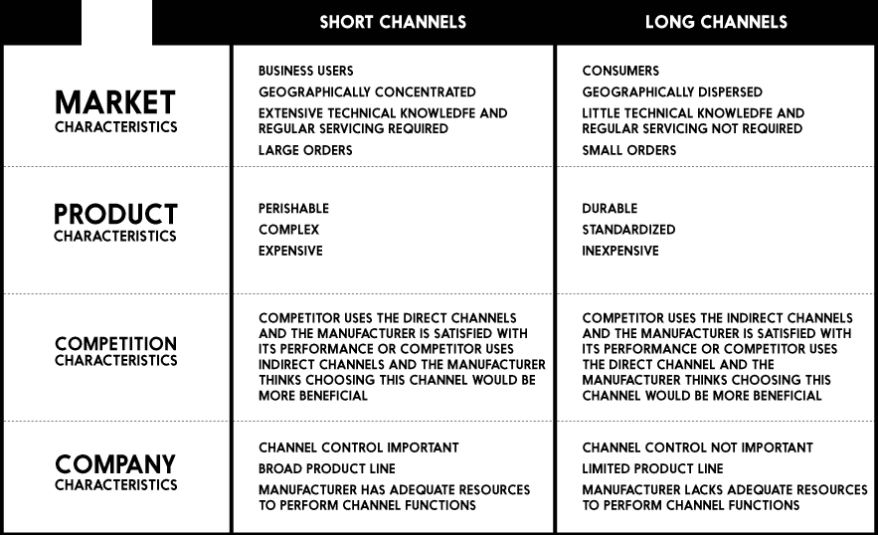
Importance of Physical Distribution Channels:

  • Ensures Product Availability

Physical distribution channels ensure products are available to customers at the right place and time. They bridge the gap between production and consumption, making goods accessible in various markets. Efficient distribution minimizes stockouts and ensures continuous supply. By strategically placing products where demand exists, businesses can serve customers promptly, increase satisfaction, and build loyalty. This availability directly influences purchase decisions and repeat sales, especially in competitive markets. Without effective physical distribution, even high-quality products may fail to reach intended customers, resulting in lost opportunities and reduced profitability.

  • Reduces Transportation and Storage Costs

Efficient physical distribution channels optimize transportation routes, load capacity, and storage facilities to minimize costs. By consolidating shipments and using appropriate warehousing strategies, businesses can lower expenses while maintaining timely deliveries. Cost reduction also improves pricing competitiveness in the market. Advanced logistics systems, such as just-in-time (JIT) inventory management, help reduce the need for large storage facilities, saving rent and maintenance costs. Moreover, bulk transportation through well-managed channels reduces per-unit freight charges. These cost efficiencies ultimately increase profitability and allow companies to offer competitive prices to customers without compromising service quality.

  • Expands Market Reach

Physical distribution channels help businesses reach diverse geographic areas, including rural, urban, and international markets. Well-established networks of wholesalers, distributors, and retailers ensure products penetrate deeper into different customer segments. This expansion enables companies to serve untapped markets, increasing overall sales volume and market share. Global brands often rely on sophisticated distribution systems to ensure consistent product availability across countries. Additionally, local adaptation of distribution strategies allows businesses to cater to specific market needs. By extending reach effectively, companies can strengthen their brand presence and establish dominance over competitors in multiple regions simultaneously.

  • Enhances Customer Satisfaction

An efficient physical distribution channel ensures fast, reliable, and damage-free delivery of products, directly contributing to customer satisfaction. Customers value convenience and timely service, and a strong distribution network fulfills these expectations. Quick product availability enhances trust in the brand and encourages repeat purchases. In industries like FMCG, electronics, and e-commerce, seamless delivery is a major factor in customer retention. Furthermore, prompt handling of returns and exchanges through distribution networks adds to a positive buying experience. Overall, smooth distribution strengthens customer relationships and boosts long-term loyalty, which is crucial for business sustainability.

  • Improves Competitiveness

A strong distribution system gives companies a competitive edge by ensuring products reach markets faster than competitors. Businesses that can deliver products promptly gain an advantage in customer preference and loyalty. Efficient logistics also allow companies to respond quickly to changing market demands or seasonal fluctuations. By maintaining a wide and reliable network, businesses can secure better shelf space in retail outlets and negotiate favorable terms with distributors. This operational strength often translates into a dominant market position, higher sales volumes, and stronger brand visibility, making it harder for competitors to match performance.

  • Facilitates Smooth Supply Chain Management

Physical distribution channels are a crucial link in the supply chain, ensuring smooth movement of goods from manufacturers to end-users. Well-coordinated channels improve communication between producers, wholesalers, retailers, and customers, leading to better inventory control and demand forecasting. This reduces delays, stock imbalances, and wastage. Integration with technology like GPS tracking and warehouse management systems further enhances efficiency. By aligning supply with demand in real-time, companies can avoid overproduction or shortages. Smooth supply chain operations also improve overall productivity and operational efficiency, which directly benefits profitability and customer satisfaction.

  • Supports Sales Growth

Effective physical distribution channels directly contribute to higher sales by ensuring wide product availability and convenience for customers. Products that are easy to find and purchase naturally sell more, leading to increased revenue. Distributors and retailers often promote products within their networks, providing additional marketing support. Furthermore, consistent supply to high-demand areas maximizes sales potential and minimizes lost opportunities. Seasonal products, in particular, benefit from quick and efficient distribution to capture peak demand. Ultimately, a robust distribution network is a strategic driver for sustainable business growth and long-term market expansion.

Types of Distribution Channels:

Distribution channels refer to the pathways through which products move from the producer to the final consumer. The choice of distribution channel impacts the product’s availability, cost, and customer experience. There are several types of distribution channels, each suited to different business models and customer needs.

  • Direct Distribution Channel

In a direct distribution channel, the producer sells the product directly to the consumer without involving intermediaries. This can be done through physical stores, company-owned retail outlets, or online platforms. Direct channels allow businesses to have full control over the pricing, branding, and customer experience. They are commonly used for high-value, customized products, or when a business wants to establish direct relationships with customers, as seen in industries like luxury goods, technology, and exclusive services.

  • Indirect Distribution Channel

Indirect distribution channels involve intermediaries between the producer and the consumer. These intermediaries can be wholesalers, distributors, or retailers who help move the product through the market. Indirect channels are common for mass-market products where reaching a larger audience efficiently is crucial. For example, a manufacturer of consumer electronics may sell its products to wholesalers, who then distribute them to various retailers, making the product available in multiple locations.

  • Dual Distribution Channel

A dual distribution channel, also known as a hybrid channel, combines both direct and indirect methods. A company uses direct sales to reach some customers while also using intermediaries to sell through other channels. This type of distribution is useful for companies that want to diversify their sales efforts or reach different market segments. For example, a company might sell directly to large corporate clients but rely on retailers to reach individual consumers. This approach increases market coverage and flexibility.

  • Intensive Distribution

Intensive distribution aims to make the product available in as many locations as possible. This type of channel is used for products with high demand, low unit cost, and frequent purchases, such as consumer packaged goods, snacks, or toiletries. The goal is to saturate the market and make the product widely accessible. The product is sold through multiple retailers, wholesalers, and other outlets to ensure it is readily available for customers.

  • Selective Distribution

Selective distribution involves using a limited number of outlets or intermediaries to distribute products. The company selectively chooses the intermediaries based on their ability to provide quality service, reach specific customer segments, or meet certain brand standards. This approach is often used for moderately priced products such as electronics or appliances. It allows the producer to maintain some control over the product’s distribution while still reaching a broad audience.

  • Exclusive Distribution

Exclusive distribution channels are characterized by a highly selective approach where the producer only sells the product through a few specific intermediaries. This type of channel is often used for luxury or high-end products, where exclusivity and prestige are critical. By limiting the number of distributors or retailers, the brand can control its image and ensure that the product is positioned correctly in the market. For example, a high-end automobile manufacturer may only sell its cars through a select network of authorized dealerships.

Choosing the Right Distribution Channel:

Choosing the right distribution channel is a crucial decision that can significantly impact a company’s success in reaching its target market. The process involves evaluating various options based on the product type, target customer preferences, cost considerations, and competitive environment.

  • Product Type

The nature of the product plays a vital role in determining the best distribution channel. For example, perishable goods like fresh food products may require direct distribution to maintain freshness, while durable goods can be sold through wholesalers or retailers. Similarly, high-end, luxury products may be best suited for exclusive distribution channels, while mass-market items benefit from extensive channel networks.

  • Market Coverage

The level of market coverage needed for the product influences the choice of distribution channel. If the goal is to achieve intensive distribution (wide availability in as many outlets as possible), using intermediaries like wholesalers or retailers is essential. On the other hand, exclusive distribution may require fewer intermediaries to maintain control and exclusivity, which works well for high-end products.

  • Customer Preferences

Understanding how customers prefer to buy products is critical when selecting a distribution channel. In the digital age, many customers prefer purchasing products online, while others prefer a traditional in-store experience. Businesses need to assess the purchasing behavior and preferences of their target market to choose a channel that aligns with their customers’ expectations.

  • Cost Considerations

The cost of using a particular distribution channel is an important factor. Direct distribution, such as selling through a company-owned retail outlet or an e-commerce platform, may involve higher operational costs but provides more control. Indirect channels like wholesalers and retailers may reduce operational costs but may result in lower profit margins due to commissions and markups. Companies need to balance cost considerations with revenue goals to make the most cost-effective choice.

  • Control and Flexibility

When a company chooses a distribution channel, it also determines the level of control it will have over its products and brand. Direct distribution allows a company to maintain more control over product presentation, pricing, and customer experience. However, indirect channels offer less control, as they rely on intermediaries to sell the product. If maintaining control over branding and customer experience is a priority, a company may opt for a direct distribution channel.

  • Competition

The distribution strategy should also consider competitors’ actions. If competitors are using particular distribution channels, entering the same channels could help a company maintain its competitive edge. Alternatively, choosing unique or innovative channels can provide differentiation in the marketplace.

  • Market Reach

The geographical scope of the target market also affects the choice of distribution channels. If a company plans to reach international or distant markets, using a distribution network that includes international agents or global e-commerce platforms might be necessary. Alternatively, for a local or regional target market, a more localized approach with regional wholesalers or retailers may be sufficient.

  • Speed and Efficiency

The time it takes for products to reach customers is another consideration. If the market demands fast delivery, a direct distribution channel, such as e-commerce with quick fulfillment services or direct sales through retail stores, may be ideal. In contrast, some customers may be willing to wait for their products, in which case a slower, but more cost-effective, channel may suffice.

error: Content is protected !!