Determination of Equilibrium Price and Quantity

Equilibrium means a state of no change. Evidently, at the equilibrium price, both buyers and sellers are in a state of no change. Technically, at this price, the quantity demanded by the buyers is equal to the quantity supplied by the sellers. Both market forces of demand and supply operate in harmony at the equilibrium price.

The equilibrium price is the price where the quantity demanded is equal to the quantity supplied. That quantity is known as the equilibrium quantity.

Graphically, this is represented by the intersection of the demand and supply curve. Further, it is also known as the market clearing price. The determination of the market price is the central theme of microeconomics. That is why the microeconomic theory is also known as price theory.

Equilibrium means a state of no change. Evidently, at the equilibrium price, both buyers and sellers are in a state of no change. Technically, at this price, the quantity demanded by the buyers is equal to the quantity supplied by the sellers. Both market forces of demand and supply operate in harmony at the equilibrium price.

Graphically, this is represented by the intersection of the demand and supply curve. Further, it is also known as the market clearing price. The determination of the market price is the central theme of microeconomics. That is why the microeconomic theory is also known as price theory.

Process of Finding Equilibrium:

To determine the equilibrium price and quantity, we must analyze both the demand and supply curves.

Step 1: Identifying the Demand and Supply Functions

The demand curve can be expressed as a function:

Qd = f(P)

where Qd is the quantity demanded and PP is the price.

Similarly, the supply curve is expressed as:

Qs = g(P)

where Qs is the quantity supplied.

At equilibrium, the quantity demanded equals the quantity supplied, so:

Qd = Qs

Step 2: Setting Quantity Demanded Equal to Quantity Supplied

Set the demand function equal to the supply function to solve for the equilibrium price. For example, if the demand function is:

Qd = 100 − 2P

And the supply function is:

Qs = 3P

Set these two equal to each other:

100 − 2P = 3P

Step 3: Solving for Equilibrium Price

Now solve for the price (PP):

100 =5P

So, the equilibrium price is 20.

Step 4: Solving for Equilibrium Quantity

Substitute the equilibrium price back into either the demand or supply equation to solve for the equilibrium quantity. Using the demand equation:

Qd = 100 − 2(20) = 100 − 40 = 60

Thus, the equilibrium quantity is 60 units.

Effects of Changes in Demand and Supply

The equilibrium price and quantity are not fixed; they change when there is a shift in either the demand or the supply curve.

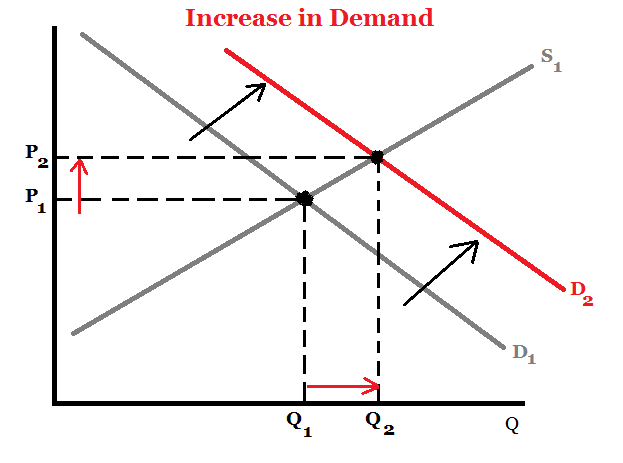
Increase in Demand

If demand increases due to factors such as higher consumer income or changes in preferences, the demand curve shifts to the right. This results in a higher equilibrium price and quantity.

Example:

  • If more consumers want to buy a good (shift in demand to the right), the equilibrium price will rise, and producers will supply more to meet the increased demand.

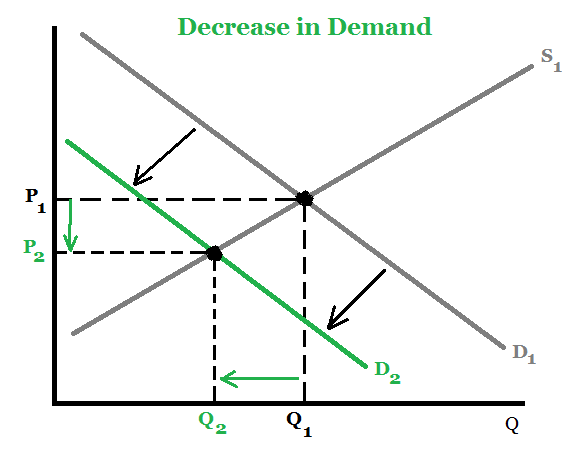
Decrease in Demand

If demand decreases (due to factors such as falling income or changes in preferences), the demand curve shifts to the left. This results in a lower equilibrium price and quantity.

Example:

  • If consumers no longer desire a good, the equilibrium price falls, and producers may reduce the quantity supplied.

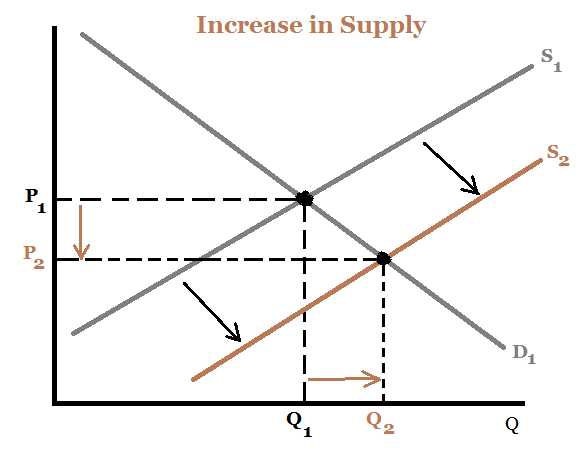
Increase in Supply

If supply increases (due to factors such as technological improvements or lower production costs), the supply curve shifts to the right. This results in a lower equilibrium price and a higher equilibrium quantity.

Example:

  • If a new technology reduces the cost of producing a good, the supply curve shifts rightward, leading to a lower price and higher quantity.

Decrease in Supply

If supply decreases (due to factors such as higher production costs or natural disasters), the supply curve shifts to the left. This results in a higher equilibrium price and a lower equilibrium quantity.

Example:

  • If a natural disaster disrupts the production of a good, the supply decreases, leading to higher prices and lower quantities available.

Role of Price Mechanism in Reaching Equilibrium

The price mechanism plays a crucial role in reaching equilibrium. If there is a surplus (where supply exceeds demand), producers will lower prices to encourage consumers to buy more. Conversely, if there is a shortage (where demand exceeds supply), consumers will compete to buy the good, causing prices to rise. This process continues until the market reaches equilibrium.

  • Surplus: If the price is above equilibrium, supply exceeds demand, and producers reduce the price.
  • Shortage: If the price is below equilibrium, demand exceeds supply, and prices rise as consumers compete for the limited supply.

Shifts in the Supply and Demand Curve

Definitely, if there is any change in supply, demand or both the market equilibrium would change. Let’s recollect the factors that induce changes in demand and supply:

Shift in Demand

The demand for a product changes due to an alteration in any of the following factors:

  • Price of complementary goods
  • Price of substitute goods
  • Income
  • Tastes and preferences
  • An expectation of change in the price in future
  • Population

Shift in Supply

The supply of product changes due to an alteration in any of the following factors:

  • Prices of factors of production
  • Prices of other goods
  • State of technology
  • Taxation policy
  • An expectation of change in price in future
  • Goals of the firm
  • Number of firms

Now let us study individually how market equilibrium changes when only demand changes, only supply changes and when both demand and supply change.

When only Demand Changes

A change in demand can be recorded as either an increase or a decrease. Note that in this case there is a shift in the demand curve.

(i) Increase in Demand

When there is an increase in demand, with no change in supply, the demand curve tends to shift rightwards. As the demand increases, a condition of excess demand occurs at the old equilibrium price. This leads to an increase in competition among the buyers, which in turn pushes up the price.

  • Shifts in Demand and Supply
  • Equilibrium, Excess Demand and Supply

Of course, as price increases, it serves as an incentive for suppliers to increase supply and also leads to a fall in demand. It is important to realize that these processes continue to operate until a new equilibrium is established. Effectively, there is an increase in both the equilibrium price and quantity.

(ii) Decrease in Demand

Under conditions of a decrease in demand, with no change in supply, the demand curve shifts towards left. When demand decreases, a condition of excess supply is built at the old equilibrium level. This leads to an increase in competition among the sellers to sell their produce, which obviously decreases the price.

Now as for price decreases, more consumers start demanding the good or service. Observably, this decrease in price leads to a fall in supply and a rise in demand. This counter mechanism continues until the conditions of excess supply are wiped out at the old equilibrium level and a new equilibrium is established. Effectively, there is a decrease in both the equilibrium price and quantity.

When only Supply Changes

A change in supply can be noted as either an increase or a decrease. Note that in this case there is a shift in the supply curve.

(i) Increase in Supply

When supply increases, accompanied by no change in demand, the supply curve shift towards the right. When supply increases, a condition of excess supply arises at the old equilibrium level. This induces competition among the sellers to sell their supply, which in turn decreases the price.

This decrease in price, in turn, leads to a fall in supply and a rise in demand. These processes operate until a new equilibrium level is attained. Lastly, such conditions are marked by a decrease in price and an increase in quantity.

(ii) Decrease in Supply

When the supply decreases, accompanied by no change in demand, there is a leftward shift of the supply curve. As supply decreases, a condition of excess demand is created at the old equilibrium level. Effectively there is increased competition among the buyers, which obviously leads to a rise in the price.

An increase in price is accompanied by a decrease in demand and an increase in supply. This continues until a new equilibrium level is attained. Further, there is a rise in equilibrium price but a fall in equilibrium quantity.

When both Demand and Supply Change

Generally, the market situation is more complex than the above-mentioned cases. That means, generally, supply and demand do not change in an individual manner. There is a simultaneous change in both entities. This gives birth to four cases:

  • Both demand and supply decrease
  • Both demand and supply increase
  • Demand decreases but supply increases
  • Demand increases but supply decreases

(i) Both Demand and Supply Decrease

The final market conditions can be determined only by a deduction of the magnitude of the decrease in both demand and supply. In fact, both the demand and supply curve shift towards the left. Essentially, there is a need to compare their magnitudes. Such conditions are better analyzed by dividing this case further into three:

The decrease in demand = decrease in supply

When the magnitudes of the decrease in both demand and supply are equal, it leads to a proportionate shift of both demand and supply curve. Consequently, the equilibrium price remains the same but there is a decrease in the equilibrium quantity.

The decrease in demand > decrease in supply

When the decrease in demand is greater than the decrease in supply, the demand curve shifts more towards left relative to the supply curve. Effectively, there is a fall in both equilibrium quantity and price.

The decrease in demand < decrease in supply

In a case in which the decrease in demand is smaller than the decrease in supply, the leftward shift of the demand curve is less than the leftward shift of the supply curve. Notably, there is a rise in equilibrium price accompanied by a fall in equilibrium quantity.

(ii) Both Demand and Supply Increase

In such a condition both demand and supply shift rightwards. So, in order to study changes in market equilibrium, we need to compare the increase in both entities and then conclude accordingly. Such a condition is further studied better with the help of the following three cases:

The increase in demand = increase in supply

If the increase in both demand and supply is exactly equal, there occurs a proportionate shift in the demand and supply curve. Consequently, the equilibrium price remains the same. However, the equilibrium quantity rises.

The increase in demand > increase in supply

In such a case, the right shift of the demand curve is more relative to that of the supply curve. Effectively, both equilibrium price and quantity tend to increase.

The increase in demand < increase in supply

When the increase is demand is less than the increase in supply, the right shift of the demand curve is less than the right shift of supply curve. In this case, the equilibrium price falls whereas the equilibrium quantity rises.

(iii) Demand Decreases but Supply Increases

This condition translates to the fact that the demand curve shifts leftwards whereas the supply curve shifts rightwards. As they move in opposite directions, the final market conditions are deduced by pointing out the magnitude of their shifts. Here, three cases further arise which are as follows:

The decrease in demand = increase in supply

In this case, although the two curves move in opposite directions, the magnitudes of their shifts is effectively the same. As a result, the equilibrium quantity remains the same but the equilibrium price falls.

The decrease in demand > increase in supply

When the decrease in demand is greater than the increase in supply, the relative shift of demand curve is proportionately more than the supply curve. Effectively, both the equilibrium quantity and price fall.

The decrease in demand < increase in supply

Here, the leftward shift of the demand curve is less than the rightward shift of the supply curve. It is important to realize, that the equilibrium quantity rises whereas the equilibrium price falls.

(iv) Demand Increases but Supply Decreases

Similar to the aforementioned condition, here also the demand and supply curve moves in the opposite directions. However, the demand curve shift towards the right(indicating an increase in demand) and the supply curve shift towards left(indicating a decrease in supply). Further, this is studied with the help of the following three cases:

Increase in demand = decrease in supply

When the increase in demand is equal to the decrease in supply, the shifts in both supply and demand curves are proportionately equal. Effectively, the equilibrium quantity remains the same however the equilibrium price rises.

Increase in demand > decrease in supply

In this case, the right shift of the demand curve is proportionately more than the leftward shift of the supply curve. Hence, both equilibrium quantity and price rise.

Increase in demand < decrease in supply

If the increase in demand is less than the decrease in supply, the shift of the demand curve tends to be less than that of the supply curve. Effectively, equilibrium quantity falls whereas the equilibrium price rises.

Demand Estimation and Forecasting

Demand Estimation is the process of predicting the future demand for a product or service based on historical data, market trends, and influencing factors. It involves analyzing variables such as price, income levels, population, consumer preferences, and substitute goods to determine the quantity consumers are likely to purchase. Demand estimation is crucial for businesses to plan production, set prices, allocate resources efficiently, and develop strategies for market penetration. Methods include statistical techniques, surveys, and econometric models. Accurate demand estimation helps minimize risks, reduce costs, and align supply with anticipated consumer needs, ensuring better decision-making and market competitiveness.

Demand Forecasting refers to the process of predicting future consumer demand for a product or service over a specific period. It is based on the analysis of historical sales data, market trends, and external factors like economic conditions, seasonal variations, and industry developments. Businesses use demand forecasting to make informed decisions about production planning, inventory management, staffing, and financial budgeting. Techniques include qualitative methods like expert opinion and quantitative approaches such as time-series analysis and regression models. Accurate forecasting helps companies meet customer demand efficiently, avoid overproduction or stockouts, and improve overall operational and financial performance.

1. Survey Methods

Survey methods are qualitative approaches that gather firsthand information from consumers, experts, or market participants. These methods are particularly useful for new products or when historical data is unavailable.

Techniques in Survey Methods

  1. Consumer Survey

    • Directly asks consumers about their future purchasing intentions.
    • Methods include interviews, questionnaires, or focus groups.
    • Effective for products with short purchase cycles or in small markets.
  2. Sales Force Opinion

    • Relies on the insights of sales representatives who interact with customers.
    • Aggregates predictions from sales teams to estimate demand.
    • Useful when sales teams have a deep understanding of customer behavior.
  3. Expert Opinion (Delphi Method)

    • Gathers insights from industry experts or specialists.
    • Repeated rounds of discussion refine estimates, leading to consensus.
    • Best for forecasting in industries with rapid technological changes.
  4. Market Experimentation

    • Tests demand by introducing the product in a limited market or under controlled conditions.
    • Provides empirical data for forecasting in wider markets.

Advantages

  • Provides real-time and targeted information.
  • Particularly helpful for new products or industries.
  • Easy to adapt to specific markets or customer segments.

Limitations

  • Expensive and time-consuming, especially for large-scale surveys.
  • Responses may be biased or inaccurate.
  • Results are often subjective and less reliable for long-term forecasts.

2. Statistical Methods

Statistical methods use quantitative techniques to analyze historical data and predict future demand. These methods are preferred for established products with available historical data.

Techniques in Statistical Methods

  1. Time-Series Analysis

    • Studies historical data to identify patterns or trends.
    • Techniques include moving averages, exponential smoothing, and seasonal decomposition.
    • Suitable for stable markets with predictable demand cycles.
  2. Regression Analysis

    • Examines relationships between demand (dependent variable) and influencing factors (independent variables like price, income, or advertising).
    • Helps identify key determinants of demand and predict changes based on these factors.
  3. Trend Projection

    • Extends historical trends into the future using graphical or mathematical methods.
    • Simple and effective for products with consistent growth or decline patterns.
  4. Econometric Models

    • Builds complex models using economic theories to predict demand.
    • Incorporates multiple variables and interdependencies.
    • Useful for detailed analysis and policy evaluation.
  5. Seasonal Index

    • Adjusts forecasts to account for seasonal variations in demand.
    • Common in industries like retail, tourism, and agriculture.

Advantages

  • Based on objective and reliable data.
  • Effective for long-term and large-scale forecasting.
  • Provides quantifiable and reproducible results.

Limitations

  • Requires accurate and extensive historical data.
  • Assumes past patterns will continue in the future, which may not hold true.
  • Complex methods may require expertise and advanced tools.

Trademarks, Features, Types, Laws

Trademark is a unique symbol, word, phrase, logo, design, or combination that identifies and distinguishes the goods or services of a particular business from others in the market. It serves as a form of intellectual property, providing legal protection against unauthorized use by others. Trademarks play a crucial role in building brand identity, trust, and customer loyalty. Registered trademarks offer exclusive rights to the owner, ensuring recognition and preventing confusion among consumers. Examples include iconic logos like the Nike Swoosh or McDonald’s Golden Arches. Trademarks are protected under specific laws, such as the Trademarks Act in many countries.

Features of Trademark:

1. Distinctive Identity

Trademark provides a unique identity to a product or service, helping it stand out in the competitive market. It enables customers to recognize the brand instantly through distinctive elements like logos, words, symbols, or designs.

  • Example: The Apple logo is instantly associated with innovation and quality.

2. Legal Protection

Trademarks are legally protected under trademark laws, such as the Trademarks Act in India or the Lanham Act in the United States. Once registered, the owner has exclusive rights to use the mark, and any unauthorized usage can be legally challenged.

  • Example: Coca-Cola has exclusive rights to its iconic logo and brand name.

3. Commercial Value

A trademark adds significant commercial value to a business by enhancing brand recognition and loyalty. Over time, it can become one of the most valuable assets of a company, contributing to goodwill and financial worth.

  • Example: The Nike Swoosh has become a symbol of excellence, adding immense value to the brand.

4. Intangible Asset

A trademark is an intangible asset, meaning it holds no physical form but represents considerable value for a business. It can be bought, sold, licensed, or franchised, providing an additional revenue stream.

  • Example: Licensing agreements for Disney characters generate significant revenue.

5. Global Recognition

Trademarks can be registered internationally, offering protection in multiple countries. This is especially crucial for businesses operating in global markets, ensuring that their brand is protected across borders.

  • Example: McDonald’s Golden Arches are recognized worldwide.

6. Versatility

Trademarks can take various forms, including words, phrases, logos, sounds, shapes, and even colors. This versatility allows businesses to create a unique and memorable brand identity that resonates with their audience.

  • Example: The “Intel Inside” jingle is a registered sound trademark.

7. Prevents Market Confusion

A trademark helps prevent confusion among consumers by clearly differentiating one brand from another. This ensures that customers can identify and choose their preferred products or services confidently.

  • Example: The Starbucks logo ensures customers recognize its coffee shops over competitors.

8. Long-Term Protection

Trademarks can be renewed indefinitely as long as they are in use. This ensures perpetual protection and association with the brand, allowing businesses to maintain their identity over generations.

  • Example: The Coca-Cola trademark has been protected for over a century.

Types of Trademark:

1. Product Marks

Product mark identifies the source of a product and distinguishes it from competitors. It is typically used for goods rather than services. Product marks help establish a unique identity in the market and build brand recognition.

  • Example: The “Apple” logo for electronic devices.

2. Service Marks

Service marks are used to identify and distinguish services offered by a business rather than tangible goods. They ensure that customers can associate quality and trust with a particular service provider.

  • Example: The “FedEx” logo for courier services.

3. Collective Marks

Collective marks are used by a group or association to represent the origin or quality of goods or services provided by its members. These marks help indicate that the product or service adheres to certain standards set by the group.

  • Example: The “CA” mark used by Chartered Accountants in India.

4. Certification Marks

Certification marks signify that a product or service meets specific standards or criteria, such as quality, origin, or manufacturing method. These marks are issued by authorized certifying organizations and are not exclusive to any single manufacturer or service provider.

  • Example: The “ISI” mark for products conforming to Indian Standards.

5. Trade Dress

Trade dress refers to the visual appearance of a product, including its packaging, shape, color, or design, that makes it unique and distinguishable. It focuses on the overall look and feel rather than specific logos or words.

  • Example: The distinct shape of the Coca-Cola bottle.

6. Sound Marks

Sound marks are unique audio elements associated with a brand. These marks help in building auditory recognition and are often used in advertisements, jingles, or as startup sounds for devices.

  • Example: The “Intel Inside” jingle.

7. Word Marks

A word mark protects the text or name of a brand, including its font style and arrangement. It ensures that no other entity can use the specific words to identify similar products or services.

  • Example: The name “Google.”

8. Logo Marks

Logo marks focus on the visual representation of a brand, such as a symbol, emblem, or graphical element. It helps establish a strong visual identity for the brand.

  • Example: The Nike “Swoosh.”

Laws of Trademark in India:

Trademarks in India are governed by a comprehensive legal framework designed to protect the intellectual property rights of businesses and individuals. The Trademarks Act, 1999 is the primary legislation, supported by various rules and international agreements.

1. Trademarks Act, 1999

This is the cornerstone of trademark protection in India, replacing the earlier Trade and Merchandise Marks Act, 1958. It governs the registration, protection, and enforcement of trademarks.

Key Provisions:

  • Registration of Trademarks: Provides for the registration of distinctive marks for goods and services.
  • Types of Marks: Includes product marks, service marks, collective marks, certification marks, and trade dress.
  • Duration of Protection: A registered trademark is valid for 10 years and can be renewed indefinitely.
  • Infringement and Penalties: Defines trademark infringement and provides remedies, including civil and criminal penalties.

2. Trademark Rules, 2017

These rules simplify and streamline the trademark registration process. They also specify the classification of goods and services as per the Nice Classification System.

Key Features:

  • Online filing of trademark applications.
  • Concessions for small businesses and startups in filing fees.
  • Clear guidelines for international trademark registration under the Madrid Protocol.

3. Intellectual Property Appellate Board (IPAB)

The IPAB (now merged with the High Court) handled disputes related to trademarks, including appeals against decisions of the Registrar of Trademarks.

4. Trademark Registration Process

The registration process involves filing an application, examination, publication in the Trademarks Journal, and eventual registration if no opposition is raised.

Steps:

  1. Conducting a trademark search.
  2. Filing the application with the Registrar of Trademarks.
  3. Examination and objection (if any).
  4. Publication for public opposition.
  5. Certificate issuance upon successful registration.

5. Remedies for Infringement

Trademark infringement occurs when an unauthorized party uses a mark that is identical or deceptively similar to a registered trademark. Remedies include:

  • Civil Remedies: Injunctions, damages, and accounts of profits.
  • Criminal Penalties: Fines and imprisonment for willful infringement.

6. International Protection

India is a member of the Madrid Protocol, allowing businesses to register trademarks internationally through a single application.

Nature and Scope of Marketing

Marketing is the process of creating, communicating, delivering, and exchanging offerings that have value for customers, clients, partners, and society at large. It involves understanding customer needs and wants, designing products or services to meet those needs, and promoting them effectively to the target audience. Marketing is not limited to selling or advertising—it encompasses market research, product development, pricing strategies, distribution, and relationship building.

In a broader sense, marketing is both an art and a science. It requires creativity to design appealing offerings and analytical skills to interpret market data and trends. The ultimate aim is to satisfy customers profitably while building brand trust and loyalty. In today’s competitive and dynamic environment, marketing also plays a role in anticipating future needs, adapting to technological changes, and delivering value in a socially responsible manner, ensuring long-term success for both businesses and their stakeholders.

Nature of Marketing:

  • Customer-Oriented Process

Marketing focuses primarily on identifying and satisfying customer needs and wants. It starts with understanding the target audience through market research and ends with delivering products or services that meet their expectations. This orientation ensures that all business activities revolve around providing value to customers. By prioritizing customer satisfaction, marketing helps build loyalty, trust, and repeat business. The success of any marketing effort is measured by how well it fulfills customer demands while creating mutual value for both the buyer and the seller. Without a customer-oriented approach, marketing loses its effectiveness and long-term impact.

  • Goal-Oriented Activity

Marketing is directed towards achieving specific organizational goals, such as increasing sales, maximizing profits, expanding market share, or building brand awareness. Every marketing activity—from product development to promotional campaigns—is planned to contribute to these objectives. Goal orientation ensures that marketing efforts are measurable and aligned with the company’s overall strategy. It provides direction, motivates employees, and helps allocate resources efficiently. Without clear goals, marketing activities may become uncoordinated and ineffective. Therefore, a results-driven approach is essential for ensuring that marketing not only attracts customers but also delivers tangible benefits to the business.

  • Continuous and Dynamic Process

Marketing is an ongoing process that evolves with changes in customer preferences, market trends, technology, and competition. It is not a one-time activity but a continuous cycle of research, planning, implementation, and evaluation. The dynamic nature of marketing demands flexibility and innovation to adapt strategies in response to market changes. For example, shifts in consumer behavior due to digitalization or economic fluctuations require businesses to adjust pricing, promotion, and distribution strategies. This adaptability ensures relevance in the market and helps businesses maintain a competitive advantage over time.

  • Value Creation and Satisfaction

At its core, marketing is about creating and delivering value to customers. Value refers to the perceived benefits a customer receives compared to the cost they pay. By offering high-quality products, unique features, and excellent service, businesses can enhance customer satisfaction and loyalty. This value creation goes beyond the product—it includes after-sales support, emotional connection, and brand experience. When customers feel that they receive more benefits than they pay for, they are likely to repurchase and recommend the brand. Thus, value creation is essential for sustainable growth and long-term business success.

  • Integrated Organizational Function

Marketing is not just the responsibility of the marketing department; it is a function that integrates all areas of a business. Production, finance, research, customer service, and logistics must work together to fulfill marketing objectives. This integration ensures that every department contributes to delivering value and maintaining customer satisfaction. For example, production must ensure quality, finance must manage pricing strategies, and logistics must ensure timely delivery. A coordinated approach strengthens the brand image and ensures consistent communication with customers. Integrated marketing helps avoid conflicts, reduces inefficiencies, and enhances the overall customer experience.

  • Mutual Benefit for Business and Society

Marketing creates value not only for businesses but also for society. By providing goods and services that meet consumer needs, marketing improves living standards and supports economic growth. It also fosters employment opportunities, encourages innovation, and promotes fair competition. Ethical marketing practices ensure that products are safe, environmentally friendly, and socially responsible. This balance between business goals and societal welfare builds trust and enhances a brand’s reputation. When marketing serves both business and society, it contributes to sustainable development and creates a positive impact beyond profit-making.

  • Influenced by External Environment

Marketing activities are significantly affected by external environmental factors, including economic conditions, cultural values, technological advancements, legal regulations, and competition. These factors are largely uncontrollable but must be closely monitored to adjust marketing strategies accordingly. For example, changes in government policies may affect pricing or distribution, while technological innovations may open new promotional channels. Understanding the external environment enables businesses to anticipate challenges, seize opportunities, and remain competitive. This adaptability to external influences ensures marketing strategies remain relevant and effective in achieving business objectives.

Scope of Marketing:

  • Study of Consumer Needs and Wants

The scope of marketing begins with identifying and understanding the needs and wants of consumers. This involves conducting market research to gather insights into buyer behavior, preferences, and purchasing patterns. By analyzing this data, businesses can design products and services that match customer expectations. The process includes segmentation, targeting, and positioning to serve the right market effectively. Without a clear understanding of consumer needs, marketing strategies may fail to attract or retain customers. Thus, studying customer needs forms the foundation for all marketing decisions and helps in developing products that deliver genuine value.

  • Product Planning and Development

Product planning is a key part of the marketing scope, involving the creation or improvement of goods and services to meet market demands. This includes determining product features, quality standards, packaging, branding, and after-sales service. Development may involve introducing completely new products or upgrading existing ones to suit changing preferences and technological advancements. Effective product planning ensures that offerings remain competitive and relevant. It also considers factors such as design, innovation, and sustainability. Since products are the core of any marketing strategy, careful planning and development directly impact customer satisfaction and business profitability.

  • Pricing Decisions

Pricing is a critical element of marketing, as it directly affects sales, revenue, and profitability. The scope of marketing includes setting prices that reflect product value, match market conditions, and meet consumer expectations. Pricing strategies may vary based on factors like competition, cost, demand, and government regulations. Marketers may use approaches such as penetration pricing, skimming pricing, or value-based pricing to achieve business goals. The right pricing decision ensures competitiveness without sacrificing profitability. It must also consider psychological aspects, as customers often associate price with quality, making it a key factor in brand positioning.

  • Promotion and Communication

Promotion refers to all activities that inform, persuade, and remind customers about products and services. It includes advertising, personal selling, sales promotions, public relations, and digital marketing. Communication plays a crucial role in creating awareness, generating interest, and building brand loyalty. Marketers must design effective messages and choose suitable media channels to reach their target audience. The scope of promotion extends to creating emotional connections with customers and maintaining consistent brand identity. In today’s digital era, social media and online campaigns have become vital tools for promotional success, ensuring wider reach at lower costs.

  • Distribution (Place) Decisions

Distribution is the process of making products available to customers at the right place, time, and quantity. It involves selecting suitable channels such as wholesalers, retailers, e-commerce platforms, or direct sales. The scope of marketing includes designing efficient distribution networks, managing logistics, warehousing, and transportation. The goal is to ensure product accessibility and customer convenience. Choosing the right distribution strategy can improve market coverage and customer satisfaction. Factors like product type, target market, and cost efficiency influence these decisions. In modern marketing, online distribution has become increasingly important for reaching global audiences quickly.

  • After-Sales Service

After-sales service is a vital part of marketing, especially for products that require installation, maintenance, or repair. It helps in building customer trust and loyalty by ensuring continued satisfaction even after purchase. Services may include warranties, customer support, training, and complaint handling. The scope of marketing recognizes after-sales service as a competitive advantage, as it enhances brand reputation and encourages repeat purchases. Effective after-sales programs also generate positive word-of-mouth, which can attract new customers. In industries like electronics, automobiles, and machinery, after-sales service often determines long-term customer relationships and overall business success.

  • Market Research

Market research involves collecting and analyzing data to support marketing decisions. It helps businesses understand customer behavior, market trends, competition, and potential opportunities. This scope of marketing ensures that strategies are based on facts rather than assumptions. Research may include surveys, focus groups, observation, and data analytics. The insights gained guide product development, pricing, promotion, and distribution. Market research also helps in identifying emerging trends and minimizing risks. In a competitive environment, continuous research is essential for adapting to changes, staying ahead of competitors, and meeting evolving customer needs effectively.

Marketing Research, Types, Process Tools and Techniques

Marketing Research is the systematic process of gathering, analyzing, and interpreting information about a market, target audience, competition, or industry trends. It helps businesses identify opportunities, assess consumer needs, preferences, and behaviors, and evaluate the effectiveness of marketing strategies. Marketing research can be classified into primary research (collecting new data through surveys, interviews, or experiments) and secondary research (analyzing existing data like reports or publications). It provides critical insights that guide decision-making, enhance customer satisfaction, and improve product or service offerings. Effective marketing research ensures that organizations remain competitive and responsive in dynamic market environments.

Features of Marketing Research:

1. Systematic Process

Marketing research follows a structured and methodical approach. It begins with identifying the problem or opportunity, followed by designing the research plan, data collection, analysis, and interpretation. This systematic process ensures accuracy and reliability in findings, which are critical for informed decision-making.

  • Example: A company launching a new product systematically conducts surveys and focus groups to evaluate consumer demand.

2. Objective-Oriented

The primary goal of marketing research is to provide solutions to specific marketing problems or to uncover opportunities. It focuses on collecting relevant data and generating actionable insights to achieve predefined objectives. By remaining goal-focused, marketing research helps avoid irrelevant or excessive data collection.

  • Example: A company may conduct research specifically to understand why sales of a product are declining.

3. Data-Driven

Marketing research relies on data, whether qualitative (opinions, emotions, or motivations) or quantitative (numbers, statistics, or trends). The quality of the research is directly tied to the accuracy, relevance, and timeliness of the data collected.

  • Example: A retailer analyzing customer purchase patterns uses sales data to design targeted promotions.

4. Analytical in Nature

Marketing research emphasizes rigorous analysis of collected data to derive meaningful insights. Various analytical tools and statistical techniques are used to interpret the data, identify trends, and make forecasts. This ensures that decisions are not based on guesswork but on factual evidence.

  • Example: A software company uses predictive analytics to estimate customer lifetime value based on historical behavior.

5. Continuous and Adaptive

Marketing research is not a one-time activity but an ongoing process. Markets are dynamic, with changing consumer behaviors, preferences, and competitive forces. Businesses must adapt their research efforts to stay relevant and updated with current trends.

  • Example: Social media platforms conduct regular research to understand user preferences and develop new features accordingly.

6. Problem-Solving Orientation

Marketing research aims to solve real-world problems by identifying issues and suggesting practical solutions. It provides actionable recommendations to enhance marketing strategies, product development, or customer engagement.

  • Example: Research findings may indicate the need for better customer service training to improve satisfaction levels.

Types of Marketing Research:

1. Exploratory Research

This type of research is conducted when the problem is not clearly defined, and the objective is to explore new ideas or insights. It is qualitative in nature and helps identify potential issues, opportunities, or solutions. Techniques like focus groups, in-depth interviews, and open-ended surveys are commonly used.

  • Example: A company exploring the viability of a new product concept by interviewing a small group of target customers.

2. Descriptive Research

Descriptive research aims to describe the characteristics of a specific market or consumer group. It is often quantitative and provides information about consumer demographics, behaviors, and preferences. Surveys, observational studies, and data analysis are typical methods used.

  • Example: A retailer conducting a survey to understand the purchasing habits of millennials.

3. Causal Research

Also known as experimental research, causal research is conducted to identify cause-and-effect relationships between variables. It tests hypotheses to determine how changes in one variable (e.g., price) impact another (e.g., sales).

  • Example: A business running A/B tests on two different ad campaigns to measure their impact on customer engagement.

4. Qualitative Research

This research focuses on understanding consumer emotions, motivations, and behaviors through non-numerical data. It uses methods like focus groups, interviews, and ethnographic studies to gather in-depth insights.

  • Example: A luxury brand conducting interviews to understand how customers perceive exclusivity.

5. Quantitative Research

Quantitative research collects and analyzes numerical data to identify trends, patterns, and relationships. It relies on large sample sizes and uses techniques like surveys, statistical analysis, and structured questionnaires.

  • Example: A telecom company analyzing customer satisfaction scores through large-scale surveys.

6. Primary Research

Primary research involves collecting original data directly from respondents. It provides specific insights tailored to the research objectives and is conducted through surveys, experiments, and direct observations.

  • Example: A startup conducting an online poll to gauge interest in its new app.

7. Secondary Research

This type of research involves analyzing existing data from sources like reports, studies, industry publications, and government statistics. It is cost-effective and useful for understanding broader trends.

  • Example: A business using market reports to understand industry growth rates.

8. Product Research

Product research focuses on understanding consumer preferences and feedback related to a product’s features, packaging, or usability. It helps in product development and enhancement.

  • Example: A beverage company testing different flavors with a focus group.

9. Market Segmentation Research

This research identifies distinct consumer segments within a broader market based on demographics, behaviors, or preferences. It helps businesses target the right audience effectively.

  • Example: A fashion retailer segmenting its market into groups based on age and lifestyle.

10. Competitive Analysis Research

This type examines competitors’ strategies, strengths, and weaknesses. It provides insights into the competitive landscape and helps businesses differentiate themselves.

  • Example: A software company analyzing its competitors’ pricing and features.

Process of Marketing Research:

1. Identifying the Problem or Opportunity

The first step in the marketing research process is clearly defining the problem or identifying the opportunity. This step is critical, as it sets the foundation for the entire research process. A poorly defined problem may lead to irrelevant or misleading results. Businesses need to determine what they want to achieve, whether it is understanding declining sales, evaluating a new product’s potential, or exploring customer preferences. For instance, a company may want to know why customer satisfaction levels have decreased over the past quarter.

2. Developing the Research Plan

Once the problem is identified, the next step is to design a comprehensive research plan. This involves selecting the type of research (exploratory, descriptive, or causal) and determining the research approach (qualitative, quantitative, or a mix of both). Additionally, researchers decide on the methods for data collection, such as surveys, interviews, focus groups, or experiments. The plan should also outline the sampling method, sample size, and research budget. A well-thought-out research plan ensures that the process is efficient and cost-effective.

3. Collecting Data

Data collection is a crucial step that involves gathering information from primary or secondary sources. Primary data is collected firsthand through methods like questionnaires, interviews, and observations. Secondary data is obtained from existing sources such as market reports, government publications, and industry databases. The choice of data collection method depends on the objectives and available resources. For instance, if a business wants real-time customer feedback, it may use online surveys or social media polls.

4. Analyzing the Data

After data collection, the next step is to organize, analyze, and interpret the information to derive meaningful insights. Statistical tools, software, and techniques like regression analysis, correlation, and data visualization are often employed. This step involves identifying patterns, trends, and relationships within the data. For example, analysis may reveal that customers prefer specific product features or that price sensitivity is affecting sales.

5. Presenting the Findings

Once the data is analyzed, the results need to be compiled into a clear and concise report. The report typically includes an executive summary, research objectives, methodology, key findings, and actionable recommendations. Visual aids like graphs, charts, and tables are often used to make the findings easier to understand. This presentation helps decision-makers grasp the key insights and make informed choices based on the research.

6. Taking Action and Monitoring Results

The final step in the marketing research process is to implement the recommendations and monitor the outcomes. Businesses use the insights gained to develop strategies, improve products, or enhance customer experiences. Continuous monitoring ensures that the implemented actions are achieving the desired results and allows for adjustments if necessary. For instance, if a marketing campaign based on research insights shows positive results, it validates the research process.

Tools and Techniques of Marketing Research:

1. Data Collection Tools

a. Surveys and Questionnaires

Surveys are one of the most popular tools for collecting primary data. They involve structured questions designed to gather quantitative or qualitative insights.

  • Example: Online surveys using platforms like Google Forms, SurveyMonkey, or Qualtrics.
  • Benefit: Cost-effective and scalable for large audiences.

b. Interviews

Interviews provide in-depth insights by engaging participants in detailed discussions. They can be conducted face-to-face, via phone, or online.

  • Example: One-on-one interviews with key customers to explore their motivations.
  • Benefit: Allows for probing and clarifying responses.

c. Focus Groups

Focus groups involve moderated discussions with a small group of participants to gather opinions and ideas.

  • Example: A retailer organizing focus groups to test new store layouts.
  • Benefit: Reveals group dynamics and diverse perspectives.

d. Observation

Observation involves monitoring consumer behavior in real-world settings without direct interaction.

  • Example: Watching how shoppers navigate a store.
  • Benefit: Captures actual behavior rather than self-reported data.

e. Experiments

Experiments test specific variables to determine cause-and-effect relationships.

  • Example: A/B testing two versions of a website landing page.
  • Benefit: Provides reliable data for decision-making.

2. Data Analysis Tools

a. Statistical Software

Statistical tools like SPSS, SAS, and R help analyze large datasets and uncover trends, correlations, and patterns.

  • Example: A company using SPSS to analyze survey results.
  • Benefit: Ensures accurate and sophisticated data analysis.

b. Data Visualization Tools

Tools like Tableau, Power BI, and Excel create visual representations of data, such as charts and graphs.

  • Example: A marketer using Tableau to create dashboards for campaign performance.
  • Benefit: Makes complex data easy to understand and interpret.

c. Predictive Analytics

Predictive tools use algorithms and machine learning to forecast future trends and behaviors.

  • Example: An e-commerce platform predicting customer purchase likelihood.
  • Benefit: Enables proactive decision-making.

3. Online Tools

a. Social Media Analytics

Platforms like Hootsuite and Brandwatch analyze consumer sentiment and behavior on social media.

  • Example: Tracking brand mentions and hashtags to measure campaign effectiveness.
  • Benefit: Provides real-time insights into public opinion.

b. Web Analytics

Google Analytics and similar tools track website traffic, user behavior, and conversion rates.

  • Example: Monitoring the effectiveness of an ad campaign through website traffic spikes.
  • Benefit: Helps optimize digital marketing strategies.

c. CRM Systems

Customer Relationship Management (CRM) tools like Salesforce and HubSpot track customer interactions and preferences.

  • Example: Analyzing customer purchase history to identify upselling opportunities.
  • Benefit: Enhances customer relationship strategies.

4. Secondary Research Tools

a. Industry Reports and Publications

Reports from organizations like Nielsen, Gartner, or McKinsey provide valuable secondary data.

  • Example: Using market trends from a Nielsen report to strategize.
  • Benefit: Saves time and resources on primary research.

b. Government Data

Government databases, like Census data or economic reports, offer comprehensive and reliable information.

  • Example: Analyzing population trends for market expansion.
  • Benefit: Provides credible data for broad insights.

5. Qualitative Techniques

a. SWOT Analysis

This technique assesses a business’s strengths, weaknesses, opportunities, and threats.

  • Example: A company analyzing its competitive edge in a new market.
  • Benefit: Supports strategic planning.

b. Ethnographic Research

This involves observing consumers in their natural environments to understand their habits and lifestyles.

  • Example: Studying how rural communities use a product.
  • Benefit: Offers deep, contextual insights.

Advantages of Marketing Research

(i) Marketing research helps the management of a firm in planning by providing accurate and up- to-date information about the demands, their changing tastes, attitudes, preferences, buying.

(ii) It helps the manufacturer to adjust his production according to the conditions of demand.

(iii) It helps to establish correlative relationship between the product brand and consumers’ needs and preferences.

(iv) It helps the manufacturer to secure economies in the distribution о his products.

(v) It makes the marketing of goods efficient and economical by eliminating all type of wastage.

(vi) It helps the manufacturer and dealers to find out the best way of approaching the potential.

(vii) It helps the manufacturer to find out the defects in the existing product and take the required corrective steps to improve the product.

(viii) It helps the manufacturer in finding out the effectiveness of the existing channels of distribution and in finding out the best way of distributing the goods to the ultimate consumers.

(ix) It guides the manufacturer in planning his advertising and sales promotion efforts.

(x) It is helpful in assessing the effectiveness of advertising programmes.

(xi) It is helpful in evaluating the relative efficiency of the different advertising media.

(xii) It is helpful in evaluating selling methods.

(xiii) It reveals the causes of consumer resistance.

(xiv) It minimizes the risks of uncertainties and helps in taking sound decisions.

(xv) It reveals the nature of demand for the firm’s product. That is, it indicates whether the demand for the product is constant or seasonal.

(xvi) It is helpful in ascertaining the reputation of the firm and its products.

(xvii) It helps the firm in determining the range within which its products are to be offered to the consumers. That is, it is helpful in determining the sizes, colours, designs, prices, etc., of the products of the firm.

(xviii) It would help the management to know how patents, licensing agreements and other legal restrictions affect the manufacture and sale of the firm’s products.

(xix) It is helpful to the management in determining the actual prices and the price ranges.

(xx) It is helpful to the management in determining the discount rates.

Limitations of Marketing Research

1. High Costs

Conducting marketing research can be expensive, especially for small businesses with limited budgets. Expenses for hiring research agencies, designing surveys, collecting data, and using analytical tools can add up quickly. This financial constraint may force companies to compromise on the quality or scope of the research.

  • Example: A startup may avoid conducting large-scale surveys due to high costs, leading to limited insights.

2. Time-Consuming Process

Marketing research is a time-intensive process that involves multiple steps, including planning, data collection, analysis, and reporting. In fast-moving markets, by the time the research is complete, the insights may already be outdated, rendering them less useful.

  • Example: A company taking months to complete research for a new product launch may lose its first-mover advantage.

3. Risk of Inaccurate Data

The accuracy of marketing research depends on the quality of data collected. If the data is incorrect, biased, or incomplete, the insights derived from it will also be flawed. Poor sampling techniques, respondent dishonesty, or misinterpretation can lead to unreliable results.

  • Example: Customers providing false responses in a survey to avoid revealing their true preferences.

4. Limited Scope

Marketing research often focuses on specific issues, making it difficult to gain a holistic view of the market. Additionally, certain qualitative factors, like emotional responses or cultural nuances, may be difficult to quantify or measure accurately.

  • Example: Research that examines customer satisfaction but overlooks external factors like economic conditions influencing buying behavior.

5. Dependency on Respondents

Marketing research relies heavily on respondents’ participation and honesty. If respondents are unwilling to engage, provide inaccurate information, or exhibit bias, the results can be compromised. Non-response or low response rates can also affect the validity of the study.

  • Example: Online surveys often experience low response rates, leading to insufficient data for meaningful analysis.

6. Rapid Market Changes

Markets are dynamic, with trends, consumer preferences, and competition evolving rapidly. Research findings may become irrelevant by the time they are implemented, especially in industries like technology or fashion where changes occur frequently.

  • Example: A company basing its advertising strategy on outdated research results may fail to connect with current consumer trends.

Personal Selling, Meaning, Objectives, Process, Importance, Techniques, Strategies and Considerations

Personal Selling is a crucial component of the promotional mix that involves direct interaction between a salesperson and a potential customer. It is a highly personalized form of communication that allows for tailored product presentations, addressing customer needs and concerns, building relationships, and ultimately persuading customers to make a purchase. In this section, we will delve into the concept of personal selling, its objectives, process, techniques, and the skills required for effective personal selling.

Personal selling can be defined as a face-to-face communication process between a salesperson and a prospective customer, with the goal of making a sale. Unlike other forms of promotion, personal selling offers direct interaction, enabling the salesperson to customize the sales message and adapt to the customer’s specific needs and preferences.

Primary Objectives of Personal Selling

  • Generating Sales

The primary objective of personal selling is to generate sales by persuading potential customers to purchase a product or service. The salesperson uses their expertise and communication skills to showcase the features, benefits, and value of the offering, emphasizing how it meets the customer’s needs.

  • Building Relationships

Personal selling allows salespeople to establish and nurture relationships with customers. By understanding their needs, providing personalized attention, and offering ongoing support, salespeople can build trust, loyalty, and long-term relationships with customers.

  • Providing Information and Education

Salespeople play a crucial role in providing customers with detailed product or service information, addressing their questions and concerns, and educating them on how the offering can solve their problems or fulfill their desires. This information exchange helps customers make informed purchase decisions.

  • Gathering Feedback

Through personal interactions, salespeople can gather valuable feedback from customers. They can gain insights into customer preferences, market trends, competitors’ activities, and potential areas of improvement for the product or service. This feedback is valuable for refining marketing strategies and enhancing the offering.

  • Market Research

Salespeople are often at the front lines of customer interactions, making them a valuable source of market intelligence. They can collect information about customer preferences, competitor strategies, and market trends, which can be used for market research and analysis.

Personal Selling Process

The personal selling process involves several sequential steps that guide salespeople in their interactions with customers. While the specific steps may vary depending on the sales methodology or organization, the general process includes the following stages:

  • Prospecting

The salesperson identifies potential customers or leads through various sources such as referrals, databases, networking, or market research. Prospecting involves evaluating the leads to determine their potential as qualified prospects.

  • Pre-approach

In the pre-approach stage, the salesperson gathers information about the prospect, such as their needs, preferences, and background. This research helps in tailoring the sales presentation and approach to address the prospect’s specific requirements.

  • Approach

The salesperson makes initial contact with the prospect. The approach should be professional, courteous, and engaging, aiming to capture the prospect’s attention and establish rapport.

  • Needs Assessment

In this stage, the salesperson engages in a conversation with the prospect to identify their needs, challenges, and goals. By asking open-ended questions and actively listening, the salesperson gains a deeper understanding of the prospect’s situation, which forms the basis for the subsequent stages.

  • Presentation

Based on the needs assessment, the salesperson designs a customized presentation that highlights the features, benefits, and value of the product or service. The presentation should focus on how the offering addresses the prospect’s specific needs and provides a solution to their challenges.

  • Handling Objections

Prospects may have concerns, objections, or doubts that need to be addressed. The salesperson should listen empathetically, clarify misunderstandings, provide additional information, and present compelling arguments to overcome objections. Handling objections requires active listening, empathy, product knowledge, and persuasive communication skills.

  • Closing the Sale

Once the prospect’s objections have been addressed, the salesperson moves towards closing the sale. This involves asking for the order or commitment from the prospect. Closing techniques may vary, including trial closes, assumptive closes, or offering incentives to prompt the prospect to make a buying decision.

  • Follow-up and Relationship Building

After the sale is closed, the salesperson follows up with the customer to ensure satisfaction, address any post-purchase concerns, and solidify the relationship. Effective follow-up helps in building customer loyalty, generating repeat business, and potentially obtaining referrals.

Importance of Personal Selling

  • Builds Strong Customer Relationships

Personal selling enables direct interaction between the salesperson and the customer, allowing for meaningful conversations and trust-building. Through one-on-one communication, the salesperson can understand customer needs better and provide personalized solutions. This approach fosters long-term relationships, increases customer loyalty, and encourages repeat business. Unlike impersonal advertising, personal selling creates a human connection, which is especially important in high-value or complex purchases where customer assurance and trust are essential for decision-making.

  • Helps Understand Customer Needs

Personal selling allows marketers to gain deep insights into individual customer needs, preferences, and concerns. Salespersons can ask questions, listen actively, and observe reactions to tailor their pitch accordingly. This interactive process helps businesses adapt their offerings in real-time and solve specific problems faced by customers. Understanding these needs not only increases the chances of closing a sale but also provides valuable feedback for product improvement and marketing strategies, enhancing overall customer satisfaction.

  • Effective for Complex Products

When dealing with complex, technical, or expensive products, personal selling becomes essential. Customers often need detailed explanations, demonstrations, or reassurance before making a purchase. Salespersons can clarify doubts, provide in-depth product knowledge, and customize solutions based on customer requirements. This face-to-face interaction builds confidence in the product and company, making personal selling ideal for products like machinery, financial services, or medical equipment where informed decisions are critical.

  • Immediate Feedback and Adaptation

Personal selling offers the unique advantage of receiving immediate feedback from customers. Sales representatives can quickly assess customer reactions, objections, or confusion and modify their sales approach accordingly. This real-time exchange improves communication effectiveness and enhances the chance of closing the deal. It also helps in identifying potential improvements in the product or marketing message. The adaptability of personal selling gives it a distinct edge over other promotional tools that lack interactive capabilities.

  • Enhances Sales Conversion Rates

Compared to other promotional methods, personal selling often results in higher conversion rates. The salesperson’s ability to tailor the sales message, answer questions, and handle objections directly increases the likelihood of turning interest into actual purchases. The personal touch, persuasive skills, and detailed product demonstrations create a more convincing environment for the buyer. This effectiveness makes personal selling especially valuable in business-to-business (B2B) contexts or high-involvement consumer purchases where buyers seek assurance and detailed information.

  • Supports New Product Introduction

When launching a new product, personal selling plays a vital role in creating awareness and educating customers. Salespersons can explain the product’s features, benefits, and usage in a clear and engaging manner. They also gather customer reactions and relay feedback to the company, aiding in refining the product or marketing strategy. In markets where consumers are unfamiliar with the product, personal selling bridges the information gap and accelerates acceptance by building trust and providing clarity.

  • Increases Customer Satisfaction

Personal selling allows businesses to offer personalized service, which enhances customer satisfaction. Salespeople can address individual queries, offer tailored recommendations, and ensure the customer fully understands the product. This level of attention and care makes customers feel valued and respected. When customers have a positive experience during the buying process, they are more likely to return, refer others, and become brand advocates, contributing to long-term business growth and profitability.

Techniques and Strategies in Personal Selling

  • Relationship Building

Personal selling emphasizes building strong relationships with customers. This involves understanding their needs, maintaining regular communication, providing ongoing support, and demonstrating a genuine interest in their success.

  • Consultative Selling

Consultative selling focuses on being a trusted advisor to the customer. Salespeople actively listen, ask probing questions, and provide solutions that align with the customer’s needs. This approach positions the salesperson as a problem-solver rather than a mere product pusher.

  • Solution Selling

Solution selling involves identifying the customer’s pain points and offering customized solutions that address those specific challenges. It requires a deep understanding of the customer’s business, industry, and competitive landscape to provide value-added solutions.

  • Relationship Marketing

Salespeople can employ relationship marketing strategies to cultivate long-term customer relationships. This involves personalized interactions, loyalty programs, after-sales support, and ongoing communication to strengthen the bond between the customer and the salesperson.

  • Team Selling

In some cases, complex sales require a team-based approach. Salespeople work together, combining their expertise and skills to address various aspects of the customer’s needs. Team selling ensures comprehensive coverage and provides a seamless experience for the customer.

  • Adaptive Selling

Adaptive selling refers to the salesperson’s ability to adapt their selling style and approach to match the customer’s communication style, preferences, and decision-making process. This requires flexibility, active listening, and the ability to read and respond to the customer’s verbal and non-verbal cues.

Skills Required for Effective Personal Selling

  • Communication Skills

Salespeople need strong verbal and written communication skills to effectively convey their messages, actively listen to customers, and articulate the value proposition of the product or service.

  • Interpersonal Skills

Building rapport, empathy, and trust are crucial in personal selling. Salespeople should be able to establish connections with customers, understand their perspectives, and navigate different personality types.

  • Product Knowledge

Salespeople must have in-depth knowledge of the product or service they are selling. This includes understanding its features, benefits, competitive advantages, and how it solves customer problems.

  • Persuasion and Negotiation Skills

Salespeople need the ability to persuade and influence customers, particularly in addressing objections and closing sales. Effective negotiation skills help in finding mutually beneficial outcomes and reaching agreement with customers.

  • Problem-Solving Skills

Salespeople should be adept at identifying customer problems or challenges and offering appropriate solutions. Problem-solving skills enable salespeople to customize their offerings and address unique customer needs effectively.

  • Time Management and Organization

Personal selling involves managing multiple prospects and leads simultaneously. Salespeople should have strong organizational skills to prioritize tasks, manage their time effectively, and follow up with prospects in a timely manner.

  • Resilience and Perseverance

Rejection is a common aspect of personal selling. Salespeople must possess the resilience to handle rejection, stay motivated, and persistently pursue new opportunities.

Ethical Considerations in Personal Selling

Personal selling, like any other business activity, requires ethical conduct to build trust and maintain long-term relationships with customers.

  • Honesty and Integrity

Salespeople should always be honest in their interactions with customers. They should avoid making false claims or exaggerations about the product or service and provide accurate information to enable customers to make informed decisions.

  • Transparency

Salespeople should disclose any potential conflicts of interest, such as receiving commissions or incentives for selling certain products. Transparent communication builds trust and ensures that customers have all the relevant information to make a decision.

  • Customer’s Best Interest

Salespeople should prioritize the customer’s best interest over their own. They should recommend products or services that genuinely meet the customer’s needs, even if it means recommending a lower-priced option or referring them to a competitor.

  • Confidentiality

Salespeople should respect the confidentiality of customer information shared during the sales process. They should handle customer data securely and use it only for the intended purpose.

  • Respect and Professionalism:

Salespeople should treat customers with respect, professionalism, and courtesy. They should avoid aggressive or manipulative tactics and ensure that customers feel valued and heard throughout the sales process.

  • Compliance with Laws and Regulations

Salespeople should adhere to all applicable laws and regulations governing personal selling, including consumer protection laws, privacy regulations, and advertising standards.

  • Ethical Sales Practices

Salespeople should avoid engaging in unethical practices, such as high-pressure selling, bait-and-switch techniques, or misleading advertising. They should focus on building trust and long-term relationships rather than short-term gains.

Marketing Planning, Importance, Steps, Elements, Benefits and Challenges

Marketing Planning is the systematic process of designing and organizing strategies to achieve marketing objectives. It involves analyzing the market, understanding customer needs, setting clear goals, and outlining actionable steps to position a company’s product or service effectively. A well-structured marketing plan serves as a roadmap, guiding businesses in allocating resources, managing activities, and responding to market changes.

Importance of Marketing Planning

  • Provides Direction and Focus

Marketing planning helps organizations focus on specific goals and objectives. It ensures all efforts align with the company’s vision and mission, minimizing wasted resources and maximizing efficiency.

  • Facilitates Decision-Making

By understanding market dynamics, competition, and customer behavior, marketing planning empowers businesses to make informed decisions.

  • Improves Coordination

Marketing planning integrates various functions, ensuring cohesive efforts between teams like sales, advertising, and product development.

  • Adaptability to Change

A marketing plan allows businesses to anticipate challenges and respond to market fluctuations or opportunities effectively.

Steps in Marketing Planning

1. Situational Analysis

  • Market Research: Gather data on market trends, customer preferences, and industry developments.
  • SWOT Analysis: Evaluate strengths, weaknesses, opportunities, and threats to understand the company’s internal and external environment.
  • Competitor Analysis: Identify competitors’ strategies, strengths, and weaknesses to carve out a competitive edge.
  • Customer Analysis: Understand the target audience, their needs, purchasing behavior, and preferences.

2. Setting Marketing Objectives

Objectives should be SMART:

  • Specific: Clearly define what the business aims to achieve.
  • Measurable: Ensure objectives can be tracked and evaluated.
  • Achievable: Set realistic and attainable goals.
  • Relevant: Align objectives with overall business goals.
  • Time-Bound: Establish a timeline for achieving goals.

Example objectives include increasing market share, boosting sales, enhancing brand awareness, or entering new markets.

3. Developing Marketing Strategies

A strategy outlines how the objectives will be achieved. This includes:

  • Segmentation: Divide the market into distinct groups based on demographics, behavior, or needs.
  • Targeting: Select the most profitable and suitable segments to focus on.
  • Positioning: Create a unique value proposition to differentiate the product or service from competitors.

4Ps of Marketing Mix play a central role here:

  • Product: Develop offerings that meet customer needs.
  • Price: Determine pricing strategies based on value, competition, and cost.
  • Place: Ensure efficient distribution channels to reach the target audience.
  • Promotion: Use advertising, sales promotion, and public relations to communicate with customers.

4. Budgeting and Resource Allocation

Allocate resources, including financial, human, and technological, to implement marketing strategies effectively. Create a detailed budget outlining expected costs for each activity, ensuring alignment with the company’s overall financial plan.

5. Implementation of the Plan

Execution involves turning strategies into actionable tasks. This includes:

  • Launching campaigns across selected channels.
  • Engaging with target audiences through advertising, social media, and events.
  • Monitoring team performance to ensure activities align with goals.

Proper coordination among teams and departments is crucial for successful implementation.

6. Monitoring and Evaluation

Measure the effectiveness of marketing activities using key performance indicators (KPIs), such as:

  • Sales growth
  • Customer acquisition cost
  • Return on investment (ROI)
  • Website traffic or social media engagement

Regular evaluation helps identify areas of improvement, ensuring the marketing plan remains relevant and effective.

Elements of a Marketing Plan

  • Executive Summary: A brief overview of the plan, highlighting key goals and strategies.
  • Market Analysis: Detailed insights into market trends, customer preferences, and competitive landscape.
  • Marketing Objectives: Clearly defined and measurable goals.
  • Marketing Strategies: Plans for segmentation, targeting, positioning, and the marketing mix.
  • Budget: Estimated costs for campaigns, promotions, and operational activities.
  • Action Plan: A timeline for tasks, responsibilities, and milestones.
  • Performance Metrics: Criteria for measuring success and tracking progress.

Benefits of Marketing Planning:

  • Enhances Market Understanding: Provides insights into customer behavior, competition, and market trends.
  • Optimizes Resource Utilization: Allocates resources effectively, reducing wastage and maximizing ROI.
  • Increases Efficiency: Streamlines processes and aligns team efforts with organizational goals.
  • Improves Risk Management: Anticipates challenges and prepares contingency plans.
  • Boosts Competitive Advantage: Helps businesses position themselves effectively in the market.

Challenges in Marketing Planning:

  • Rapid Market Changes: Adapting to evolving consumer preferences and technology can be challenging.
  • Resource Constraints: Limited budgets or staff can hinder the execution of plans.
  • Data Overload: Analyzing large volumes of data may complicate decision-making.
  • Resistance to Change: Teams may struggle to adapt to new strategies or processes.
  • Uncertainty: External factors like economic downturns or regulatory changes can impact plans.

Indifference Curve Analysis

Indifference curve analysis is basically an attempt to improve cardinal utility analysis (principle of marginal utility). The cardinal utility approach, though very useful in studying elementary consumer behavior, is criticized for its unrealistic assumptions vehemently. In particular, economists such as Edgeworth, Hicks, Allen and Slutsky opposed utility as a measurable entity. According to them, utility is a subjective phenomenon and can never be measured on an absolute scale. The disbelief on the measurement of utility forced them to explore an alternative approach to study consumer behavior. The exploration led them to come up with the ordinal utility approach or indifference curve analysis. Because of this reason, aforementioned economists are known as ordinalists. As per indifference curve analysis, utility is not a measurable entity. However, consumers can rank their preferences.

Indifference Curve Analysis Vs. Marginal Utility Approach

Let us look at a simple example. Suppose there are two commodities, namely apple and orange. The consumer has $10. If he spends entire money on buying apple, it means that apple gives him more satisfaction than orange. Thus, in indifference curve analysis, we conclude that the consumer prefers apple to orange. In other words, he ranks apple first and orange second. However, in cardinal or marginal utility approach, the utility derived from apple is measured (for example, 10 utils). Similarly, the utility derived from orange is measured (for example, 5 utils). Now the consumer compares both and prefers the commodity that gives higher amount of utility. Indifference curve analysis strictly says that utility is not a measurable entity. What we do here is that we observe what the consumer prefers and conclude that the preferred commodity (apple in our example) gives him more satisfaction. We never try to answer ‘how much satisfaction (utility)’ in indifference curve analysis.

Assumptions

Theories of economics cannot survive without assumptions and indifference curve analysis is no different. The following are the assumptions of indifference curve analysis:

  • Rationality

The theory of indifference curve studies consumer behavior. In order to derive a plausible conclusion, the consumer under consideration must be a rational human being. For example, there are two commodities called ‘A’ and ‘B’. Now the consumer must be able to say which commodity he prefers. The answer must be a definite. For instance – ‘I prefer A to B’ or ‘I prefer B to A’ or ‘I prefer both equally’. Technically, this assumption is known as completeness or trichotomy assumption.

  • Consistency

Another important assumption is consistency. It means that the consumer must be consistent in his preferences. For example, let us consider three different commodities called ‘A’, ‘B’ and ‘C’. If the consumer prefers A to B and B to C, obviously, he must prefer A to C. In this case, he must not be in a position to prefer C to A since this decision becomes self-contradictory.

Symbolically,

If A > B, and B > c, then A > C.

  • More Goods to Less

The indifference curve analysis assumes that consumer always prefers more goods to less. Suppose there are two bundles of commodities – ‘A’ and ‘B’. If bundle A has more goods than bundle B, then the consumer prefers bundle A to B.

  • Substitutes and Complements

In indifference curve analysis, there exist substitutes and complements for the goods preferred by the consumer. However, in marginal utility approach, we assume that goods under consideration do not have substitutes and complements.

  • Income and Market Prices

Finally, the consumer’s income and prices of commodities are fixed. In other words, with given income and market prices, the consumer tries to maximize utility.

  • Indifference Schedule

An indifference schedule is a list of various combinations of commodities that give equal satisfaction or utility to consumers. For simplicity, we have considered only two commodities, ‘X’ and ‘Y’, in our Table 1. Table 1 shows various combinations of X and Y; however, all these combinations give equal satisfaction (k) to the consumer.

Table 1: Indifference Schedule

Combinations X (Oranges) Y (Apples) Satisfaction
A 2 15 k
B 5 9 k
C 7 6 k
D 17 2 k

You can construct an indifference curve from an indifference schedule in the same way you construct a demand curve from a demand schedule.

On the graph, the locus of all combinations of commodities (X and Y in our example) forms an indifference curve (figure 1). Movement along the indifference curve gives various combinations of commodities (X and Y); however, yields same level of satisfaction. An indifference curve is also known as iso utility curve (“iso” means same). A set of indifference curves is known as an indifference map.

Marginal Rate of Substitution

Marginal rate of substitution is an eminent concept in the indifference curve analysis. Marginal rate of substitution tells you the amount of one commodity the consumer is willing to give up for an additional unit of another commodity. In our example (table 1), we have considered commodity X and Y. Hence, the marginal rate of substitution of X for Y (MRSxy) is the maximum amount of Y the consumer is willing to give up for an additional unit of X. However, the consumer remains on the same indifference curve.

In other words, the marginal rate of substitution explains the tradeoff between two goods.

Diminishing marginal rate of substitution

From table 1 and figure 1, we can easily explain the concept of diminishing marginal rate of substitution. In our example, we substitute commodity X for commodity Y. Hence, the change in Y is negative (i.e., -ΔY) since Y decreases.

Thus, the equation is

MRSxy = -ΔY/ΔX and

MRSyx = -ΔX/ΔY

However, convention is to ignore the minus sign; hence,

MRSxy = ΔY/ΔX

In figure 1, X denotes oranges and Y denotes apples. Points A, B, C and D indicate various combinations of oranges and apples.

In this example, we have the following marginal rate of substitution:

MRSx for y between A and B: AA­­1/A1B = 6/3 = 2.0

MRSx for y between B and C: BB­­1/B1C = 3/2 = 1.5

MRSx for y between C and D: CC­­1/C1D = 4/10 = 0.4

Thus, MRSx for y diminishes for every additional units of X. This is the principle of diminishing marginal rate of substitution.

Law of Demand

Demand theory is a principle relating to the relationship between consumer demand for goods and services and their prices. Demand theory forms the basis for the demand curve, which relates consumer desire to the amount of goods available. As more of a good or service is available, demand drops and so does the equilibrium price.

Demand is the quantity of a good or service that consumers are willing and able to buy at a given price in a given time period. People demand goods and services in an economy to satisfy their wants, such as food, healthcare, clothing, entertainment, shelter, etc. The demand for a product at a certain price reflects the satisfaction that an individual expects from consuming the product. This level of satisfaction is referred to as utility and it differs from consumer to consumer. The demand for a good or service depends on two factors:

  • Its utility to satisfy a want or need.
  • The consumer’s ability to pay for the good or service. In effect, real demand is when the readiness to satisfy a want is backed up by the individual’s ability and willingness to pay.

Built into demand are factors such as consumer preferences, tastes, choices, etc. Evaluating demand in an economy is, therefore, one of the most important decision-making variables that a business must analyze if it is to survive and grow in a competitive market. The market system is governed by the laws of supply and demand, which determine the prices of goods and services. When supply equals demand, prices are said to be in a state of equilibrium. When demand is higher than supply, prices increase to reflect scarcity. Conversely, when demand is lower than supply, prices fall due to the surplus.

The law of demand introduces an inverse relationship between price and demand for a good or service. It simply states that as the price of a commodity increases, demand decreases, provided other factors remain constant. Also, as the price decreases, demand increases. This relationship can be illustrated graphically using a tool known as the demand curve.

The demand curve has a negative slope as it charts downward from left to right to reflect the inverse relationship between the price of an item and the quantity demanded over a period of time. An expansion or contraction of demand occurs as a result of the income effect or substitution effect. When the price of a commodity falls, an individual can get the same level of satisfaction for less expenditure, provided it’s a normal good. In this case, the consumer can purchase more of the goods on a given budget. This is the income effect. The substitution effect is observed when consumers switch from more costly goods to substitutes that have fallen in price. As more people buy the good with the lower price, demand increases.

Sometimes, consumers buy more or less of a good or service due to factors other than price. This is referred to as a change in demand. A change in demand refers to a shift in the demand curve to the right or left following a change in consumers’ preferences, taste, income, etc. For example, a consumer who receives an income raise at work will have more disposable income to spend on goods in the markets, regardless of whether prices fall, leading to a shift to the right of the demand curve.

The law of demand is violated when dealing with Giffen or inferior goods. Giffen goods are inferior goods that people consume more of as prices rise, and vice versa. Since a Giffen good does not have easily available substitutes, the income effect dominates the substitution effect.

Demand theory is one of the core theories of microeconomics. It aims to answer basic questions about how badly people want things, and how demand is impacted by income levels and satisfaction (utility). Based on the perceived utility of goods and services by consumers, companies adjust the supply available and the prices charged.

Law of Demand

The law of demand is one of the most fundamental concepts in economics. It works with the law of supply to explain how market economies allocate resources and determine the prices of goods and services that we observe in everyday transactions. The law of demand states that quantity purchased varies inversely with price. In other words, the higher the price, the lower the quantity demanded. This occurs because of diminishing marginal utility. That is, consumers use the first units of an economic good they purchase to serve their most urgent needs first, and use each additional unit of the good to serve successively lower valued ends.

  • The law of demand is a fundamental principle of economics which states that at a higher price consumers will demand a lower quantity of a good.
  • Demand is derived from the law of diminishing marginal utility, the fact that consumers use economic goods to satisfy their most urgent needs first.
  • A market demand curve expresses the sum of quantity demanded at each price across all consumers in the market.
  • Changes in price can be reflected in movement along a demand curve, but do not by themselves increase or decrease demand.
  • The shape and magnitude of demand shifts in response to changes in consumer preferences, incomes, or related economic goods, NOT to changes in price.

Understanding the Law of Demand

Economics involves the study of how people use limited means to satisfy unlimited wants. The law of demand focuses on those unlimited wants. Naturally, people prioritize more urgent wants and needs over less urgent ones in their economic behavior, and this carries over into how people choose among the limited means available to them. For any economic good, the first unit of that good that a consumer gets their hands on will tend to be put to use to satisfy the most urgent need the consumer has that that good can satisfy.

For example, consider a castaway on a desert island who obtains a six pack of bottled, fresh water washed up on shore. The first bottle will be used to satisfy the castaway’s most urgently felt need, most likely drinking water to avoid dying of thirst. The second bottle might be used for bathing to stave off disease, an urgent but less immediate need. The third bottle could be used for a less urgent need such as boiling some fish to have a hot meal, and on down to the last bottle, which the castaway uses for a relatively low priority like watering a small potted plant to keep him company on the island.

In our example, because each additional bottle of water is used for a successively less highly valued want or need by our castaway, we can say that the castaway values each additional bottle less than the one before. Similarly, when consumers purchase goods on the market each additional unit of any given good or service that they buy will be put to a less valued use than the one before, so we can say that they value each additional unit less and less. Because they value each additional unit of the good less, they are willing to pay less for it. So the more units of a good consumers buy, the less they are willing to pay in terms of the price.

By adding up all the units of a good that consumers are willing to buy at any given price we can describe a market demand curve, which is always downward-sloping, like the one shown in the chart below. Each point on the curve (A, B, C) reflects the quantity demanded (Q) at a given price (P). At point A, for example, the quantity demanded is low (Q1) and the price is high (P1). At higher prices, consumers demand less of the good, and at lower prices, they demand more.

Factors Affecting Demand

The shape and position of the demand curve can be impacted by several factors. Rising incomes tend to increase demand for normal economic goods, as people are willing to spend more. The availability of close substitute products that compete with a given economic good will tend to reduce demand for that good, since they can satisfy the same kinds of consumer wants and needs. Conversely, the availability of closely complementary goods will tend to increase demand for an economic good, because the use of two goods together can be even more valuable to consumers than using them separately, like peanut butter and jelly. Other factors such as future expectations, changes in background environmental conditions, or change in the actual or perceived quality of a good can change the demand curve, because they alter the pattern of consumer preferences for how the good can be used and how urgently it is needed.

Demand theory objectives

  • Forecasting sales
  • Ma­nipulating demand
  • Appraising salesmen’s performance for setting their sales quotas
  • Watching the trend of the company’s competi­tive position.

Of these the first two are most im­portant and the last two are ancillary to the main economic problem of planning for profit.

1. Forecasting Demand

Forecasting refers to predicting the future level of sales on the basis of current and past trends. This is perhaps the most important use of demand stud­ies. True, sales forecast is the foundation for plan­ning all phases of the company’s operations. There­fore, purchasing and capital budget (expenditure) programmes are all based on the sales forecast.

2. Manipulating Demand

Sales forecasting is most passive. Very few com­panies take full advantage of it as a technique for formulating business plans and policies. However, “management must recognize the degree to which sales are a result only of the external economic environment but also of the action of the company itself.

Sales volumes do differ, “depending upon how much money is spent on advertising, what price policy is adopted, what product improve­ments are made, how accurately salesmen and sales efforts are matched with potential sales in the various territories, and so forth”.

Often advertising is intended to change consumer tastes in a manner favourable to the advertiser’s product. The efforts of so-called ‘hidden persuaders’ are directed to ma­nipulate people’s ‘true’ wants. Thus sales forecasts should be used for estimating the consequences of other plans for adjusting prices, promotion and/or products.

Importance of Demand Analysis

  • Business Forecasting

Demand analysis is vital for forecasting future sales. It helps businesses estimate the quantity of a product that consumers will likely purchase over a specific period. Accurate forecasts enable companies to plan production schedules, manage inventory, allocate resources efficiently, and avoid underproduction or overproduction. This proactive planning improves operational efficiency and reduces costs. Demand forecasting also helps firms adapt to seasonal changes, market trends, and economic fluctuations, ensuring they remain responsive to consumer needs and market conditions.

  • Pricing Policy Formulation

Understanding demand is essential for determining the most effective pricing strategy. Through demand analysis, firms can identify how sensitive consumers are to price changes (price elasticity of demand). If demand is inelastic, companies may raise prices without a significant drop in sales. If it is elastic, firms must remain competitive with pricing. Analyzing demand patterns helps in setting optimal prices that balance profitability with consumer satisfaction, ensuring maximum revenue without alienating potential buyers.

  • Efficient Resource Allocation

Demand analysis aids in the optimal allocation of limited resources. By knowing which products or services are in high demand, businesses can prioritize investments, labor, and raw materials accordingly. This ensures resources are not wasted on low-demand items. For example, if demand analysis shows growing interest in electric vehicles, manufacturers may divert resources from traditional models to electric production, leading to better financial returns and strategic growth.

  • Marketing and Sales Strategy Development

An effective marketing plan depends on a deep understanding of consumer demand. Demand analysis reveals who the buyers are, what they need, and how much they are willing to spend. Businesses can tailor promotions, distribution channels, and product features to match demand patterns. Targeted campaigns and personalized customer engagement strategies become more effective when rooted in accurate demand insights, leading to higher conversion rates and customer loyalty.

  • Product Planning and Development

Demand analysis supports product innovation and development decisions. It helps firms identify unmet needs and emerging trends in the market. By studying demand data, companies can decide whether to introduce new products, discontinue existing ones, or modify features to meet changing customer preferences. This reduces the risk of product failure and increases the chances of launching offerings that are relevant, timely, and well-received by consumers.

  • Investment Decision-Making

Before investing in new plants, equipment, or market expansion, companies need to assess whether future demand justifies such expenditure. Demand analysis provides the necessary insights to evaluate potential returns on investment. For example, if demand is expected to grow significantly in a region, it may warrant establishing a new facility there. This minimizes financial risk and aligns investment decisions with long-term market opportunities and consumer behavior.

  • Helps Government and Policy Makers

Governments and policy makers use demand analysis to make informed decisions about infrastructure, subsidies, taxes, and social welfare programs. By understanding what goods and services are in high demand, governments can align public spending with citizen needs. Demand insights also aid in controlling inflation, managing subsidies, and framing import-export policies. For instance, demand data for housing or healthcare helps governments prioritize urban development and public service improvements.

  • Risk Management and Contingency Planning

Demand analysis helps businesses identify potential risks associated with market fluctuations. By studying demand trends, companies can anticipate downturns, supply disruptions, or changing customer preferences. This allows them to develop contingency plans, diversify offerings, or explore new markets in advance. For example, if a drop in demand for fossil fuels is predicted, energy firms can pivot toward renewables. Thus, demand analysis minimizes uncertainty and enhances long-term sustainability.

error: Content is protected !!