Stress Management Intervention Primary, Secondary and Tertiary

Primary Intervention

Actions at the primary level directly target the causes or sources of stress that are present within an organization in order to reduce or completely eliminate them. The aim is to reduce the possibility of developing mental health problems by reducing workers’ exposure to the risks in their work environment.

For example, it is known that lack of participation in the decision-making process has consequences for the mental health of individuals. Thus, an organization that wishes to undertake primary prevention could establish a mechanism which gathers the suggestions and requests of individuals, analyzes them, and applies them within the work environment with the participation of these individuals. In this way, the organization helps to reduce employees’ exposure to this risk factor and to prevent the development of work-related mental health problems.

Advantages and disadvantages

Primary prevention strategies are the only ones that reduce or eliminate mental health problems at work at their source. Because these strategies directly attack the causes of the problem, they will also considerably reduce their resulting costs. However, such significant results will require a real commitment from the organization. This explains why such strategies are used less often. It takes time and energy to eliminate the risks present in the workplace. Sometimes several months go by before the positive effects of primary strategies can be seen. Financial, human and technical resources are also required.

Such strategies require support by upper management and the commitment of all persons concerned. They must be part of a well planned and structured process. Ensuring the success of such an undertaking is a major challenge. For example, the development and functioning of the decision-making process described above can be expected to take some time and require the mobilization of human and technical resources. A system has to be implemented to gather suggestions made by employees, as well as to analyze, choose and apply them within the work environment. All these steps require significant effort and cannot be accomplished overnight.

Although implementing primary level strategies normally requires time, energy and resources, this is not always the case. Sometimes improvements can be made by simply adapting certain existing management practices within the organization. Team meetings are a good example. Several organizations hold weekly or monthly meetings with their employees. Not much is required to make these meetings an occasion to give employees recognition and support, and to facilitate feedback. In addition, an organization that wants to encourage the participation of employees in the decision-making process could use these meetings to gather requests and suggestions from employees until such time that an official process is implemented.

Secondary prevention:

Secondary prevention aims to help individuals develop the knowledge and skills to better recognize and manage their reactions to stress. Giving them the necessary tools allows them to better adapt to the situation or to the work environment and reduces the impact of stress. The content and form of these strategies may vary considerably but they usually include awareness and information-sharing activities, as well as skills development programs.

Advantages and disadvantages

Secondary prevention strategies are a useful tool because they make individuals aware of and inform them about the problem of mental health at work. These strategies also help them develop their skills and their mental resources in order to increase their resistance to stress.

However, secondary prevention strategies do not change the conditions in which work is performed. They only deal with the consequences of the problem in order to control the damage. This is why such strategies only have short-term effects. For example, while stress management training changes people’s reaction so that they can better adapt to their work, it does not eliminate the sources of stress within an organization.

Many firms that until now have relied exclusively on this type of strategy now realize that they are unable to adequately fight against work-related mental health problems. In order for secondary prevention strategies to be totally effective, they must be combined with primary and tertiary strategies.

Tertiary prevention

Tertiary prevention strategies aim to treat and rehabilitate persons as well as facilitate a return to work and the follow up of those who suffer or have suffered from a work-related mental health problem. These strategies generally include counselling services to refer employees to specialists if need be. Tertiary prevention activities are often part of employee assistance programs. These programs feature personalized client-centred help for persons with difficulties so they can analyze their problems and feel supported in their search for solutions. These strategies may also include return-to-work programs for employees who are on sick leave, as well as a help network for example, informal caregivers who can provide support, active listening and referrals to professional resources if necessary.

Advantages and disadvantages

In spite of the fact that the quality and quantity of services vary from one organization to another, they generally help individuals who have personal difficulties or work-related difficulties to obtain information, help and support from in-house counsellors and from counsellors outside the organization. Tertiary level services are voluntary, confidential and available at all times.

As far as drawbacks are concerned, tertiary activities, just like secondary ones, are centred on the person rather than the work situation. By trying to reduce the symptoms, once again they target only the consequences of the problem. Furthermore, because the Employee Assistance Program (EAP) is confidential, it cannot deal with organizational causes.

Return-to-work program

  • Maintains the employment relationship with the person on leave;
  • Return-to-work plan;
  • Employment support measures (for example: progressive return to work, temporary assignments, medical follow up).

Peer help networks

  • Active listening;
  • Information;
  • Support;
  • Referrals to specialized resources.

Employee assistance programs (EAP)

  • Information;
  • Assessing needs;
  • Short-term help through individual or group meetings;
  • Telephone support line;
  • Referrals to specialized resources (doctors, psychologists, psychiatrists, social workers, guidance counsellors, lawyers).

Models of Stress Management Transactional Model, Health Realization/ Innate Health Model

The Transactional Model

In 1984, Richard Lazarus and Susan Folkman proposed the Transactional Model (Cognitive Appraisal), a model that emphasizes how stress becomes the result of the imbalance between what the situation demands and what the person possesses in relation to those demands. According to them, stress is not directly resulting from the source of the stress otherwise known as the stressors; rather, it emerges because of the individual’s inability to satisfy demands. For these two researchers, therefore, stress management relates to the capacity of a person to utilize his resources in order to cope with the stress.

The Transactional Model tells us that a stress management program can only become effective if the individual’s ability to eliminate, reduce, or cope with stress is successful assessed, and that the factors related to such capacity are put into consideration.

Health Realization Model

Also called as the Innate Health Model of Stress, the Health Realization Model states that the presence of a probable stressor does not directly result to the stress experience. This idea was opposing that of the Transactional Model, because it states that the stress management program must be cantered on the perception of the potential stressor by the individual, not on his appraisal of stress coping abilities.

According to this model, the appraisal must be focused on filtering one’s mind of negativity an insecurity, so that he would not perceive a potential stressor as a source of stress, and would therefore lead to a more effective elimination or reduction of stress.

Stress Management Techniques

More and more people have realized their need to handle stress in a more effective way , which is why it is nearly impossible to identify all the stress management techniques applied by each of us. Nevertheless, here are the mostly recognized techniques on stress management:

  • Exercise
  • Starting a New a Hobby
  • Meditation
  • Autogenic training
  • Artistic Expression
  • Fractional relaxation
  • Progressive relaxation
  • Spas
  • Alternative/ natural medicine
  • Social activity
  • Cognitive therapy
  • Conflict resolution
  • Deep breathing
  • Reading novels
  • Prayer
  • Relaxation techniques
  • Listening to Music
  • Yoga

Future of Stress Management

Stress can be effectively managed in many different ways. The best stress management plans usually include a mix of stress relievers that address stress physically and psychologically and help to develop resilience and coping skills.

Use Quick Stress Relievers

Some stress relief techniques can work in just a few minutes to calm the body’s stress response. These techniques offer a “quick fix” that helps you feel calmer at the moment, and this can help in several ways.

When your stress response is not triggered, you may approach problems more thoughtfully and proactively. You may be less likely to lash out at others out of frustration, which can keep your relationships healthier. Nipping your stress response in the bud can also keep you from experiencing chronic stress.

Quick stress relievers like breathing exercises, for example, may not build your resilience to future stress or minimize the stressors that you face. But they can help calm the body’s physiology once the stress response is triggered.

Develop Stress-Relieving Habits

Some techniques are less convenient to use when you are in the middle of a stressful situation. But if you practice them regularly, they can help you manage stress in general by being less reactive to it and more able to reverse your stress response quickly and easily.

Long-term healthy habits, like exercise or regular meditation, can help to promote resilience toward stressors if you make them a regular part of your life.3 Communication skills and other lifestyle skills can be helpful in managing stressors and changing how we feel from “overwhelmed” to “challenged” or even “stimulated.”

Eliminate Stressors When You Can

You may not be able to completely eliminate stress from your life or even the biggest stressors, but there are areas where you can minimize it and get it to a manageable level.

Any stress that you can cut out can minimize your overall stress load. For example, ending even one toxic relationship can help you more effectively deal with other stress you experience because you may feel less overwhelmed.

Ten ways you can help them manage stress now and in the future:

  • Create a culture that promotes stress management.

Since we are on call 24/7 work must be more like home since home is already more like work. This could be achieved by promoting activities like napping at work, taking meditation breaks, walking during lunch, engaging in chair yoga during breaks, having more social time at work, etc.

  • Managers must lead by example.

It’s a well-known fact that when the manager of a department works late every night, works through lunch and puts his or her own needs last, everyone in that department is going to do the same. Managers need to model balanced behavior that leads to balanced workers.

  • Manage stress while it’s happening.

The two best techniques for managing your stress while it’s happening are cognitive restructuring and mindfulness. Cognitive restructuring teaches you how to recognize your irrational thinking (AKA, negative self-talk which causes you boatloads of stress) and teaches you how to change it, on the fly, so you stop stress before it starts. Mindfulness teaches you how to find refuge in the present moment and thus liberate you from lots of anxiety (future-oriented thinking) and lots of anger (holding onto events that happened in the past). This also allows you to keep a lot of stress at bay.

  • Train employees to recognize stress-related illness so they can discuss it intelligently with their doctor.

Doctors receive little or no training in medical school on how to treat stress-related illness and are quick to prescribe pharmaceutical solutions that usually involve side-effects and don’t address the source of the problem. This allows their patients to effectively ignore their stress symptoms which are now masked by their prescription.  Your employees need to know this and know what alternatives are available to them to prevent stress-related health problems in the future.

  • Make the message of stress management simpler.

What if we start with the problem and work backwards to the solution, which in this case would be various forms of stress management. So, if we start with everyday health problems like migraine headaches, insomnia, chronic pain and many gastro-intestinal issues for example, and work backwards to a stress management solution from there like biofeedback, meditation, yoga and mindfulness (match these in the same order with the health issues listed above), people would be more motivated to participate in programs that solve their specific problems that don’t involve side effects. 

  • Stress science could also include the new brain science.

Stress management has always been about maintaining an internal locus of control (AKA feeling like you are in the driver’s seat of your own life). We now know that our locus of control may actually reside in the prefrontal cortex (PFC) of the brain. Knowing how to access and nurture the PFC ultimately leads to greater control over our emotions, our fears and our stress.

  • Make stress management proactive.

We need to elevate stress management practices like exercise, yoga, and meditation to the same status as brushing your teeth or taking a shower. It doesn’t take any will power to brush your teeth or take a shower every morning, you just do it. In the future, the same will be true of stress management. When you talk to any group ask the people in your audience if they do any of the above activities on at least a 3-day a week basis. Then ask if they would ever go back to NOT doing them. The answers you get will serve as powerful testimonials to kind of results one gets by making these activities a part of one’s daily and/or weekly routine.

  • Acknowledge stress sensitivity.

Some people are wired differently. The best way to deal with a wiring problem is by rewiring. You rewire your brain through affirmations, skill-building and habit formation. In addition, meditation practice can facilitate the whole process and literally change the structure of your brain.

  • Embrace the European model.

In Europe the employer takes responsibility for the stress levels that its employees experience at work and makes an effort to both lower these levels AND teach the employee better methods for coping with the stress that can’t be lowered by changing certain aspects of the job itself.  In the UK mindfulness training at work is mandated by law.

  • Teach employees about underlying sources of stress in their life like time pressure, relationship problems, disorganization and financial stress.

In order to address time pressure, employees need to build in extra time for things to go wrong or that take longer than they think. For relationship problems they can spend time every day connecting with the most important people (friends and family members, coworkers) in their lives. In order to address disorganization, they need to be encouraged to set aside time every day for planning and getting organized. (Maybe the first 5-10 minutes after arriving at work.) In order to address financial stress, bring in financial counselors who can teach people about the importance of lowering credit card debt and saving a small amount each month. Addressing these MAJOR underlying causes of stress will bring about a growing sense of inner peace that is quite simply more valuable than gold.

Stress Management Therapy concepts and Benefits

Popular examples of stress management include meditation, yoga, and exercise. We’ll explore these in detail, with a range of different approaches to ensure that there’s something that works for everyone.

First, let’s set one thing straight: we’re not aiming towards being stress-free all of the time. That’s unrealistic. After all, it’s an unavoidable human response that we all experience from time to time and it’s not all bad either.

However, we can all benefit from identifying our stress and managing it better. Before we dive any deeper into managing stress.

The stress response pattern looks like this:

  • Life Situation: caught in traffic jam; late for work
  • Perceived as Stress: I’m incompetent; boss will be angry; lose promotion
  • Emotional Arousal: irritable, paranoid; poor concentration; overly sensitive
  • Physiological Arousal: elevated heart rate and breathing; sweating
  • Consequences: loss of tranquility, poor performance; stinky

There are many healthy ways to relieve stress. Multiple methods can also be used together! This can help people relieve stress that affects them at different levels, like physically and emotionally. 

When deciding how to manage stress, it is important to make sure your method is healthy and will work long-term. For example, eating comfort food may help someone feel better in the short term. But if eating comfort food becomes a primary method for dealing with stress, their health can be affected. This may result in another potential stressor, poor physical health. 

Talking to a therapist about stress can also be a key part of addressing and reducing it in the long-term. After getting to know you, a therapist may recommend healthy strategies for dealing with stress. They might personalize these to best suit your needs.

Over 75% of people in the United States report having physical symptoms of stress, according to a 2014 study. These symptoms included tiredness, tension, headaches, and upset stomach. On top of this, 43% said they eat unhealthy food or eat too much when stressed. Both of these habits can lead to serious health problems. A therapist or counselor can help you learn to manage stress in ways that improve, not reduce, your health and longevity. 

Counseling for Stress Management

When stress leads to drug abuse, chronic illness or pain, lack of pleasure or relaxation, or otherwise negatively affects well-being, meeting with a mental health professional or medical doctor can help. Health care professionals can work with you to treat your stress symptoms and work through the issues causing it.

Therapy can help address stress that occurs as a result of life events. When a person is stressed due to loss, divorce, or a life-altering medical diagnosis, therapy can help address these concerns and other effects they can have on a person’s life. When workplace issues lead to stress, for example, a therapist may help a person explore ways to deal with those issues. If an individual is stressed because of a family or relationship issue, couples or family therapy may help them resolve the issue. This can reduce stress for everyone involved.

Types of Therapy to Relieve Stress

Therapists and counselors use many types of treatment to help people cope with stress in healthy ways. For example, cognitive behavioral therapy (CBT) is often an effective form of therapy for stress. CBT can help change negative thought patterns that develop because of stress. It is often used to help people find new ways of thinking about events that cause stress. These new ways of thinking can help reduce the impact of the stressor.

Other types of therapy that can help with stress are often mindfulness-based. This means they promote mindfulness as a method for reducing stress. Many types of therapy incorporate mindfulness. A few of these include mindfulness-based cognitive therapy (MBCT), dialectical behavior therapy (DBT), and acceptance and commitment therapy (ACT). 

Stress can also come from other mental health conditions like anxiety, PTSD, or addictions. These conditions are also treatable with therapy. A therapist can help you understand your overall mental health. Based on what they find, they can recommend the best treatment plan for your situation. 

Treatment Options for Stress Therapy

Psychotherapy: This type of therapy takes place with a psychologist, psychiatrist, or another type of mental health professional. In psychotherapy, people are encouraged to discover the underlying causes of their stress so that they can learn strategies for improving their quality of life.

Behavior Therapy: There are several types of behavioral therapy. Cognitive-behavioral therapy (CBT) is one of the most beneficial ways to deal with stress. In CBT, people are taught to recognize and change negative thought patterns and apply different tools to help them improve their negative-self talk to be more positive. For relieving stress, this means people can learn to be less hard on themselves and to recognize that it’s ok to reduce some of their burdens without seeing themselves as a failure.

Alternative Therapies: In addition to traditional methods of stress therapy, there are many activities that an individual can do to alleviate their stress. Activities like exercise, yoga, acupuncture, massage, meditation, and social support are all useful tools to try if a person is faced with intense feelings of stress or pressure.

Common and Popular Stress Management Tools

Meditation

Meditation consists of attempting to focus attention on one thing a word, an image, simply counting slowly, or focusing solely on the flow of breath in and out of the body to the exclusion of all other thoughts. By focusing on only one thing, it’s much more difficult to worry, be afraid, hateful, or angry. This type of focus is also helpful in choosing what thoughts to focus on, as well as insight into persistent patterns of thinking.

Yoga

Yoga can be done from a chair and not only involves the same level of concentration and focus as meditation, but also improves flexibility a plus for people with SCI.

Visualization and guided imagery

This uses the power of the mind to achieve overall physical relaxation, often by visualizing very detailed peaceful and relaxing scenes. Several studies have documented increased athletic performance with the regular use of visualization. Actors regularly visualize themselves performing before they ever take the stage. More importantly, visualization has been practiced, studied and used with success in people with cancer, chronic pain, and those with headaches, muscle spasms and general or specific anxieties.

Progressive relaxation

This is the process of methodically tensing and relaxing specific muscle groups throughout the body, beginning with the head and working down, or with the feet and working up. The tensing phase normally lasts five to ten seconds, followed by 20 to 30 seconds of conscious and focused relaxation of the same muscle group.

Controlled breathing

Controlled breathing focuses on the process of breathing the full inhalation, the expansion of the belly and the lungs, exhalation, the contraction of the midsection, and all the various physical sensations and sounds that accompany breathing that we normally ignore. Improper or shallow breathing can lead to higher levels of anxiety, depression, muscle tension, fatigue, and headaches. Deep, controlled breathing increases the amount of oxygen taken into the lungs, as well as the amount of carbon dioxide expelled from them, helping the body and mind to work more efficiently and effectively.

Various controlled breathing methods are often used for one to five minutes, three to five times a day, or as needed to relieve symptoms or stress. Spinal cord injury may affect full and complete breathing capacity, either directly or as a result of poor posture. Practicing deep, controlled breathing may require reclining or lying down for some, but the benefits of managing stress, calming the body and the mind, and increasing oxygen flow are well worth the effort.

Benefits

There are numerous benefits to be had from reducing and managing stress, beginning with an increase in concentration, a decrease in anxiety, and a reduction in pain. Effectively managing stress often leads to improved health. Stress management programs are drug-free. Most importantly, stress management programs put you in charge and give you a sense of control, which leads to enhanced self-esteem, less likelihood of depression, and an overall improvement in quality of life. The primary cost consideration is an investment of your time.

Stress Management Techniques

5 Stress management techniques:

  1. Get Rid of Unnecessary Stress

Stress is something that is going to come for each of us at different times and in different forms. While it is impossible to completely avoid it, there are a few things you can do to eliminate the amount of stress you are dealing with.

Don’t be afraid to say no: Often times we feel like we have to always be available to help other people out. While it is important to be available for our loved ones, we have to remember to take care of ourselves, too. Saying no doesn’t mean you are a bad person; you just have to keep yourself from having too much on your plate at one time.

Surround yourself with positive people: Negativity is contagious and if you are around people who are bringing you down, then it is time to find some new friends to spend your time with.

Be in control: Remembering that you are the one in control of your life and your decisions will help your whole perspective on the situation.

Don’t overbook your life: Keep your schedule open for downtime. When children are small, they need naps to recharge during the day. Adults also need designated time during the day to relax and do what they want to do. Keep your schedule open for this to be a possibility for you.

Change the Situation

Sometimes we are faced with situations where we cannot control the amount of stress that is being thrown at us. There are, however, ways for us to alter the situation to make it easier for us to bear.

Don’t bottle it up: Bottling up your emotions only leads to an explosion later on that could have been avoided if you had just spoken your mind and let your feelings be known. Voicing your opinion and emotions will allow other people to help you conquer the stress you are dealing with.

Manage your time better: If you are running late on deadlines, you are going to be stressed out. Keep a planner and stay on top of your obligations and life will be much easier.

Be strong: If something is being done that you do not agree with or feel to be wrong, be assertive and strong and stand up for yourself.

Change Yourself

If you cannot change the situation, consider trying to change your mindset and position on the matter at hand. Once you change your mindset, you will be better able to navigate through the stressful situations you find yourself in.

Stay positive: When you are feeling stressed out, think about all of the positive things happening in your life. This will make the stress seem small and your blessings seem much bigger.

Consider the bigger picture: Having a better perspective on the whole situation is important as you are dealing with various things. If you won’t remember this current situation a week or a year from now, then it is not worth your time to be overly stressed out.

Lower your expectations: We often have very high expectations for people in our lives, and when they can’t live up to them, we get disappointed and down. Don’t lower them too much, but also try not to hold people to expectations you can’t live up to yourself. Remember everyone is human and we all make mistakes from time to time.

Accept Your Life

When dealing with situations such as the loss of a loved one or an unforeseen illness that strikes your household, there is no way to avoid the stress that comes along with it. Instead, the best way to move past it is to just accept the situation.

You can’t control the uncontrollable Knowing there are things in life that we cannot avoid is imperative to living a stress-free life.

Have Fun and Love Your Life

A great way to handle stress is to increase your resistance to it. Making your life as happy and healthy as possible will leave little to no room for stress to creep in.

  • Sleep, sleep, sleep: When you are losing sleep, your whole life can be thrown out of its normal routine. Maintain a good sleep schedule so you can keep anxiety, stress, and sadness to a minimum.
  • Exercise daily: Getting your endorphins running and your body healthy will help you to feel more confident and more in control of your life.
  • Be with others: Surround yourself with those whom you love and can be yourself around. These people are your rock and will help you when life gets hard.

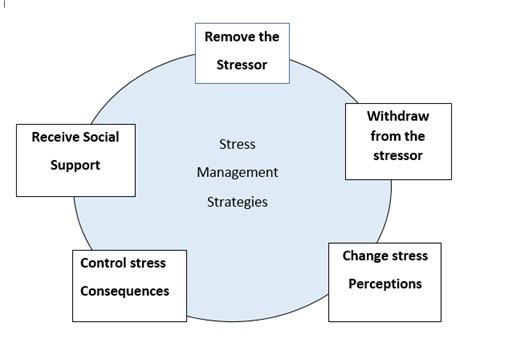
Stress Management: Stress is obvious and employees have to adapt to stress in such a way that they are no longer aware of it. Companies can effectively manage stresses by removing the stressors that cause needless tension and job burnout. Other stress management strategies may keep employees “stress-fit,” but they don’t solve the fundamental causes of stress. Organizations manage stress by investigating the main causes of stress in their workplace. Another suggestion is to change the corporate culture and reward systems so they support a work-life balance and no longer reinforce dysfunctional workaholism. More generally, the most effective ways to remove workplace stressors is to empower employees so that they have more control over their work and work environment. Role-related stressors can be lessened by selecting and assigning employees to positions that match their capabilities. Noise and safety risks are stressful, so improving these conditions would minimize stress in the workplace. Workplace bullying can be minimized through clear guidelines of behaviour and feedback for those who infringe those standards.

Figure: Stress management strategies:

Mangers have important contribution in the identification and intervention of constant workplace stress. Lazarus (1991) has recognized three main strategies for reducing work-related stress. In the first strategy, managers can help their employees to cope up with workplace stress is changing the working conditions so that they are more favourable to effective coping. When barriers are removed such as work overload, environmental annoyances, isolation, and lack of autonomy, an environment is created in which an employee can perform better. The second strategy to reduce work-related stress is to facilitate the employee to improve his or her transaction with the environment. Managers should provide the worker with services such as an employee assistance program or links to stress management resources to help them work through the issues that hamper adequate appraisal of the situation. Moreover, such programs will teach the employee how to utilize behavioural skills such as implementing a new diet, meditation techniques, and relaxation techniques in order to relieve the physical and psychological effects of stress. Usually, these programs will involve cognitive behavioural interventions (Long, 1988). The third strategy is to assist the employee recognizes the stressful relationship between the individual or group and the work setting (Lazarus, 1991) and developing a strategy to help reduce the tension in that affiliation.

To summarize, Stress is an adaptive reaction to a threatening situation that is perceived by person in work setting or in his life. Stressors are the causes of stress and include any environmental conditions that place a physical or emotional demand on the person. Stressors are found in the physical work environment, the employee’s various life roles, interpersonal relations, and organizational activities and conditions. Conflicts between work and non-work obligations are a common source of worker stress. Workplace stress has dangerous consequences on the health of employees such as it can cause significant psychological and physiological problems. Workplace stress has been associated with the aetiology of physical disorders such as heart disease, hypoadrenia, immunosuppression, and chronic pain. Additionally, the psychological impact of workplace stress includes depression, persistent anxiety, pessimism, and resentment.

The impact of these symptoms on organizations is significant as these symptoms lead to antagonism in the workplace, low morale, interpersonal conflict, increased benefit expenses, decreased productivity, and increased absenteeism. To cope up with stressful situation, experts provide various stress management strategies. By providing the foundation for employees to prosper while also allowing employees to take responsibility for their stress related symptoms, organizations will find considerable improvement in productivity and an improved workplace dynamism. Some tactics directly remove superfluous stressors or remove employees from the stressful environment. Other strategies facilitate employees to modify their interpretation of the environment so that it is not viewed as a severe stressor. Wellness programs promote employees to develop better physical defences against stress experiences. Social support provides emotional, informational, and material resource support to safeguard the stress experience.

Detach Involvement Detachment is distancing oneself in order to gain perspective and to expand the context.

The degree of detachment or involvement which is most appropriate will vary during the coaching relationship. It will be for the coach to choose what is most appropriate.

Involvement is the ability to be both mentally and emotionally involved.

Mentally, to ascertain and clarify the facts presented by the client.

Emotionally, being aware of the client’s feelings, which enables empathy, but also to be in touch with his or her own feelings.

Together, they give the coach a fuller grasp of the client’s and their own reality.

A) The inter-personal relationship:

Detached involvement is an indispensable skill of in-depth coaching. It is a skill which can be learned and developed, both by the coach and the client.

Detached involvement ensures that the coach will be present to the client in the most effective way.

It facilitates non-attachment to outcome, which can be a challenging goal for many coaches.

When detached involvement is lacking, the coach’s tendency will be to become over-involved with the client’s story, perhaps lapse into mentoring, offering advice and strategies, and taking too much responsibility for the outcome.

B) The intra-personal relationship:

Who will be making this choice when you are the coach in question?

Where in your personality is your locus of decision-making, of making choices when you are coaching? Which part of you decides?

It is most likely to be the part or parts of you that normally run your life, known as your Primary Selves. Hal and Sidra Stone identified some of the selves in their book, “Embracing your Selves” (1988): the Pleaser, the Perfectionist, the Inner Critic and the Controller. We might add the Hard Worker and the Helper and the Victim to this list.

These sub-selves or sub-personalities sometimes act like the dominant members of a board of directors, who come to meetings with their own agenda and set of priorities based on their point of view. In such cases, the authority of the CEO may be absent or just ignored.

Another analogy would be a kingdom in which the rightful ruler is absent, and the kingdom is actually ruled by the barons. I call this situation the Empty Throne.

C) The inter-functional relationship:

To what extent is detached involvement applicable in the external coach’s relationship with the organisation which has engaged him?

Over-involvement might lead the coach to major on pleasing the coachee’s employer at the coachee’s expense and at the expense of the coach’s integrity.

Over-detachment might lead to the coach following their own agenda at the expense of their relationship with the corporate client.

 So, which part of you will be making these choices?

Our sub-personalities come with their own perspectives, their own priorities and make their choices accordingly.

In order to practice detached involvement successfully, you will need to consciously rise above the level of your sub-personalities and attain your centre, your Conscious Self. If your sub-personalities are the musicians in the orchestra, your Conscious Self is the conductor of the orchestra.

In the previous three scenarios, the coach will need to discern from a clear and stable place.

So, what can we do to arrive at our centre, our Conscious Self?

The applied psychology of Psychosynthesis offers us a technique called the Dis-identifying and Identifying Exercise which helps us to disidentify from the contents of our personality and connect with our deeper centre of identity, our Conscious Self, also known as our “I”.

How do we know when we have attained our “I”?

We typically experience a greater calm, a degree of serenity and balance beyond the daily norm.

A place where clarity and sureness of choice is more available to us.

It is from this place that we can discern most clearly and choose the appropriate levels of detachment and involvement in all the interventions in our coaching practice.

When you practice detached involvement, you’re both a participant and an observer of your life at the same time. You see all experiences as part of life’s journey without judging them as being good or bad. You simply experience them and are in control of your responses to them. You’re fully involved, but detached from the allure of outcomes.

So, how do you learn to practice detached involvement?

  • Take nothing personally
  • Make no assumptions
  • Make as few judgments as possible
  • Let go of the need to be right
  • Let go of the need to control
  • Be passionate about all of life’s experiences, even the painful ones
  • Give all you have, your true gifts, to whatever you’re doing
  • Detach from future potential results

Conflict Management Skill

Conflict management plays a very important role in preventing conflicts among individuals. When individuals strongly oppose each other’s opinions and ideas, the probability of a conflict arises. A conflict starts when individuals think on different lines and find it very difficult to accept each other’s ideas. Conflict must be avoided as it destroys the peace, lowers the productivity as well as demotivates the individuals. All the factors leading to a fight must be explored and efforts must be made to prevent a conflict. A conflict is not very easy to control; an individual needs certain skills for the same.

Let us study the skills in detail.

  1. Effective communication Skills

Effective communication skills are of utmost importance to prevent conflicts. While interacting with others, you have to take special care of your speech and the way you speak. Never ever shout on anyone, even if you do not agree with him. Always speak in a polite but convincing manner. Greet others with a warm smile. It works. Be very specific and precise in your speech. Do not use complicated words and confuse others. Keep a control on your tongue and do not use words which might hurt the sentiments of others. Avoid using abusive languages.

  1. Listening Skills

An individual must not give his expert comments unless and until he is very clear what the other person wants. Always be a good listener. Don’t just jump to conclusions and assume things on your own. Always listen to the other side of the story as well.

  1. Discussion

Don’t just follow the rumor mills blindly, do discuss with others as well. Differences can crop up anytime but fighting would provide no solution. It is always better to sit and discuss the issues on an open forum. All the participants must give their inputs and efforts must be made to find out an alternative. Invite all the members involved and never ignore anyone as it would never solve the problem. Everyone has a right to express his views and a middle way has to be found.

  1. Patience

One needs to be very patient to avoid conflicts. There would be people at your workplace and even home who would try to provoke you to fight. Never ever get influenced. Always follow your instincts and support what is right. Be very sensible and patient. Learn to keep a control on your emotions. Do not ever lose your temper as it would only make the situation worse.

  1. Impartial

An individual has to be impartial to avoid conflicts. Do not always support your friend. Stand by what is correct and never support what is wrong. Any individual, even if he is your friend must be corrected if you feel he is wrong. Listen to everyone and never ignore anyone just because you don’t know him.

  1. Never Criticize

Make the other person understand if he is wrong. Don’t criticize him as it would definitely hurt his sentiments. The other person might not be as intelligent as you are, but you have no right to make fun of him. Others will look up to you if you guide the other person well and make him realize his mistakes.

  1. Positive Attitude

Positive attitude is essential to avoid fights and conflicts. In offices, never ever play the Blame game. No one is perfect and if you have done anything wrong, have the courage to accept it. Human Beings are bound to make mistakes but never try to put the blame on anyone else’s shoulders. Avoid backbiting as it only spoils the relationships. If you don’t agree with anyone’s views, discuss with him on his face, he will like it. Don’t always find faults in others and be a little more adjusting as life is all about adjustments.

  1. Ignore others

Individuals must try to adopt the middle path approach which considers the interests of one and all. Don’t unnecessarily waste your energy for a person who is too adamant and is not willing to compromise at all. Ignore the person who is too demanding as it would solve half of your problems.

Importance of Conflict Management

A conflict arises when individuals have varied interests, opinions and thought processes and are just not willing to compromise with each other. It is always wise to adjust to some extent and try to find a solution to the problem rather than cribbing and fighting. Conflicts and disagreements only lead to negativity and things never reach a conclusion. It only adds on to the tensions and makes life hell. It actually leaves you drained and spoils your reputation. Every individual should try his level best to avoid conflict at the first place rather than resolving it later. Precautions must be taken at the right time to avoid a conflict.

Imagine yourself constantly fighting with your fellow worker. Would you ever feel going to office?

The issues resulting in a conflict must be controlled at the right time to prevent the eruption of a big fight. Conflict management plays an important role everywhere, at work places and even in our personal lives. Fighting never makes anyone happy and actually makes one’s life miserable.

No organization runs for charity, it has to make money to survive well. Employees must give their hundred percent at work to ensure the maximum productivity. Nothing productive will ever come out if the employees are constantly engaged in fighting and criticizing others. Conflict management plays a very important role at workplaces to prevent conflicts and for the employees to concentrate on their work. The team leaders must ensure that the roles and responsibilities of each and every employee are clearly passed on to them. Employees should be demotivated to interfere in each other’s work. Employees waste half of their time and energy in fighting with others and find it very difficult to work which they are actually supposed to do. An individual must enjoy his work; otherwise he would never be able to give his best.

Conflict management goes a long way in strengthening the bond among the employees and half of the problems automatically disappear. Individuals must feel motivated at work and find every single day exciting and challenging. Before implementing any idea, it must be discussed with everyone and no one should ever feel ignored or left out. This way, every employee feels indispensable for the office and he strives hard to live up to the expectations of his fellow workers and in a way contributing to the organization in his best possible way. Conflict management avoids conflicts to a great extent and thus also reduces the stress and tensions of the employees. No one likes to carry his tensions back home and if you fight with your colleagues and other people, you are bound to feel uncomfortable and restless even at home.

Conflict management also plays an important role in our personal lives. Tussles and fights spoil relationships and only increase our list of enemies. Everyone needs friends who will stand by us when we need them. Conflict must be avoided at homes as it spoils the ambience and spreads negativity. Individuals tend to disrespect others as a result of conflicts. Conflict management prevents fall out between family members, friends, relatives and makes life peaceful and stressfree. Blamegame never helps anyone, instead it makes life miserable. No idea can ever be implemented if the individuals fight among themselves.

Conflict management helps to find a middle way, an alternative to any problem and successful implementation of the idea. Problems must be addressed at the right time to prevent conflict and its adverse effects at a later stage. Through conflict management skills, an individual explores all the possible reasons to worry which might later lead to a big problem and tries to resolve it as soon as possible.

Conflict Management is very important because it is always wise to prevent a fight at the first place rather than facing its negative consequencies. Stress disappears, people feel motivated, happy and the world definitely becomes a much better place to stay as a result of conflict management.

Change, Meaning, Importance, Types, Nature of Planned Change, Factors Influencing Change, Change Process

Change refers to the process of making things different from their current state, whether in personal life, society, or organizations. It involves a shift in structure, processes, technology, strategies, or behavior to adapt to evolving circumstances. In organizational terms, change means moving from an existing way of working to a new and improved method that better meets goals and challenges. It can be planned or unplanned, gradual or sudden, and may arise due to internal factors like innovation, leadership, or workforce needs, or external forces such as competition, globalization, and government regulations. Change is necessary for growth, development, and survival, as it helps organizations remain flexible and competitive. Ultimately, change signifies progress, improvement, and the continuous journey of adaptation to new realities.

Importance of Planned Change:

  • Ensures Smooth Transition

Planned change allows organizations to move from the current state to a desired future state in a systematic manner. By identifying objectives, creating strategies, and preparing employees in advance, it minimizes disruptions to daily operations. A smooth transition helps avoid confusion, reduces resistance, and maintains productivity during change initiatives.

  • Reduces Resistance

When change is planned, employees are informed about the purpose, benefits, and process of the transformation. This open communication builds trust and reduces fear of the unknown. Involving employees in planning makes them feel valued, lowering resistance and increasing acceptance of new practices, systems, or organizational structures.

  • Aligns with Organizational Goals

Planned change ensures that transformations are strategically aligned with long-term goals and visions. By carefully analyzing current challenges and future opportunities, leaders implement changes that contribute to competitiveness, efficiency, and sustainability. This alignment helps organizations stay focused, innovative, and better prepared for external pressures like competition and technology.

  • Improves Efficiency and Productivity

Planned change enables organizations to adopt new technologies, processes, and methods in a structured way. By analyzing inefficiencies in advance, management can redesign workflows and allocate resources more effectively. Employees receive training and support, which reduces errors and increases confidence in using new systems. This leads to higher productivity, better time management, and cost savings. A planned approach also ensures that improvements are measurable and continuously monitored, creating a culture of accountability and performance.

  • Builds Competitive Advantage

Organizations operate in a dynamic environment where survival depends on adaptability. Planned change helps businesses stay ahead by anticipating market shifts, customer demands, and technological innovations. Instead of reacting under pressure, organizations proactively design strategies that give them an edge over competitors. Employees become more innovative and adaptive, contributing to long-term sustainability. By planning change, organizations can maintain stability while embracing new opportunities, ensuring growth, profitability, and relevance in the industry.

Types of Planned Change:

  • Strategic Change

Strategic change refers to long-term, organization-wide transformation aimed at achieving business objectives and sustaining competitiveness. It involves major decisions related to vision, mission, restructuring, mergers, acquisitions, or diversification. Strategic change ensures alignment with the external environment, such as market shifts, technological innovations, or policy changes. It requires strong leadership, careful planning, and commitment from top management, as it directly impacts the direction of the organization. Since it influences culture, structure, and processes, employees must be prepared and guided to adapt. Strategic planned change is essential for survival, growth, and maintaining long-term competitive advantage in dynamic markets.

  • Structural Change

Structural change focuses on modifying the organizational design, hierarchy, roles, responsibilities, and reporting relationships. It aims to improve efficiency, communication, and decision-making by redefining how departments and teams function. Structural planned change may include decentralization, departmental restructuring, flattening hierarchies, or adopting a matrix structure. Such changes are often necessary when an organization grows in size, diversifies operations, or adopts new business models. By restructuring, organizations eliminate duplication, improve coordination, and enhance accountability. Structural change helps align organizational design with strategic goals, ensuring smoother workflow and better adaptability to new challenges in a competitive environment.

  • Technological Change

Technological change involves introducing new tools, systems, software, or machinery to improve efficiency and productivity. It may include automation, artificial intelligence, digital platforms, or upgraded production equipment. Technological planned change is vital for organizations to remain competitive in today’s fast-paced environment. It enhances speed, accuracy, and cost-effectiveness, but often requires employee training and skill development. Resistance is common due to fear of job loss or lack of technical expertise, so proper communication and support are essential. By planning technological changes, organizations ensure smoother adoption, minimize disruption, and stay innovative in delivering better products and services.

  • PeopleCentric Change

People-centric change focuses on improving the behavior, attitudes, and skills of employees. It involves training, leadership development, team building, motivation, and cultural transformation. Since employees are the backbone of organizational success, this type of change ensures they are aligned with new goals and practices. It addresses issues like resistance, communication gaps, and low morale by fostering trust and participation. People-centric planned change enhances adaptability, collaboration, and job satisfaction. By investing in human capital, organizations can create a positive work environment where employees feel empowered and motivated to embrace changes that contribute to overall growth and performance.

Nature of Planned Change:

  • GoalOriented

Planned change is always directed toward achieving specific organizational objectives. It is not random but carefully designed to bring improvement in productivity, efficiency, and competitiveness. Management identifies clear goals, such as adopting new technology, restructuring processes, or enhancing employee performance. Every step of planned change revolves around these targets, ensuring that efforts lead to measurable outcomes. Goal orientation provides direction, reduces wastage of resources, and keeps employees focused on common objectives. This nature of planned change ensures that organizational transformation is purposeful, consistent with long-term strategy, and contributes directly to overall growth and success.

  • Systematic Process

Planned change follows a structured, step-by-step process rather than sudden or unorganized actions. It begins with analyzing the need for change, setting objectives, preparing strategies, implementing actions, and monitoring results. Each stage is carefully designed to ensure smooth transition and minimal disruption. Unlike unplanned change, which is reactive, planned change is proactive and anticipates future requirements. This systematic nature helps organizations manage complexities effectively and reduces uncertainties. It ensures that change efforts are logical, consistent, and easier for employees to understand, thereby increasing acceptance and reducing resistance.

  • FutureOriented

Planned change is focused on preparing the organization for future challenges and opportunities. It anticipates shifts in technology, customer preferences, competition, and regulations. By implementing forward-looking strategies, organizations ensure sustainability and growth. This future orientation makes planned change proactive rather than reactive, allowing businesses to stay ahead of competitors. It encourages innovation, adaptability, and continuous improvement. Employees are guided toward developing skills required for tomorrow’s environment. Thus, the future-oriented nature of planned change ensures organizations remain relevant, resilient, and capable of handling uncertainties in a dynamic business world.

  • Continuous in Nature

Planned change is not a one-time event but a continuous and ongoing process. Organizations operate in an ever-changing environment, where new challenges and opportunities arise regularly. Planned change ensures that adaptation becomes a constant activity rather than an occasional reaction. It emphasizes continuous improvement through monitoring, feedback, and adjustment of strategies. By being continuous, it fosters a culture of learning, innovation, and flexibility. Employees become more open to transformation, reducing fear of change. This nature of planned change ensures organizations remain dynamic, competitive, and better positioned to achieve long-term stability and success.

  • Involves Participation

Planned change requires the active involvement and participation of employees at all levels. It is not limited to top management decisions but includes engaging workers in discussions, planning, and implementation. Participation creates a sense of ownership, reducing resistance and increasing motivation. Employees feel valued and become more committed to achieving desired outcomes. This collaborative nature improves communication, trust, and team spirit. When people contribute ideas and feedback, organizations gain diverse perspectives, making change strategies more effective. Thus, the participative nature of planned change ensures smoother execution and greater acceptance of organizational transformation.

Factors Influencing Change:

  • Organizational Culture

Organizational culture shapes employee attitudes, values, and behavior, influencing how change is perceived and accepted. A flexible, innovative culture supports adaptation, while a rigid, hierarchical culture may resist change. The shared beliefs, norms, and traditions determine openness to new ideas. Leaders must assess the existing culture before implementing changes. Aligning change initiatives with cultural values and promoting awareness, participation, and communication can facilitate smoother adoption and reduce resistance, making culture a critical factor in successful organizational transformation.

  • Leadership Style

Leadership style significantly impacts how change is introduced and managed. Transformational and participative leaders inspire trust, motivate employees, and encourage engagement, easing adoption of new processes. Autocratic or unsupportive leadership often leads to fear, resistance, or confusion. Leaders influence employee perception by modeling desired behavior, communicating vision, and providing guidance. Effective leadership ensures alignment between organizational goals and employee actions. Choosing the right leadership approach is crucial for guiding teams through change, minimizing resistance, and fostering commitment to achieving planned outcomes.

  • Technology Advancements

Technological advancements often drive change within organizations, requiring updates to processes, systems, and skills. Adoption of new technology can improve efficiency, accuracy, and competitiveness, but may face resistance due to fear of job loss or skill gaps. Organizations must provide training, support, and resources to facilitate smooth transitions. The pace, complexity, and relevance of technology influence how quickly employees accept changes. Ensuring that technology aligns with organizational goals and capabilities determines its successful implementation as a driver of planned change.

  • Economic Factors

Economic conditions, such as inflation, recession, or growth, influence organizational change. Companies may need to restructure, reduce costs, or invest in expansion based on economic trends. Budget constraints, market competition, and resource availability shape the scale and pace of change initiatives. Economic pressures can create urgency but also resistance if employees fear layoffs or reduced benefits. Effective planning requires understanding economic conditions, anticipating challenges, and balancing organizational objectives with financial realities to ensure sustainable and feasible change.

  • Political and Legal Factors

Government regulations, policies, and political stability affect organizational change. Compliance with labor laws, environmental standards, taxation, and trade policies may require structural, procedural, or strategic adjustments. Political uncertainties or sudden policy shifts can create risk and resistance within organizations. Change initiatives must consider legal requirements and political contexts to avoid penalties and maintain operational continuity. Organizations that proactively anticipate legal and regulatory influences can implement smoother transitions while protecting employees, resources, and long-term business objectives.

  • Social and Cultural Factors

Societal values, cultural norms, and demographic trends influence how change is accepted within organizations. Employee beliefs, traditions, and social expectations shape attitudes toward new policies, practices, or technology. Misalignment with social or cultural norms can lead to resistance and misunderstanding. Organizations must respect diversity, promote inclusion, and adapt communication strategies to cultural sensitivities. Understanding social and cultural factors ensures that planned changes are relevant, acceptable, and supported, enhancing employee engagement and the effectiveness of organizational transformation.

  • Internal Organizational Factors

Internal factors such as structure, resources, employee skills, and operational efficiency directly affect change. For example, lack of expertise, poor coordination, or inadequate infrastructure can hinder implementation. Internal communication, teamwork, and employee readiness also determine success. Managers must assess strengths and weaknesses, allocate resources effectively, and provide necessary training to ensure smooth transitions. By addressing internal factors, organizations can minimize resistance, reduce disruptions, and increase the likelihood of achieving planned outcomes, making these elements critical in the success of any change initiative.

Process of Planned Change:

  • Recognizing the Need for Change

The first step in planned change is identifying the need for transformation. Organizations must assess internal inefficiencies, declining performance, or employee dissatisfaction, as well as external pressures such as competition, technological advances, or regulatory changes. Recognition involves careful observation, data analysis, and feedback from stakeholders. Without acknowledging the need for change, organizations remain stagnant, risking loss of market relevance. Managers must clearly define the problem and its impact to create urgency. Recognizing the need sets the foundation for all subsequent steps and ensures that change initiatives are purposeful, focused, and aligned with organizational objectives.

  • Setting Objectives and Goals

Once the need for change is identified, clear objectives and goals must be established. These goals provide direction and benchmarks for measuring success. Objectives should be specific, measurable, achievable, relevant, and time-bound (SMART). For example, implementing a new software system may aim to reduce process time by 20% within six months. Clear goals help employees understand the purpose of change and their role in achieving it. They also allow managers to monitor progress and make necessary adjustments. Well-defined objectives reduce confusion, increase commitment, and ensure the change initiative is aligned with organizational strategy and desired outcomes.

  • Planning and Designing the Change

This step involves developing a detailed strategy to implement the change. Planning includes identifying resources, timelines, tasks, roles, and responsibilities. Managers must anticipate potential challenges, risks, and employee resistance, designing strategies to address them. The plan should outline communication methods, training requirements, and feedback mechanisms to ensure smooth execution. Effective design ensures that the change is structured, coordinated, and aligns with organizational goals. Planning also includes establishing metrics for evaluation. By creating a comprehensive blueprint, organizations can minimize disruption, allocate resources efficiently, and ensure all stakeholders are prepared and aware of their responsibilities throughout the change process.

  • Implementing the Change

Implementation is the stage where planned strategies are put into action. Employees are trained, new processes or systems are introduced, and communication channels are actively used to guide the transition. Managers must monitor progress, provide support, and address resistance promptly. Successful implementation requires coordination among departments, adherence to timelines, and reinforcement of desired behaviors. During this phase, leadership plays a crucial role in motivating employees, resolving conflicts, and maintaining focus on objectives. Careful monitoring ensures that the change is adopted effectively, minimizing disruption to operations while maximizing engagement and acceptance across the organization.

  • Monitoring and Evaluating the Change

The final step involves assessing the effectiveness of the change process. Managers must measure outcomes against the defined objectives using performance indicators, feedback, and data analysis. Monitoring identifies gaps, challenges, or unintended consequences that need correction. Evaluation helps determine whether goals were achieved, resources were used efficiently, and employees adapted successfully. Continuous feedback allows for refinement and improvement, reinforcing positive behaviors. By monitoring and evaluating, organizations ensure sustainability and prevent regression to old practices. This step also provides learning for future change initiatives, enhancing the organization’s capacity for adaptation, innovation, and long-term growth.

Functional Strategies, Features, Importance, Challenges

Functional Strategies refer to the specific tactics and actions developed by various departments within an organization to support overarching business strategies and objectives. Each functional area—such as marketing, finance, human resources, operations, and information technology—crafts its strategy to optimize performance and contribute to the company’s goals. These strategies are tailored to the unique capabilities, processes, and needs of each function and are crucial for the efficient allocation of resources, coordination of activities, and achievement of competitive advantage. Effective functional strategies ensure that each department aligns with the broader strategic vision of the organization, creating synergy and improving overall operational effectiveness to maximize business success and sustainability.

Features of Functional Strategies:

  • Specificity:

Functional strategies are detailed and tailored to address the unique challenges and opportunities within a specific department such as marketing, finance, operations, or human resources.

  • Alignment:

They are designed to align with the overall corporate strategy, ensuring that each functional area contributes effectively to the overarching goals of the organization.

  • Resource Allocation:

Functional strategies involve specific plans for allocating resources within a department to maximize efficiency and effectiveness in achieving set objectives.

  • Goal-Oriented:

These strategies are goal-oriented, focused on achieving specific outcomes that contribute to the success of the entire organization.

  • Measurability:

They include measurable targets and key performance indicators (KPIs) that help assess the performance of each functional area and its impact on the organization’s success.

  • Adaptability:

Functional strategies are flexible, allowing departments to adapt to changes in the external environment, including market conditions, technology, and regulatory changes.

  • Integration:

Effective functional strategies are integrated with each other, ensuring that the activities of different departments are coordinated and mutually supportive, avoiding silos within the organization.

  • Competitive Advantage:

They are often designed to leverage the strengths and core competencies of a functional area to provide a competitive advantage, such as innovation in product development or excellence in customer service.

Importance of Functional Strategies:

  • Enhanced Coordination:

Functional strategies help coordinate activities within individual departments and ensure that these activities are aligned with the broader strategic goals of the organization, leading to more cohesive and effective operations.

  • Resource Optimization:

They facilitate the optimal use of resources within each department, ensuring that resources such as time, money, and personnel are utilized efficiently and effectively to achieve specific functional goals.

  • Goal Achievement:

Functional strategies are essential for translating high-level organizational goals into actionable plans within each department, which helps in achieving specific and measurable outcomes that contribute to the overall success of the business.

  • Improves Accountability:

By setting specific objectives for each department, functional strategies improve accountability by making it easier to track performance and hold individual departments responsible for their results.

  • Increases Adaptability:

They allow departments to quickly adapt to changes in the market or industry by having strategies that are tailored to the specific dynamics and challenges faced by each functional area.

  • Supports Innovation:

Functional strategies can foster innovation by encouraging departments to develop creative solutions and improvements within their specific areas of expertise, thus contributing to competitive advantage.

  • Enhances Communication:

Clear functional strategies improve communication within and across departments by defining clear roles, responsibilities, and expectations, which helps in reducing conflicts and enhancing synergy.

  • Drives Competitive Advantage:

By maximizing the efficiency and effectiveness of each department, functional strategies contribute to building and sustaining a competitive advantage. For example, a cutting-edge marketing strategy can help capture greater market share, while an innovative R&D strategy can lead to the development of unique products.

Challenges of Functional Strategies:

  • Alignment with Corporate Strategy:

One of the primary challenges is ensuring that functional strategies align well with the overall corporate strategy. Misalignment can lead to efforts that do not support or even contradict other organizational goals.

  • Resource Constraints:

Functional areas often compete for limited resources, such as budget, personnel, and technology. Balancing these resources effectively across various departments can be challenging and may impact the effectiveness of functional strategies.

  • Interdepartmental Coordination:

Ensuring coordination and cooperation among different functional areas can be difficult. Lack of coordination can lead to silos that hinder information sharing and collaborative problem-solving.

  • Adaptability to Change:

External changes such as market dynamics, economic conditions, and technological advancements require functional strategies to be flexible. Adapting strategies in response to these changes can be challenging, particularly in larger, less agile organizations.

  • Measuring Performance:

Developing clear, measurable KPIs that accurately reflect the performance of functional strategies can be complex. Without precise metrics, assessing effectiveness and making informed decisions becomes problematic.

  • Skill Gaps:

Effective implementation of functional strategies often requires specific skills and expertise. Skill gaps within teams can lead to suboptimal execution of these strategies.

  • Cultural Fit:

Functional strategies must fit within the organizational culture to be effective. Strategies that clash with the established culture may face resistance, reducing their effectiveness or leading to failure.

  • Innovation Constraints:

While functional strategies aim to optimize current operations, they can sometimes constrain innovation by focusing too heavily on refining existing processes and products. Balancing operational excellence with innovation is a significant challenge.

Strategy Evaluation and Strategy Control

Strategy Evaluation is a crucial phase in the strategic management process where the effectiveness of a strategic plan is assessed. This involves systematically analyzing the performance of implemented strategies to determine their success in achieving organizational goals. The evaluation process includes monitoring ongoing performance, comparing actual outcomes against predefined objectives, and identifying deviations. It also entails assessing the relevance of the current strategy in the face of evolving external and internal conditions. Strategy evaluation helps organizations to understand whether strategic choices are delivering the desired results, and it provides the basis for necessary adjustments. Effective strategy evaluation ensures that an organization remains aligned with its objectives and can adapt to changing circumstances, thereby maintaining competitiveness and sustainability.

Nature of Strategy evaluation:

  • Continuous Process:

Strategy evaluation is not a one-time activity but a continuous process that occurs throughout the implementation of a strategy. It requires regular monitoring and assessment to ensure that strategies are responsive to changes in the internal and external environment.

  • Multidimensional:

The evaluation involves assessing multiple dimensions of performance, including financial results, market share, customer satisfaction, and internal operational efficiency. This comprehensive approach helps in understanding the overall impact of the strategy.

  • Objective and Systematic:

Effective strategy evaluation must be objective, relying on measurable data to assess performance. It should be systematically integrated into the strategic management process, with clear criteria and methodologies for assessment to avoid biases and ensure consistency.

  • Forward-Looking:

While it often reviews past and current performance, strategy evaluation is also forward-looking. It involves forecasting and scenario planning to anticipate future challenges and opportunities, allowing organizations to proactively adjust their strategies.

  • Adaptive:

Strategy evaluation must be adaptive, offering the flexibility to modify strategies as needed. This adaptiveness is crucial in today’s fast-paced business environments where internal and external factors can change rapidly.

  • Integrated with Decision-Making:

The insights gained from strategy evaluation should directly influence decision-making processes. This integration ensures that strategic adjustments are informed by concrete evaluation data, leading to better-aligned and more effective strategic moves.

Importance of Strategy evaluation:

  • Performance Assessment:

Strategy evaluation allows organizations to assess whether strategic initiatives are meeting their intended goals. It provides metrics and feedback on the effectiveness of strategies in real time, helping managers understand where they are succeeding and where improvements are needed.

  • Adaptability:

In today’s fast-changing business environment, the ability to adapt strategies based on performance and changing conditions is crucial. Strategy evaluation provides the data necessary to make informed decisions that can pivot or redirect resources as needed.

  • Resource Allocation:

Effective strategy evaluation helps ensure that resources are being used efficiently. By regularly assessing the outcomes of strategy implementation, organizations can optimize the use of their resources, reallocating them from underperforming areas to those with greater potential.

  • Risk Management:

It helps in identifying risk factors in strategies and their implementation. Early detection of potential risks allows organizations to take corrective actions proactively, thereby mitigating losses and leveraging opportunities more effectively.

  • Alignment with Objectives:

Regular evaluation helps maintain alignment between the strategy and the organization’s long-term objectives. It ensures that all strategic activities contribute towards the overarching goals, and adjustments can be made to keep efforts on track.

  • Feedback Loop:

Strategy evaluation establishes a critical feedback loop for continuous improvement. Feedback from the evaluation phase is essential for refining strategies, enhancing processes, and improving outcomes over time.

  • Organizational Learning:

It facilitates organizational learning by documenting successes and failures. This learning contributes to better strategic planning in the future as insights are gathered on what works and what doesn’t.

  • Stakeholder Confidence:

Regular and transparent evaluation processes improve credibility and stakeholder confidence. Investors, management, and other stakeholders are more likely to support an organization that actively evaluates and adapts its strategies based on solid data.

Strategy Control

Strategy Control is the systematic process used by organizations to monitor and regulate the implementation of their strategies to ensure that strategic objectives are being met effectively and efficiently. It involves the ongoing assessment of performance against established goals and the external environment to identify any deviations or operational setbacks. Strategy control allows for corrective actions to be taken when performance does not align with expectations. This control process is essential for adapting strategies in response to changes in market conditions, competitive dynamics, or internal organizational shifts. By providing a mechanism for continuous feedback and adjustment, strategy control ensures that an organization remains on track towards achieving its strategic goals, thus enhancing overall strategic management and organizational resilience.

Nature of Strategy Control:

  • Integrative:

Strategy control integrates with all levels of strategic planning and implementation. It connects long-term objectives with operational activities and aligns them to ensure that every action contributes toward achieving strategic goals.

  • Dynamic:

It is dynamic and adapts to changes in the internal and external environments. As market conditions, competitive landscapes, and organizational capacities evolve, strategy control mechanisms help managers adjust their strategies in real-time to stay relevant and effective.

  • Continuous Process:

Strategy control is not episodic; it is a continuous process that happens throughout the lifecycle of a strategy. It involves regular monitoring and revising of strategies to ensure that they are effective under current circumstances.

  • Preventive and Corrective:

It serves both preventive and corrective functions. Preventive controls are designed to anticipate and mitigate potential deviations before they occur, while corrective controls are implemented to adjust strategies after deviations have been identified.

  • Feedback-Oriented:

Central to strategy control is the use of feedback. This feedback, derived from various performance metrics, allows organizations to evaluate their progress against set benchmarks and make necessary adjustments.

  • Decision Supportive:

Strategy control provides essential information that supports strategic decision-making. By assessing performance and identifying trends and anomalies, it guides leaders in making informed decisions about future strategic directions or necessary adjustments to current strategies.

Importance of Strategy Control:

  • Ensures Alignment with Objectives:

Strategy control is crucial for ensuring that all actions and initiatives within the organization remain aligned with the strategic objectives. It helps in monitoring whether the activities at different levels of the organization contribute towards the overall goals.

  • Adaptability to Environmental Changes:

The business environment is dynamic, with frequent changes in market conditions, competition, regulations, and technology. Strategy control allows organizations to respond to these changes promptly by adjusting strategies in a timely manner to maintain competitiveness and relevance.

  • Optimizes Resource Utilization:

Effective strategy control helps in ensuring that resources are not wasted on non-productive or less effective activities. It aids in optimizing the allocation and use of resources (financial, human, and operational) to enhance efficiency and effectiveness.

  • Mitigates Risks:

By continuously monitoring progress and performance, strategy control helps identify potential risks and issues before they become significant problems. This proactive approach allows organizations to implement corrective measures early, thereby reducing potential losses and taking advantage of emerging opportunities.

  • Facilitates Decision Making:

Strategy control provides management with critical feedback based on performance data. This feedback is integral for making informed decisions regarding the continuation, modification, or termination of strategies based on their effectiveness and efficiency.

  • Improves Organizational Learning and Development:

Through continuous monitoring and evaluation, strategy control contributes to organizational learning by highlighting what is working well and what is not. This process encourages a culture of continuous improvement and helps build a knowledge base that can influence future strategies.

Key differences between Strategy evaluation and Strategy Control

Aspect Strategy Evaluation Strategy Control
Purpose Assess effectiveness Ensure alignment
Focus Outcome analysis Process monitoring
Timing Periodic Continuous
Orientation Retrospective Proactive and corrective
Primary Role Judgment Adjustment
Scope Broader assessment Specific performance checks
Feedback Type Strategic insights Operational feedback
Outcome Decision-making support Performance alignment
Decision Influence Strategic redirection Tactical adjustments
Typical Tools SWOT, KPI analysis Dashboards, real-time alerts
Information Flow Often top-down Both top-down and bottom-up
Implementation Analytical and reflective Dynamic and directive

International Trade Laws Objectives Set 2

  1. The exchange of goods and services are known as …………………………
  • Domestic Trade
  • International Trade
  • Trade
  • None of these.


  1. Which of the following is not considered as factors of production?
  • Land
  • Labour
  • Money
  • Capital


  1. Trade between two countries is known as ………….
  • External
  • Internal
  • Inter-regional
  • None of Above


  1. International Trade is most likely to generate short-term unemployment in:
  • Industries in which there are neither imports nor exports
  • Import-competing industries
  • Industries that sell to domestic and foreign buyers.
  • Industries that sell to only foreign buyers


  1. Free traders maintain that an open economy is advantageous in that it provides all the following except:
  • Increased competition for world producers
  • A wider selection of products for consumers
  • Relatively high wage levels for all domestic workers
  • The utilization of the most efficient production methods


  1. Which of the following is not a benefit of international trade?
  • Lower domestic prices
  • Development of more efficient methods and new products
  • A greater range of consumption choices
  • High wage levels for all domestic workers


  1. Which is not an advantage of international trade:
  • Export of surplus production
  • Import of defence material
  • Dependence on foreign countries
  • Availability of cheap raw material


  1. Trade between two countries can be useful if cost ratios of goods are …………..
  • Equal
  • Different
  • Undetermined
  • Decreasing


  1. Foreign trade creates among countries ………………
  • Conflicts
  • Cooperation
  • Hatred
  • Both a. and b.


  1. All are advantages of foreign trade except ………….
  • People get foreign exchange
  • Cheaper goods
  • Nations compete
  • Optimum utilization of countries’ resources


Q.2. Fill in the blanks.

  1. International Trade means trade between …………………. (Provinces/ Countries/ Regions)
  2. Two countries can give from foreign trade if ………… are different. (Effect/ Tariff/ Cost)
  3. ………….. encourages trade between two countries. (Different tax system/Reduced tariffs/ National currencies)
  4. Drawback of protection system is ……… (Consumers have to pay higher prices/ Producers get higher profits/ Quality of goods may be affected/ All above)
  5. ………….. is a drawback of free trade. (Prices of local goods rise/ Govt. looses incomes from custom duties/National resources are underutilized)
  6. International trade is possible primarily through specialization in production of …… goods. (All/ One/ Few)
  7. A country that does not trade with other countries is called …… country. (Developed/ Closed/ Independent)
  8. Policy of Protection in trade ……… (Facilitates trade/ Protects foreign producers/ Protects local producers/ Protects exporters)
  9. The largest item of Indian import list is ……….. (Consumer goods/ Machinery/ Petroleum/ Computers)
  10. Trade between two states in an economy is known as …… (External/ Internal/None)


SET 2

Q.1. Multiple Choice Questions.

  1. Who among the following enunciated the concept of single factoral terms of trade?
  • Jacob Viner
  • G.S.Donens
  • Taussig
  • J.S.Mill


  1. ‘Infant industry argument’ in international trade is given in support of:
  • Granting Protection
  • Free trade
  • Encouragement to export oriented small and tiny industries
  • None of the above


  1. Terms of trade that relate to the Real Ratio of international exchange between commodities is called:
  • Real cost terms of trade
  • Commodity terms of trade
  • Income terms of trade
  • Utility terms of trade


  1. The main advantage in specialization results from:
  • Economies of large-scale production
  • The specializing country behaving as monopoly.
  • Smaller Production runs resulting in lower unit costs.
  • High wages paid to foreign workers.


  1. Net export equals ……
  • Export * Import
  • Export + Import
  • Export – Import
  • Exports of service only


  1. A tariff ………………….
  • Increase the volume of trade
  • Reduces the volume of trade
  • Has no effect on volume of trade
  • Both a. and c.


7. Terms of Trade of developing countries are generally unfavourable because …….

  • They export primary goods
  • They import value added goods
  • They export few goods
  • Both a. and b.


  1. Terms of Trade a country show ……………
  • Ratio of goods exported and imported
  • Ratio of import duties
  • Ratio of prices of exports and imports
  • Both a. and c.


  1. Terms of trade between two countries refer to a ratio of …..
  • Export prices to import prices
  • Currency values
  • Export to import
  • Balance of trade to Balance of payments


10. Rich countries have deficit in their balance of payments ……..

  • Sometimes
  • Never
  • Alternate years
  • Always


Q.2. Fill in the blanks.

  1. BOP means balance of Receipts and payments of …… (all banks/ State bank/ Foreign exchange by a country/ Government)
  2. Favourable trade means exports are ……. than imports. (More/ Less/ Neutral)
  3. Net barter terms of trade is also known as …. Terms of trade.(Commodity/ Income/Utility)
  4. ….. is not a factor affecting TOT. (Reciprocal demand/ Size of demand/ Price of demand)
  5. If tariff is higher, then the imports will …… (Increase/ Decrease/ Same as before)
  6. ……. has given the concept of reciprocal demand. (Mills/ Adam/ Ricardo)
  7. ……… is the curve, which expresses the total demand for one good (imports) in terms of the total supply of another good (exports). (Offer/ Official / Corporate)
  8. Balance of payment is prepared by an economy ……. (Yearly/ Monthly/ Weekly)
  9. …….. kinds of accounts are included in BOP. (2/ 3/4)
  10. …….is not a type of disequilibrium in BOP. (Cyclical/ Seasonal/ Frictional/ Disguised)


SET 3

Q.1. Multiple Choice Questions.

  1. The first classical theory of International Trade is given by …………………..
  • Keynes
  • Adam Smith
  • Friedman
  • Heckscher-Ohlin


  1. In classical theory of International Trade, the exchange of goods and services takes on the basis of ………….. system?
  • Barter
  • Money
  • Labour
  • capital


  1. If capital is available in large proportion and labour is less, then that economy is known as ……………..
  • Capital Intensive
  • Labour Intensive
  • Both a. and b
  • None of above


  1. In Heckscher Ohlin theory, what is assumed to be same across the countries?
  • Transportation cost
  • Technology
  • Labour
  • capital


  1. Opportunity cost is also known as ……………………
  • Next Best alternative
  • Transformation cost
  • Both a. and b
  • None of above.


  1. Factor proportions theory is also known as the
  • comparative advantage theory
  • laissez faire theorem.
  • HeckscherOhlin theorem
  • product cycle model.


  1. Trade between two countries can be useful if cost ratios of goods are:
  • Equal
  • Different
  • Undetermined
  • Decreasing


  1. According to Hecksher and Ohlin basic cause of international trade is:
  • Difference in factor endowments
  • Difference in markets
  • Difference in political systems
  • Difference in ideology


  1. The theory explaining trade between two countries is called:
  • Comparative disadvantage theory
  • Comparative cost theory
  • Comparative trade theory
  • None of the above


  1. David Ricardo presented the theory of international trade called:
  • Theory of absolute advantage
  • Theory of comparative advantage
  • Theory of equal advantage.
  • Theory of total advantage


Q.2. True or False.

  1. Absolute advantage theory is given by Adam Smith.

True

  1. Ricardo has supplemented Absolute advantage theory.

 True

  1. Heckscher and Ohlin have given comparative cost advantage theory of International Trade.

False

  1. Multilateral trade means one country comes into trade with more than one country.

True

  1. Opportunity cost means unforgiving cost.

False

  1. Modern theory of International Trade is given by Ricardo.

False

  1. 2×2×2 model of International Trade is known by Heckscher Ohlin model.

True

  1. Transformation cost is also known as opportunity cost.

True

  1. Gravity model of trade was first used by Jan Tinbergen.

True

  1. Adam Smith advocated free trade and specialized.

True


Set 4

Multiple Choice Questions.

  1. GATT was made in the year ………………..
  • 1945
  • 1947
  • 1950
  • 1951


  1. The new world Trade organization WTO., which replaced the GATT came into effect from____
  • 1ST January 1991
  • 1st January 1995
  • 1st April 1994
  • 1st May 1995


  1. 5 banks of BRICS nations have agreed to establish credit lines in ….. currencies.
  • Legal
  • Plastic
  • Crypto currency
  • National


  1. Where was the 11th meeting of BRICS Trade Ministers held from 13 Nov 2019 – 14 Nov 2019?
  • Shanghai
  • Beijing
  • Tokyo
  • Brasilia


  1. What is the name of the SAARC satellite to be launched on May 5, 2017?
  • South Asia Satellite
  • South Asian Association Satellite
  • South East Asia satellite
  • SAARC satellite


  1. Full form of SAFTA is ……………………..
  • South Asia Free Trade Agreement
  • South Asia Foreign Trade Agreement
  • South Asia Framework Trade Agreement
  • Both a and b

6. Which of the following commitments has not been made by India to WTO?

  • Reduction in tariffs
  • Increase in quantitative restrictions
  • Increase in qualitative restrictions
  • Trade related Intellectual Property Rights


  1. The European Union was formally established on …..
  • November, 1993
  • April, 1995
  • January, 1997
  • May, 1996


8. SAARC was established in …..

  • 1980
  • 1985
  • 1990
  • 1995


  1. NAFTA came into effect in …..
  • 1990
  • 1994
  • 1998
  • 2004

10. The dominant member state of OPEC is ……………..

  • Iran
  • Iraq
  • Kuwait
  • Saudi Arabia


Q.2. Fill in the blanks.

  1. Headquarter of WTO is in ………….. Geneva/USA/Germany.
  2. Before WTO, ……………… was working instead of that. GATY/ GATR/ GATT.
  3. …………….. round negotiations initiated the establishment of WTO. Uruguay/ Urdun/ Urbuny .
  4. India had joined WTO in the year …………. (1995/ 1996/ 1997)
  5. In …………….. , SAARC was established. (1985/ 1986/ 1987)
  6. The first SAARC summit was organized at …….. (Dhaka/ Kathmandu/ Nepal)
  7. ……..is not a country in SAFTA. (India/ Nepal/ Pakistan/ USA)
  8. ……… countries are member of OECD. (34/ 35/ 36)
  9. ………… is not a country under OECD. (Norway/ Canada/ China)
  10. ………….. are the member states of European Union. (28/ 29/30)
error: Content is protected !!