Financial Goals and Planning

Setting short-term, midterm, and long-term financial goals is an important step toward becoming financially secure. If you aren’t working toward anything specific, you’re likely to spend more than you should. You’ll then come up short when you need money for unexpected bills, not to mention when you want to retire. You might get stuck in a vicious cycle of credit card debt and feel like you never have enough cash to get properly insured, leaving you more vulnerable than you need to be to handle some of life’s major risks.

Financial Goal planning refers to setting financial goals and developing plans to achieve them. Your financial goals can be short-term, medium-term, or long-term. Short-term goals can be achieved within a span of one to three years. Examples are building an emergency fund or investing for a vacation. The medium-term financial goals could be buying a car or an SUV.

The long-term financial goals usually take a longer span of 10-15 years or even more. Examples are planning for retirement, buying a home, or saving for your child’s education and marriage. You must always invest for your financial goals based on the time horizon and risk profile.

Financial goals such as children’s marriage, buying a house, or a car are high-value goals. You must plan and invest your money to achieve these goals over a longer period of time. Financial goal planning helps you decide where to put your money. You can select the best investments based on your risk appetite and stay on track to achieve your financial goals.

Financial goal planning helps you to get more organised with your money. For example, you would have to cut down on excessive spending to achieve a financial goal such as saving for your children’s higher education.

Annual financial planning gives you an opportunity to formally review your goals, update them, and review your progress since last year. If you’ve never set goals before, take the opportunity to formulate them so you can get or stay on firm financial footing. Here are goals, from near-term to distant, that financial experts recommend setting to help you learn to live comfortably within your means, reduce your money troubles, and save for retirement.

Short-Term Financial Goals

Setting short-term financial goals can give you the confidence boost and foundational knowledge you need to achieve larger goals that will take more time. These first steps are relatively easy to achieve. Though you can’t make $1 million appear in your retirement account right now, you can sit down and create a budget in a few hours, and many people may be able to save up a decent emergency fund in a year. Here are some key short-term financial goals that will start helping right away and get you on track to achieving longer-term goals.

Create an emergency fund

An emergency fund is money you set aside specifically to pay for unexpected expenses. To get started, Rs. 5000 to Rs. 10,000 is a good goal. When you meet that goal, you’ll want to expand it so that your emergency fund can cover greater financial difficulties, such as unemployment. If you didn’t have an emergency fund prior to the COVID-19 pandemic, you likely wished you did. And if you did have one, you may have tapped into it and need to replenish it.

Pay off credit cards

Experts disagree on whether to pay off credit card debt or create an emergency fund first. Some say that you should create an emergency fund even if you still have credit card debt because, without an emergency fund, any unexpected expense will send you further into credit card debt. Others say you should pay off credit card debt first because the interest is so costly that it makes achieving any other financial goal much more difficult. Pick the philosophy that makes the most sense to you, or do a little of both at the same time.

Mid-term financial goals

Typically, midterm goals take about five years to achieve. A little more expensive than an everyday goal, they are still achievable with discipline and hard work. Paying off a credit card balance, a loan or saving for a down payment on a car are all mid-term goals.

Long-term financial goals

This type of goal usually takes much more than 5 years to achieve. Some examples of long term goals are saving for a college education or a new home.

Homeownership

Buying a home is a common long-term financial goal. Whether you’re saving for a down payment or working to pay off a mortgage, homeownership is one of the largest financial targets to aim for.

Saving up a sizeable down payment is the best way to get a reasonable home loan. And if you save enough, you can avoid the cost of Private Mortgage Insurance, which will save you even more money.

Invest in a College Education

Unfortunately, due to the increasing cost of college, paying off student loans has become a modern long-term goal. Whether you’re a student paying off your own balance or a parent saving for your child’s education, college tuition is easily a substantial goal to base your budget on.

Retirement

  • Estimate your desired annual living expenses during retirement. The budget you created when you started on your short-term financial goals will give you an idea of how much you need. You may need to plan for higher healthcare costs in retirement.
  • Subtract the income you will receive. Include Social Security, retirement plans, and pensions. This will leave you with the amount that needs to be funded by your investment portfolio.
  • Estimate how much in retirement assets you need for your desired retirement date. Base this on what you currently have and are saving on an annual basis. An online retirement calculator can do the math for you. If 4% or less of this balance at the time of retirement covers the remaining amount of expenses that your combined Social Security and pensions do not cover, you are on track to retire.

Importance of Financial Planning

Financial Planning is process of framing objectives, policies, procedures, programmes and budgets regarding the financial activities of a concern. This ensures effective and adequate financial and investment policies. The importance can be outlined as:

  • Adequate funds have to be ensured.
  • Financial Planning helps in ensuring a reasonable balance between outflow and inflow of funds so that stability is maintained.
  • Financial Planning ensures that the suppliers of funds are easily investing in companies which exercise financial planning.
  • Financial Planning helps in making growth and expansion programmes which helps in long-run survival of the company.
  • Financial Planning reduces uncertainties with regards to changing market trends which can be faced easily through enough funds.
  • Financial Planning helps in reducing the uncertainties which can be a hindrance to growth of the company. This helps in ensuring stability an d profitability in concern.
Building Financial Plans

Set financial goals

It’s always good to have a clear idea of why you’re saving your hard-earned money. Think it through using our financial goals worksheet.

Create a budget

Consider this your monthly cash flow and savings/investing plan. Give yourself permission to decide where and how to send your money with our budgeting worksheet.

Plan for taxes

It can go a long way toward helping you keep more of your money next year. Our tax planning worksheet will help you think through potential income tax credits and deductions.

Build an emergency fund

All the planning in the world won’t help if life throws you a curveball and you’re not prepared financially. That’s where an emergency fund comes in handy. Our calculator will help you decide how much you need.

Manage debt

Understanding and managing debt is a key part of creating a financial plan. Use our debt management worksheet to log your numbers and find the right balance.

Protect with insurance

Life can change in an instant. People with a good financial plan hope for the best, but plan for the unexpected. Insurance helps with that. Use our disability and life insurance worksheet to log your coverage and identify any gaps.

Plan for retirement

Even if it’s a long way off, think about what you want your money to do for you when you retire, and create a plan to make it happen. Our retirement savings checklist will help.

Create your personal investment Portfolio

Constructing your first investment portfolio is an achievement in itself. After all, it is your first step towards wealth accumulation. Building a portfolio involves distributing your investment amongst asset classes like equity, debt, and cash. It is known as asset allocation. Although equity is the best tax-efficient and inflation countering vehicle. However, putting all your money in equity isn’t a prudent move. You need to diversify the sums that are to be allocated in each asset class as per your investment goals. It is always wiser to be a long-term investor in order to accumulate greater corpus. Your investment horizon would ideally be around 10-15 years. Once you have constructed a portfolio, you need to rebalance it periodically to keep the portfolio risk within expected limits. This is relevant from standpoint of market fluctuations. At the very outset, you may decide the time intervals after which you will be rebalancing. You can do it once in every six months or a year.

Dealing with surplus cash judiciously

How you deal with the surplus cash determines your future. When you don’t have a plan, you are likely going to indulge in overspending. This money could have been used to make you financially self-sufficient. In the backdrop of inflation, everything is going to be costlier with each passing year. If you don’t invest, your money won’t grow to bridge the inflationary gap. You might have to work beyond your 70s to pay your bills. It’s like not being able to retire forever. Investing can be a great way to channelize the extra cash and counter inflation. It can be used to grow wealth and divert it to goal accomplishment. The earlier you start investing the better. Investing need not be a difficult and boring task. Perceive it as a bridge between where you are and where you want to be. Start with identifying goals like buying a car or planning for retirement. Categorise those goals into short-term and long-term. Goals that can be achieved within 1 to 3 years are essentially short-term. Goals that need a horizon of 3-5 years are called medium-term goals. Goals that require more than 5 years to achieve our long-term goals. Then identify your risk appetite i.e. the degree to which you are comfortable with a fall in the value of your investments. If you can digest say a 20% fall in the value of investments, you are a high-risk seeker. Else, categorize yourself as a risk-averse person. After identifying your goals and risk appetite, you can conveniently select the investment haven. A risk-seeker may go for a diversified equity fund. Conversely, a risk-averse short-term investor may go to a liquid fund or a balanced fund. Mutual funds have come up as the most versatile investment haven. You can start Systematic Investment Plan (SIP) at a nominal sum of Rs 500. Under SIP, a fixed amount gets deducted from your saving and is invested in mutual fund scheme of your choice.

Maintain a personal balance sheet

Having a personal balance sheet helps to know what you own and what you owe! It’s a pretty powerful tool to take your finances to the next level. It’s a statement wherein you can jot down your assets and liabilities. The difference between your assets and liabilities shows your personal Net Worth. Before getting started, pull together your bank statements and other proofs of the liabilities. Then list down your assets like the bank balance, all investments, home value, and value of other assets. Take a sum of all the assets to arrive at the total value of your assets. Afterward list down your liabilities like the car loan, home loan, credit card balances and remaining balances in other loans. The sum of all the liabilities will show the value of the money you owe. When you subtract the value of liabilities from assets, you get your Net Worth. Ideally, it needs to be positive which means money you own is greater than the money you owe.

Regulate your expenses wisely

If you are living paycheck to paycheck and find yourself struggling for money even before the month ends, then chances are you are living way beyond your means. Maybe there are a lot of unplanned expenses! These might be leaving you with no money for the necessities. But there’s a way out of this. Try making a budget. Unless you have a budget before your eyes, you won’t be able to control your cash flows. A budget simply shows how much money you have coming in and how those funds are spent. Start by categorizing your expenses into fixed and variable; urgent and non-urgent; necessities and luxury; avoidable and unavoidable. In this way, you will create a full inventory of expenses in front of you. The more you convert things from abstract to physical, the better you will get a hold of them. You can create a hierarchy of needs and decide which one’s to address first. It’s all about prioritizing. You need to accept that you have got limited resources and unlimited wants.

Manage your Money

Managing one’s money need not be boring. It’s not rocket science and you need not be from a financial background. You only need to show a bit of commitment. Deciding to save is the first step towards money management. Saving money can be the powerful tool towards greater financial independence. Imagine yourself borrowing from a friend for that urgent visit to the doctor! In case you don’t have any friend, then you might have to swipe your credit card. And you know credit card is the most expensive form of debt. Repeat this a few more times and you end up in a debt trap even before you realize that. You may have many financial goals in your mind. Like buying a vehicle or the latest smartphone or wealth accumulation. In all these situations, you need money.

Cutting Expenses

Determine where you might be spending too much. Are you splurging on entertainment? What about your car payments, vacations, or food?

It’s important to look for ways to save, but balance is also crucial. Your goal isn’t to eliminate every fun activity but to control your spending to free up some of your income for savings.

Code of Ethics for Wealth Manager

A properly framed code is, in effect, a form of legislation within the company binding on its employees, with specific sanctions for valuation of the code. It may be a document which may outline the mission and values of the business or organization, how professionals are supposed to approach problems, the ethical principles based on the organization’s core values and the standards to which the professional will be held.

Wealth Managers abide by the following:

  • To act with integrity in fulfilling the responsibilities of your appointment and seek to avoid any acts, omissions or business practices which damage the reputation of Quays Wealth Management Ltd and the financial services industry.
  • To act honestly and fairly at all times when dealing with clients and to act in the best interests of each client and treat them fairly.
  • To treat people fairly regardless of age; disability; gender reassignment; pregnancy and maternity; marriage and civil partnership; race; religion and belief; sex; and sexual orientation.
  • To observe applicable law, regulations and professional conduct standards when carrying out financial services activities.
  • To observe the standards of market integrity, good practice and conduct required or expected of participants in markets when engaging in any form of market dealings.
  • To only make recommendations that are suitable, appropriate and that puts the interests of the client first.
  • To attain and actively manage a level of professional competence appropriate to your responsibilities and commit to continued learning to ensure the currency of your knowledge, skills and expertise.
  • To decline any engagement for which you are not competent unless you have access to such advice and assistance as will enable you to carry out the work competently, and act in the clients best interests.
  • To uphold the highest personal and professional standards.
  • To act with fairness, integrity and courtesy in all business activities.

Compliance with Applicable Rules

Members shall know and comply with the provisions of the laws, regulations and self-regulatory rules as well as all internal rules of their employer that are applicable to their activities. Members must comply with the provisions of laws, regulations and rules enacted by self-regulatory bodies. They must also abide with the internal guidelines issued by their employer.

Principle of Professional Ethics

Members shall exercise their profession in an independent, diligent and professional as well as ethical manner. They undertake in all cases to give priority to the interests of the clients and commit to treat them fairly. The principles of professional ethics can be divided into four fundamental principles:

  • Integrity: Members must preserve their professional and personal integrity.
  • Independence: Members must exercise independent and objective judgment in their professional activities.
  • Loyalty and priority of the clients’ interests: Members owe a duty of loyalty to the clients. They must under all circumstances give priority to the clients’ interests and ensure that they are treated fairly and equitably.
  • Professionalism and diligence: Members must always act as qualified professionals and perform their activities with the diligence required from qualified professionals.

Duty to Inform the Employer

Members shall inform their employer that they have to comply with these Rules of Conduct and Fundamental Principles of Professional Ethics. As a general rule, members should inform their employer that they are a member of the Association of International Wealth Management and are therefore bound by these Rules of Conduct and Fundamental Principles of Professional Ethics.

Conflicts of Interests

Members shall avoid any situation of conflict with interests of clients. If a conflict cannot be avoided, priority has to be given to the interests of the clients. Members treat the interests of clients and investors in accordance with the principle of equal treatment. Members have to disclose any fact affecting their objectivity and their independence.

Duty of Information

Members must ensure that the information they provide to clients and investors is clear, timely and accurate. They are prohibited from promising a given return.

Compliance with Applicable Rules

Members shall know and comply with the provisions of the laws, regulations and self-regulatory rules as well as all internal rules of their employer that are applicable to their activities. Members must comply with the provisions of laws, regulations and rules enacted by self-regulatory bodies. They must also abide with the internal guidelines issued by their employer.

Sanctions

The effectiveness of regulating professional conduct by professional standards arises from the existence of efficient penalties, recognized as such by and in the profession.

Code of ethics

Diligence

Provide professional services diligently. Diligence requires fulfilling professional commitments in a timely and through manner, and taking due care in planning, supervising and delivering professional services.

Competence

Maintain the abilities, skills and knowledge necessary to provide professional services competently. Competence requires attaining and maintaining an adequate level of abilities, skills and knowledge in the provision of professional services. Competence also includes the wisdom to recognize one’s own limitations and when consultation with other professionals is appropriate.

Fairness

Be fair and reasonable in all professional relationships. Disclose and manage conflicts of interest. Fairness requires providing clients what they are due, owed or should expect from a professional relationship, and includes honesty and disclosure of material conflicts of interest.

Integrity

Provide professional services with integrity. Integrity requires honesty and condor in all professional matters. Financial Planning professionals are placed in positions of trust by clients, and the ultimate source of that trust is the Financial Planning professional’s personal integrity.

Confidentiality

Protect the confidentiality of all client information. Confidentiality requires client information to be protected and maintained in such a manner that allows access only to those who are authorized.

Professionalism

Act in a manner that demonstrates exemplary professional conduct. Professionalism requires behaving with dignity and showing respect and courtesy to clients, fellow professionals, and others in business-related activities, and complying with appropriate rules, regulations and professional requirements.

Objectivity

Provide professional services objectively. Objectivity requires intellectual honesty and impartiality. Regardless of the services delivered or the capacity in which a financial planning Professional functions, objectivity requires Financial Planning professionals to ensure the integrity of their work, manage conflicts and exercise sound professional judgment.

Client First

Place the client’s interests first. Placing the client’s interests first is a hallmark of professionalism, requiring the Financial Planning professional to act honestly and not place personal gain or advantage before the client’s interest.

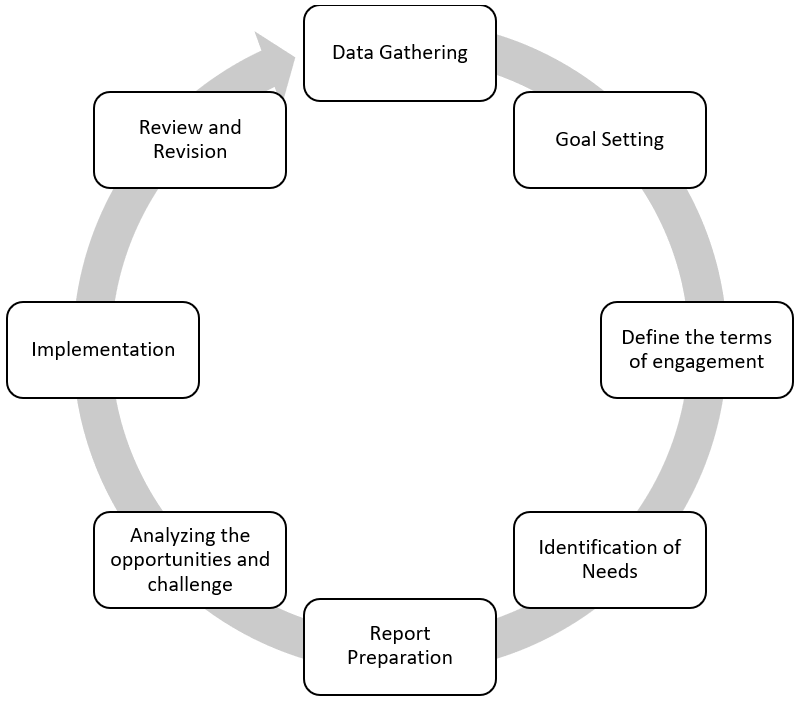
Process of Wealth management

Wealth Management is an investment advisory service that combines other financial services to address the needs of affluent clients. Using a consultative process, the advisor gleans information about the client’s wants and specific situation, and then tailors a personalized strategy that uses a range of financial products and services.

Data Gathering: Establishing details about your assets and liabilities, income and expenditure. Understanding arrangements already in place and attitude to investment risk.

  • Assets (and their fair market value)
  • Liabilities
  • Monthly Cash Expenditures
  • Income Tax Situation
  • Wills and Trusts
  • Insurance Contracts
  • Retirement assets

Goal Setting: Establishing your goals and aspirations for the short and long term. Understanding your commitment to meeting your objectives

Define the terms of engagement: Wealth Manager for providing his services has to define the terms of engagement, the service deliveries and the fees the wealth manager is going to charge the client for his services.

Identification of Needs: We will analyze your current position and assess any gaps in your situation. Next, identify what needs to be done to meet your objectives. Once the objectives have been identified, we begin the process of analyzing your financial information to develop a strategy for your individual financial plan. We pay particular attention to those areas of your plan of utmost importance to you.

Report Preparation: Our analysis and recommendations are presented in a written report. This forms the basis of a formal review at which we agree on an action plan. Upon completion of analysis, we can provide an outline of an overall strategy.

Analyzing the opportunities and challenge: Analyzing the opportunities and challenges is explaining the client the risk factors associated with each investment alternative that the wealth manager purposes.

Implementation: The best plan is worthless without proper implementation so in this critical step we walk with you to put the plan in action. Effecting the plan will invariably involve new and changed arrangements. We liaise with providers and other professionals to implement the agreed plan.

Review and Revision: Wealth management is a long-term plan that requires regular annual review. Changes in your circumstances are considered as well as fund performance.

Wealth management Needs & Expectation of Client’s

Being upfront from the very beginning is key to managing client expectations. Set out your rules of play before you take on any work, and agree on your process together. If you can’t guarantee something, be clear about it it’s always better to under promise and overdeliver. Remember that many clients don’t actually know much about the creative process at all, so take this chance to be clear about what you can and cannot promise, e.g. writing a great promotional article doesn’t mean it’s definitely going to get a great placement.

Managing client expectations is one of the most difficult and often frustrating aspects of the financial planning business. Although many clients can be quite reasonable when they lose money in their investments, there will invariably be a few who are determined to vent their frustrations at you, either via telephone, other correspondence, or in person.

The wealth management landscape is constantly evolving. Today’s investors have high expectations, demanding anytime, anywhere access to accounts and information, while expecting frictionless speed of updates and requiring greater transparency.

However, there are a number of things that advisors can do to help prevent most of these outbursts; and that’s by helping clients create expectations within the bounds of reality. It sounds almost too simple, but when clients are better educated about what they can expect from their investments and their relationship with their financial planners they are less likely to be outraged by things that are beyond the planner’s control.

Client Profiling

Customer profiling is the practice of organizing customers into specific groups possessing similar goals or characteristics. A customer profile can be based on a number of identifiers including demographics, location, hobbies, preferred social media channels, likes/dislikes, buying patterns, psychographics and credit background. Assigning every customer, a profile allows organizations to target products, services and communications in a consistent manner that resonates to a group of customers.

Client profiling is a useful concept that helps in establishing a relationship with the client. It helps in figuring out the financial personality of the client. While clients within each profile may be dissimilar, they can be broadly identified as following types:

Relationship clients

These people want to form a bond with someone whom they trust. They tend to be easy to talk to at the initial meeting. Much of the interaction is informal and conversational. Getting to know these clients as individuals is of utmost importance. They want to feel comfortable. They tend to be very good, long-term clients and very nice to work with.

Fear-based clients

These people tend to have very little financial experience or have had bad financial experiences. These clients are also reliant upon financial advisors. They often need educating, although they may seemingly not want it. The job of the financial advisor is not to take care of them but rather to work with them. They have to be helped in gaining confidence in the money arena.

Curious clients

They are working with financial advisors because of time constraints. They take a great interest in what a financial advisor does. These clients would have formed their opinions through what they have read or heard. They often will continue to focus on items that validate their thinking and they are knowledgeable.

Greedy clients

These are often the clients who are only interested in some in-articulated and ever-changing objectives, usually measured by short-term results. They may appear to be charming initially because they are often marked by high energy and a quick mind.

Benefits of customer profiling

  • The ability to tailor marketing efforts to relevant audiences.
  • Personalization of customer experiences to increase brand loyalty.
  • Can provide a more holistic view of market potential.
  • Improved customer satisfaction
  • Increased response, click or open rates.
  • More potential customers, prospects and customer types are identified.
  • Increased sales and revenue.

Content Marketing for staying relevant

Content that relates to your needs, goals and desires is what is most relevant to you. Relevance is usually what catches your eye like specific trends, stories and updates.

Relevant content is personalized content that feels conversational and speaks to your audience’s needs, pains, goals, and desires. To simplify this concept, your business should think of relevant content for your buyers, as individuals, based on what they do, continuously over time, directed toward an outcome, and everywhere they are (the ABCDs of Relevant Content). Buyer’s expectations of your business are rapidly changing. They expect you to know who they are, know what they like, and have personalized conversations on every channel they are on. Because of this, it is essential to make sure that everything you put out there speaks to your individual buyers.

  • Keep Your Competitors Close

Every industry has its key players, so every little thing matters. Tracking similar and competing brands positions you to make proactive competitive changes. Keeping up-to-date on industry newsletters, scanning press releases for competing products and practicing social media listening can help a brand anticipate the various ‘threats’ from competitor activity.

  • Analyse market trends

As trends change, marketers need to reinvent their strategies to generate content that engages their customers.

Take, for instance, the video marketing trend that picked up pace in 2017; HubSpot reported that 48% of marketers planned to add YouTube videos to their marketing plan in 2018.

Another recent trend has been to address the needs of the consumer not to the end of making an immediate sale but to ease their customer journey. This is why there’s been a sudden decline in sponsored posts, branded email, and even traditional ads all of which are no longer as effective as they were earlier.

A case-specific example of a brand having adapted its marketing strategy and content would be Warner Brothers Studio.

To prepare for an upcoming movie, it decided to base its media planning on insights gathered from big data. It considered the behaviour and engagement patterns of the target audience. By personalising its approach and tailoring content to the chosen platforms, WB Studio registered a 26% increase in ROI.

This goes to show that analysing marketing trends like these can give you a competitive edge and help your team create customer-relevant content pieces.

  • Understand who you’re creating content for

Imagine you’re going for a job interview. How would you prepare for it? You would understand what the company does, where its interests lie, the gaps in its industry presence that you can help fill, and so on.

What you wouldn’t do is walk into the interview without any background research and offer answers based solely on your assumptions and beliefs.

Creating relevant content for your target audience is exactly like that. You need to know the context they function in, what they already have access to, and what they need. So, define demographics, the context of content, pain points, and so on of your average buyer before creating content.

Consider the phone-case brand Peel. It has managed to stand out in an industry where phone cases are bought and sold in bulk, by creating covers that are thin and functional, yet attractive.

The brand has utilised Facebook ads to help differentiate their product from those of their competitors. And Instagram has been used for a dual purpose: first, as a platform to establish brand presence and product identity through an aesthetically appealing feed, and second, as a means to respond to customer feedback.

  • Use an apt medium

You can do everything possible to generate and post premium quality content. But if your target audience does not find it, does it even exist?

The truth is that effective content can only have a chance at being path-breaking when an effective distribution strategy is also at work.

Start by finding out how your audience consumes content. Using the right medium to start conversations, speaking in a language they are comfortable with, and using audience targeting options will help you build a better relationship with them.

Lead with Your Purpose

Audiences usually discern what you do fairly easily, but what sets your brand apart is why you do it. At CB&A for example, we’re driven by a passion to increase awareness of education initiatives that deliver equitable learning opportunities for schools and students. This mission influences everything about our brand marketing philosophy. It keeps us motivated, but our mission also drives our engagement in the education community and attracts clients to us in the first place.

Create niche relevant content

As has been discussed by Joe Pulizzi in this blog, creating generic content will lower your chances of breaking through the clutter on the internet, making it difficult for consumers to differentiate you from your competitors. You need to set your brand apart.

But before beginning to create a new area of specialisation, identify your potential competitors. Study their content approach, writing style, popular posts, and specific jargon used to target niche areas. Then build trust and influence by creating a niche content that’s relevant to your audience.

Mobile Marketing foundations

Mobile marketing is a multi-channel, digital marketing strategy aimed at reaching a target audience on their smartphones, tablets, and/or other mobile devices, via websites, email, SMS and MMS, social media, and apps.

Mobile is disrupting the way people engage with brands. Everything that can be done on a desktop computer is now available on a mobile device. From opening an email to visiting your website to reading your content, it’s all accessible through a small mobile screen. Consider:

80% of internet users own a smartphone.

Mobile platforms, such as smartphones and tablets, host up to 60% of digital media time for users in the U.S.

Google anticipates search queries on mobile devices to surpass desktop searches by the end of 2015.

Effective mobile advertising means understanding your mobile audience, designing content with mobile platforms in mind, and making strategic use of SMS/MMS marketing and mobile apps.

Types of Mobile Marketing

Mobile marketing has proven to be effective as now, the consumer has an increased control over the kind of advertisements that are sent to him. There was a time when most messages sent to consumers were not very useful, posing a serious threat to mobile marketing.

Corrective actions, both by corporations and network providers have helped to weed out unscrupulous elements, making mobile marketing an ethical way of promotion and publicity. Some types of mobile marketing are as follows.

Short Message Service (SMS)

Short message service initiated the concept of mobile marketing and still is used to promote a variety of products and services. Although, it has been put to a lot of abuse, regulations in the past few years have meant a revival of this form of mobile marketing.

The biggest advantage of SMS marketing is its reach and the low cost of marketing. Every cell phone has an ability to receive an SMS, which essentially means a larger target audience for corporations.

Multimedia Message Service (MMS)

Multimedia messages score over SMS as being a more effective form of marketing as it provides the user with images, audio and video. MMS can also be used to run advertisements as one gets to see on a TV, and offers a more efficient way of marketing a product, however, the cost of sending an MMS is more than that of an SMS.

Mobile Applications

Mobile applications have proved to be a great tool for mobile marketers, as these are innovative and offer the user a host of features. There are certain widgets that are displayed on the home screen of mobile phones, allowing the user to directly log into them, and advertisements can be placed on these applications to promote a product.

Bluetooth Mobile Marketing

This type of marketing helps in customizing the type of advertisements a user will receive, and most of it is based upon the geographical location of the user. This is an effective form of marketing as it helps in delivering relevant information to the user, and helps in filtering the advertisements which may not be useful for the user.

For example, the probability of a person enrolling for a dancing or a yoga course is more if the venue is closer to where he stays. This is the prime reason why Bluetooth mobile marketing is an effective tool for serving custom ads to the user.

Mobile Internet Advertisements

When you are online, you might have seen several advertisements popping up on your computer screen. Mobile Internet advertisements work in the same way, and deliver high-quality content to users. These are mostly built for smartphone users who have a reliable Internet connection.

Apart from the general consumer advertisements, mobile marketing has also helped entrepreneurs to expand their business and network with people. The QR (quick-response barcodes) allow interested parties to know more about a business project.

Today, iPhone is equipped with Near Field Communication, which allows users to buy stuff online, as one does from a computer. Truly, there are more exciting times ahead, and innovations in technology can provide some magnificent options to corporations as well as consumers.

Mobile Marketing Strategy

As with any marketing effort, every brand and organization will develop a unique mobile strategy based on the industry and target audience. Mobile technology is all about customization and personalization, which means mobile marketing is, too.

Step 1: Create Mobile Buyer Personas

Understanding your audience is the first step to any marketing strategy, and buyer personas are a valuable tool to aid in that understanding. Buyer personas are simply fictional representations of your various types of customers. Create a profile that describes each one’s background, job description, main sources of information, goals, challenges, preferred type of content, objections, and/or role in the purchase process. It is easier to determine a channel and voice for your marketing messages when you have a clear picture of your target audience.

Make a specific point to detail your target audience’s mobile habits as well. How much of their web usage happens on mobile devices? Are they comfortable completing a purchase on a smartphone? A simple way to start is to research big data reports on mobile usage. Some interesting observations include:

  • 65% of all email is first opened on a mobile device.
  • 48% of users start their mobile internet sessions on a search engine.
  • 56% of B2B buyers frequently use smartphones to access vendors’ content.
  • 95% of adults primarily use their smartphones to access content/information.

To better understand your specific target market, monitor Google Analytics for your site’s mobile traffic numbers. You can also ask or survey clients and prospects about their mobile web usage.

A/B testing which compares two versions of the same campaign on a certain channel can also be informative for developing any aspect of buyer personas. When all other factors are the same, do your email campaign landing pages get more views when you send a related email on weekends or on weekdays? In the mornings or in the evenings? Which title or email subject gets more click-throughs?

Both the general and specific data will help develop audience personas that include mobile usage.

Step 2: Set Goals

The key to defining any effective strategy is to first decide what success looks like. Get the key stakeholders together to map your mobile marketing strategy. Identify goals by asking your team some of these questions:

  • What are we currently doing for mobile? This will define your starting point, and make sure everyone is on the same page as you begin.
  • If you are already doing mobile marketing, how are those initiatives performing? This conversation will identify what is already working, what is not, and what’s not even being measured.
  • What are your main objectives for including mobile marketing in your overall strategy? Discuss why you’re considering mobile now, what conversations have led up to this point, and what you expect from mobile marketing.
  • Who are your key audiences for mobile marketing? Talk about your customer personas in light of mobile usage updates. How similar or different is each persona’s mobile usage?
  • How are you engaging your mobile audience cross-channel? This discussion will help analyze how the channels you’re currently using can be included in your mobile marketing strategy.

Step 3: Establish KPIs

Just like your other marketing efforts, mobile marketing needs to be tested and optimized. Determine which realistic, measurable KPIs define your mobile campaign’s success. For example:

  • Engagement: Provide mobile-friendly content for potential customers who are searching for information about your industry or product. Make sure your website is mobile-responsive to improve mobile SEO.
  • Acquisition: Make sure lead nurturing emails are mobile-friendly with clear calls-to-action. Buttons in emails should be near the top of the message and be big enough to easily tap in order to facilitate click-throughs. Then make it as easy as possible for someone to fill out a form on your mobile-optimized landing page.
  • Customer Service: In a connected, social marketplace, customer service is very much a marketing opportunity. Allow your customers to easily reach you through any platform they want, including simple click-to-call buttons for smartphone users.

In order to identify the right KPIs for your mobile marketing campaign, ask yourself:

  • Do I want to increase conversions from email messages?
  • Am I trying to improve traffic to sales pages?
  • How important is it that I generate more qualified prospects?
  • Does our brand need to improve sales by converting more traffic on certain pages?

Step 4: Monitor Mobile Metrics

Google Analytics can help monitor mobile usage of your site:

  • Mobile behavior data reveals how well your mobile content engages your audience.
  • Mobile conversion data will indicate whether or not some of your key landing pages still need to be optimized for mobile browsing.

Adding the Device Category field to the Site Content dashboard will display the quantity and quality of much mobile traffic to each individual page on your site.

The table on the Site Content dashboard includes metrics like pageviews and bounce rate. Add the Device Category by clicking the “Secondary dimension” menu above the first column and selecting “Device Category” from the “Users” submenu. The table will then display the most-viewed pages on your site, per device, so you can see how mobile actually affects your web traffic.

That information can hint at which search queries may be leading mobile traffic to your site, what content your mobile audience is most interested in, and which pages to optimize for mobile browsing first.

Newsletters for Content Marketing

An email newsletter is a periodical email sent by a person or business containing news, updates, curated content from the topic that you signed up for.

Unlike a promotional email that almost hypnotizes you to ‘buy’, ‘join’, ‘enroll’ or email from boss that asks you to change the font on a presentation immediately (at 6 pm on a Friday!), a newsletter just asks to be loved and enjoyed.

Go niche: Write about topics your subscribers signed up for. If you told them, you would send them poetry, it would be awkward & confusing to send them financial analysis or cooking lessons.

Provide value: Before sending the hit button, ask if you were reading this newsletter from someone else, would you trash it in 2.3 seconds or keep it bookmarked as favorite?

Write with intent. Think of what it is that you want to say with this piece. Your every content should either move a reader away from pain or towards pleasure.

Be authentic: Write as if you are having a conversation with someone. Write honestly. Don’t embellish your stories. Write with emotions; to express, not impress.

Steps

Define your goals

Start by defining your goals. They must be integrated into your overall content strategy. Goals must be very specific: for instance, increase prospects by 12%.

Before developing a newsletter, it’s important to ask yourself what focus it will have and how that fits into your overall marketing strategy. Readers have short attention spans that are continuously getting shorter. If they don’t immediately see something relevant and interesting, your email gets deleted. Producing unique content by segment returns routinely justifiable results.

Define your audience

Who do you want to reach and stay in touch with? Should you have one or several newsletters? This can be a matter of resources and commitment within each department, but the closer the content comes to meeting the reader’s specific interests, the better. Of course, recruiting future students is always a top priority and newsletters can be an effective tool in this regard.

Determine how often you will publish

Maintaining a regular schedule is great, but your priority should be on developing relevant content to share. If you send too frequently, you risk recipients unsubscribing from being perceived as a spammer. Some newsletters let new subscribers choose frequency-specific options (“weekly”, “monthly”, “bimonthly”, etc.). Testing which day of the week and times of year are most effective, along with the relative success of all other aspects of your publication, should be an ongoing process.

Continuously develop your contact list

  • On your website
  • Ask students to sign up on social media
  • If it is a general newsletter, have a sign-up button at the end of all your outside communications
  • Communicate what they will receive and the benefits of signing up. For a prospective students’ newsletter, an effective call to action could be “Stay tuned to what is happening on campus.”

Create engaging, digestible content based on your audience

Busy readers are likely to browse a newsletter before deciding if any article is worth reading. Enhance your usability with punchy headlines, easily readable short stories and attractive visuals. Since people generally process information better in smaller chunks, be aware that in a newsletter with ten articles, most readers may perhaps only read two or three. Shorter, more frequent delivery might be preferable. Subject lines have to instantly engage, and by limiting what is displayed to an introductory paragraph, encouraging readers to click to see the full article on your website, browsing becomes easier and your website’s traffic is increased.

Use Google Analytics to track your newsletter’s impact on your traffic

Studies analyzing online behaviour suggest email newsletters are the best way to drive users back to websites, where the real engagement takes place, so it is imperative that users are directed to an optimal student recruitment landing page. Feedback and your website’s analytics will allow you to constantly improve the effectiveness of your message and fully integrate the newsletter into your education marketing strategy.

Email Marketing Segmentation

Segmentation is the division of email subscribers into smaller segments based on set criteria. Typically, segmentation is used as a personalization tactic to deliver more relevant email marketing to subscribers based on their geographic location, interests, purchase history, and much more. Segments are created so that the marketer can cater specifically to each different email list and that list’s independent interests, rather than creating one mass message for all.

The basic identifiers for someone’s digital existence is their name and their email address. If you’re trawling your database and encounter very old email addresses, fair warning emails tend to degrade. People change email addresses when they change jobs, change webmail providers, adopt a different handle, or simply change their throwaway, but don’t worry about this now. When your campaign is underway, you’ll be able to track unresponsive email addresses and cull them from your list.

  • Existing email list: Of course, if this isn’t your first email marketing rodeo, then draw from your previous efforts at list-building.
  • Email account: Naturally, the first place you might look would be your present and former email accounts. Webmail accounts in particular make it easy for you to export your contacts, usually in CSV format.
  • CRM: If you use a CRM (and take steps to maintain clean data) then you’ll have a wealth of contact information in here. If it’s a fairly well-known CRM, there’s a good chance your email marketing service provider integrates with it already. If not, you can export your contacts in a CSV file.
  • Contact management system: Contact management apps can sync with your email, phone, and social media, so you might be able to get most of your contacts in one fell swoop. (Your CRM may have already replaced this, though.)
  • Ecommerce platform: Check your online store for current and past customers. Different platforms have different methods for exporting customers: depending on the solution, you may be able to export their purchase orders, their email addresses, and other relevant information. Check whether your email marketing solution integrates with your ecommerce platform.

5 ways you can segment your list:

  • B2B and specialization email segmentation: You work with other businesses. You may sell or provide services to other businesses. And because of the different people you work with, you wouldn’t send the same email to a vendor contact as you do to a sales manager, a marketing specialist, or an administrative assistant. They each require their own messaging.
  • Geographic email segmentation: The most obvious way to segment emails is through geography. For instance, imagine your business is hosting a special event. You send out content to a full email list, which includes contacts both local and distant.
  • Content-specific email segmentation: For this, you need to rely on data collected about specific contacts. What pages did they visit on your site? What did they download from it? What tools did they use? Did they purchase anything?
  • Influencer email segmentation: This is more complicated than the title alone suggests. Customer loyalty is no longer just about purchase totals and the frequency of purchases. Today, it’s about who recommends your brand. Who’s given you testimonials or reviews? Who shares your brand on social media? Which platform? How effective are they? Send superficially to those customers and show them some love for being a voluntary brand ambassador.
  • Behavior-specific email segmentation: This goes into a level of email marketing segmentation that’s even deeper. How long is a customer lingering on a page? How many pages do they view on an average visit? Do they visit and buy quickly, like an impulse buyer? Or do they visit a few times in a week, loading the same items into an online cart and canceling, like a nervous buyer?

Email Marketing Tools and Setup

Email marketing tools are very useful and cost-effective to market your products and services. They are especially great marketing tools for small businesses that don’t have the technical knowledge.

Factors

Integrations

It should also integrate easily with other third-party apps and social media platforms. Seamless integration allows you to handle customer data better and easily view key metrics.

Mobile-Optimization

According to an IBM study, most consumers prefer to read their emails on mobile. 49.1% of all emails in the world are opened on mobile. Compare this to 33.3% read on webmail and 17.6% on desktop.

Tools

  1. Sender

Sender is an effective email marketing tool built to help startups and fully established businesses grow. It allows them to reach their goals faster by providing useful features that enable them to take their email marketing strategies to the next level.

Sender has numerous pre-built email templates to choose from, but you can also create your own using custom elements. With Sender, you can also create signup forms and pop-ups.

Additionally, you can leverage their email automation feature to manage abandoned carts, welcome emails, and personalized celebration emails.

  1. Pinpointe

Pinpointe’s ‘Email Marketing Tool for Teams’ is the best solution for companies who have multiple people collaborating to design and deliver their email campaigns. Enterprises and marketing agencies can define specific user roles like campaign creation, database management and reporting, for each team member. Agencies can set up as many as 500 separate team accounts for each customer and define or restrict what each team member can have access to.

Pinpointe provides one of the best drag and drop editors we’ve seen. With hundreds of templates and pre-made blocks, companies can create beautiful looking, mobile friendly emails very quickly and without having to know html.

The smart-segments feature allows you to target your emails to relevant prospects with precision. Overall, this is the go-to tool if you want to do email marketing at scale.

  1. HubSpot Marketing Free Email

HubSpot offers a fully-featured email marketing tool that was built to help businesses grow, no matter where they are on their journey.

The tool has a free-forever plan that allows you to send up to 2,000 emails per calendar month. Once the business grows, you can opt for one of the paid tiers and unlock more features and benefits.

The great thing about HubSpot is that it offers all-in-one solutions to help you do more than just email marketing. They enable you to use your website data to run more personalized email campaigns. You can also benefit from their live chat, form builder, CRM, and other features.

  1. SendinBlue

Sendinblue is a great email marketing tool that can help you run effective campaigns in an automated, seamless manner.

It allows you to create professional-quality newsletters using their drag-and-drop feature and just a few clicks. Even professionals who don’t have any knowledge of coding can easily use their platform to create attractive newsletters.

Its advanced segmentation lets you target narrow audience segments with the right message.

Key Features

  • CRM integration for you to access contact details and insights
  • Unlimited contacts
  • Support for bulk emails
  • Rich email template library
  • A/B testing of email subject lines and sending times
  • Dynamic content to give your emails a personal touch

Setup

Determine Your Goals.

If you’re like me, then when you get an idea in your head, you’re eager to rush out and put it into action. Slow down there! If you want your campaign to be successful, you’ve got to step back and think about what you’re trying to accomplish.

  • If your website earns money on ad impressions, you’re probably trying to drive traffic. Your emails will likely contain links to popular or recent content on your site.
  • If you sell products in an ecommerce store, you might be trying to drive sales. In this case, your emails might link to best sellers, promote new merchandise, welcome new members, or reward loyal ones.
  • If you’re looking to bring attention to a cause, you might send out a newsletter with human interest stories, current events, details on community activities, or requests for donations.

Choose an Email Marketing Platform.

There are a few ways you can go about doing this. If your email marketing needs are fairly simple, it’s possible your CRM provides email marketing features that fit your needs. However, if you’re looking to build self-sustaining email marketing campaigns with email triggers and autoresponders, you’ll probably want a dedicated email marketing service provider.

  • MailChimp: MailChimp allows you to send automated, targeted emails, track performance metrics, design templates with a drag-and-drop interface, and incorporate social media ad campaigns. It also integrates with major ecommerce platforms. MailChimp has a free version, while paid subscriptions start at $10/month.
  • Mailify: Mailify Sunrise is the newest version of the email marketing and marketing automation platform. This version brings new features, such as the possibility to create online forms linked to your contact lists or to easily create and send out SMS marketing. Mailify also offers a wide range of fully responsive templates to choose from. With an intuitive interface, you can easy create emails and landing pages that reflect your style with the drag and drop builder. The app is also integrated with Magento, Prestashop and WordPress.
  • GetResponse: GetResponse offers email marketing, custom landing pages, and webinar marketing with solutions tailored to different industries. It integrates with popular ecommerce platforms, and its marketing automation scales for growing companies. Its basic email marketing package starts at $15/month, billed monthly, with discounts available for annual/bi-annual plans.
  • Constant Contact: Constant Contact offers highly effective email marketing with a bevy of mobile-responsive templates suited for various needs and industries. It tracks KPIs in real-time, simplifies list-building and contact management, and provides campaign ideas by industry. Constant Contact offers a 60-day free trial; paid subscriptions start at $20/month with annual discounts.
  • ActiveCampaign: ActiveCampaign offers email marketing and marketing automation with a drag-and-drop campaign builder. It enables highly-specific segmentation strategies by consolidating data from your integrated third-party apps. It provides detailed reports, optimization tools, and ecommerce integration. Subscriptions start at $9/month with annual discounts, and further discounts for non-profits.
  • Campaign Monitor: Campaign Monitor provides a library of professionally-designed email templates for branded email marketing. It offers a drag-and-drop campaign builder, dynamic content, optimization tools, and detailed tracking tools. It rates very highly in customer support touted as the “highest among major vendors” with 24/7 customer support. Campaign Monitor offers a very limited free version to get users started, while paid plans begin at $9/month. There are also pricing options to pay per campaign.

Build and Segment an Email List.

Your list may have humble roots with only a few subscribers, but prospects are prospects. It’s tempting to buy an email and bulk-send cold emails (hey, it works for some people), but you probably already have a fair number of contacts floating around in your records. If you choose to build an email list from scratch, there are ways to do that, too.

Consolidate Your Contacts

The basic identifiers for someone’s digital existence is their name and their email address. If you’re trawling your database and encounter very old email addresses, fair warning — emails tend to degrade. People change email addresses when they change jobs, change webmail providers, adopt a different handle, or simply change their throwaway, but don’t worry about this now. When your campaign is underway, you’ll be able to track unresponsive email addresses and cull them from your list.

  • Existing email list: Of course, if this isn’t your first email marketing rodeo, then draw from your previous efforts at list-building.
  • Email account: Naturally, the first place you might look would be your present and former email accounts. Webmail accounts in particular make it easy for you to export your contacts, usually in CSV format.
  • CRM: If you use a CRM (and take steps to maintain clean data) then you’ll have a wealth of contact information in here. If it’s a fairly well-known CRM, there’s a good chance your email marketing service provider integrates with it already. If not, you can export your contacts in a CSV file.
  • Contact management system: Contact management apps can sync with your email, phone, and social media, so you might be able to get most of your contacts in one fell swoop. (Your CRM may have already replaced this, though.)
  • Ecommerce platform: Check your online store for current and past customers. Different platforms have different methods for exporting customers: depending on the solution, you may be able to export their purchase orders, their email addresses, and other relevant information. Check whether your email marketing solution integrates with your ecommerce platform.

Build and Grow a List from Scratch

It’s possible that even after trawling your contact databases, your emailing list is emptier than a middle school dance floor. Not to worry, there are ways to build a database of contacts from scratch. It’ll take some work, but the good news is your list will probably be more current, with more relevant prospects, than if you scoured addresses from an old database.

  • Attract visitors with compelling content. Building organic traffic through inbound marketing (i.e. creating relevant content for your target audience and promoting it) is a slow but reliable way to build an email list. Better yet, these self-selected subscribers are more likely to have interest in your email campaigns.
  • Offer relevant, gated assets. This works well particularly for B2B email campaigns. If your company produces a white paper, case study, research report, etc. then you can make it available for free in exchange for an email address. You might collect a few throwaway accounts, but there’ll be a lot of work emails in there.
  • Make it easy to subscribe. Putting a nice call-to-action at the bottom of a custom landing page will attract conversions, especially if the visitor is coming from a targeted ad or promoted content.
  • Offer guarantees against spam. People are more likely to sign up for your newsletter, promotions, fundraising, and so on if you assure you won’t flood their inbox. If you offer subscribers an option to choose their level of engagement daily, weekly, bi-weekly, monthly make sure you respect that.
  • Offer promotions for subscribing. For example, new subscribers receive 15% off their next purchase and free shipping! Choose any promotion you want. This is a great way to build your list and also drive sales.
  • Use a Facebook call-to-action button. Facebook allows your company profile to contain a call-to-action button that you can customize to let prospects sign up for your email list. It’ll appear at the top of your business profile page alongside the like button. Another reason why you need a polished social media presence!
  • Tweet about the benefits of your email list. Promote the above gated content and promotions or simply the virtues of being on your email list to all of your followers. Set up an automation using a social media management platform (like Hootsuite) so new followers get a DM with a subscription link.
  • Include a subscription link in your email signature. There are dos and don’ts to email signatures, but you can find a way to include a subscription link.

Segmenting Your Email List

Segmenting your email list lets you send highly-targeted emails to people based on their interests or demographic criteria. If it’s relevant to them, they’re more likely to open it; if they open it, there’s a chance they could convert.

Depending on your product or service, there are several data points you might consider when segmenting your audience. These include:

  • Geography: The physical location of your recipients by country, region, state, or city. This can help you tailor content specific to certain places or accommodate time zone differences.
  • Demographics: Demographic criteria includes age, gender, language, background, job title, or any other data points specific to an individual.
  • Firmographics: Firmographic criteria refers to characteristics regarding a company, such as headquarters, industry, revenue, and number of employees. This is particularly useful for B2B account-based marketing or sales.
  • Past purchases: This is useful for ecommerce retailers in particular. This can inform an email’s dynamic content or the nature of promotions personalized to recipients’ interests.
  • Amount spent: This is useful for encouraging customers to hit a threshold at which they gain benefits, or rewarding loyal customers with a discount.
  • Position in sales funnel: The abandoned shopping cart is the most well-known example. However, you can send emails customized to any stage of the buyer’s journey to push them farther down the funnel.
  • Time since last purchase: Win back past customers before they go cold. Offer them incentives to return, announce new merchandise, or preview upcoming sales.
  • Expressed interests: Send relevant content to the parties most interested based on interests they confirmed when subscribing to your emailing list.
  • Email engagement: Customers who opt to receive emails no more than, say, twice a month can have abbreviated bi-weekly newsletters sent to their inboxes with the top topics of that period.

Enable Tracking.

Tracking and obtaining performance analytics is how you optimize email campaigns and marketing assets based on what works with which segments. The possibilities are nearly endless, and you can adapt subject lines, preheader text, email templates, content design, calls to action, and landing pages through A/B tests and analysis over time.

  1. Unique Open Rate: This tracks the number of distinct recipients who’ve opened your email. This is a separate metric than Total Opens, which includes multiple opens by the same recipient.
  2. Click-through Rate: Your click-through rate measures the number of recipients who click one or more links in the email, which bring them to a landing page on your website. Generally, the more clicks, the better. In practice, click-through rates can vary greatly per industry and by the nature of the campaign.
  3. Click-to-Open Rate: This metric divides the number of unique clicks by the number of unique opens to tell you the percentage of recipients who both opened the email and actually clicked a link. This gives you a sense of how well your content is actually performing with the people who see it.
  4. Bounce Rate: The bounce rate measures the rate at which your emails are rejected by email servers. There are two types of bounces hard and soft. A hard bounce usually occurs as the result of non-existent or invalid email addresses. A soft bounce can indicate recipient’s inbox is over quota or the email message is too large. High bounce rates are a sign you should trim your email list of unproductive addresses or use confirmation emails to ensure subscribers actually want to subscribe.
  5. Unsubscribe Rate: This is the rate at which recipients are unsubscribing from your email campaign. Unsubscribe rates vary by industry, but generally anything over 1% means you should look to provide more value in your content, improve the quality of your contact list, optimize the frequency of your emails, and better segment your list.
  6. Spam Complaint Rate: A high spam complaint rate is a sign your recipients don’t see value in your emails. This should concern you in particular because an excessive complaint rate may result in your account being disabled by email marketing service providers. Different providers specify different acceptable spam complaint rates, but it’s generally very low perhaps no more than .1%.

Send

Congratulations! You’ve created an email marketing campaign. Now it’s time to send your emails. You might hit a homerun on your first campaign, but don’t be discouraged if it’s a dude. we learn more from our failures than our successes. Segment your lists, study campaign performance, make alterations, test your emails against one another, and every day you’ll get a little closer to your goals.

error: Content is protected !!