Steps in Formation of a Company

The formation of a company in India is a meticulous process governed by the Companies Act, 2013, which outlines the rules, regulations, and procedures. This law provides the legal framework for the establishment of different types of companies such as private, public, one-person companies, etc. The formation process can be divided into several stages, each of which requires compliance with specific legal formalities.

Stage 1. Promotion Stage

Promotion is the first stage in the formation of a company, where the idea of starting a company takes shape, and the necessary actions are initiated by the promoters.

Who is a Promoter?

Promoter is a person or a group of persons who conceive the idea of forming a company and take the necessary steps to incorporate it. They are responsible for:

  • Identifying Business Opportunities: Promoters identify the potential opportunities for starting a new business and devise strategies for utilizing those opportunities.
  • Feasibility Study: This involves the evaluation of the commercial, financial, and technical viability of the proposed company. The promoter assesses whether the business idea will succeed.
  • Business Plan Preparation: The promoter prepares a detailed business plan, outlining the company’s objectives, strategies, resources, and funding needs.
  • Arrangement of Capital: The promoter identifies the potential sources of capital, whether through personal savings, loans, or investor funding.
  • Appointment of Directors: The promoter nominates the directors who will oversee the company’s operations after incorporation.
  • Legal Compliances: The promoter is responsible for ensuring that all necessary legal formalities, such as obtaining licenses, are completed.

Stage 2. Selection of Company Name

The next significant step in company formation is selecting an appropriate name for the company. This is governed by the guidelines of the Ministry of Corporate Affairs (MCA).

  • Reserve Unique Name (RUN):

The promoter must submit an application for reserving the company’s name through the MCA’s online service, known as the Reserve Unique Name (RUN) facility. The proposed name should not be identical or similar to any existing company name or trademark.

  • Name Approval:

Once the application is submitted, the Registrar of Companies (RoC) will either approve or reject the name within a few working days. If approved, the name is reserved for 20 days during which time the company must proceed with the next steps.

Stage 3. Preparation of Documents

Once the company’s name is approved, the next step involves preparing and submitting the following key documents:

Memorandum of Association (MoA)

Memorandum of Association outlines the company’s constitution and defines its relationship with the outside world. It contains essential clauses such as:

  • Name Clause: States the company’s registered name.
  • Registered Office Clause: Specifies the location of the company’s registered office.
  • Object Clause: Defines the objectives for which the company is being formed.
  • Liability Clause: Indicates the extent of the liability of the members.
  • Capital Clause: Mentions the authorized capital of the company.

Articles of Association (AoA)

Articles of Association detail the internal management of the company, including rules related to the conduct of business, rights and responsibilities of directors, and procedures for meetings and resolutions.

Stage 4. Application for Incorporation

Once the MoA and AoA are prepared, the promoter must file the Incorporation Application (Form SPICe+). This is the most crucial stage in the formation process, as it involves the actual registration of the company with the Registrar of Companies (RoC).

Required Documents for Incorporation:

  • MoA and AoA: Duly signed by the promoters and subscribers.
  • Declaration of Compliance: A declaration signed by the promoters, affirming that all legal requirements of company formation have been complied with.
  • Identity Proofs of Directors and Subscribers: PAN, passport, Aadhar card, or other acceptable ID proofs.
  • Address Proof: Utility bills or other documents for the company’s registered office.
  • Digital Signature Certificate (DSC): The directors must obtain DSCs, which are used to sign documents electronically.
  • Director Identification Number (DIN): Every proposed director must have a DIN, which can be applied for during the incorporation process.

Filing SPICe+ (Simplified Proforma for Incorporating Company Electronically):

SPICe+ is a comprehensive online form provided by the MCA for the incorporation of companies. The form integrates multiple services including PAN, TAN, EPFO, ESIC, and bank account opening.

Stage 5. Payment of Fees

At the time of filing the incorporation documents, the promoter must pay the necessary government fees. These fees vary depending on the authorized capital of the company and the type of company being registered. For instance:

  • For a Private Limited Company, the fees are based on the share capital.
  • For a One Person Company (OPC), the fees are typically lower.

Stage 6. Certificate of Incorporation (COI)

Once all the documents and forms are submitted, and the prescribed fees are paid, the RoC reviews the application. If the RoC finds the documents in order, it issues the Certificate of Incorporation (COI). The COI is conclusive evidence that the company has been legally registered and is a recognized entity under Indian law.

The Certificate of Incorporation contains:

  • The company’s name.
  • The CIN (Company Identification Number).
  • The date of incorporation.
  • The name of the RoC who issued the certificate.

Stage 7. Post-Incorporation Formalities

Even after the company is registered, several formalities must be completed to ensure the smooth operation of the company:

  • Opening a Bank Account: The company needs to open a bank account in its name, which will be used for all financial transactions.

  • Registered Office Address: The company must ensure that it has a registered office within 30 days of incorporation and submit the address to the RoC.
  • Issuance of Share Certificates: The company must issue share certificates to the subscribers within two months of incorporation.
  • Statutory Books: The company must maintain statutory books such as a register of members, a register of directors, minutes of meetings, and other records required by law.
  • Compliance with Tax and Regulatory Requirements: The company needs to register for GST, Professional Tax, and any other applicable taxes. It must also file its annual returns and financial statements with the RoC.

Stage 8. Commencement of Business

Once the above formalities are completed, the company can start its business operations. However, for companies incorporated with share capital, a Declaration for Commencement of Business must be filed within 180 days of incorporation. This declaration affirms that the subscribers have paid for the shares they agreed to take and is mandatory for the company to begin its business activities.
Meaning, Contents, Forms of Articles of Association and its Alteration

Articles of Association (AoA) is a key legal document required for the incorporation of a company. It outlines the internal regulations and governance structure of the company, setting the rules for how it will be managed and controlled. While the Memorandum of Association (MoA) defines the company’s relationship with the external world, the AoA focuses on its internal functioning. Together, these documents form the company’s constitution, determining its objectives and operational framework.

AoA must be submitted to the Registrar of Companies (RoC) during incorporation and must align with the provisions of the Companies Act, 2013 in India. It governs aspects like the conduct of board meetings, the appointment of directors, share transfers, and the rights and duties of shareholders.

Meaning of Articles of Association:

Articles of Association is a legal document that outlines the rules for a company’s internal management and procedures. It defines the responsibilities of the directors, the processes for making decisions, the rights and duties of shareholders, and the company’s rules for issuing and transferring shares. The AoA provides a framework for running the company’s day-to-day operations and ensuring smooth governance.

While the MoA defines the company’s objectives and limits, the AoA allows for flexibility in how those objectives are achieved. It acts as a contract between the company and its members (shareholders), as well as among the members themselves, ensuring that the company is managed in accordance with agreed rules and practices.

Contents of Articles of Association:

Companies Act, 2013, provides significant flexibility in drafting the Articles of Association, allowing companies to customize their internal regulations.

  1. Share Capital and Variation of Rights

AoA outlines the company’s share capital structure, including the different classes of shares (e.g., equity shares, preference shares), and their respective rights and restrictions. It also specifies the process for issuing new shares, altering share capital, and varying the rights attached to different classes of shares.

  1. Transfer and Transmission of Shares

This section of the AoA provides the rules for transferring shares between shareholders, including the procedure for the sale or gift of shares. It also covers the transmission of shares in the event of the death or insolvency of a shareholder. The AoA may include restrictions on share transfers, especially in the case of private limited companies, where shares cannot be freely transferred.

  1. Board of Directors

AoA specifies the composition of the Board of Directors, their powers, and the procedures for their appointment and removal. It may include details about the minimum and maximum number of directors, the qualifications required to become a director, and the process for filling vacancies on the board. Additionally, it governs the roles and responsibilities of the board in managing the company’s affairs.

  1. Meetings and Voting Rights

AoA outlines the rules for holding meetings of the board and shareholders, including the notice period, quorum requirements, and procedures for passing resolutions. It also specifies the voting rights of shareholders and directors, including whether decisions are made by simple majority or special resolution.

  1. Dividends and Reserves

AoA defines the procedure for declaring and distributing dividends to shareholders. It includes the company’s policy on retaining profits for reserves, the amount to be distributed as dividends, and the process for calculating and paying dividends to shareholders.

  1. Borrowing Powers

This section defines the borrowing powers of the company, including the authority of the Board of Directors to raise loans or issue debentures. It outlines the terms and conditions under which the company can borrow funds, including any limitations on borrowing.

  1. Accounts and Audits

AoA specifies the rules regarding the maintenance of accounts, auditing of financial statements, and the appointment of auditors. It may also detail the financial year of the company and the process for approving and filing annual financial statements.

  1. Winding Up

AoA includes provisions for the winding up of the company, detailing the process for liquidation and the distribution of assets in the event of the company’s dissolution. It may outline how assets are to be distributed among shareholders, creditors, and other stakeholders.

  1. Indemnity

AoA may include an indemnity clause that provides protection to the company’s officers and directors against liabilities incurred in the course of performing their duties, provided they act in good faith.

Forms of Articles of Association:

AoA can take various forms depending on the type and structure of the company. While there is no prescribed form for the AoA under the Companies Act, 2013, the following are the common types of companies that need to customize their Articles:

  1. Private Limited Companies

Private companies tend to have more restrictive Articles, particularly concerning the transfer of shares and the maximum number of shareholders. The AoA of a private limited company often includes specific provisions limiting the right to transfer shares, setting out processes for director appointments, and defining the company’s internal governance structure.

  1. Public Limited Companies

AoA of public limited companies is generally more flexible compared to private limited companies, particularly in areas like share transfer and raising capital. Public companies must comply with additional regulatory requirements, and their AoA typically includes provisions that align with listing agreements and stock exchange rules.

  1. One Person Companies (OPC)

In the case of One Person Companies, the AoA is relatively simple, as the company has only one shareholder and fewer compliance requirements. The AoA of an OPC will typically focus on the limited role of the single shareholder in managing the company’s affairs.

Alteration of Articles of Association:

Companies Act, 2013, allows for the alteration of the AoA as long as the changes comply with legal requirements and are approved by the shareholders. The AoA is a flexible document, and companies often need to update it to reflect changes in their business environment or governance needs.

Process for Altering the Articles of Association

  1. Board Resolution:

The process for altering the AoA begins with the Board of Directors passing a resolution to propose changes to the Articles. The resolution must specify the reasons for the proposed alteration and schedule a general meeting of the shareholders.

  1. Special Resolution:

The alteration of the AoA requires approval from the shareholders by passing a special resolution in the general meeting. A special resolution requires at least 75% of the shareholders to vote in favor of the changes.

  1. Filing with the Registrar of Companies (RoC):

Once the special resolution is passed, the company must file the altered AoA with the RoC using the prescribed forms (e.g., Form MGT-14). The alteration becomes effective only after the RoC registers the modified AoA.

  1. Approval by Regulatory Authorities:

In certain cases, the alteration may require approval from other regulatory bodies. For example, changes to the AoA of a public company listed on a stock exchange must be approved by the stock exchange or the Securities and Exchange Board of India (SEBI).

Limitations on Alteration:

  • Consistency with the Memorandum of Association:

AoA cannot contain provisions that are inconsistent with the MoA. The MoA takes precedence, and any changes to the Articles must be in alignment with the company’s objectives as set out in the MoA.

  • Statutory Restrictions:

Certain statutory provisions, such as those related to the rights of minority shareholders, cannot be altered without complying with the provisions of the Companies Act.

Allotment of Shares, Types, Rules, Restrictions

Allotment of Shares refers to the process by which a company distributes its shares to applicants who have subscribed during an offering, such as an Initial Public Offering (IPO) or private placement. Once the subscription period ends, the company reviews the applications, determines the allocation of shares, and officially assigns them to the investors. Allotment is done based on the availability of shares and the demand. If the offering is oversubscribed, shares may be distributed on a proportionate basis or through a lottery system, ensuring fairness to applicants.

Types of Allotment of Shares:

  1. Public or Initial Allotment:

This occurs when a company issues shares for the first time through an Initial Public Offering (IPO) or a Follow-on Public Offer (FPO). Shares are allotted to the public based on their applications and may be determined through a fixed price or book-building process. If oversubscribed, allotment is done proportionally.

  1. Private Placement:

Shares are allotted to a select group of investors, such as institutional investors, private equity firms, or wealthy individuals. It doesn’t involve public participation and is often quicker and subject to fewer regulatory hurdles.

  1. Rights Issue Allotment:

Existing shareholders are given the opportunity to purchase additional shares in proportion to their current shareholding, often at a discounted price. Shares are allotted based on the shareholder’s entitlement and their decision to take up the offer.

Rules Regarding Allotment of Shares:

  1. Minimum Subscription Rule:

A company can allot shares only if it receives a minimum subscription of 90% of the total issue within a specified period. If the company fails to achieve this, the issue must be canceled, and the application money is refunded to investors.

  1. SEBI Guidelines (for Public issues):

Securities and Exchange Board of India (SEBI) sets rules for public issues, including requirements for disclosing financial details, ensuring fair pricing, and the process for allotting shares. Companies must follow these guidelines when issuing shares through IPOs or public offers.

  1. Time Limit for Allotment:

Shares must be allotted within a prescribed time frame, usually 60 days from the date of receiving the application. If the company fails to allot shares within this period, it must refund the application money within 15 days. Otherwise, the company is liable to pay interest on the amount.

  1. Return of Allotment:

After allotting shares, the company must file a Return of Allotment (Form PAS-3) with the Registrar of Companies (ROC) within 30 days. This document details the number of shares allotted, the shareholders, and the allotment process.

  1. Listing Requirements:

If the shares are issued through an IPO or public offer, the company must ensure that the shares are listed on a recognized stock exchange. The allotment must comply with the rules and regulations of the stock exchange as well.

  1. Proper Allotment Procedures:

The company must follow proper procedures during the allotment, including board approval, maintaining proper records of applicants, and ensuring fairness in case of oversubscription (proportional allotment or lottery system).

  1. Non-Payment of Allotment Money:

If a shareholder fails to pay the allotment money, the company has the right to forfeit the shares after providing due notice.

Restrictions on Allotment of Shares:

  1. Minimum Subscription:

Company cannot proceed with the allotment of shares unless it receives at least 90% of the total issue as a minimum subscription. If this threshold is not met, the company must refund the application money to investors. This ensures that the company raises adequate capital to meet its objectives.

  1. Approval by Regulatory Authorities:

In the case of public offers, companies must receive approvals from regulatory authorities such as the Securities and Exchange Board of India (SEBI) and comply with its guidelines. Any non-compliance can lead to a restriction on the allotment process.

  1. Time Limit for Allotment:

Shares must be allotted within 60 days from the date of receiving the share application. If the company fails to allot shares within this period, the application money must be refunded to the investors within the next 15 days. If not, the company must pay interest at a specified rate.

  1. Prohibition on Allotment Before Filing the Prospectus:

Companies issuing shares to the public must file a prospectus with the Registrar of Companies (ROC) before making any allotment. Allotment without issuing or filing a prospectus is prohibited and can be declared void.

  1. Return of Allotment:

After allotment, companies are required to file a Return of Allotment (Form PAS-3) with the ROC within 30 days of the allotment. If this form is not filed, further allotments may be restricted, and penalties may be imposed.

  1. Oversubscription and Proportional Allotment:

In cases of oversubscription (when applications exceed the number of shares available), the company is restricted from issuing more shares than initially offered. It must allocate shares on a proportionate basis or through a fair method, such as a lottery system, to ensure equitable distribution.

  1. Restrictions on Allotment to Certain Investors:

  • Foreign Investors: Allotment to foreign investors must comply with the Foreign Direct Investment (FDI) guidelines. Companies cannot allot shares to foreign nationals or institutions without adhering to these rules.
  • Restricted Categories: Allotments may be restricted for certain categories of investors, such as related parties or company insiders, without appropriate board approvals or shareholder resolutions.
  1. Non-Payment of Allotment Money:

If the allotment money is not paid by the applicant within the specified time, the company has the right to forfeit the shares. The allottee loses their entitlement to the shares and any amount already paid.

  1. SEBI Regulations (for Listed Companies):

For listed companies, allotment of shares must comply with SEBI’s guidelines, including transparency, proper disclosures, and fair pricing. Failure to adhere to these regulations can restrict further share allotments.

  1. Lock-in Period:

For certain types of shareholders, especially promoters and institutional investors in private placements, a lock-in period may apply. During this period, these shareholders are restricted from selling or transferring their shares.

Calls on Shares

Reputed companies require the applicants to send the full value of the shares along with the applications. This is because, the Companies Act does not prohibit companies to collect the entire amount at the time of issue itself. But the usual practice of the companies is to collect a certain percentage of the face value of the shares on application and allotment and the balance in one or more installments known as calls.

A call may be defined as a demand made by the company on its shareholders to pay a part or the whole of the unpaid balance within a specified time. Lord Lindley says that the expression “Call” denotes both the demand for money and also the sum demanded.

The following points should be noted, in this context, so that the reader can understand what a call really means.

  1. Time for Making the Call: The call can be made at any time during the life time of the company or during the course of winding up. During the life time, the call should be made by the Board of Directors and during the course of winding up, it should be made by the liquidator.
  2. Obligatory: Each shareholder is obliged to pay the amount of call as and when the call is made. But, this liability arises only when the call is made and not before.
  3. Debt Due: As soon as a call is made, the call amount shall become a debt due from the shareholders to the company.
  4. Consequences of Default: If a shareholder fails to pay the call amount, the company can enforce payment of the amount together with interest or can forfeit the shares.
  5. Calls and Other Payments: A call is different from other payments made by a shareholder. The amounts paid on application and allotment are not calls. Similarly, if a company requires the shareholders to pay the entire amount either on application or on allotment, it is not a call under this Act.

Legal Provisions Relating to the Calls

The statutory provisions relating to the making of calls can be summed up as follows:

  1. Call should Bona fide: The power to make call is generally in nature of a trust and so it can be exercised bona fide and for the benefit of the company. It should not be made for private ends. It means the directors or the liquidator can make the call only when there is a bona fide need for funds.
  2. Uniformity: The calls should be made on an uniform basis on all the shares falling under the same class. If a call is made only on some shareholders of the same class but not on others or a greater amount is demanded from some shareholders and a lesser amount from others of the same class, the call is not valid.
  3. Provisions of the Articles: The calls should be made strictly in accordance with the provisions of the Articles. If this is not done, the call will be invalid.

Procedure for making Calls

Generally, the procedure for making calls is incorporated in the Articles of most companies. If a company has its own Articles, it should follow the provisions of its Articles. If not, the regulations specified in Table A of the Act shall apply.

The following provisions of Table A can be noted at this stage.

  1. The power to make calls generally vests in the Board of Directors.
  2. The calls should be made by passing a resolution at the meeting of the Board.
  3. The call money should not exceed 50% of the face value of the share at one time. However, companies may have their own Articles and raise this limit.
  4. There must be at least 30 days interval between two successive calls.
  5. When a call is made a letter known as “Call Letter” or “Call Notice” should be sent to all the shareholders of the same class.
  6. The notice should also specify the amount of the call, place of payment etc. and should be sent at least 14 days before the last date for payment.
  7. The Board of directors has the power to revoke or postpone a call after it is made.
  8. Joint shareholders are jointly and severally liable for payment of calls.
  9. If a member fails to pay call money, he is liable to pay interest not exceeding the rate specified in the Articles or terms of issue. The directors are free to waive the payment of interest.
  10. If any member desires to pay the call money in advance, the directors may at their discretion accept and pay interest not exceeding the rate specified in the Articles.
  11. A defaulting member will not have any voting right till call money is paid by him.

Prospectus, Statements in view of prospectus

Sec. 2(36) of the Companies Act describes a prospectus as any document issued as a prospectus and includes any notice, circular, advertisement or other document inviting deposits from the public or inviting offers from the public for the subscription or purchase of any share in, or debentures of a body corporate.”

In other words, it is a document which invites deposits from the public or invites offers from the public for the subscription of shares in, or debentures of, a company. The words “inviting deposits from the public” were added by the Companies (Amendment) Act, 1974.

Features and Characteristics of Prospectus:

(i) It is a document issued as a prospectus;

(ii) It is an invitation to the member of the public;

(iii) The public is invited to subscribe to the shares or debentures of the company;

(iv) It includes any notice, circular, advertisement inviting deposits from the public;

(v) It is a document by which the company procures its share capital needed to carry on its activities.

Forms and Contents of the Prospectus:

Sec. 56 states that every prospectus must

  1. State the matters specified in Part I of Schedule II, and
  2. Set out the reports specified in Part II of Schedule II.

The Statement in Lieu of Prospectus is a document filed with the Registrar of the Companies ( ROC ) when the company has not issued prospectus to the public for inviting them to subscribe for shares. The statement must contain the signatures of all the directors or their agents authorized in writing. It is similar to a prospectus but contains brief information. The Statement in Lieu of Prospectus needs to be filed with the registrar if the company does not issues prospectus or the company issued prospectus but because minimum subscription has not been received the company has not proceeded for the allotment of shares.

If a public company does not invite the public to subscribe for its shares but acquires to have money from private sources it may not issue a prospectus. In the circumstances, the promoters are required to prepare a draft prospectus which is known as ‘Statement in lieu of Prospectus’ which must contain the information required to be disclosed by Schedule III of the Act.

Sec. 70(1) states that a company having a share capital which does not issue a prospectus shall not allot any of its shares or debentures unless at least 3 days before the allotment of shares or debentures there has been delivered to the Registrar for registration a statement in lieu of prospectus.

The statement shall be signed by every person who is named therein as a director or proposed director of the company or by his authorised agent in writing. It shall be in the form and contain particulars set out in Schedule III of the Act.

Sec. 70(4) lays down that, in contravention of Sec. 70(1), the company and every director of the company, who wilfully authorizes or permits the contravention shall be punishable with fine which may extent to Rs. 1,000.

Similarly Sec. 70(5) also states that where the statement in lieu of prospectus contains any untrue statement, the persons responsible, for the issue thereof, may be punished by imprisonment which may extend to 2 years or with fine which may extend to Rs. 5,000, or with both.

Red Herring Prospectus:

A Red Herring Prospectus is a document which is submitted by an issuer company who intents to have public offerings of securities (i.e.; stock or bonds). It is associated with an Initial Public Offering (IPO). It must be filed with the Securities and Exchange Commission (SEC). The term Red herring comes from the tradition where young hunting dogs in Great Britain were trained in order to follow a scent by the use of ‘Red’ (i.e. salted and smoked) herring (i.e., kipper).

It is interesting to note that this pungent fish would be dragged across a trail until the puppy learned to follow the scent. But the term is used in prospectus simply due to disclosure statement which is printed in red ink on the cover which clearly states that the issuing company is not attempting to sell its shares.

Contents of Red Herring Prospectus:

(a) Purpose of the issue;

(b) Proposed offering Price Range;

(c) Promotion expenses;

(d) Copy of the underwriting agreement;

(e) Underwriter’s commission and discount;

(f) Disclosure of any option agreement;

(g) Balance Sheet;

(h) Net proceeds to the issuing company;

(i) Earning statement for .last three years;

(j) Legal option on the issue;

(k) Copies of the Articles of Incorporation of the issuer; and

(l) Names and addresses of all offices, underwriters, directors and stockholders owning 10% or more of the existing outstanding stock.

Share Capital, Features, Types

Share Capital refers to the total amount of capital raised by a company through the issue of shares to shareholders. It represents the ownership interest of shareholders in the company and forms a major part of the company’s funding. Share capital is divided into Equity shares and Preference shares, and it can be further categorized into authorized, issued, subscribed, and paid-up capital. The concept of share capital is crucial in determining voting rights, dividends, and the extent of liability of shareholders. It enables companies to raise long-term funds without incurring debt and provides investors with an opportunity to share in profits and ownership.

Features of Share Capital:

Share capital is the money raised by a company through the issuance of shares. It forms the financial foundation of a company and signifies the shareholders’ stake in the ownership of the business. The features of share capital reflect its role in corporate structure, investor relations, and financial stability.

1. Permanent Source of Capital

Share capital is a long-term and permanent source of finance for a company. Unlike loans or debentures, it is not repaid during the lifetime of the company. It stays invested in the business to support growth, operations, and expansion. This permanence strengthens the company’s financial structure and gives confidence to creditors. It is repayable only at the time of winding up, subject to the provisions of the Companies Act and satisfaction of liabilities.

2. Ownership Right

Share capital represents the ownership of the company. Shareholders are regarded as owners and not creditors of the company. The extent of their ownership depends on the number and type of shares they hold. Equity shareholders, in particular, have voting rights, control over company decisions, and a share in residual profits. This ownership right makes share capital unique as compared to borrowed funds, where lenders do not hold any ownership interest in the business.

3. Divisible into Small Units

Share capital is divided into small and equal parts called shares. This divisibility allows companies to raise capital from a large number of investors, even with small contributions. Each share has a nominal (face) value, and the shareholders receive share certificates as proof of ownership. This feature makes it easier for the company to mobilize large capital through public participation and offers flexibility to investors to invest as per their capacity.

4. Variety of Types

Share capital can be classified into different types to suit both company requirements and investor preferences. Major types include:

  • Authorized capital: maximum capital a company can raise

  • Issued capital: part offered to investors

  • Subscribed and paid-up capital: actually bought and paid for

  • Equity and preference shares: based on rights and returns

This classification helps companies structure their capital efficiently and offer flexibility in fundraising.

5. Limited Liability of Shareholders

A key feature of share capital is that it comes with limited liability for shareholders. Their financial responsibility is restricted to the unpaid amount on the shares they hold. They are not liable for company debts beyond this amount. This limitation encourages wider public investment as individuals are assured that their personal assets are protected. It distinguishes shareholders from proprietors or partners in firms who may face unlimited liability.

6. Transferability

In the case of public companies, shares representing share capital are generally freely transferable. Shareholders can sell their shares to others without seeking company approval (subject to applicable regulations). This feature ensures liquidity for investors, allowing them to exit when needed. However, in private companies, share transfer is usually restricted by the Articles of Association. Transferability adds flexibility and encourages investment in the corporate sector.

7. Right to Receive Dividends

Share capital entitles shareholders to dividends, which are a share in the company’s profits. While equity shareholders receive variable dividends declared by the company’s board, preference shareholders receive a fixed rate of dividend. Dividends are distributed only out of available profits and are not guaranteed. Still, the right to earn returns in the form of dividends makes shares an attractive investment, aligning investor interests with the company’s success.

Types of Share Capital:

  • Authorized Share Capital

Also known as nominal or registered capital, it refers to the maximum amount of capital that a company is authorized to raise through the issue of shares, as mentioned in its Memorandum of Association (MOA). A company cannot issue shares beyond this limit unless it amends the MOA by passing a resolution and obtaining regulatory approvals. Authorized capital determines the upper ceiling of a company’s financial base and is not necessarily fully issued or subscribed initially.

  • Issued Share Capital

Issued capital is the portion of authorized capital that the company actually offers to the public or investors for subscription. It may be equal to or less than the authorized capital. The company may issue shares in one or more stages, depending on its funding needs. For example, if a company has ₹10 lakh authorized capital and offers ₹5 lakh worth of shares to the public, then ₹5 lakh is the issued capital. It reflects the company’s active fundraising efforts.

  • Subscribed Share Capital

Subscribed capital is the part of issued capital that has been subscribed or agreed to be purchased by investors. It shows how much of the issued capital has actually been taken up by the public or private investors. For instance, if a company issues ₹5 lakh worth of shares and the public subscribes to ₹4 lakh, then the subscribed capital is ₹4 lakh. This type indicates the market response and investor confidence in the company.

  • Called-up Share Capital

Called-up capital is the portion of subscribed capital that the company has asked shareholders to pay. Companies may not ask for the full face value of shares immediately but may demand it in installments. For example, if a shareholder subscribes to 1,000 shares of ₹10 each and the company has called up only ₹6 per share, the called-up capital is ₹6,000. It indicates the actual demand made by the company for capital infusion.

  • Paid-up Share Capital

Paid-up capital is the portion of called-up capital that the shareholders have actually paid to the company. It is the real amount received by the company and forms part of the permanent capital. If some shareholders default in paying calls, then the paid-up capital is less than the called-up capital. For example, if ₹6,000 was called up and ₹5,800 was paid, then the paid-up capital is ₹5,800. It reflects the actual cash inflow from share capital.

  • Uncalled Capital

Uncalled capital is the portion of subscribed capital which has not yet been demanded (or “called”) by the company from its shareholders. This amount can be called in the future if the company needs additional funds. It represents a potential source of funding and is common in cases where shares are not fully paid up. It remains with shareholders until the company makes a formal call.

  • Reserve Capital

Reserve capital is a part of the uncalled capital that the company decides will be called up only at the time of winding up. It cannot be used during the lifetime of the company. The company must pass a special resolution to create reserve capital. It acts as a safety buffer for creditors in the event of liquidation, ensuring that some capital remains available to settle liabilities when the company is dissolved.

Share Warrant, Share Certificate

Share Warrant is a negotiable instrument issued by a company that entitles the holder to acquire a specific number of shares at a predetermined price within a certain period. It is often used by companies as a means of raising capital or offering incentives to investors. Share warrants can be traded on the stock market like shares, but they do not carry voting rights or entitle the holder to dividends until the warrant is exercised, i.e., converted into shares.

Key Characteristics of Share Warrants:

  • Negotiable Instrument:

Share warrant is a transferable instrument that can be freely traded. The holder of a share warrant can sell it in the market, offering flexibility in investment decisions.

  • Right to Subscribe to Shares:

Share warrant grants the holder the right, but not the obligation, to purchase shares at a specified price (called the exercise price) within a set time frame. This option is attractive to investors because they can benefit from price fluctuations of the company’s shares.

  • No Ownership Rights:

Share warrant holders do not own the shares until they exercise the warrant. They are not considered shareholders and do not have voting rights or dividend entitlements.

  • Specified Time Period:

Warrants have an expiration date by which they must be exercised. After this period, the warrant becomes void, and the holder loses the opportunity to purchase shares at the pre-agreed price.

  • Issued by the Company:

Share warrants are issued by the company directly and are different from other market instruments like options, which are often issued by financial institutions or traded in the derivatives market.

  • Discounted Pricing:

Companies sometimes offer warrants at a price lower than the market price to make them attractive to investors. This can be particularly beneficial if the company’s share price increases before the warrant’s expiration, as the holder can buy the shares at a lower price.

Advantages of Share Warrants:

  • Capital Raising:

Companies can raise capital without immediately diluting shareholder equity. If warrants are exercised, the company will receive the exercise price as additional capital.

  • Incentive for Investors:

Share warrants can serve as a sweetener for investors, providing an additional benefit that increases the attractiveness of the investment.

  • Leverage Opportunity:

Investors can potentially gain leverage through warrants by buying shares at a lower price, benefiting from future appreciation in the company’s stock price.

Disadvantages of Share Warrants:

  • No Immediate Shareholder Rights:

Until exercised, the warrant holder has no claim to dividends or voting rights, limiting their influence in the company.

  • Expiration Risk:

If the company’s stock price does not rise above the exercise price before the warrant’s expiration, the warrant can become worthless.

Legal Provisions in India:

Under the Companies Act, 2013, the concept of share warrants is not commonly used by private companies, as the Act mandates all securities to be fully paid up before being issued. However, listed companies often use share warrants as part of capital raising or financial restructuring strategies.

Share Certificate

Share Certificate is an official document issued by a company that certifies ownership of a specific number of shares in that company. It serves as evidence of the title of a shareholder and acts as a legal proof of the ownership of shares. Share certificates are issued to shareholders after the shares have been allotted and fully paid up.

Key Characteristics of Share Certificates:

  • Proof of Ownership:

Share certificate is the primary document that certifies ownership of shares in a company. It acts as proof that the shareholder owns the shares mentioned in the certificate.

  • Physical or Dematerialized Form:

In the past, share certificates were issued in physical form, but with the rise of dematerialization, most companies now issue shares in electronic form. However, in cases where shares are still held in physical form, a physical certificate is provided.

  • Essential Information:

A share certificate contains key information such as:

  1. The name and address of the shareholder.
  2. The number of shares held by the shareholder.
  3. The unique share certificate number.
  4. The distinctive numbers of the shares.
  5. The face value of each share.
  6. The date of issue of the certificate.
  • Legal Document:

Share certificates are legal documents that can be presented in court as evidence of ownership. They must be signed by authorized company officers (usually the company secretary and one director) and bear the company’s seal.

  • Transferability:

Shares represented by share certificates are transferable, and the certificate plays a role in the transfer process. When shares are transferred, the old certificate is typically surrendered to the company, and a new certificate is issued to the new owner.

  • Issuance Timeline:

Under Indian law, the company is required to issue the share certificate within two months from the date of allotment of shares or within one month from the date of transfer of shares.

Advantages of Share Certificates:

  • Legal Recognition:

Share certificate legally proves that a shareholder owns a part of the company. This is crucial in situations like litigation or disputes over ownership.

  • Ease of Transfer:

In the case of physical shares, the certificate facilitates the transfer process, as it must be surrendered and reissued when ownership changes.

  • Historical Importance:

Before dematerialization, physical share certificates were important records of ownership and were often kept for long periods.

Disadvantages of Share Certificates:

  • Risk of Loss:

Physical share certificates can be lost, stolen, or damaged, leading to complications in proving ownership and requiring reissuance by the company.

  • Cumbersome Transfer Process:

In the case of physical share certificates, the transfer process can be time-consuming, as it requires physical handling and verification by the company.

Legal Provisions in India:

Under the Companies Act, 2013, companies are required to issue share certificates within the prescribed time frame (as mentioned above). Share certificates must be signed by authorized officers and stamped with the company’s seal. If a shareholder loses a certificate, the company must follow due legal procedures for reissuing a duplicate certificate.

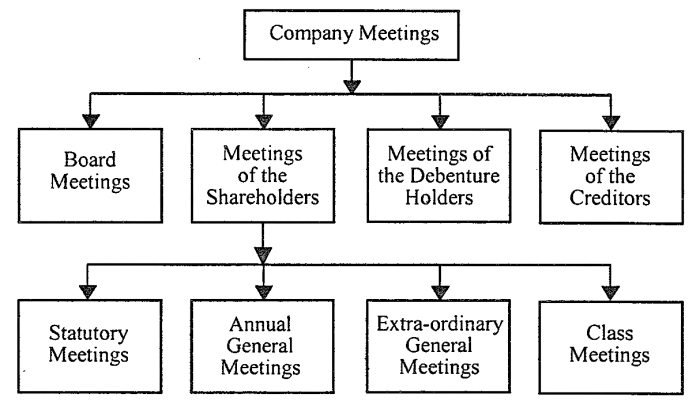
Company Meetings: Statutory, Annual general meeting, Extraordinary Meeting

Statutory Meeting

Statutory Meeting is the first meeting of the shareholders of a public company. It must be held within a period of not less than one month nor more than 6 months from the date at which the company is entitled to commence business. It is held only once in the lifetime of a company. A private company and a company limited by guarantee and not having a share capital need not hold such a meeting.

The purpose of the statutory meeting with its statutory report is to put the shareholders of the company in the possession of all the important facts relating to the new company, what shares have been taken up, what the moneys received etc. This also provides an opportunity to the shareholders of meeting to discuss the whole situation, the management and prospects of the company.

The Board of Directors must, atleast 21 days before the day on which the meeting is to be held, A forward a report, called the ‘statutory report’ to every member of the company. This report contains all the necessary information relating to formational aspects of the company for the information of the shareholders.

Contents of Statutory Report

  1. The total number of shares allotted, distinguishing those allotted as fully or partly paid up otherwise than in cash, the extent to which they are partly paid up, the consideration for which they have been allotted and total amount received in cash;
  2. An abstract of the receipts and payments under distinctive heads upto a date within seven days of the date of report;
  3. An account of estimate of the preliminary expenses of the company.
  4. The names, addresses and occupations of the managing director, director, and also its secretary and auditors of the company;
  5. The particulars of any contract which, and the modification or proposed modification of which, are to be submitted to the meeting for approval;
  6. The extent to which underwriting contracts, if any, have not been carried out and the reason therefor;
  7. The arrears, if any, due on calls from directors, managing director or manager; and
  8. The particulars of any commission or brokerage paid, or to be paid, in connection with the issue or sale of shares to any director, managing director or manager.

Annual General meeting

Annual General Meeting (AGM) is a yearly meeting of stockholders or shareholders, members of company, firm and organizations. Annual General Meeting is held every financial year and it is mandatory for everyone. In AGM functions like reviewing company account, approving audited accounts, elections, fiscal records of the past year are discussed.

As per Companies Act, an annual general meeting must be held by every company once a year without fail. There cannot be a gap of more than 15 months between two AGMs.

However, the first AGM of a company can be held at any date, within a period of 18 months, since the date of incorporation of the company. Annual general meetings help members understand the company’s rate of growth and potential for improvement.

An AGM gives insights into what steps made the company more successful and which steps caused loss. it helps the members and the board to decide the future course of action. An AGM must be held on a working day.

If the Government declares a public holiday on the day of the meeting, it will be considered a working day by the members attending the meeting. The annual general meeting can be held at the registered office of the company.

Legal Requirements for holding an Annual General Meeting

Legally, a notice period of 21 days must be given to all the members before the meeting. However, there is an exception to this rule. If all the voting members consent, the meeting may be held at an earlier date. Further, the following documents are also to be sent with the notice. Articles of Association, company bylaws, and jurisdiction specifies the rules that govern annual general meeting.

  • Copy of annual accounts of the company
  • Director’s report on the company’s position for the given year
  • Report by the Auditor of the annual accounts.

Members are allowed to use proxies in their absence. The proxy does not need to be a member of the company. However, the proxy forms have to be submitted to the company at least 48 hours before the meeting.

Quorum for Annual General Meeting

Unless the articles of the company state otherwise, the quorum for an Annual General Meeting is as follows

  • Public companies: At least 5 members must be present.
  • Other companies:At least 2 members must be present within half an hour of the commencement of the meeting.

Issues Undertaken at Annual General Meeting

The functions of business undertaken at a typical annual general meeting are listed as follows:

  • The declaration of dividend among shareholders
  • Consideration of annual accounts
  • Discussion of the director’s report and the auditor’s report
  • Appointment and fixing of the remuneration of the statutory auditors
  • Appointing replacement directors in place of existing directors retiring

Extraordinary meeting

An Extraordinary General Meeting (an EGM) can be defined as a meeting of shareholders which is not an Annual General Meeting (an AGM). It is held when some urgent issue becomes about the company arises or any situation of crisis and it requires the input of all senior executives and the Board.

As we know, an EGM is held in case of emergency situations and requires the attention of senors execs and the Board. Members, shareholders, and execs must be instructed on the purpose of the meeting so they have time to prepare their valuable input and then, collectively decide further course of action.

Who can Call for an EGM

The members/shareholders of a company can call for an extraordinary general meeting. However, only certain members with a significant stake in the company are allowed to call for an EGM. They are listed in the Companies Act,2013 as follows.

  • In the case of a company having a share capital, members holding not less than one-tenth of such paid-up capital of the company that carry voting rights in regard to that matter as on the date of depositing the requisition;
  • In the case of a company not having a share capital, members holding not less than one-tenth of the total voting power in regard to that matter as at the date of deposit of the requisition.
  • EGM called by Board.  Upon the receival of a valid requisition, the Board has a period of 21 days to call for an EGM. The EGM must be then held with 45 days from the day of the EGM being called.
  • EGM called by the requisitionists: In case the Board fails to call for an EGM, it can be called for by the requisitionists themselves during a period of 3 months from the day the requisition was deposited. If the EGM is held within this specified period of 3 months, it can be adjourned to any day in the future after the 3 months.

Essentials of a Valid Requisition

  1. Specify the issue for which the meeting is called
  2. Signed by requisitionists
  3. Must be deposited at the company’s registered office.

Requirements for holding an EGM

A notice period of 21 days must be given to the members. However, there is an exception to this rule. Where if 95% of the voting members consent, the EGM can be held at a shorter notice.

Quorum Required for EGM

Unless the company’s Articles state otherwise, the following number of members are required for a quorum.

  • In the case of a public company: Five(5) members personally present
  • In the case of any other company: Two (2) members personally present

Quorum for Different Meetings

Quorum means the minimum number of persons who being entitled to attend a meeting must be present at the meeting so that the business of the meeting can be transacted validly. Such a number is desirable so that a meeting gets a representative character and no decisions are taken with a very small number of persons being present.

At the same time the quorum shall not be too big so that a meeting falls through on account of small attendance.

Features of Quorum:

(1) What shall be the quorum for different types of meetings of an organisation are usually mentioned in its bye-laws or in the Articles of Association in case of a company. Some statutes also make such provisions. For example Sec. 174 of the Companies Act makes such provisions. The bye-laws or the Articles cannot provide smaller quorum than what are provided in the statutes, if any.

(2) A meeting cannot be started if quorum is not present. The quorum might be continuously present. If any member or members leaves or leave earlier and by that the quorum falls, then any decision taken afterwards will not be binding, if the by-laws or Articles so provide.

(3) It is the duty of the chairman to see that the quorum is present. The secretary helps him in counting the quorum. If at the middle of the meeting quorum falls, any member present may draw the attention of the chairman to this fact by raising a ‘point of order’.

(4) If quorum is not present at the scheduled hour of a meeting already notified, then the members present will wait for half an hour.

After half an hour the following alternative effects can take place:

(A) In Case of an Informal Meeting:

(i) The chairman may allow informal discussions but no binding decisions can be taken. The meeting is adjourned and can be held afterwards after giving fresh notice.

(ii) If the quorum is missing by a small margin, the chairman may allow discussions and decisions may be taken which, however, have to be formally ratified at a next meeting where quorum must be present.

(B) In Case of Any Meeting of a Company:

The Act provides that the meeting shall be adjourned:

(i) In case of a general meeting to the same day in the next week, at the same time and place or to such other day and at such other time and place as the Board may determine.

(ii) In case of a Board meeting, unless the Articles otherwise provide, to the same day in the next week, at the same time and place or if that day is a holiday till the next succeeding day which is not a public holiday, at the same time and place.

(iii) In case of an extraordinary general meeting requisitioned by members the meeting is not adjourned and the meeting just fails.

(5) In case of a members’ meeting of a company where proxy is allowed only members present in person are counted for quorum and not the proxies but representatives are counted

(6) When fraction comes out while calculating quorum (like one-third, one-fourth) the next round number is taken into account.

(7) Conflicting views exist with regard to counting when there are joint holders of shares. Generally it is accepted that joint holders of shares shall be treated as a single member. Some people think that each joint holder is a separate member if his name appears in the Register of Members.

Where Quorum is Strictly not Necessary:

Normally the quorum is necessary for a valid meeting.

But in the following circumstances a less number of persons may make the quorum:

(1) Whenever a meeting is adjourned for want of quorum, any number of members present at the adjourned meeting shall make the quorum.

(2) At a Board meeting when a matter comes up in which one or more than one director is or are interested then, director or directors concerned cannot take part in the discussion. The remaining directors shall make the quorum. If only on- director is left out then of course there cannot be a quorum and the matter shall be referred to a general meeting of members for decision.

(3) In case of class meetings if one person alone holds all the shares of that particular class of shares then he alone shall make the quorum.

(4) In case of an annual general meeting of a company (ailed by the order of the Central Government on the complaint by only one member of the company, or a general meeting called by the Company Law Board on the application of one member of the company then the member alone present in person or by proxy, shall make the quorum when the meeting is held.

The General Patterns of Quorum:

Every company in its Articles of Association or an association in its bye laws or a Com­mittee or Sub-Committee in its own rules and regulations usually provides what shall be the quorum for the different kinds of meetings to be held under it. The quorum for a general meeting is usually one-fourth or one-third of the total number of members or a fixed number like ten, fifteen etc. taking into consideration the total strength of the members.

The Companies Act is very liberal and provides that if nothing is mentioned in the Articles then any two members in case of a private company and any five members in case of a public company, present in person at a general meeting, shall make the quorum.

The quorum for the meeting of an important committee, like the Executive Committee or Managing Committee, is generally fixed at one-third. The Companies Act provides that the quorum for Board meeting, if nothing is provided in the Articles, shall be one-third or two whichever is bigger.

The directors themselves at the first Board meeting may fix the quorum for Board meetings. In some special cases, the quorum is fixed at a big percentage of the total number of members. For example, the quorum for a class meeting in a company is very often fixed by the Articles to be two- thirds or three-fourths or all the shareholders belonging to that class.

Sometimes all the members make the quorum. For example, in a private company having only two directors, both the directors shall make the quorum at a Board meeting. Again, in a private company having only two shareholders, both the members shall make the quorum at a general meeting.

Issue of Debentures

Company debenture is one of the important sources of finance for large companies, in addition to equity stocks, bank loans, and bonds. Companies need to follow certain procedures for issue of debentures to raise money. There are several ways of issuing a debenture viz. at a par, premium or discount and even for consideration other than cash.

Issue of Debentures

The procedure of issuing debentures by a company is similar to the one followed while issuing equity stocks. The company starts by releasing a prospectus declaring the debenture issuance. The interested investors, then, apply for the same. The company may need the entire amount while applying for the debentures or may ask for installments to be paid while submitting the application, on allotment of debentures or on various calls by the company. The company can issue debentures at a par, at a premium or at a discount as explained below.

Different ways for issuing of Debenture

Once the company invites the applications and the investors apply for the debentures, the company can issue debentures in one of the following ways:

Issue of Debenture at par

When the issue price of the debenture is equal to its face value, the debenture is said to be issued at par. When a debenture is issued at par, the long-term borrowings in the liabilities section of the balance sheet equals the cash in the assets side of the balance sheet. Thus, no further adjustment is required to balance the assets and the liabilities of the company. The company can collect the whole amount in one installment i.e on an application or in two installments i.e. on an application and subsequent allotment. However, there might be a scenario in which money is collected in more than two installments i.e. on an application, on an allotment and at various calls by the company.

Issue of debenture at discount

The debenture is said to be issued at a discount when the issue price is below its nominal value. Let us take an example – a Rs. 100 debenture is issued at Rs. 90, then Rs.10 is the discount amount. In such a scenario, the liabilities and the assets sides of the balance sheet do not match. Thus, the discount on debentures’ issuance is noted as a capital loss and is charged to ‘Securities Premium Account’ and is reflected as an asset. The discount can be written off later.

Issue of Debenture At Premium

When the price of the debenture is more than its nominal value, it is said to be issued at a premium. For example, a Rs. 100 debenture is issued for Rs.105 and Rs.5 is the premium amount. Again, assets and liabilities do not match in such situation. Therefore, the premium amount is credited to Securities Premium Account and is reflected under ‘Reserves and Surpluses’ on the liabilities side of the balance sheet.

The Issue of Debenture as Collateral

The debentures can be issued as a collateral security to the lenders. This happens when the lenders insist on additional assets as security in addition to the primary security. The additional assets may be used if the complete amount of loan cannot be realized from the sale of the primary security. Therefore, the companies tend to issue debentures to the lenders in addition to some other physical assets already pledged. The lenders may redeem or sell the debentures on the open market if the primary assets do not pay for the complete loan.

Issue of Debenture for Consideration Other Than Cash

Debentures can also be issued for consideration other than cash. Generally, companies follow this route with their vendors. So, instead of paying the cash for the assets purchased from the vendor, the companies issue debentures for consideration other than cash. In this case, also, the debentures can be issued at a par, premium or discount and are accounted for in the similar fashion.

Over Subscription

The company invites the investors to subscribe to its debenture issue. However, it may happen that the applications received for the debentures may be more than the original number of debentures offered. This scenario is referred to as oversubscription. In the case of over-subscription, a company cannot allocate more debentures than it had originally planned to issue. So, the company refunds the money to the applicants to whom debentures are not allotted. However, the excess money received from applicants who are allocated debentures is not refunded. The same money is used towards allotment adjustment and the subsequent calls to be made.

error: Content is protected !!