Event: Mutually Exclusive Events, Collectively Exhaustive Events, Independent Events, Simple and Compound Events

Mutually Exclusive Events

When two events (call them “A” and “B”) are Mutually Exclusive it is impossible for them to happen together:

P(A and B) = 0

“The probability of A and B together equals 0 (impossible)”

But, for Mutually Exclusive events, the probability of A or B is the sum of the individual probabilities:

P(A or B) = P(A) + P(B)

“The probability of A or B equals the probability of A plus the probability of B”

Collectively Exhaustive Events

In probability, a set of events is collectively exhaustive if they cover all of the probability space: i.e., the probability of any one of them happening is 100%. If a set of statements is collectively exhaustive, we know at least one of them is true.

If you are rolling a six-sided die, the set of events {1, 2, 3, 4, 5, 6} is collectively exhaustive. Any roll must be represented by one of the set.

Sometimes a small change can make a set that is not collectively exhaustive into one that is. A random integer generated by a computer may be greater than or less than 5, but those are not collectively exhaustive options. Changing one option to “greater than or equal to five” or adding five as an option makes the set fit our criteria.

Another way to describe collectively exhaustive events is that their union must cover all the events within the entire sample space. For example, events A and B are said to be collectively exhaustive if

A U B=S

where S is the sample space.

Independent Events

Independent Events are not affected by previous events.

A coin does not “know” it came up heads before.

And each toss of a coin is a perfect isolated thing.

Probability of an event happening = Number of ways it can happen / Total number of outcomes

Simple and Compound Events

A simple event is one that can only happen in one way in other words, it has a single outcome. If we consider our previous example of tossing a coin: we get one outcome that is a head or a tail.

A compound event is more complex than a simple event, as it involves the probability of more than one outcome. Another way to view compound events is as a combination of two or more simple events.

Simple Event

An event that has a single point of the sample space is known as a simple event in probability.

Probability of an event occurring = No. of favorable outcomes / Total no. of outcomes

Compound Event

If an event has more than one sample point, it is termed as a compound event. The compound events are a little more complex than simple events. These events involve the probability of more than one event occurring together. The total probability of all the outcomes of a compound event is equal to 1.

To calculate probability, the following formula is used:

Probability of an event = [The number of favorable outcomes] / [the number of total outcomes].

First, we find the probability of each event occurring. Then we will multiply these probabilities together. In the case of a compound event, the numerator (number of favourable outcomes) will be greater than 1.

For example, the probability of rolling an odd number on a die, then tossing a head on a coin.

Here P(odd number) = 3/6

P(head) = 1/2

Hence required probability = (3/6)(½ )

= 3/12           

Deseasonalisation of Data

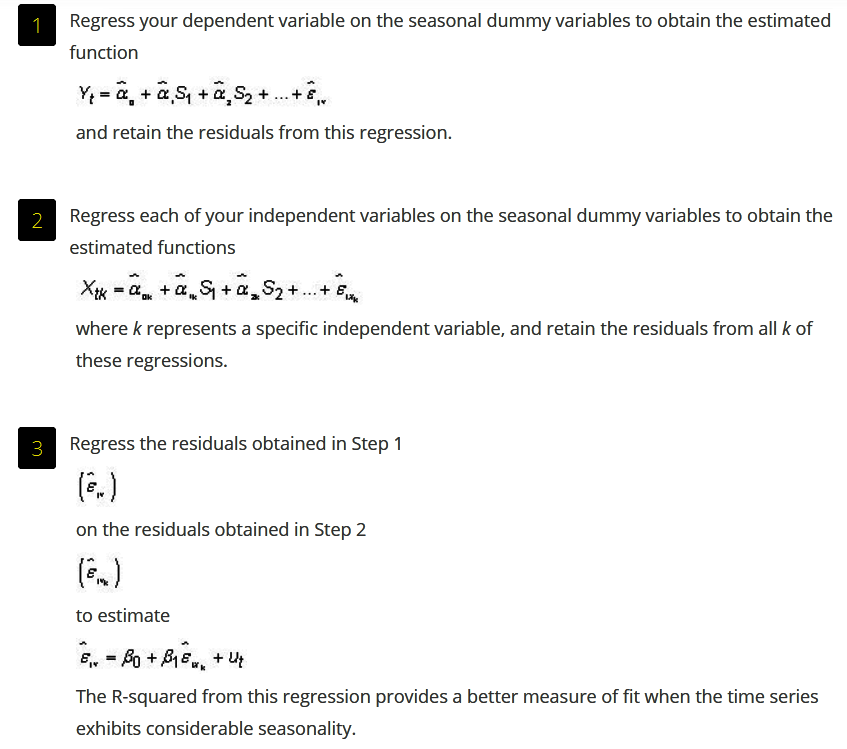
Seasonality is a characteristic of a time series in which the data experiences regular and predictable changes that recur every calendar year. Any predictable fluctuation or pattern that recurs or repeats over a one-year period is said to be seasonal.

Seasonal effects are different from cyclical effects, as seasonal cycles are observed within one calendar year, while cyclical effects, such as boosted sales due to low unemployment rates, can span time periods shorter or longer than one calendar year.

Seasonality Types

There are three common seasonality types: yearly, monthly and weekly.

(i) Yearly seasonality

Yearly seasonality encompasses predictable changes in demand month over month and are consistent on an annual basis. For example, the purchase of swimsuits and sunscreen prior to the summer months and notebooks and pens leading up to the new school year.

(ii) Monthly seasonality

Monthly seasonality covers variations in demand over the course of a month, like the purchasing of items biweekly when paychecks come in or at the end of the month when there’s extra money in the budget.

(iii) Weekly seasonality

Weekly seasonality is a characteristic of more general product consumption and reflects a host of variables. You may find that consumers buy more (or less) of different products on different days of the week.

Challenges in estimating seasonality indices

The seasonality model illustrated here above is a rather naive approach that work for long smooth seasonal time-series. Yet, there are multiple practical difficulties when estimating seasonality:

  • Time-series are short. The lifespan of most consumer goods do not exceed 3 or 4 years. As a result, for a given product, sales history offers on average very few points in the past to estimate each seasonal index (that is to say the values of S(t) during the course of the year, cf. the previous section).
  • Time-series are noisy. Random market fluctuations impact the sales, and make the seasonality more difficult to isolate.
  • Multiple seasonalities are involved. When looking at sales at the store level, the seasonality of the product itself is typically entangled with the seasonality of the store.
  • Other patterns such as trend or product lifecycle also impact time-series, introducing various sort of bias in the estimation.

In many cases, seasonal patterns are removed from time-series data when they’re released on public databases. Data that has been stripped of its seasonal patterns is referred to as seasonally adjusted or deseasonalized data.

Semi Average Method

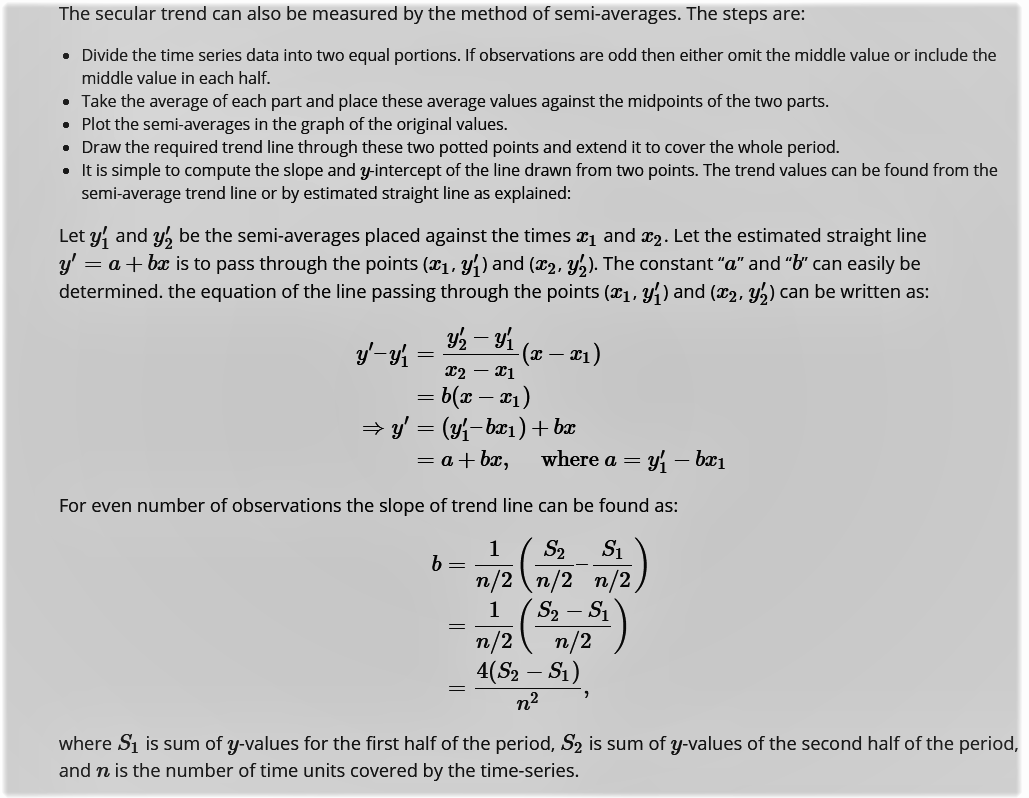
Under this method, as the name itself suggests semiaverages are calculated to find out the trend values. By semi-averages is meant the averages of the two halves of a series. In this method, thus, the given series is divided into two equal parts (halves) and the arithmetic mean of the values of each part (half) is calculated. The computed means are termed as semi-averages. Each semi-average is paired with the centre of time period of its part. The two pairs are then plotted on a graph paper and the points are joined by a straight line to get the trend. It should be noted that if the data is for even number of years, it can be easily divided into two halves. But if it is for odd number of years, we leave the middle year of the time series and two halves constitute the periods on each side of the middle year.

Advantages:

  1. It is simple method of measuring trend.
  2. It is an objective method because anyone applying this to a given data would get identical trend value.

Disadvantages:

  1. This method can give only linear trend of the data irrespective of whether it exists or not.
  2. This is only a crude method of measuring trend, since we do not know whether the effects of other components are completely eliminated or not.


Uses and Limitations of Time Series

Understanding data

Another benefit of time series analysis is that it can help an analyst to better understand a data set. This is because of the models used in time series analysis help to interpret the true meaning of the data, as touched on previously.

Opportunity to Clean data

The first benefit of time series analysis is that it can help to clean data. This makes it possible to find the true “signal” in a data set, by filtering out the noise. This can mean removing outliers, or applying various averages so as to gain an overall perspective of the meaning of the data.

Of course, cleaning data is a prominent part of almost any kind of data analysis. The true benefit of time series analysis is that it is accomplished with little extra effort.

Forecasting data

Last but not least, a major benefit of time series analysis is that it can be the basis to forecast data. This is because time series analysis by its very nature uncovers patterns in data, which can then be used to predict future data points.

For example, autocorrelation patterns and seasonality measures can be used to predict when a certain data point can be expected. Further, stationarity measures can be used to estimate what the value of that data point will be.

Really, it’s the forecasting aspect of time series analysis that makes it so popular in business applications. Analyzing and understanding past data is all good and well, but it’s being able to predict the future that helps to make optimal business decisions.

Time Series Analysis Helps You Identify Patterns

Memories are fragile and prone to error. You may think that your sales peak before Christmas and hit their bottom in February… but do they really?

The simplest and, in most cases, the most effective form of time series analysis is to simply plot the data on a line chart. With this step, there will no longer be any doubts as to whether or not sales truly peak before Christmas and dip in February.

Limitations

Time series methods draw on vastly different areas in statistics, and lately, machine learning. You have to know a lot about all of these things, in general, to make sense of what you’re doing. There is no real unification of the theory, either.

Often there are ways around getting a model that is time-series based where the predictions are almost as good and is faster to implement. Note that this may or may not blow up in your face later on. In some cases, however, temporal effects are so weak that it makes more sense to just use the non-temporal ones… which can be difficult to explain (the need to check) to a manager if we’ve had to spend 2.5 weeks setting up the tests for temporal effects. Personal experience here.

This is hard stuff, and if you’re not motivated by challenge, you can get overwhelmed. Also, there is, in some other areas of data science, the notion that all we use are ARIMA models and EWMA; while we do often use these tools, we also use RNN and LTSM networks and a whole lot of interesting things.

Most machine learning algorithms don’t deal with time well.

Problems in the Construction of Index Numbers

  1. Difficulties in the Selection of Commodities:

The selection of representative commodities for the index number is another difficulty. The choice of representative commodities is not an easy matter. They have to be selected from a wide range of commodities which the majority of people consume. Again, what were representative commodities some ten years ago may not be representative today. The consumption pattern of consumers might change and thereby make the index number useless. So, the choice of representative commodities presents real difficulties.

  1. Difficulties in the Selection of the Base Period:

The first difficulty relates to the selection of the base year. The base year should be normal. But it is difficult to determine a truly normal year. Moreover, what may be the normal year today may become an abnormal year after some period. Therefore, it is not advisable to have the same year as the base period for a number of years. Rather, it should be changed after ten years or so. But there is no fixed rule for this.

  1. Difficulties in the Collection of Prices:

Another difficulty is that of collecting adequate and accurate prices. It is often not possible to get them from the same source or place. Further, the problem of choice between wholesale and retail prices arises. There are much variations in the retail prices. Therefore, index numbers are based on wholesale prices.

  1. Arbitrary Assigning of Weights:

In calculating weighted price index, a number of difficulties arise. The problem is to give different weights to commodities. The selection of higher weight for one commodity and a lower weight for another is simply arbitrary. There is no set rule and it entirely depends on the investigator. Moreover, the same commodity may have different importance for different consumers. The importance of commodities also changes with the change in the tastes and incomes of consumers and also with the passage of time. Therefore, weights are to be revised from time to time and not fixed arbitrarily.

  1. Not All Purpose:

An index number constructed for a particular purpose cannot be used for some other purpose. For instance, a cost of living index number for industrial workers cannot be used to measure the cost of living of agricultural workers. Thus there are no all purpose index numbers.

  1. International Comparisons not Possible:

International price comparisons are not possible with index numbers. The commodities consumed and included in the construction of an index number differ from country to country. For instance, meat, eggs, cars, and electrical appliance are included in the price index of advanced countries whereas they are not included in that of backward countries. Similarly, weights assigned to commodities are also different. Thus, international comparisons of index numbers are not possible.

  1. Comparisons of Different Places not Possible:

Even if different places within a country are taken, it is not possible to apply the same index number to them. This is because of differences in the consumption habits of people. People living in the northern region consume different commodities than those consumed by the people in the south of India. It is, therefore, not right to apply the same index number to both.

  1. Not Applicable to an Individual:

An index number is not applicable to an individual belonging to a group for which it is constructed. If an index number shows a rise in the price level, an individual may not be affected by it. This is because an index number reflects averages.

  1. Difficulty of Selecting the Method of Averaging:

Another difficulty is to select an appropriate method of calculating averages. There are a number of methods which can be used for this purpose. But all methods give different results from one another. It is, therefore, difficult to decide which method to choose.

  1. Difficulties Arising from Changes Overtime:

In the present times, changes in the nature of commodities are taking place continuously overtime due to technological changes. As a result, new commodities are introduced and people start consuming them in place of the old ones. Moreover, prices of commodities might also change with technical changes. They may fall. But new commodities are not entered into the list of commodities in preparing the index numbers. This makes the index numbers based on old commodities unreal.

Using Regression Lines for Prediction

Linear regression analysis is a powerful technique used for predicting the unknown value of a variable from the known value of another variable.

More precisely, if X and Y are two related variables, then linear regression analysis helps us to predict the value of Y for a given value of X or vice verse.

Using regression to make predictions doesn’t necessarily involve predicting the future. Instead, you predict the mean of the dependent variable given specific values of the independent variable(s). For our example, we’ll use one independent variable to predict the dependent variable. We measured both of these variables at the same point in time.

Photograph of a crystal ball that a psychic uses to make predictions. Psychic predictions are things that just pop into mind and are not often verified against reality. Unsurprisingly, predictions in the regression context are more rigorous. We need to collect data for relevant variables, formulate a model, and evaluate how well the model fits the data.

But suppose the correlation is high; do you still need to look at the scatterplot? Yes. In some situations the data have a somewhat curved shape, yet the correlation is still strong; in these cases making predictions using a straight line is still invalid. Predictions in these cases need to be made based on other methods that use a curve instead.

  • Regression explores significant relationships between dependent variable and independent variable
  • Indicates the strength of impact of multiple independent variables on a dependent variable
  • Allows us to compare the effect of variable measures on different scales and can consider nominal, interval, or categorical variables for analysis.

Linear regression does not test whether data is linear. It finds the slope and the intercept assuming that the relationship between the independent and dependent variable can be best explained by a straight line.

One can construct the scatter plot to confirm this assumption. If the scatter plot reveals non linear relationship, often a suitable transformation can be used to attain linearity.

Dividends u/s. 2(22)

Under Sec 2(22)(b)

  • Distribution of Debenture, Debenture stocks or Deposit Certificate in any form with or without interest by the company to its shareholders shall be deemed as a dividend.
  • Distribution of Bonus shares to the Preference shareholders shall also be deemed as a dividend.

SEC 2(22)(c): Distribution of Assets on Liquidation deemed as Dividend

  • Distribution of the asset made to the shareholders of the company at the time of its liquidation shall be treated as the deemed dividend to the extent of the accumulated profits of the company immediately before it’s liquidation, whether capitalized or not.
  • Fair Market Value of the asset shall be taken for the purpose of computing the deemed dividend u/s 2(22)(c).

SEC 2(22)(d) Distribution on Reduction of Share Capital Deemed as Dividend

  • Any distribution made by the company on the reduction of share capital to the extent to which company possesses accumulated profits, whether capitalized or not.
  • For the purpose of computing the Dividend under this Section, FMV of the assets on the date of distribution shall be taken.

Exceptions:

  1. If the loan is granted in the ordinary course of its business and lending of money is a substantial part of the company’s business, the loan or advance to a shareholder or to the specified concern is not deemed to be a dividend.
  2. Where a loan had been treated as a dividend and subsequently the company declares and distributes a dividend to all its shareholders including the borrowing shareholder, and the dividend so paid is set off by the company against the previous borrowing, the adjusted amount will not be again treated as a dividend.

Other exceptions:

Apart from the exceptions cited above, the following also do not constitute “dividend”:

  1. Any payment made by a company on purchase of its own shares from a shareholder in accordance with the provisions of section 77A of the Companies Act, 1956;
  2. Any distribution of shares on demerger by the resulting companies to the shareholders of the demerged company (whether or not there is a reduction of capital in the demerged company).

Winnings from lotteries Puzzles, crown world puzzles, Races

Section 2(24) (ix) provides that any winnings from lotteries, crossword puzzles, races, including horse races, card games and other games of any sort, including TV games, or from gambling or betting or any form or nature whatsoever will be included in the definition of “income from other sources”.

It is clearly provided in Section 58 that no deduction in respect of any expenditure or allowance would be allowed in connection with income by way of winnings from lotteries, crossword puzzles, races including horse races, card games and other games of any sort or from gambling of betting of any form or nature.

  1. Special rate of Income-tax in case of winnings from lotteries, crossword puzzles, races, etc. [Section 115BB]:

Although, winnings from lotteries, etc. is part of total income of the assessee, such income is taxable at a special rate of Income-tax, which at present, is

30% + education cess @ 2% + SHEC @ 1%.

Deduction of any expenses, allowance or loss not allowed from such winnings:

According to section 58(4), no deduction in respect of any expenditure or allowance, in connection with such income, shall be allowed under any provision of the Income-tax Act. However, expenses relating to the activity of owning and maintaining race horses are allowable.

In other words, the entire income of winnings, without any expenditure or allowance, will be taxable. In fact, deduction under sections 80C to 80U on Deductions from Gross Total Income will also not be available from such income although such income is a part of the total income.

As lottery income is taxed at flat rate, the basic exemption of income (say Rs. 5,00,000) is not available to the assessee.

  1. Grossing up of Lottery Income, etc.:

As in the case of some other incomes, there is also a provision for tax to be deducted at source from income from winning of lotteries, horse races and crossword puzzles. The rate of TDS in the case of such incomes is 30% if the income exceeds Rs. 10,000. Such tax deducted at source is income and the amount received is net income after deduction of tax at source.

Interest on Securities

An interest in securities is the asset of a client for whom an intermediary holds security on an unallocated basis, commingled with the interests in securities of other clients. The distinction between securities and interests in securities is often overlooked in practice.

Interests in securities are always intangible. The only evidence of them comprises electronic records. Interests in securities confer property rights in relation to the underlying securities, and in some cases, these underlying securities comprise tangible bearer instruments. However, this does not mean that interests in securities are themselves tangible. They are unallocated, and therefore do not attach to any tangible asset.

In income-tax parlance, security is a document possessed by the creditor as a guarantee for the payment indebted to him. Interest on securities refers to any of the following types of income:

  • Interest on any security which has been issued by the Central Government or State Government.
  • Interest on debentures or other securities for money issued by on or behalf of a local authority or a company/co-operation established by a Central, State or Provincial Act.

Basis of Charge

If the assessee maintains books of account on a cash basis, interest by way of interest on securities is taxable on receipt basis. If the books are being maintained on the mercantile system, it is taxable on due basis. It is again taxable on receipt basis if such interest had not been charged to tax on the due basis for any earlier previous year.

Due Date of Interest

Interest on securities does not accrue on a daily basis or according to the period on which investment is held. It becomes due on the due dates specified on securities.

Interest Exempt from Tax

Interest on notified securities, as well as notified bonds and certificates, are fully exempt from tax. Also, interest on Post Office savings bank account is exempt up to an amount of Rs 3,500 with respect to an individual, and Rs 7,000 in the case of a joint account.

Grossing up of Interest

Grossing up mechanism specifies that the payer must ensure complete payment of the amount due to the recipient, which precisely means that the payer must cover the tax deduction costs of the payee.

Gross interest, which is derived after adding net interest with tax deducted at source, is taxable. Net interest is grossed up in the hands of the recipient if the payer deducts tax at source. Net interest is grossed up by using the following formula:

100/ (100 – Rate of tax deduction at source)

Avoidance of Tax

As already discussed, interest on securities does not accrue on a daily basis, but on certain stipulated dates. Given this scenario, there might be instances where a person transfers securities to another person on a few days or even the evening prior to the due date and reacquires the same or similar securities after the receipt of interest by the transferee. This would enable the transferor to evade tax in respect of such interest. Such a transaction is popularly known as a bond washing transaction. The following measures have been suggested to prevent tax avoidance:

When Income Belongs to the Transferor

Section 94(1) of the Income-tax Act provides that, if a security owner transfers the securities on the eve of the due date of interest and acquires them back at a later point of time, the interest received by the assessee will not be a part of the assessee’s income, but the transferor’s, thereby forcing the transferor to remit his/her tax dues.

When Tax is Avoided through Sale of Interest-bearing Securities

Other than what is known as a bond washing transaction, sale of securities cum-interest is another method of avoiding tax. Selling of sales cum- interest refers to a situation where an assessee, who holds a beneficial interest in securities during the previous year, sells them in a manner that either no income is received or income received is lesser than the sum he would have received if interest had accrued on a daily basis. In this case, income from securities for the particular year would be deemed as income of such person. The aforementioned anti-avoidance measures are not applicable if the owner of securities proves to the satisfaction of the Assessing Officer that there has been no avoidance of income tax or the avoidance of income-tax was exceptional and not systematic, and hence there was not any avoidance of income-tax.

Section 194A of the Income Tax Act

It describes and lays out the provisions under which TDS will be applicable for deduction on interest incomes or payments on anything but securities.

Following are some of its salient features:

  • TDS is deductible on interest against fixed deposits, recurring deposits, loans and advances of both a secured (for instance, against collateral) and unsecured nature.
  • TDS Deductible on interest against securities are also considered under the TDS rules; however, the provisions with respect to that are covered under Section 193 of the Income Tax Act.
  • This section is only applicable to the residents of India. Hence, all the provisions are not applied to Non-Resident Indians.
  • Payments made to NRIs are also subject to TDS deductions, but that portion is covered in Section 195 of the Income Tax Act.
  • In case an individual or an entity is not liable to pay taxes since their incomes do not exceed the minimum income slab which is taxable as per the government regulations, the respective entities can submit a copy of either Form 15G (for resident Indians under the age of 60 and Hindu Undivided Families) or Form 15H (for resident Indians either turning 60 during the Financial Year or who have already turned 60) to the payer of the interest.

The following persons are required to deduct TDS according to section 194A:

  • An individual or a Hindu Undivided Family provided that under and as per Section 44AB of the Income Tax Act of 1961, they are liable to get their accounts audited by a Chartered Accountant. Other individuals and Hindu Undivided Families are exempted from these provisions of Section 194A of the Income Tax Act.
  • All other entities described as “assessees” by the Income Tax Act of 1961, such as a Partnership, a Company, an Association of Persons (AOP) or a Body of Individuals (BOI).

The following persons are required to deduct TDS according to section 194A:

  • This type of income tax is to be deducted by the entities described above, either at the time of payment of interest thereof in either cash, cheque, draft or any other mode, or when the said interest payment is credited to the account of the individual receiving the tax, whichever is earlier.
  • In the cases in which such interest is credited to accounts such as Interest Payable Accounts or Suspense Accounts or any other accounts, conditions laid down under Section 194A shall apply and TDS will have to be deducted.

No TDS is to be deducted for interest payable on the following bonds / securities:

  • Interest on 7 year National Savings Certificate (IV issue).
  • Interest on the National Development Bonds.
  • Interest on 4.25% National Defence Loan, 1968 or National Defence Loan, 1972 held by an Individual.
  • Interest on 4.25% National Defence Bonds, 1972 held by a resident Individual.
  • Interest on Security of the Central Government or a State Government provided the interest amount doesn’t exceed INR 10,000.
  • Interest on 6.5% Gold Bonds, 1977 or 7% Gold Bonds, 1980 held by a resident Individual only if the total nominal value of the bonds didn’t exceed INR 10,000 at any time during the period to which the interest relates.
  • Interest on debentures to a resident individual or HUF provided the aggregate amount of interest doesn’t exceed INR 5,000, and the interest is paid by cheque.
  • Interest on debentures issued by notified institution/authority/public sector company/a co-operative society.
  • Interest to the Life Insurance Corporation on the securities owned by it or in which it has a full beneficial interest.
  • Interest to the General Insurance Corporation on the securities owned by it or in which it has a full beneficial interest.
  • Interest to any other insurer on the securities owned by it or in which it has a full beneficial interest.
  • Interest on securities only if issued by a company in dematerialized form and listed on the recognized stock exchange.

Exemption limit under section 193 of income tax act

There is no exemption limit specified in case of TDS under section 193 except two following cases;

  • In the case of debentures issued by listed companies the limit is Rs. 5000 provided such amount should be given by an account payee cheque. And
  • In case of 8% saving (taxable) bonds the limit is Rs. 10, 000.

Gifts received by an Individual

India is a country of close-knitted families and having a lot of reasons to celebrate owing to its diversified culture, customs and religion. Numerous occasions arise where gifts are exchanged. In fact, gifting each other is a symbol of love and affection and can also be a symbol of social status.

However, many a time gifts can also be a part of tax planning/tax evasion. While tax planning done within the framework of law is permissible, tax evasion is prohibited and can be penalized.

The Government introduced gift tax in April 1958 regulated by Gift Tax Act, 1958 (The GTA) with an objective to impose taxes on giving and receiving gifts under certain specific circumstances. Gifts in the form of cash, demand draft, bank cheques, or anything having value were covered.

However, the GTA was abolished in October 1998 and made all gifts tax-free. But, Gift Tax was reintroduced in a new form and included in the Income-tax provisions in 2004. It is highly important to have a basic understanding of taxation on gifts in India to avoid any ignorant /unplanned tax outflow.

As per section 56(2)(x) of Income Tax Act, gifts received by an individual or a hindu undivided family in the form of money or property (without consideration or with inadequate consideration) is taxable as income under the head Income from Other Sources provided such income falls under five categories mentioned below and such income does not fall in the exempted category.

Property

Property means the following capital assets of the recipient:

1) Immovable property being land or building or both

2) Shares and securities

3) Jewellery

4) Archaeological collection

5) Drawings

6) Paintings

7) Sculptures

8) Any work of art

9) Bullion

Category Criterion for taxability Taxable income For ceiling limit of Rs.50,000 whether a single or all transactions of PY will be considered
1. Any sum of money (Gift in cash/cheque/ draft other than loan) Aggregate amount received from one or more persons during the previous year (PY) exceeds Rs.50,000 Whole of such aggregate amount All transactions
2. Immovable property without consideration Stamp duty value of the property exceeds Rs.50,000 Stamp duty value Single transaction
3. Immovable property for a consideration which is less than stamp duty value Property is received for a consideration which is less than stamp duty value by an amount exceeding Rs.50,000 Difference between the stamp duty value and the consideration is more than the higher of the following amounts:

(i) the amount of fifty thousand rupees; and

(ii) the amount equal to five per cent of the consideration

Then excess differential amount will be taxable

Single transaction
4. Movable property without consideration Aggregate fair market value (FMV) of properties received exceed Rs.50,000 Whole of such aggregate FMV All transactions
5. Movable property for a consideration less than FMV Property is received for a consideration which is less than aggregate FMV by an amount exceeding Rs.50,000 Difference between aggregate FMV and the consideration All transactions

Stamp duty value

It means the value adopted or assessed or assessable by any authority of the Central/State Government for the purpose of payment of stamp duty in respect of an immovable property.

Exempted category

While computing the aggregate limit of Rs.50,000 in any of the five categories above, the following shall not be considered:

1) Money/property received from a relative

2) Money/property received on the occasion of the marriage of the individual

3) Money/property received by way of will/inheritance

4) Money/property in contemplation of death of the payer

5) Money/property received from a local authority

6) Money/property received from any fund/foundation/university/other educational institution/hospital/ medical institution/any trust/institution referred u/s 10(23C)

7) Money/property received from charitable institute registered u/s 12AA

8) Money/property received by way of transaction not regarded as transfer under clause (i) or clause (iv) or clause (v) or clause (vi) or clause (via) or clause (viaa) or clause (vib) or clause (vic) or clause (vica) or clause (vicb) or clause (vid) or clause (vii) of section 47; or

9) Money/property received from an individual by a trust created or established solely for the benefit of relative of the individual.

10) Money/property received by any person, by whatever name called, in connection with the termination of his employment or the modification of the terms and conditions relating thereto

Relative

The word relative includes the following:

Relative In case the taxpayer is X
1) Spouse of the individual Mrs. X
2) Brother or Sister of the individual Brothers or Sisters of X
3) Brother or Sister of the spouse of the individual Brothers or Sisters of Mrs. X
4) Brother or sister of either of the parents of the individual Brothers or Sisters of father or mother of X
5) Any lineal ascendant or descendant of the individual Lineal ascendant/descendant of X
6) Any lineal ascendant or descendant of the spouse of the individual Lineal ascendant/descendant of Mrs. X
7) Spouse of the person referred to in (2) to (6) Spouse of the aforesaid persons

error: Content is protected !!