Optimum Capital Structure, Meaning, Features, Constraints

Optimum Capital Structure is the ideal mix of debt and equity that minimizes a company’s cost of capital while maximizing its market value. It balances financial risk and return, ensuring stability and profitability. A well-structured mix reduces financing costs, improves earnings per share (EPS), and enhances shareholder wealth. Too much debt increases financial risk, while excessive equity may dilute ownership. Factors like profitability, business risk, tax benefits, and industry norms influence the capital structure. Achieving an optimal balance allows a firm to operate efficiently, maintain liquidity, and sustain long-term growth.

Features of an Optimum Capital Structure

  • Minimization of Cost of Capital

An optimum capital structure ensures the lowest possible weighted average cost of capital (WACC) by balancing debt and equity financing. Debt financing offers tax benefits through interest deductions, reducing the cost of capital. However, excessive debt increases financial risk, while too much equity dilutes ownership. A well-structured capital mix helps the firm achieve financial efficiency, maximize profitability, and enhance shareholder returns. The right balance lowers borrowing costs, increases investment appeal, and maintains financial flexibility for future business expansions.

  • Financial Stability and Flexibility

A good capital structure ensures financial stability, allowing the company to manage economic fluctuations and market uncertainties. It should provide flexibility for raising funds without significantly increasing financial risk. Businesses must maintain a balance between long-term and short-term funding sources, ensuring they can respond to growth opportunities or economic downturns. Flexibility allows the company to adjust leverage levels, issue new shares, or retain earnings as needed. This adaptability ensures the company maintains solvency and supports sustainable growth.

  • Maximization of Shareholder Value

An optimal capital structure aims to increase shareholder wealth by maximizing returns while minimizing financial risk. Properly balancing debt and equity enhances earnings per share (EPS) and improves stock performance. When a company maintains an ideal mix, it boosts investor confidence, leading to higher stock prices and market valuation. Efficient capital structuring reduces financial distress, ensuring steady dividends and returns for investors. This approach attracts potential investors, increases market credibility, and supports long-term profitability and business growth.

  • Proper Utilization of Resources

An optimum capital structure ensures that the company effectively utilizes its financial resources. Efficient allocation of capital avoids excessive reliance on debt, which can lead to financial distress, or too much equity, which can dilute earnings per share. Proper resource management allows businesses to fund operations, invest in expansion, and improve productivity without unnecessary financial strain. By maintaining an optimal balance, firms can sustain long-term stability and profitability while avoiding underutilization or overleveraging of financial resources.

  • Risk Management and Control

An ideal capital structure maintains a balance between risk and return by managing financial leverage effectively. While debt financing is cost-effective due to tax benefits, excessive reliance on debt can lead to higher interest payments and financial distress. A well-balanced structure ensures the company can meet its financial obligations without burdening its cash flow. Managing debt-to-equity ratio efficiently helps in maintaining liquidity, reducing insolvency risks, and ensuring steady financial performance, even during economic downturns.

  • Sufficient Liquidity for Operations

An optimal capital structure ensures that the company has enough liquidity to meet short-term and long-term obligations. While leveraging debt helps reduce capital costs, excessive debt can lead to cash flow constraints and insolvency risks. The right balance allows businesses to maintain operational efficiency, meet working capital needs, and fund business expansion without financial stress. Companies with a well-managed capital structure can also attract investors and creditors, as they demonstrate financial stability and the ability to meet commitments.

  • Adaptability to Market Conditions

An effective capital structure must be flexible enough to adapt to changing market conditions and business needs. Economic fluctuations, interest rate changes, and industry-specific risks can impact financial planning. A company with an adaptable capital structure can restructure debt, raise equity, or retain earnings based on financial needs. This flexibility ensures the firm remains competitive, maintains solvency, and seizes growth opportunities without overburdening itself with financial liabilities.

  • Legal and Regulatory Compliance

An optimum capital structure adheres to legal and regulatory frameworks governing financial management. Companies must comply with tax regulations, financial disclosure requirements, and debt-equity ratio guidelines. Ensuring legal compliance reduces the risk of penalties, litigation, or regulatory scrutiny. A well-structured financial plan aligns with corporate governance principles, enhances transparency, and builds trust with investors and stakeholders. Proper adherence to financial regulations also improves the company’s reputation and long-term sustainability in the market.

Constraints in Designing Optimal Capital Structure

  • Business Risk and Industry Characteristics

The level of business risk varies across industries, affecting capital structure decisions. Industries with unstable revenue streams (such as technology or startups) may prefer equity financing to avoid fixed debt obligations, while stable industries (such as utilities) can handle higher debt. Companies must assess market demand, economic cycles, and operational risks before deciding on an ideal mix of debt and equity. Business risk influences financial leverage, as excessive debt can increase financial distress and bankruptcy risks.

  • Cost of Capital Considerations

Every company aims to minimize its weighted average cost of capital (WACC) while maximizing returns. However, achieving the right balance is challenging. Debt financing is cheaper due to tax benefits, but excessive debt increases interest burden and bankruptcy risk. Equity financing does not have repayment obligations but leads to ownership dilution and higher cost of issuing shares. Striking the perfect balance between debt and equity depends on market conditions, investor expectations, and financial health.

  • Availability of Financing Options

Not all businesses have access to the same financing options. Established firms with strong credit ratings can raise capital through debt at favorable interest rates, while startups and SMEs may struggle to secure bank loans and rely more on equity financing. The availability of funds depends on factors like financial performance, collateral, creditworthiness, and market conditions. Limited access to external finance restricts capital structure flexibility, forcing businesses to depend on retained earnings or high-cost financing sources.

  • Market Conditions and Investor Sentiments

Capital structure choices are influenced by prevailing market conditions, investor confidence, and economic stability. In a booming economy, investors are more willing to fund businesses through equity, while debt financing is easier with lower interest rates. During economic downturns, raising capital becomes difficult, and companies must rely on retained earnings or restructuring existing debt. Market perceptions also affect stock prices, making equity financing more or less attractive depending on the financial health of the company.

  • Regulatory and Legal Constraints

Government regulations and financial laws impose restrictions on borrowing limits, debt-equity ratios, and corporate governance policies. Companies must comply with rules related to taxation, financial disclosures, and industry-specific debt norms. Regulatory requirements may also affect dividend policies, capital reserve maintenance, and foreign investment restrictions. Violating these constraints can lead to penalties, legal liabilities, or loss of investor confidence, making it crucial to design a compliant capital structure that aligns with legal obligations.

  • Taxation Policies and Incentives

Tax implications play a crucial role in capital structure decisions. Debt financing provides tax shields through interest expense deductions, reducing overall tax liabilities. However, excessive debt can increase financial risks and expose firms to higher default probabilities. On the other hand, equity financing does not provide tax benefits, but dividends are subject to double taxation (at corporate and investor levels). Government policies and changes in corporate tax rates impact the attractiveness of debt vs. equity financing strategies.

  • Cash Flow Stability and Earnings Volatility

Companies with stable cash flows can afford to take on more debt, as they can meet interest payments without financial strain. However, businesses with volatile earnings and irregular cash flows may struggle with debt obligations, increasing the risk of default and bankruptcy. An optimal capital structure must consider future revenue predictability, ensuring that financial commitments remain manageable under different economic conditions. Firms experiencing fluctuating income levels prefer lower debt reliance and a higher proportion of retained earnings.

  • Ownership and Control Considerations

Equity financing leads to ownership dilution, where existing shareholders lose some control over decision-making. In contrast, debt financing allows business owners to retain ownership but increases financial liabilities and repayment obligations. Companies must decide between raising funds through debt (which adds financial risk) or issuing shares (which affects control and earnings per share). In closely held businesses or family-owned enterprises, maintaining control and decision-making authority is a crucial factor in capital structure planning.

  • Interest Rate Fluctuations and Inflation

Changes in interest rates and inflation levels impact borrowing costs and financial planning. High interest rates make debt financing expensive, discouraging excessive leverage. Inflation reduces the purchasing power of cash flows, affecting a company’s ability to service debt obligations. Companies must consider future economic conditions and monetary policies while deciding on the proportion of debt and equity financing. A flexible capital structure allows businesses to adapt to changing interest rate environments and manage risks effectively.

  • Growth Opportunities and Business Expansion

Companies with high growth potential require substantial funding for expansion, acquisitions, and new projects. While debt financing offers a lower cost of capital, excessive leverage may restrict financial flexibility and future borrowing capacity. Equity financing provides long-term funds but dilutes shareholder value. An optimal capital structure should support business expansion plans while maintaining financial stability, profitability, and investment attractiveness. Companies must align financing strategies with long-term growth objectives to sustain competitiveness and market leadership.
Steps in Financial Planning

Financial Planning is the process of setting financial goals, assessing resources, estimating future financial needs, and creating strategies to achieve financial stability and growth. It ensures optimal fund allocation, risk management, and profitability. A well-structured financial plan helps businesses make informed decisions, control expenses, and secure long-term financial sustainability in a dynamic economic environment.

Steps in Financial Planning:

  • Setting Financial Goals

The first step in financial planning is to define clear financial goals based on the organization’s vision and objectives. These goals can be short-term, such as managing working capital, or long-term, such as expanding operations or increasing profitability. Financial goals should be specific, measurable, achievable, relevant, and time-bound (SMART). Clearly defined goals help businesses align their financial strategies and allocate resources effectively. Setting financial objectives provides direction, ensures financial discipline, and helps in evaluating financial performance over time, allowing businesses to track progress and make necessary adjustments.

  • Assessing the Current Financial Position

A thorough analysis of the company’s financial position is essential before creating a financial plan. This involves evaluating assets, liabilities, cash flow, income, and expenses. Financial statements, such as the balance sheet, income statement, and cash flow statement, provide insights into a company’s financial health. Assessing financial standing helps identify strengths, weaknesses, and areas that need improvement. Businesses can determine their liquidity, profitability, and financial stability by analyzing financial data. Understanding the current financial situation is crucial for making informed decisions and setting realistic financial goals.

  • Estimating Future Financial Requirements

Once the current financial position is assessed, the next step is to estimate future financial requirements. This involves forecasting revenue, expenses, investments, and capital needs for business expansion. Financial projections should consider factors such as market trends, inflation, business growth, and economic conditions. Companies need to plan for both short-term and long-term financial needs to ensure sustainability. By predicting future financial requirements, businesses can arrange necessary funding sources and avoid liquidity crises. Accurate forecasting helps in making strategic financial decisions and ensures the availability of funds when needed.

  • Identifying Sources of Funds

After estimating financial requirements, businesses must determine how to finance their goals. Funding can come from internal sources such as retained earnings or external sources like bank loans, issuing shares, or venture capital. Choosing the right mix of debt and equity is essential for maintaining financial stability. Companies should evaluate funding options based on interest rates, repayment terms, and cost of capital. A well-structured financial plan ensures a balanced capital structure, minimizes financial risks, and optimizes the use of available resources to support business operations and growth.

  • Budgeting and Fund Allocation

Budgeting is a crucial step in financial planning that involves creating a structured financial plan to allocate funds efficiently. It includes preparing budgets for operational costs, investments, marketing, and other business activities. A well-prepared budget ensures cost control, avoids unnecessary expenses, and optimizes resource utilization. Companies must regularly review and adjust budgets based on actual performance. Effective budgeting helps businesses track financial progress, maintain financial discipline, and ensure that funds are utilized in the most productive areas to achieve financial objectives.

  • Risk Assessment and Management

Financial planning involves identifying potential financial risks and developing strategies to mitigate them. Businesses face risks such as market fluctuations, interest rate changes, inflation, and economic downturns. Proper risk assessment includes analyzing financial vulnerabilities and implementing measures such as diversification, insurance, and hedging. Risk management strategies help organizations protect their financial assets and ensure business continuity. A well-planned risk management approach minimizes uncertainties and prepares businesses to handle financial challenges effectively, ensuring long-term stability and profitability.

  • Implementation of the Financial Plan

Once the financial plan is developed, it must be implemented effectively. This involves executing budgeted activities, securing necessary funding, and following financial strategies. Proper coordination between different departments, such as finance, operations, and marketing, is crucial for successful implementation. Businesses should ensure compliance with financial regulations and monitor cash flow to avoid financial bottlenecks. A well-implemented financial plan provides a roadmap for achieving business goals and ensures that financial resources are used efficiently to drive growth and profitability.

  • Monitoring and Revising the Financial Plan

Financial planning is an ongoing process that requires continuous monitoring and evaluation. Businesses must track financial performance, compare actual results with planned objectives, and identify deviations. Regular financial analysis helps in identifying weaknesses and making necessary adjustments to improve financial outcomes. Changes in market conditions, government policies, or business objectives may require modifications to the financial plan. By regularly reviewing financial performance, businesses can adapt to new challenges, improve financial strategies, and ensure long-term financial success and sustainability.

Factors influencing a Sound Financial plan

Financial Plan is a strategic blueprint that outlines an organization’s financial goals, resource allocation, investment strategies, and risk management measures. It ensures optimal fund utilization, profitability, and long-term stability. A well-structured financial plan includes budgeting, capital structure planning, cash flow management, and financial forecasting. It helps businesses make informed decisions, achieve financial sustainability, and adapt to changing economic conditions while maintaining liquidity and operational efficiency.

Factors Influencing a Sound Financial Plan:

  • Business Goals and Objectives

A sound financial plan must align with an organization’s short-term and long-term goals. Clear financial objectives help in resource allocation, investment planning, and risk management. Whether a company aims for expansion, market diversification, or profitability, the financial plan should support these goals. Without well-defined objectives, financial decisions may lack direction, leading to inefficiencies. Businesses must regularly evaluate and adjust their financial strategies to remain aligned with evolving objectives and market conditions, ensuring sustained growth and stability.

  • Economic Conditions

The overall economic environment significantly impacts financial planning. Inflation, interest rates, GDP growth, and economic cycles influence investment decisions, borrowing costs, and financial stability. During economic booms, businesses may adopt aggressive expansion strategies, whereas during recessions, they may focus on cost-cutting and liquidity management. A sound financial plan incorporates economic forecasts and market trends to mitigate risks and capitalize on opportunities. Monitoring macroeconomic indicators helps businesses adapt to changing conditions and maintain financial resilience.

  • Capital Structure

A balanced capital structure ensures financial stability and growth. The right mix of debt and equity financing impacts a company’s profitability, risk exposure, and cost of capital. Excessive reliance on debt increases financial risk due to high-interest obligations, while over-dependence on equity can dilute ownership and reduce returns. A sound financial plan carefully evaluates financing options to optimize capital costs. Businesses should maintain a capital structure that supports operational efficiency, investment capacity, and long-term sustainability.

  • Liquidity and Cash Flow Management

Maintaining adequate liquidity is essential for meeting financial obligations, operational expenses, and unforeseen contingencies. A sound financial plan ensures a steady cash flow through effective revenue management, timely payments, and efficient working capital control. Poor liquidity management can lead to financial distress, delayed payments, and operational disruptions. Businesses must forecast cash flows, maintain contingency reserves, and optimize fund utilization to avoid liquidity crises. Proper cash flow management ensures smooth business operations and financial stability.

  • Risk Management

Financial risks, including market volatility, credit risks, and economic uncertainties, must be addressed in financial planning. A sound financial plan incorporates risk assessment techniques such as diversification, hedging, and insurance to mitigate potential financial losses. Identifying and analyzing risks helps businesses develop contingency strategies to safeguard financial health. Without effective risk management, businesses may face financial instability, reduced profitability, and potential losses. A proactive risk management approach ensures long-term resilience and business sustainability.

  • Regulatory and Tax Compliance

Adhering to financial regulations and tax laws is crucial for a sound financial plan. Non-compliance can result in penalties, legal issues, and reputational damage. Businesses must consider corporate tax structures, GST regulations, financial reporting standards, and legal obligations while planning finances. Staying updated on regulatory changes ensures smooth financial operations and avoids legal risks. A well-planned tax strategy helps minimize liabilities and optimize profits while ensuring compliance with government policies and industry norms.

  • Investment Decisions

Strategic investment planning is a key component of a sound financial plan. Businesses must carefully analyze investment opportunities, expected returns, and associated risks. Investment decisions should align with long-term business objectives and financial capacity. A well-diversified investment portfolio minimizes risks and enhances financial security. Poor investment choices can lead to financial instability and losses. Evaluating investment feasibility, return on investment (ROI), and market trends ensures effective capital allocation and wealth maximization.

  • Market Competition and Industry Trends

Competitive market conditions and industry trends influence financial planning. Businesses must analyze competitors’ financial strategies, pricing models, and market positioning to remain competitive. A sound financial plan considers industry growth, technological advancements, and consumer preferences to make informed financial decisions. Adapting to market trends ensures business sustainability and profitability. Ignoring industry dynamics can lead to outdated financial strategies, loss of market share, and reduced profitability. Staying informed about market changes is essential for financial success.

  • Cost Control and Profitability

Efficient cost management enhances profitability and financial health. A sound financial plan focuses on reducing unnecessary expenses while maintaining quality and productivity. Businesses must analyze cost structures, implement cost-cutting measures, and optimize operational efficiency. Strategic budgeting and expense tracking ensure financial stability. Poor cost management can lead to reduced profitability, cash flow issues, and financial instability. Regular financial audits and performance reviews help businesses maintain a balance between cost efficiency and revenue generation.

  • Technological Advancements

Technology plays a crucial role in financial planning by improving efficiency, accuracy, and decision-making. Businesses use financial software, AI-driven analytics, and automated systems for budgeting, forecasting, and risk assessment. A sound financial plan incorporates technological advancements to streamline financial processes and enhance productivity. Ignoring technology can lead to inefficiencies and competitive disadvantages. Implementing modern financial tools ensures better data analysis, improved cash flow management, and enhanced financial decision-making.

  • Stakeholder Expectations

Financial planning must consider the expectations of stakeholders, including investors, shareholders, employees, and customers. A sound financial plan ensures transparency, accountability, and ethical financial management. Investors seek profitability and return on investment, while employees expect job security and growth opportunities. Aligning financial strategies with stakeholder interests fosters trust and long-term relationships. Failure to meet stakeholder expectations can result in decreased investor confidence, employee dissatisfaction, and reputational risks. Managing stakeholder expectations is essential for financial success.

  • Globalization and International Markets

Businesses operating in global markets must consider exchange rates, trade policies, and international financial regulations in their financial planning. Fluctuations in currency values, global economic trends, and geopolitical risks impact financial decisions. A sound financial plan includes strategies to manage foreign exchange risks, international investments, and cross-border transactions. Globalization offers growth opportunities, but financial planning must address associated risks. Ignoring international financial factors can lead to financial losses and instability in global operations.

Role of a Financial Manager

The role of a finance manager in India involves financial planning, capital structure management, investment decisions, risk management, and ensuring regulatory compliance. They oversee working capital, optimize resource allocation, and implement financial strategies to enhance profitability. Finance managers also handle mergers, acquisitions, and corporate finance activities to drive business growth. They ensure accurate financial reporting, maintain investor confidence, and align financial goals with business objectives. By managing financial risks and adhering to SEBI, RBI, and taxation regulations, they contribute to a company’s stability and expansion. Their role is critical in ensuring financial sustainability and long-term business success.

Role of a Finance Manager in India:

  • Financial Planning and Strategy

A finance manager in India plays a crucial role in financial planning by setting short-term and long-term financial goals for the organization. They prepare budgets, forecast future financial needs, and align financial strategies with business objectives. By analyzing market trends, economic conditions, and company performance, they ensure optimal resource allocation. Financial planning helps businesses maintain liquidity, achieve growth, and minimize financial risks. Effective financial strategies contribute to organizational success, ensuring sustainable development and maximizing shareholder value in a dynamic economic environment.

  • Capital Structure Management

The finance manager is responsible for deciding the appropriate mix of debt and equity to finance business operations. They evaluate factors like interest rates, risk tolerance, and funding requirements to determine the optimal capital structure. Proper capital management ensures financial stability, reduces the cost of capital, and enhances profitability. In India, where businesses rely on a mix of bank loans, equity funding, and bonds, finance managers must make strategic decisions to balance financial risks and returns, ensuring business expansion and investor confidence.

  • Investment and Capital Budgeting Decisions

Finance managers assess investment opportunities and allocate funds to projects that yield maximum returns. They use capital budgeting techniques like Net Present Value (NPV), Internal Rate of Return (IRR), and Payback Period to evaluate long-term investments. Investment decisions impact the company’s growth and profitability, requiring careful risk assessment. In India, finance managers play a key role in funding infrastructure projects, business expansions, and technology upgrades. By making sound investment decisions, they ensure efficient capital utilization and long-term financial sustainability.

  • Working Capital Management

Effective working capital management ensures smooth business operations by maintaining an optimal balance between current assets and liabilities. Finance managers oversee cash flow, accounts receivable, inventory, and accounts payable to avoid liquidity crises. In India, businesses often face challenges like delayed payments and credit constraints. Finance managers implement strategies like just-in-time inventory management and credit control policies to optimize working capital. Proper management reduces financial stress, improves operational efficiency, and ensures uninterrupted business activities, contributing to overall organizational success.

  • Risk Management and Compliance

Finance managers in India identify, assess, and mitigate financial risks such as market volatility, credit risks, and regulatory changes. They implement strategies like diversification, hedging, and insurance to protect the company’s financial health. Compliance with financial regulations, including taxation, corporate governance, and SEBI guidelines, is essential. By ensuring adherence to legal and regulatory frameworks, finance managers prevent penalties and reputational risks. Strong risk management practices enhance business stability, investor trust, and long-term financial security in the ever-evolving Indian economic landscape.

  • Profit Allocation and Dividend Policy

Finance managers decide how to allocate profits between reinvestment and dividend distribution to shareholders. In India, companies follow different dividend policies based on profitability, growth prospects, and shareholder expectations. A well-planned dividend strategy enhances investor confidence and maintains stock market stability. Finance managers ensure a balance between rewarding investors and reinvesting in business expansion. Proper profit allocation contributes to financial sustainability, shareholder satisfaction, and the company’s long-term growth, making it a critical function of financial management in India.

  • Financial Reporting and Analysis

Finance managers are responsible for preparing and analyzing financial statements, including balance sheets, income statements, and cash flow statements. They ensure transparency, accuracy, and compliance with accounting standards like the Indian Accounting Standards (Ind AS). Financial analysis techniques such as ratio analysis and trend analysis help in assessing profitability, liquidity, and financial stability. In India, finance managers play a crucial role in presenting financial reports to stakeholders, regulators, and investors. Effective financial reporting enhances decision-making, investor confidence, and corporate governance.

  • Corporate Finance and Mergers & Acquisitions

Finance managers in India oversee corporate finance activities, including mergers, acquisitions, and fundraising. They evaluate potential mergers and acquisitions to enhance business expansion and competitive advantage. Managing financial restructuring, negotiating deals, and assessing the financial viability of partnerships are key responsibilities. With India’s growing startup ecosystem and increasing foreign investments, finance managers play a vital role in securing funding, facilitating corporate restructuring, and ensuring strategic financial growth. Their expertise in corporate finance decisions directly impacts business success and market positioning.

Time Value of Money, Introduction, Meaning, Definition, Need, Features and Importance

Time Value of Money (TVM) is a financial principle stating that money available today is worth more than the same amount in the future due to its earning potential. This is because money can be invested to generate returns over time. TVM considers factors like interest rates, inflation, and opportunity cost, which influence the value of money. It is essential in investment decisions, loan calculations, and retirement planning. Key TVM concepts include present value (PV), future value (FV), annuities, and discounting cash flows, helping businesses and individuals make informed financial choices.

There is no reason for any rational person to delay taking an amount owed to him or her. More than financial principles, this is basic instinct. The money you have in hand at the moment is worth more than the same amount you ‘may’ get in future. One reason for this is inflation and another is possible earning capacity. The fundamental code of finance maintains that, given money can generate interest, the value of a certain sum is more if you receive it sooner. This is why it is called as the present value.

Meaning of Time Value of Money

The Time Value of Money means that money available today has greater purchasing power and earning capacity compared to the same amount received later. This happens because money can be invested to earn interest or returns over time. Inflation, risk, and opportunity cost further influence this value. Thus, when money is delayed, its potential to earn returns is lost, decreasing its present worth. TVM allows evaluation of how money’s value changes across different time periods.

Definition of Time Value of Money

The Time Value of Money is defined as the concept that the value of a sum of money changes over time due to its earning potential, interest, risk, and inflation. It states that “a rupee today is worth more than a rupee tomorrow” because today’s money can be invested to generate future income. TVM is used to determine present value, future value, annuities, and discounting calculations essential for financial decisions.

Basic TVM Formula:

Depending on the exact situation in question, the TVM formula may change slightly. For example, in the case of annuity or perpetuity payments, the generalized formula has additional or less factors. But in general, the most fundamental TVM formula takes into account the following variables:

FV = PV x [ 1 + (i / n) ] (n x t)

  • FV = Future value of money
  • PV = Present value of money
  • i = interest rate
  • n = number of compounding periods per year
  • t = number of years

Need of Time Value of Money:

  • Investment Decision-Making

Time Value of Money (TVM) helps investors evaluate whether an investment today will yield better returns in the future. Since money can earn interest over time, understanding TVM ensures that funds are allocated to the most profitable opportunities. It helps in comparing different investment options by calculating their present value (PV) and future value (FV), enabling businesses and individuals to make informed financial decisions that maximize wealth over time.

  • Loan and Mortgage Calculations

TVM is crucial in determining the repayment structure for loans and mortgages. Lenders use interest rates and discounting principles to set loan terms, ensuring that future payments account for the decrease in money’s value over time. Borrowers can use TVM to assess the real cost of a loan and compare different financing options. Understanding TVM helps individuals choose the best repayment strategy and avoid overpaying due to high-interest rates.

  • Retirement and Financial Planning

TVM plays a key role in financial and retirement planning. Individuals must determine how much to save and invest today to meet future financial goals. By calculating future value, they can estimate the amount required for retirement and adjust contributions accordingly. TVM ensures that people consider inflation and interest rates when planning for long-term financial stability, ensuring a comfortable future.

  • Business Valuation and Capital Budgeting

Companies use TVM to assess investment projects, capital budgeting, and business valuation. It helps in determining whether an investment will generate higher returns than the cost of capital. Businesses apply TVM to calculate net present value (NPV), internal rate of return (IRR), and payback period, allowing them to make sound financial decisions. Proper application of TVM ensures efficient allocation of resources to maximize profitability.

  • Inflation and Purchasing Power Considerations

Inflation reduces the value of money over time, making TVM essential for maintaining purchasing power. Individuals and businesses must consider inflation-adjusted returns when making long-term financial decisions. Without accounting for TVM, savings and investments may lose value, leading to financial instability. Understanding TVM helps in preserving wealth by ensuring money grows at a rate higher than inflation.

Features of Time Value of Money

  • Money Has Earning Capacity

A key feature of the Time Value of Money is that money has the ability to earn returns when invested. A sum received today can be placed in a savings account, fixed deposit, mutual fund, or business venture to generate additional income. This earning capacity makes present money more valuable than future money. The higher the potential return, the greater the difference between current and future value. This feature forms the foundation for interest calculations, investment decisions, and long-term financial planning.

  • Present Value Is Greater Than Future Value

TVM emphasises that the present value of money is always higher than its future value. This difference arises because future money cannot earn returns until it is received. Additionally, inflation gradually reduces the purchasing power of money over time. Therefore, ₹1,000 today can buy more goods and services than ₹1,000 in the future. This feature helps financial managers evaluate delayed payments, investment options, and cost–benefit decisions by appropriately discounting future cash flows to the present.

  • Based on Interest and Discounting Concepts

The Time Value of Money operates on two core financial principles: interest and discounting. Interest refers to the return earned on invested money over time, while discounting reduces future cash flows to their present worth. Both processes rely on a rate—interest rate for compounding and discount rate for calculating present value. These calculations help determine future value (FV), present value (PV), annuities, and loan amortisation schedules. Understanding these principles is essential for accurate financial analysis.

  • Affected by Inflation and Purchasing Power

Inflation plays a major role in determining the time value of money. As prices rise over time, the actual purchasing power of money declines. Therefore, money held idle loses value when inflation is high. TVM incorporates the impact of inflation while comparing cash flows across time. Financial managers must consider both nominal and real interest rates to evaluate the true value of money. This feature ensures that long-term investment decisions reflect realistic future purchasing power.

  • Time Period Influences Value Strongly

The length of the time period significantly impacts how money grows or depreciates. The longer the time duration, the greater the effect of compounding or discounting. Even small changes in time can lead to large differences in future or present value. For example, investments held for 10 years will grow substantially more than those held for 2 years due to compounding. This feature helps businesses plan long-term finance, assess project viability, and determine loan repayment schedules accurately.

  • Risk and Uncertainty Affect Value

Risk and uncertainty also influence the time value of money. Future cash flows are uncertain due to market fluctuations, business risks, economic instability, and interest rate changes. Because of this uncertainty, future money is considered riskier and therefore less valuable. Higher risk typically requires a higher discount rate to determine present value. This feature ensures that risk-adjusted returns are calculated properly and that investments are evaluated in a realistic and cautious manner.

  • Essential for Comparing Future Cash Flows

TVM is crucial for comparing cash flows that occur at different points in time. Since money changes in value, financial managers cannot directly compare cash inflows and outflows from different years. TVM techniques like discounting and compounding standardize cash flows into the same time frame, enabling accurate comparison. This feature is widely used in capital budgeting, loan decisions, bond valuation, and retirement planning. It ensures that all financial choices are based on realistic and consistent value estimates.

  • Fundamental to Investment and Financial Decisions

Time Value of Money is the backbone of financial decision-making. Whether it is evaluating investment alternatives, determining loan instalments, estimating cost of capital, or planning long-term finances, TVM provides the necessary quantitative framework. It helps investors understand how money grows, how risks affect value, and how different options compare over time. This feature makes TVM indispensable in financial management, ensuring that decisions maximise returns, minimise costs, and support sound financial planning for individuals and organisations.

Importance of Time Value of Money

  • Helps in Making Rational Financial Decisions

The Time Value of Money is essential for making logical and informed financial decisions. Since the value of money changes over time, financial managers must evaluate the present worth and future worth of cash flows before choosing an option. TVM helps compare today’s cash inflow with future benefits, ensuring decisions are not based merely on nominal amounts. By understanding how money grows or depreciates, individuals and businesses make rational choices that maximise returns and minimise risks.

  • Basis for Investment Evaluation and Capital Budgeting

TVM is the foundation of investment appraisal techniques such as Net Present Value (NPV), Internal Rate of Return (IRR), Payback Period, and Profitability Index. These techniques rely on discounting future cash flows to determine the viability of long-term projects. Without TVM, managers cannot accurately assess whether a project will generate value over time. Therefore, TVM ensures resources are allocated to profitable and sustainable investments, supporting efficient capital budgeting and long-term business growth.

  • Essential for Loan and Mortgage Calculations

Financial institutions use TVM concepts to calculate loan EMIs, interest payments, and amortisation schedules. Borrowers must understand TVM to analyse the true cost of borrowing and compare loan alternatives. TVM helps determine how interest accumulates over time and how much of the instalment goes toward principal repayment. This knowledge ensures borrowers choose affordable loans, avoid excessive interest costs, and manage personal finances effectively. For banks, TVM ensures fair and accurate lending practices.

  • Useful in Retirement and Long-Term Financial Planning

TVM plays a crucial role in planning for retirement, education funds, insurance needs, and future financial goals. Individuals use TVM to calculate how much money must be saved today to achieve a desired future amount. It helps estimate future corpus requirements by accounting for inflation, interest rates, and time period. By understanding TVM, people can plan systematically, invest regularly, and ensure financial security in later years. Thus, TVM supports disciplined long-term wealth creation.

  • Helps Measure Opportunity Cost of Money

The Time Value of Money highlights the opportunity cost associated with holding or spending money today. If money is not invested, its earning potential is lost over time. TVM helps quantify this opportunity cost by comparing returns from different investment alternatives. Financial managers use TVM to evaluate whether funds should be spent now, saved, or invested for higher future returns. This ensures money is used in the most productive way, maximising financial efficiency.

  • Facilitates Better Comparison of Financial Alternatives

Since cash flows often occur at different times, TVM enables fair comparison between financial options. For example, comparing two investment projects with different cash flow timings requires converting them to present or future values using TVM concepts. Without this standardisation, comparisons would be misleading. TVM ensures accurate evaluation by accounting for time-based value differences. This is essential not only in investment decisions but also in analysing savings plans, lease agreements, and business proposals.

  • Supports Valuation of Financial Assets and Securities

TVM is fundamental in valuing bonds, shares, annuities, and other financial instruments. Bond valuation requires discounting future coupon payments, while stock valuation uses expected dividends and growth models. TVM helps determine the intrinsic value of these assets, ensuring investors make informed decisions. Understanding TVM prevents overpayment for securities and assists in identifying undervalued investment opportunities. Thus, TVM strengthens financial markets by improving valuation accuracy and investor confidence.

  • Strengthens Risk Management and Future Forecasting

TVM helps assess risk by adjusting future cash flows to reflect uncertainty, inflation, and changing interest rates. Higher risk requires a higher discount rate, reducing the present value of uncertain future returns. This ensures managers do not overestimate the value of risky investments. TVM also supports forecasting by analysing how financial values change over time under different scenarios. By integrating risk and time, TVM improves financial planning, capital structuring, and overall decision-making accuracy.

Doubling Period: Rule 69 and 72

The Rule of 72 is a simple mathematical formula used to estimate how long an investment will take to double, given a fixed annual rate of return. The formula is:

Doubling Period = 72 / Rate of Return

For example, if an investment earns 8% per year, the doubling time is:

72 / 8 = 9 years

The Rule of 72 is most accurate for interest rates between 6% and 10%. It is widely used by investors and financial planners to make quick estimations about the growth of investments and the effects of compound interest over time.

Rule of 69

The Rule of 69 is another method for estimating the doubling time of an investment, often used for continuous compounding interest rather than discrete annual compounding. The formula is:

Doubling Period = 69 / Rate of Return + 0.35

For example, with a 10% return, the doubling time is:

6910 + 0.35 = 6.9 + 0.35 = 7.25 years

Since the Rule of 69 is more accurate for continuously compounding investments, it is often preferred in advanced financial calculations and banking applications where interest is compounded frequently.

Comparison of Rule of 72 and Rule of 69

  • Rule of 72 is simpler and works well for most practical applications with annual compounding.

  • Rule of 69 is more precise for continuously compounding interest, making it ideal for theoretical financial models.

  • The Rule of 72 is widely used by investors for quick estimates, while the Rule of 69 is preferred in professional financial analysis.

Importance of Doubling Period Calculation:

  • Helps in investment planning by predicting when money will double.

  • Aids in retirement savings decisions to achieve financial goals.

  • Allows businesses to estimate capital growth over time.

  • Helps in understanding inflation impact on money over long periods.

Dividends, Characteristics, Types, Accounting entries

Dividends are the portion of a company’s profits distributed to its shareholders as a reward for their investment. They represent a return on the capital contributed by shareholders and are typically declared by the Board of Directors, subject to shareholders’ approval in the Annual General Meeting (AGM). Dividends can be paid in cash, shares (stock dividend), or other assets, and may be interim (declared during the year) or final (declared at year-end). The payment of dividends is regulated by the Companies Act, 2013, and must comply with prescribed rules regarding profit availability, reserves, and transfer of a portion of profits to reserves before declaration, ensuring fairness and financial stability.

Characteristics of Dividends:

  • Profit Distribution

Dividends represent a portion of the company’s net profits distributed to shareholders as a reward for their investment. They are not an expense but an appropriation of profit, declared only when the company earns sufficient profits and meets legal requirements. The amount and rate of dividend are decided by the Board of Directors and approved by shareholders in the Annual General Meeting. Profit distribution through dividends reflects the company’s financial strength and profitability, building shareholder confidence. However, payment is subject to statutory provisions and the need to maintain adequate reserves for future growth, debt obligations, and business contingencies.

  • Board and Shareholder Approval

The declaration of dividends requires the recommendation of the company’s Board of Directors and the approval of shareholders in the Annual General Meeting (AGM). While the board proposes the rate and form of dividend, shareholders have the right to approve or reject it, though they cannot increase the amount proposed. For interim dividends, only board approval is necessary. This dual-approval system ensures transparency, accountability, and alignment of management decisions with shareholder interests. The process is regulated by the Companies Act to safeguard both the company’s financial stability and the rights of shareholders to receive a fair return on their investment.

  • Forms of Payment

Dividends can be paid in various forms, such as cash dividends, share dividends (bonus shares), or dividends in kind (assets). Cash dividends are the most common, providing immediate monetary benefit to shareholders. Share dividends increase the number of shares held, offering potential for long-term capital appreciation. Non-cash dividends, though rare, may involve the distribution of assets. The choice of form depends on the company’s liquidity position, strategic goals, and legal provisions. Regardless of form, dividends must be paid out of distributable profits and in compliance with the company’s articles of association and relevant provisions of the Companies Act, 2013.

  • Legal Regulation

Dividend declaration and payment are strictly regulated by the Companies Act, 2013, and company articles of association to ensure fairness and protect stakeholders. Companies must declare dividends only from current year profits, past reserves, or both, after fulfilling all legal requirements. They are required to transfer a specified percentage of profits to reserves before payment. Additionally, dividends must be paid within 30 days of declaration, failing which the company and its officers are liable to penalties. These legal safeguards prevent misuse of profits, ensure timely payments, and maintain the financial health and credibility of the business in the market.

  • Impact on Reserves and Liquidity

Payment of dividends directly affects a company’s reserves and cash flow. While it provides shareholders with immediate returns, it reduces the amount of retained earnings available for reinvestment in business expansion, debt repayment, or contingencies. Excessive dividend payouts can strain liquidity, especially if not backed by strong operating cash flows. Therefore, companies must balance between rewarding shareholders and retaining sufficient funds for future growth. Decisions on dividend amounts take into account liquidity position, upcoming capital expenditures, profitability trends, and industry norms, ensuring sustainable financial management while keeping shareholder interests intact in both short-term and long-term perspectives.

  • Influence on Shareholder Value

Dividends play a significant role in enhancing shareholder value, as regular and adequate payouts signal financial stability and profitability. For income-oriented investors, consistent dividends are an attractive feature, improving investor confidence and potentially increasing the company’s share price. Conversely, irregular or low dividends may signal financial distress, leading to reduced investor trust. Dividend policy also impacts the market perception of a company’s growth potential—higher retention of profits may indicate expansion plans, while generous payouts can reflect surplus cash. Thus, dividend decisions form a crucial part of shareholder relationship management and overall corporate financial strategy in competitive markets.

Types of Dividends:

  • Cash Dividend

A cash dividend is the most common form of dividend where shareholders receive payment in the form of cash, directly credited to their bank accounts or paid via cheque. It offers immediate monetary benefits and is preferred by investors seeking regular income. However, it requires the company to have sufficient cash reserves and liquidity. The declaration and payment are made after deducting applicable taxes, such as Dividend Distribution Tax (if applicable in earlier periods) or Tax Deducted at Source (TDS). Cash dividends are straightforward to administer but can reduce a company’s working capital and reserves if paid excessively.

  • Stock Dividend (Bonus Shares)

A stock dividend involves the distribution of additional shares to existing shareholders instead of paying cash. Also known as bonus shares, it increases the number of shares held by investors without altering their total ownership percentage. Companies issue stock dividends when they want to reward shareholders but retain cash for business needs. This type of dividend can enhance liquidity of shares in the market and is often seen as a sign of company confidence in future earnings. It benefits long-term investors through potential capital appreciation, though it does not provide immediate cash flow to shareholders.

  • Interim Dividend

An interim dividend is declared and paid before the end of the company’s financial year, usually after the release of quarterly or half-yearly results. It is decided solely by the Board of Directors without requiring approval from shareholders in a general meeting. Interim dividends are often declared when the company reports strong interim profits and wishes to share them promptly with shareholders. While it provides early returns, it is subject to later financial performance. If the company’s profits decline in the remaining part of the year, final dividends may be lower or omitted entirely to maintain financial stability.

  • Final Dividend

A final dividend is declared at the end of the financial year after accounts are finalized and profits are determined. It is recommended by the Board of Directors and approved by shareholders in the Annual General Meeting (AGM). This dividend reflects the company’s overall performance for the year and is usually higher than interim dividends. Payment is made from accumulated profits after fulfilling all statutory requirements, including transfers to reserves. Since it is based on audited results, it offers greater assurance of sustainability. Final dividends are generally preferred by investors who value predictable and stable annual income.

  • Property Dividend

A property dividend, also called a dividend in kind, is the distribution of assets other than cash or shares to shareholders. The assets may include physical goods, real estate, or other securities held by the company. This type of dividend is rare and usually occurs when a company wants to reward shareholders without impacting cash reserves. The distributed assets are recorded at their fair market value, and any gain or loss on transfer is recognized in the company’s accounts. Property dividends may create valuation and transfer challenges but can be an innovative way to enhance shareholder value.

  • Scrip Dividend

A scrip dividend is offered when a company wishes to declare a dividend but lacks sufficient cash for immediate payment. Instead, the company issues promissory notes (scrips) to shareholders, promising payment at a later date with or without interest. It essentially works like a short-term debt instrument. Scrip dividends are used during temporary cash flow shortages while maintaining a commitment to reward shareholders. They help preserve liquidity in the short term but may signal financial constraints to the market. When redeemed, shareholders receive the promised cash, which may include an additional interest component depending on the terms.

Accounting  entries of Dividends:

Stage Particulars Journal Entry Explanation

1. Declaration of Interim Dividend

Interim Dividend A/c Dr.

 To Bank A/c

Interim Dividend A/c Dr.

  To Bank A/c

Paid during the year directly from bank, reducing cash balance.

2. Declaration of Final Dividend

Profit & Loss Appropriation A/c Dr.

 To Proposed Dividend A/c

Profit & Loss Appropriation A/c Dr.

  To Proposed Dividend A/c

Transfers the declared final dividend from profits to a payable liability.

3. Payment of Final Dividend

Proposed Dividend A/c Dr.

 To Bank A/c

Proposed Dividend A/c Dr.

  To Bank A/c

Settlement of dividend liability to shareholders by paying cash.

4. Payment of Dividend Tax (if applicable)

Dividend Distribution Tax A/c Dr.

 To Bank A/c

Dividend Distribution Tax A/c Dr.

  To Bank A/c

Payment of tax on dividends as per statutory requirements (earlier periods).

5. Unpaid/Unclaimed Dividend Transfer

Proposed Dividend A/c Dr.

 To Unpaid Dividend A/c

Proposed Dividend A/c Dr.

  To Unpaid Dividend A/c

Transfer of unpaid dividends to a separate liability account.

6. Transfer of Unpaid Dividend to IEPF

Unpaid Dividend A/c Dr.

 To Investor Education & Protection Fund A/c

Unpaid Dividend A/c Dr.

  To IEPF A/c

Mandatory transfer of unclaimed dividends (older than 7 years) to IEPF.

Working Capital, Concepts, Introductions, Meaning, Definitions, Need, Types, Importance and Determinants

Working Capital refers to the difference between a company’s current assets (such as cash, accounts receivable, and inventory) and its current liabilities (such as accounts payable and short-term debts). It represents the funds available for day-to-day operations, ensuring smooth business functioning. Adequate working capital is essential for meeting short-term obligations, maintaining liquidity, and supporting operational efficiency. A positive working capital indicates the company can cover its short-term liabilities, while a negative working capital signals potential financial strain. Effective management of working capital ensures optimal utilization of resources, enhances profitability, and minimizes the risk of liquidity crises.

Meaning of Working Capital

Working capital refers to the funds required by a business for its day-to-day operations. It represents the capital used to finance current assets such as cash, inventory, accounts receivable, and short-term investments. Adequate working capital ensures smooth functioning of business activities like purchasing raw materials, paying wages, meeting short-term liabilities, and managing operating expenses. Insufficient working capital may lead to operational disruptions, while excessive working capital results in inefficient use of funds. Thus, effective working capital management is essential for maintaining liquidity, profitability, and overall financial stability of a firm.

Definitions of Working Capital

J.S. Mill

“Working capital is the sum of current assets of a business.”

Gerstenberg

“Working capital is the excess of current assets over current liabilities.”

Weston and Brigham

“Working capital refers to a firm’s investment in short-term assets such as cash, marketable securities, accounts receivable, and inventories.”

Hoagland

“Working capital is the difference between current assets and current liabilities.”

Shubin

“Working capital is the amount of funds necessary to cover the cost of operating the enterprise.”

Concepts in respect of Working Capital:

(i) Gross working capital and

(ii) Networking capital.

Gross Working Capital:

The sum total of all current assets of a business concern is termed as gross working capital. So,

Gross working capital = Stock + Debtors + Receivables + Cash.

Net Working Capital:

The difference between current assets and current liabilities of a business con­cern is termed as the Net working capital.

Hence,

Net Working Capital = Stock + Debtors + Receivables + Cash – Creditors – Payables.

Need for Working Capital:

  • Ensuring Smooth Operations

Working capital is vital for the seamless execution of day-to-day activities, such as purchasing raw materials, paying wages, and meeting other operating expenses. It acts as the financial backbone for sustaining operational efficiency and continuity.

  • Meeting Short-Term Obligations

Businesses must regularly settle short-term liabilities like accounts payable, taxes, and utility bills. Adequate working capital ensures timely payment of these obligations, protecting the company’s creditworthiness and reputation.

  • Maintaining Inventory Levels

A proper working capital ensures that a company can maintain optimal inventory levels. This helps in avoiding stockouts that could disrupt production or sales and ensures timely fulfillment of customer demands.

  • Managing Cash Flow

Working capital ensures that a business has sufficient liquidity to bridge the gap between cash inflows and outflows. This is especially important for industries with seasonal demand, where revenues may fluctuate.

  • Supporting Credit Sales

Businesses often extend credit to customers to maintain competitiveness. Working capital is needed to finance these credit sales until payments are received, preventing cash flow issues.

  • Tackling Unexpected Expenses

Unforeseen expenses, such as repairs, penalties, or market fluctuations, can disrupt business operations. Adequate working capital acts as a buffer to manage such contingencies without jeopardizing the company’s stability.

  • Financing Growth and Expansion

For businesses aiming to expand or explore new markets, working capital is necessary to fund increased operational demands, such as additional inventory, labor, or marketing expenses, without disrupting current operations.

  • Ensuring Financial Stability

A healthy working capital position reflects a company’s financial health and enhances its ability to secure loans or attract investors. It reassures stakeholders of the business’s ability to meet obligations and pursue growth opportunities.

Types of working Capital

Working capital can be categorized based on its purpose, time frame, or sources. These classifications help businesses better understand and manage their financial requirements.

1. Permanent Working Capital

This refers to the minimum level of current assets required to maintain the day-to-day operations of a business. It remains constant over time, regardless of fluctuations in sales or production levels.

  • Fixed Permanent Working Capital: The portion of working capital that remains unchanged even during seasonal variations or changes in business cycles.
  • Variable Permanent Working Capital: The additional working capital required due to growth in production and operations over time.

2. Temporary Working Capital

Temporary working capital is required to meet short-term or seasonal demands. It fluctuates depending on the level of business activity and market conditions.

  • Seasonal Working Capital: Needed to manage increased demand during peak seasons.
  • Special Working Capital: Required for non-recurring or special needs, such as promotional campaigns or sudden bulk orders.

3. Gross Working Capital

Gross working capital represents the total investment in current assets, such as cash, accounts receivable, and inventory. It emphasizes the importance of efficiently managing current assets to maintain liquidity.

4. Net Working Capital

Net working capital is the difference between current assets and current liabilities. It indicates the surplus or deficiency of current assets over liabilities and reflects the business’s ability to meet short-term obligations.

5. Positive and Negative Working Capital

  • Positive Working Capital: Occurs when current assets exceed current liabilities, indicating good liquidity and financial health.
  • Negative Working Capital: Happens when current liabilities exceed current assets, signaling potential financial strain and risk of insolvency.

6. Reserve Working Capital

Reserve working capital refers to the extra funds kept aside to handle unexpected emergencies or contingencies, such as economic downturns or sudden increases in costs.

7. Regular Working Capital

This type of working capital is used to meet routine business operations, including the purchase of raw materials, payment of wages, and covering operational expenses.

8. Special Working Capital

Special working capital is required for one-time projects or events, such as launching a new product, entering a new market, or undertaking a merger or acquisition.

Importance of Working Capital

  • Ensures Business Continuity

Adequate working capital ensures that a business can meet its day-to-day operational expenses, such as paying wages, purchasing raw materials, and covering overhead costs. This continuity is critical to prevent operational disruptions and maintain productivity.

  • Enhances Liquidity

Working capital reflects a company’s short-term financial health and liquidity. It ensures that the organization has sufficient funds to meet immediate obligations, avoiding situations like delayed payments, penalties, or defaulting on liabilities.

  • Supports Customer Credit

Offering credit to customers is a common business practice to boost sales and customer satisfaction. Proper working capital allows a business to manage the time gap between extending credit and receiving payment without compromising liquidity.

  • Facilitates Inventory Management

A well-managed working capital ensures that the business can maintain an optimal inventory level, avoiding stockouts or overstocking. This is crucial for meeting customer demands promptly and efficiently.

  • Prepares for Contingencies

Businesses often face unexpected challenges, such as economic downturns, sudden market changes, or equipment breakdowns. Adequate working capital acts as a financial cushion, enabling companies to handle such contingencies without significant setbacks.

  • Improves Creditworthiness

A business with strong working capital is viewed as financially stable and reliable by creditors and investors. This improved creditworthiness makes it easier to secure loans, negotiate better terms, and attract investments for growth and expansion.

  • Boosts Profitability

Efficient working capital management helps minimize costs, such as interest on short-term borrowings or penalties for delayed payments. It also optimizes resource utilization, enhancing overall profitability.

  • Supports Business Growth

For a company aiming to expand, working capital is crucial to fund increased operational needs like additional inventory, higher production costs, or expanded marketing efforts. It ensures that growth initiatives are supported without causing financial strain.

Determinants of Working Capital:

  • Nature of Business

The type of business significantly determines its working capital requirements. Manufacturing firms require substantial working capital due to the need for raw materials, work-in-progress, and finished goods inventory. Conversely, service-oriented businesses, like consulting or IT firms, require minimal working capital as they primarily focus on delivering services and do not maintain significant inventory. Similarly, trading firms require moderate working capital to manage goods for resale. Understanding the nature of the business helps identify whether large, small, or minimal funds are needed to support day-to-day operations.

  • Business Size and Scale

The size and scale of a business directly impact its working capital needs. Larger businesses with extensive operations require more working capital to finance inventory, receivables, and other operational expenses. These organizations typically handle large volumes of transactions, necessitating higher funds. In contrast, smaller businesses with limited operations and simpler processes have lower working capital requirements. However, as businesses expand, they need to adjust their working capital to sustain growth, ensuring that financial resources align with their scale.

  • Production Cycle

The production cycle, which measures the time required to convert raw materials into finished goods, affects working capital requirements. A longer production cycle increases the need for funds to cover costs such as raw materials, labor, and overheads during the production process. Conversely, businesses with shorter production cycles require less working capital as they can quickly convert inventory into cash. Efficient production processes help minimize the length of the cycle, reducing working capital requirements while improving overall financial stability.

  • Credit Policy

A company’s credit policy for customers and suppliers significantly influences its working capital. Liberal credit terms for customers increase accounts receivable, raising the need for additional working capital to manage delayed cash inflows. Conversely, strict credit terms reduce the amount tied up in receivables. On the supplier side, favorable credit terms reduce immediate cash outflows, lowering working capital requirements. Balancing credit policies ensures that businesses maintain adequate liquidity while fostering strong customer and supplier relationships.

  • Economic Conditions

Economic factors like inflation, interest rates, and market conditions impact working capital requirements. During inflationary periods, businesses require more working capital to handle rising costs of raw materials, wages, and utilities. Unstable economic conditions may also prompt companies to maintain higher reserves to tackle uncertainties. Conversely, during periods of economic stability, businesses can optimize their working capital levels, focusing on investments and growth. Adapting to economic trends is crucial for maintaining financial stability and operational efficiency.

Internal Rate of Return, Advantages, Disadvantages, Calculation, Formula

The Internal Rate of Return (IRR) is the discount rate at which the Net Present Value (NPV) of a project becomes zero. It represents the expected annual return on an investment, helping businesses evaluate the profitability of potential projects. A higher IRR indicates a more attractive investment opportunity. IRR is widely used in capital budgeting decisions, comparing it with the cost of capital to determine project feasibility. However, IRR has limitations, such as multiple values for projects with non-conventional cash flows. Despite this, it remains a key tool for financial analysis and decision-making in corporate finance.

Advantages Of IRR:

  • Considers the Time Value of Money

IRR method takes into account the time value of money, ensuring that future cash flows are discounted appropriately. Unlike simple return calculations, IRR recognizes that a rupee today is worth more than a rupee in the future. This makes IRR a more accurate tool for evaluating long-term investment projects. By discounting cash flows, it provides a clearer picture of a project’s true profitability, making it easier for businesses to make informed financial decisions.

  • Provides a Clear Investment Decision Rule

IRR offers a straightforward decision-making rule: if the IRR is higher than the cost of capital, the project is considered financially viable. This simplifies comparisons between different investment opportunities. Businesses can easily determine whether a project will generate returns exceeding their required rate of return. This clear and intuitive approach helps managers and investors assess the attractiveness of various investment options without needing complex calculations.

  • Facilitates Easy Comparisons Between Projects

Since IRR expresses profitability as a percentage, it allows companies to compare multiple investment opportunities regardless of size. This makes IRR particularly useful when selecting projects with different initial investment amounts. By ranking projects based on IRR, businesses can prioritize those with the highest potential returns. This comparative approach simplifies capital allocation and ensures that resources are invested in the most profitable ventures.

  • Does Not Require a Predetermined Discount Rate

IRR is independent of external assumptions. This is beneficial because determining an accurate discount rate can be challenging. By calculating the inherent rate of return, IRR allows businesses to assess profitability without relying on uncertain external factors. This self-sufficiency makes IRR a flexible tool for evaluating investment decisions.

  • Works Well for Projects with Conventional Cash Flows

IRR is particularly effective for projects with standard cash flow patterns—an initial outflow followed by a series of inflows. In such cases, IRR provides a single, clear rate of return that accurately reflects the project’s profitability. This makes it a practical method for evaluating straightforward investments such as factory expansions, equipment purchases, and infrastructure developments.

  • Useful for Capital Rationing Decisions

When companies face budget constraints, IRR helps prioritize investments by ranking projects based on their profitability. Businesses with limited capital can select projects with the highest IRRs to maximize returns. This ensures that financial resources are allocated efficiently, improving overall investment performance. By considering both return potential and capital constraints, IRR serves as a valuable tool in strategic financial planning.

Disadvantages Of IRR:

  • Ignores the Scale of Investment

One major drawback of IRR is that it does not consider the size of the investment. A project with a high IRR may have a much smaller total return compared to a project with a lower IRR but a larger overall profit. This can mislead decision-makers into selecting smaller, high-IRR projects over larger, more profitable ones. The Net Present Value (NPV) method is often preferred because it accounts for the absolute value of profits rather than just the percentage return.

  • Assumes Cash Flow Reinvestment at IRR

IRR assumes that all future cash flows are reinvested at the same rate as the IRR itself. In reality, companies may not always be able to reinvest funds at such a high rate. This can lead to overestimating the actual profitability of the project. The Modified Internal Rate of Return (MIRR) is sometimes used to address this issue by assuming reinvestment at a more realistic rate, such as the cost of capital.

  • Multiple IRRs in Non-Conventional Cash Flows

Projects with unconventional cash flows—where cash inflows and outflows occur more than once—can result in multiple IRRs. This happens when a project has cash flow reversals, such as an outflow followed by an inflow, then another outflow. In such cases, the IRR formula produces more than one valid percentage, making it difficult to determine the actual rate of return. This creates confusion and reduces the reliability of IRR as a decision-making tool.

  • Fails to Consider the Cost of Capital

IRR does not explicitly take the cost of financing into account. A high IRR does not necessarily mean a project is profitable if the company’s cost of capital is also high. This limitation makes IRR less reliable for firms with fluctuating or high financing costs. Decision-makers must always compare IRR with the cost of capital to make sound investment choices.

  • Not Ideal for Mutually Exclusive Projects

When comparing mutually exclusive projects (where selecting one project eliminates the possibility of choosing another), IRR may lead to incorrect decisions. A project with a higher IRR but lower NPV might be chosen over a project with a lower IRR but significantly higher total value. Since NPV directly measures value addition, it is a better metric in such cases. Relying solely on IRR for mutually exclusive projects can result in suboptimal investment decisions.

  • Complexity in Calculation

Calculating IRR can be complicated, especially for projects with irregular cash flows. Unlike NPV, which uses a simple discounting formula, IRR requires iterative trial-and-error methods or financial software to determine the correct rate. This complexity can make it difficult for managers without strong financial expertise to interpret results. Additionally, IRR does not work well when projects have delayed or highly unpredictable cash flows.

Calculation Of IRR:

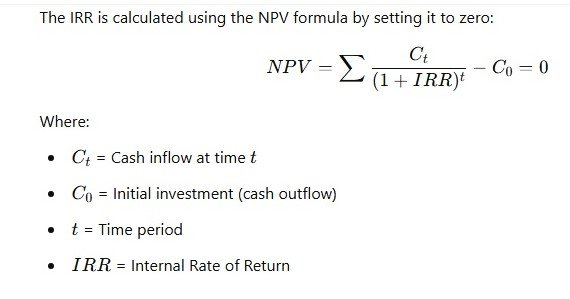
The Internal Rate of Return (IRR) is the discount rate that makes the Net Present Value (NPV) of a project equal to zero. It is the rate at which the present value of future cash inflows equals the present value of cash outflows.

Formula for IRR:

The IRR is calculated using the NPV formula by setting it to zero:

Decision Rules Of IRR:

If projects are independent

* Accept the project which has higher IRR than cost of capital(IRR> k).

* Reject the project which has lower IRR than cost of capital(IRR

If projects are mutually exclusive

* Accept the project which has higher IRR

* Reject other projects

For the acceptance of the project, IRR must be greater than cost of capital. Higher IRR is accepted among different alternatives.

Net Present Value (NPV), Formula, Advantages, Disadvantages

Net Present Value (NPV) method is a capital budgeting technique used to evaluate investment projects by calculating the present value of expected future cash flows. It discounts future cash inflows and outflows to their present value using a predetermined discount rate (usually the cost of capital). A positive NPV indicates that a project is expected to generate more value than its cost, making it a worthwhile investment, while a negative NPV suggests potential losses. NPV considers the time value of money (TVM) and provides a clear profitability measure, making it one of the most reliable investment appraisal methods.

Formula:

Net Present Value (NPV) = Total present valueNet cash outlay

Calculation Of Net Present Value (NPV)

Suppose,

The net investment = $ 50,000

Cash flow per year = $ 16,000

Period(No. of years)= 5 years

minimum required rate of return = 10%

Required: Net present value (NPV) 

Solution,

Net present value (NPV) = Total present value – Net investment = (16000 x 3.972) – 50000 = $ 10,656

Decision Rules Of Net Present Value

  • If projects are independent

    Accept the project with positive NPV.

    Reject the project with negative NPV.

  • If projects are mutually exclusive

    Accept the project with high NPV.

    Reject other projects.

Advantages of Net Present Value (NPV):

  • Considers the Time Value of Money (TVM)

NPV method accounts for the time value of money, recognizing that a rupee received today is more valuable than a rupee received in the future. It discounts future cash flows to their present value, ensuring a more accurate assessment of an investment’s profitability. This makes NPV superior to non-discounting techniques like the Payback Period or Accounting Rate of Return (ARR), as it factors in the depreciation of money’s purchasing power over time, providing a realistic estimate of expected returns.

  • Evaluates Total Profitability

NPV considers the entire lifespan of a project. It evaluates all expected cash inflows and outflows over the investment period, ensuring a comprehensive financial analysis. This long-term perspective helps businesses make better investment decisions by giving a complete picture of the project’s financial viability, ensuring that projects generating higher total returns are prioritized over those with short-term gains.

  • Helps in Comparing Investment Options

NPV is a reliable tool for comparing multiple investment opportunities by assessing their expected profitability. Investors and companies can use NPV to rank projects based on their net present values, selecting the option that maximizes wealth. Since it quantifies returns in absolute terms, it eliminates subjectivity in decision-making and ensures that capital is allocated efficiently, especially when there are constraints on available resources.

  • Considers Risk and Required Rate of Return

The discount rate used in NPV calculations often reflects the cost of capital, incorporating the risk associated with the investment. Higher risk projects are assigned a higher discount rate, ensuring that future cash flows are adjusted accordingly. This helps businesses assess whether the project’s returns are sufficient to compensate for the risks undertaken, making NPV a risk-sensitive measure that provides a realistic estimate of financial performance.

  • Indicates Value Addition to Shareholders

Since NPV measures the present value of net cash flows, a positive NPV implies that the project is expected to enhance shareholder wealth. This makes it particularly useful for businesses aiming to maximize firm value. NPV directly reflects the financial benefits that a project can generate for investors, ensuring that corporate financial decisions align with the goal of wealth maximization.

  • Works Well for Mutually Exclusive Projects

When choosing between mutually exclusive projects (where only one project can be selected), NPV helps determine the most beneficial investment. Since it provides a direct measure of absolute profitability, it allows businesses to select the option that generates the highest value. This ensures that companies invest in projects that yield the best long-term financial returns, leading to better capital allocation and sustainable business growth.

Disadvantages Net Present Value (NPV):

  • Complexity in Calculation

NPV method requires accurate estimation of cash flows, discount rates, and project duration, making it more complex than simpler methods like the Payback Period. It demands detailed financial forecasting, which may not always be precise. Small changes in discount rates or future cash flow estimates can significantly impact the results, making the decision-making process more challenging. Businesses with limited financial expertise may find it difficult to apply NPV effectively, leading to potential miscalculations and incorrect investment decisions.

  • Difficulty in Determining the Discount Rate

Choosing the appropriate discount rate is a major challenge in NPV calculations. The discount rate usually represents the company’s cost of capital, but estimating this rate accurately can be difficult due to market fluctuations, risk factors, and economic conditions. If the discount rate is set too high, it may incorrectly reject profitable projects, whereas a low discount rate may lead to poor investment choices. Since different stakeholders may have varying opinions on the appropriate rate, this can lead to inconsistency in project evaluations.

  • Ignores Project Size Differences

NPV evaluates the total absolute profitability of a project but does not consider the size of the investment required. A larger project with a higher NPV may seem more attractive, even if a smaller project with a lower NPV offers better returns in percentage terms. This limitation makes it difficult to compare projects of different scales, especially when capital is limited. Decision-makers may need to use additional methods like Profitability Index (PI) to assess relative investment efficiency.

  • Requires Accurate Cash Flow Estimations

NPV is highly dependent on accurate future cash flow projections, which can be difficult to predict. Unexpected market changes, inflation, interest rate fluctuations, and economic downturns can make initial projections unreliable. If actual cash flows deviate significantly from estimates, the calculated NPV may become misleading, resulting in incorrect investment decisions. Over-optimistic or conservative estimates can skew the analysis, leading businesses to accept or reject projects based on inaccurate financial expectations.

  • Does Not Consider Liquidity and Short-Term Gains

NPV focuses on long-term profitability, potentially overlooking a company’s short-term financial needs. Some projects with a high NPV may take several years to generate positive cash flows, which could strain a company’s working capital. Businesses needing quick liquidity might prefer investments with faster payback, even if they have a lower NPV. Thus, companies may need to use additional financial tools to ensure short-term stability while planning for long-term growth.

  • Difficult to Compare Projects with Unequal Lifespans

When comparing projects with different durations, NPV may not provide a fair evaluation. A longer project may show a higher total NPV simply because it runs for a longer period, even if a shorter project offers better value in a shorter time frame. This makes it challenging for decision-makers to compare investment opportunities fairly. To address this, businesses often use Equivalent Annual Annuity (EAA) to normalize NPVs across different time horizons for better comparisons.

error: Content is protected !!