Doubling Period: Rule 69 and 72

The Rule of 72 is a simple mathematical formula used to estimate how long an investment will take to double, given a fixed annual rate of return. The formula is:

Doubling Period = 72 / Rate of Return

For example, if an investment earns 8% per year, the doubling time is:

72 / 8 = 9 years

The Rule of 72 is most accurate for interest rates between 6% and 10%. It is widely used by investors and financial planners to make quick estimations about the growth of investments and the effects of compound interest over time.

Rule of 69

The Rule of 69 is another method for estimating the doubling time of an investment, often used for continuous compounding interest rather than discrete annual compounding. The formula is:

Doubling Period = 69 / Rate of Return + 0.35

For example, with a 10% return, the doubling time is:

6910 + 0.35 = 6.9 + 0.35 = 7.25 years

Since the Rule of 69 is more accurate for continuously compounding investments, it is often preferred in advanced financial calculations and banking applications where interest is compounded frequently.

Comparison of Rule of 72 and Rule of 69

  • Rule of 72 is simpler and works well for most practical applications with annual compounding.

  • Rule of 69 is more precise for continuously compounding interest, making it ideal for theoretical financial models.

  • The Rule of 72 is widely used by investors for quick estimates, while the Rule of 69 is preferred in professional financial analysis.

Importance of Doubling Period Calculation:

  • Helps in investment planning by predicting when money will double.

  • Aids in retirement savings decisions to achieve financial goals.

  • Allows businesses to estimate capital growth over time.

  • Helps in understanding inflation impact on money over long periods.

Dividends, Characteristics, Types, Accounting entries

Dividends are the portion of a company’s profits distributed to its shareholders as a reward for their investment. They represent a return on the capital contributed by shareholders and are typically declared by the Board of Directors, subject to shareholders’ approval in the Annual General Meeting (AGM). Dividends can be paid in cash, shares (stock dividend), or other assets, and may be interim (declared during the year) or final (declared at year-end). The payment of dividends is regulated by the Companies Act, 2013, and must comply with prescribed rules regarding profit availability, reserves, and transfer of a portion of profits to reserves before declaration, ensuring fairness and financial stability.

Characteristics of Dividends:

  • Profit Distribution

Dividends represent a portion of the company’s net profits distributed to shareholders as a reward for their investment. They are not an expense but an appropriation of profit, declared only when the company earns sufficient profits and meets legal requirements. The amount and rate of dividend are decided by the Board of Directors and approved by shareholders in the Annual General Meeting. Profit distribution through dividends reflects the company’s financial strength and profitability, building shareholder confidence. However, payment is subject to statutory provisions and the need to maintain adequate reserves for future growth, debt obligations, and business contingencies.

  • Board and Shareholder Approval

The declaration of dividends requires the recommendation of the company’s Board of Directors and the approval of shareholders in the Annual General Meeting (AGM). While the board proposes the rate and form of dividend, shareholders have the right to approve or reject it, though they cannot increase the amount proposed. For interim dividends, only board approval is necessary. This dual-approval system ensures transparency, accountability, and alignment of management decisions with shareholder interests. The process is regulated by the Companies Act to safeguard both the company’s financial stability and the rights of shareholders to receive a fair return on their investment.

  • Forms of Payment

Dividends can be paid in various forms, such as cash dividends, share dividends (bonus shares), or dividends in kind (assets). Cash dividends are the most common, providing immediate monetary benefit to shareholders. Share dividends increase the number of shares held, offering potential for long-term capital appreciation. Non-cash dividends, though rare, may involve the distribution of assets. The choice of form depends on the company’s liquidity position, strategic goals, and legal provisions. Regardless of form, dividends must be paid out of distributable profits and in compliance with the company’s articles of association and relevant provisions of the Companies Act, 2013.

  • Legal Regulation

Dividend declaration and payment are strictly regulated by the Companies Act, 2013, and company articles of association to ensure fairness and protect stakeholders. Companies must declare dividends only from current year profits, past reserves, or both, after fulfilling all legal requirements. They are required to transfer a specified percentage of profits to reserves before payment. Additionally, dividends must be paid within 30 days of declaration, failing which the company and its officers are liable to penalties. These legal safeguards prevent misuse of profits, ensure timely payments, and maintain the financial health and credibility of the business in the market.

  • Impact on Reserves and Liquidity

Payment of dividends directly affects a company’s reserves and cash flow. While it provides shareholders with immediate returns, it reduces the amount of retained earnings available for reinvestment in business expansion, debt repayment, or contingencies. Excessive dividend payouts can strain liquidity, especially if not backed by strong operating cash flows. Therefore, companies must balance between rewarding shareholders and retaining sufficient funds for future growth. Decisions on dividend amounts take into account liquidity position, upcoming capital expenditures, profitability trends, and industry norms, ensuring sustainable financial management while keeping shareholder interests intact in both short-term and long-term perspectives.

  • Influence on Shareholder Value

Dividends play a significant role in enhancing shareholder value, as regular and adequate payouts signal financial stability and profitability. For income-oriented investors, consistent dividends are an attractive feature, improving investor confidence and potentially increasing the company’s share price. Conversely, irregular or low dividends may signal financial distress, leading to reduced investor trust. Dividend policy also impacts the market perception of a company’s growth potential—higher retention of profits may indicate expansion plans, while generous payouts can reflect surplus cash. Thus, dividend decisions form a crucial part of shareholder relationship management and overall corporate financial strategy in competitive markets.

Types of Dividends:

  • Cash Dividend

A cash dividend is the most common form of dividend where shareholders receive payment in the form of cash, directly credited to their bank accounts or paid via cheque. It offers immediate monetary benefits and is preferred by investors seeking regular income. However, it requires the company to have sufficient cash reserves and liquidity. The declaration and payment are made after deducting applicable taxes, such as Dividend Distribution Tax (if applicable in earlier periods) or Tax Deducted at Source (TDS). Cash dividends are straightforward to administer but can reduce a company’s working capital and reserves if paid excessively.

  • Stock Dividend (Bonus Shares)

A stock dividend involves the distribution of additional shares to existing shareholders instead of paying cash. Also known as bonus shares, it increases the number of shares held by investors without altering their total ownership percentage. Companies issue stock dividends when they want to reward shareholders but retain cash for business needs. This type of dividend can enhance liquidity of shares in the market and is often seen as a sign of company confidence in future earnings. It benefits long-term investors through potential capital appreciation, though it does not provide immediate cash flow to shareholders.

  • Interim Dividend

An interim dividend is declared and paid before the end of the company’s financial year, usually after the release of quarterly or half-yearly results. It is decided solely by the Board of Directors without requiring approval from shareholders in a general meeting. Interim dividends are often declared when the company reports strong interim profits and wishes to share them promptly with shareholders. While it provides early returns, it is subject to later financial performance. If the company’s profits decline in the remaining part of the year, final dividends may be lower or omitted entirely to maintain financial stability.

  • Final Dividend

A final dividend is declared at the end of the financial year after accounts are finalized and profits are determined. It is recommended by the Board of Directors and approved by shareholders in the Annual General Meeting (AGM). This dividend reflects the company’s overall performance for the year and is usually higher than interim dividends. Payment is made from accumulated profits after fulfilling all statutory requirements, including transfers to reserves. Since it is based on audited results, it offers greater assurance of sustainability. Final dividends are generally preferred by investors who value predictable and stable annual income.

  • Property Dividend

A property dividend, also called a dividend in kind, is the distribution of assets other than cash or shares to shareholders. The assets may include physical goods, real estate, or other securities held by the company. This type of dividend is rare and usually occurs when a company wants to reward shareholders without impacting cash reserves. The distributed assets are recorded at their fair market value, and any gain or loss on transfer is recognized in the company’s accounts. Property dividends may create valuation and transfer challenges but can be an innovative way to enhance shareholder value.

  • Scrip Dividend

A scrip dividend is offered when a company wishes to declare a dividend but lacks sufficient cash for immediate payment. Instead, the company issues promissory notes (scrips) to shareholders, promising payment at a later date with or without interest. It essentially works like a short-term debt instrument. Scrip dividends are used during temporary cash flow shortages while maintaining a commitment to reward shareholders. They help preserve liquidity in the short term but may signal financial constraints to the market. When redeemed, shareholders receive the promised cash, which may include an additional interest component depending on the terms.

Accounting  entries of Dividends:

Stage Particulars Journal Entry Explanation

1. Declaration of Interim Dividend

Interim Dividend A/c Dr.

 To Bank A/c

Interim Dividend A/c Dr.

  To Bank A/c

Paid during the year directly from bank, reducing cash balance.

2. Declaration of Final Dividend

Profit & Loss Appropriation A/c Dr.

 To Proposed Dividend A/c

Profit & Loss Appropriation A/c Dr.

  To Proposed Dividend A/c

Transfers the declared final dividend from profits to a payable liability.

3. Payment of Final Dividend

Proposed Dividend A/c Dr.

 To Bank A/c

Proposed Dividend A/c Dr.

  To Bank A/c

Settlement of dividend liability to shareholders by paying cash.

4. Payment of Dividend Tax (if applicable)

Dividend Distribution Tax A/c Dr.

 To Bank A/c

Dividend Distribution Tax A/c Dr.

  To Bank A/c

Payment of tax on dividends as per statutory requirements (earlier periods).

5. Unpaid/Unclaimed Dividend Transfer

Proposed Dividend A/c Dr.

 To Unpaid Dividend A/c

Proposed Dividend A/c Dr.

  To Unpaid Dividend A/c

Transfer of unpaid dividends to a separate liability account.

6. Transfer of Unpaid Dividend to IEPF

Unpaid Dividend A/c Dr.

 To Investor Education & Protection Fund A/c

Unpaid Dividend A/c Dr.

  To IEPF A/c

Mandatory transfer of unclaimed dividends (older than 7 years) to IEPF.

Working Capital, Concepts, Introductions, Meaning, Definitions, Need, Types, Importance and Determinants

Working Capital refers to the difference between a company’s current assets (such as cash, accounts receivable, and inventory) and its current liabilities (such as accounts payable and short-term debts). It represents the funds available for day-to-day operations, ensuring smooth business functioning. Adequate working capital is essential for meeting short-term obligations, maintaining liquidity, and supporting operational efficiency. A positive working capital indicates the company can cover its short-term liabilities, while a negative working capital signals potential financial strain. Effective management of working capital ensures optimal utilization of resources, enhances profitability, and minimizes the risk of liquidity crises.

Meaning of Working Capital

Working capital refers to the funds required by a business for its day-to-day operations. It represents the capital used to finance current assets such as cash, inventory, accounts receivable, and short-term investments. Adequate working capital ensures smooth functioning of business activities like purchasing raw materials, paying wages, meeting short-term liabilities, and managing operating expenses. Insufficient working capital may lead to operational disruptions, while excessive working capital results in inefficient use of funds. Thus, effective working capital management is essential for maintaining liquidity, profitability, and overall financial stability of a firm.

Definitions of Working Capital

J.S. Mill

“Working capital is the sum of current assets of a business.”

Gerstenberg

“Working capital is the excess of current assets over current liabilities.”

Weston and Brigham

“Working capital refers to a firm’s investment in short-term assets such as cash, marketable securities, accounts receivable, and inventories.”

Hoagland

“Working capital is the difference between current assets and current liabilities.”

Shubin

“Working capital is the amount of funds necessary to cover the cost of operating the enterprise.”

Concepts in respect of Working Capital:

(i) Gross working capital and

(ii) Networking capital.

Gross Working Capital:

The sum total of all current assets of a business concern is termed as gross working capital. So,

Gross working capital = Stock + Debtors + Receivables + Cash.

Net Working Capital:

The difference between current assets and current liabilities of a business con­cern is termed as the Net working capital.

Hence,

Net Working Capital = Stock + Debtors + Receivables + Cash – Creditors – Payables.

Need for Working Capital:

  • Ensuring Smooth Operations

Working capital is vital for the seamless execution of day-to-day activities, such as purchasing raw materials, paying wages, and meeting other operating expenses. It acts as the financial backbone for sustaining operational efficiency and continuity.

  • Meeting Short-Term Obligations

Businesses must regularly settle short-term liabilities like accounts payable, taxes, and utility bills. Adequate working capital ensures timely payment of these obligations, protecting the company’s creditworthiness and reputation.

  • Maintaining Inventory Levels

A proper working capital ensures that a company can maintain optimal inventory levels. This helps in avoiding stockouts that could disrupt production or sales and ensures timely fulfillment of customer demands.

  • Managing Cash Flow

Working capital ensures that a business has sufficient liquidity to bridge the gap between cash inflows and outflows. This is especially important for industries with seasonal demand, where revenues may fluctuate.

  • Supporting Credit Sales

Businesses often extend credit to customers to maintain competitiveness. Working capital is needed to finance these credit sales until payments are received, preventing cash flow issues.

  • Tackling Unexpected Expenses

Unforeseen expenses, such as repairs, penalties, or market fluctuations, can disrupt business operations. Adequate working capital acts as a buffer to manage such contingencies without jeopardizing the company’s stability.

  • Financing Growth and Expansion

For businesses aiming to expand or explore new markets, working capital is necessary to fund increased operational demands, such as additional inventory, labor, or marketing expenses, without disrupting current operations.

  • Ensuring Financial Stability

A healthy working capital position reflects a company’s financial health and enhances its ability to secure loans or attract investors. It reassures stakeholders of the business’s ability to meet obligations and pursue growth opportunities.

Types of working Capital

Working capital can be categorized based on its purpose, time frame, or sources. These classifications help businesses better understand and manage their financial requirements.

1. Permanent Working Capital

This refers to the minimum level of current assets required to maintain the day-to-day operations of a business. It remains constant over time, regardless of fluctuations in sales or production levels.

  • Fixed Permanent Working Capital: The portion of working capital that remains unchanged even during seasonal variations or changes in business cycles.
  • Variable Permanent Working Capital: The additional working capital required due to growth in production and operations over time.

2. Temporary Working Capital

Temporary working capital is required to meet short-term or seasonal demands. It fluctuates depending on the level of business activity and market conditions.

  • Seasonal Working Capital: Needed to manage increased demand during peak seasons.
  • Special Working Capital: Required for non-recurring or special needs, such as promotional campaigns or sudden bulk orders.

3. Gross Working Capital

Gross working capital represents the total investment in current assets, such as cash, accounts receivable, and inventory. It emphasizes the importance of efficiently managing current assets to maintain liquidity.

4. Net Working Capital

Net working capital is the difference between current assets and current liabilities. It indicates the surplus or deficiency of current assets over liabilities and reflects the business’s ability to meet short-term obligations.

5. Positive and Negative Working Capital

  • Positive Working Capital: Occurs when current assets exceed current liabilities, indicating good liquidity and financial health.
  • Negative Working Capital: Happens when current liabilities exceed current assets, signaling potential financial strain and risk of insolvency.

6. Reserve Working Capital

Reserve working capital refers to the extra funds kept aside to handle unexpected emergencies or contingencies, such as economic downturns or sudden increases in costs.

7. Regular Working Capital

This type of working capital is used to meet routine business operations, including the purchase of raw materials, payment of wages, and covering operational expenses.

8. Special Working Capital

Special working capital is required for one-time projects or events, such as launching a new product, entering a new market, or undertaking a merger or acquisition.

Importance of Working Capital

  • Ensures Business Continuity

Adequate working capital ensures that a business can meet its day-to-day operational expenses, such as paying wages, purchasing raw materials, and covering overhead costs. This continuity is critical to prevent operational disruptions and maintain productivity.

  • Enhances Liquidity

Working capital reflects a company’s short-term financial health and liquidity. It ensures that the organization has sufficient funds to meet immediate obligations, avoiding situations like delayed payments, penalties, or defaulting on liabilities.

  • Supports Customer Credit

Offering credit to customers is a common business practice to boost sales and customer satisfaction. Proper working capital allows a business to manage the time gap between extending credit and receiving payment without compromising liquidity.

  • Facilitates Inventory Management

A well-managed working capital ensures that the business can maintain an optimal inventory level, avoiding stockouts or overstocking. This is crucial for meeting customer demands promptly and efficiently.

  • Prepares for Contingencies

Businesses often face unexpected challenges, such as economic downturns, sudden market changes, or equipment breakdowns. Adequate working capital acts as a financial cushion, enabling companies to handle such contingencies without significant setbacks.

  • Improves Creditworthiness

A business with strong working capital is viewed as financially stable and reliable by creditors and investors. This improved creditworthiness makes it easier to secure loans, negotiate better terms, and attract investments for growth and expansion.

  • Boosts Profitability

Efficient working capital management helps minimize costs, such as interest on short-term borrowings or penalties for delayed payments. It also optimizes resource utilization, enhancing overall profitability.

  • Supports Business Growth

For a company aiming to expand, working capital is crucial to fund increased operational needs like additional inventory, higher production costs, or expanded marketing efforts. It ensures that growth initiatives are supported without causing financial strain.

Determinants of Working Capital:

  • Nature of Business

The type of business significantly determines its working capital requirements. Manufacturing firms require substantial working capital due to the need for raw materials, work-in-progress, and finished goods inventory. Conversely, service-oriented businesses, like consulting or IT firms, require minimal working capital as they primarily focus on delivering services and do not maintain significant inventory. Similarly, trading firms require moderate working capital to manage goods for resale. Understanding the nature of the business helps identify whether large, small, or minimal funds are needed to support day-to-day operations.

  • Business Size and Scale

The size and scale of a business directly impact its working capital needs. Larger businesses with extensive operations require more working capital to finance inventory, receivables, and other operational expenses. These organizations typically handle large volumes of transactions, necessitating higher funds. In contrast, smaller businesses with limited operations and simpler processes have lower working capital requirements. However, as businesses expand, they need to adjust their working capital to sustain growth, ensuring that financial resources align with their scale.

  • Production Cycle

The production cycle, which measures the time required to convert raw materials into finished goods, affects working capital requirements. A longer production cycle increases the need for funds to cover costs such as raw materials, labor, and overheads during the production process. Conversely, businesses with shorter production cycles require less working capital as they can quickly convert inventory into cash. Efficient production processes help minimize the length of the cycle, reducing working capital requirements while improving overall financial stability.

  • Credit Policy

A company’s credit policy for customers and suppliers significantly influences its working capital. Liberal credit terms for customers increase accounts receivable, raising the need for additional working capital to manage delayed cash inflows. Conversely, strict credit terms reduce the amount tied up in receivables. On the supplier side, favorable credit terms reduce immediate cash outflows, lowering working capital requirements. Balancing credit policies ensures that businesses maintain adequate liquidity while fostering strong customer and supplier relationships.

  • Economic Conditions

Economic factors like inflation, interest rates, and market conditions impact working capital requirements. During inflationary periods, businesses require more working capital to handle rising costs of raw materials, wages, and utilities. Unstable economic conditions may also prompt companies to maintain higher reserves to tackle uncertainties. Conversely, during periods of economic stability, businesses can optimize their working capital levels, focusing on investments and growth. Adapting to economic trends is crucial for maintaining financial stability and operational efficiency.

Internal Rate of Return, Advantages, Disadvantages, Calculation, Formula

The Internal Rate of Return (IRR) is the discount rate at which the Net Present Value (NPV) of a project becomes zero. It represents the expected annual return on an investment, helping businesses evaluate the profitability of potential projects. A higher IRR indicates a more attractive investment opportunity. IRR is widely used in capital budgeting decisions, comparing it with the cost of capital to determine project feasibility. However, IRR has limitations, such as multiple values for projects with non-conventional cash flows. Despite this, it remains a key tool for financial analysis and decision-making in corporate finance.

Advantages Of IRR:

  • Considers the Time Value of Money

IRR method takes into account the time value of money, ensuring that future cash flows are discounted appropriately. Unlike simple return calculations, IRR recognizes that a rupee today is worth more than a rupee in the future. This makes IRR a more accurate tool for evaluating long-term investment projects. By discounting cash flows, it provides a clearer picture of a project’s true profitability, making it easier for businesses to make informed financial decisions.

  • Provides a Clear Investment Decision Rule

IRR offers a straightforward decision-making rule: if the IRR is higher than the cost of capital, the project is considered financially viable. This simplifies comparisons between different investment opportunities. Businesses can easily determine whether a project will generate returns exceeding their required rate of return. This clear and intuitive approach helps managers and investors assess the attractiveness of various investment options without needing complex calculations.

  • Facilitates Easy Comparisons Between Projects

Since IRR expresses profitability as a percentage, it allows companies to compare multiple investment opportunities regardless of size. This makes IRR particularly useful when selecting projects with different initial investment amounts. By ranking projects based on IRR, businesses can prioritize those with the highest potential returns. This comparative approach simplifies capital allocation and ensures that resources are invested in the most profitable ventures.

  • Does Not Require a Predetermined Discount Rate

IRR is independent of external assumptions. This is beneficial because determining an accurate discount rate can be challenging. By calculating the inherent rate of return, IRR allows businesses to assess profitability without relying on uncertain external factors. This self-sufficiency makes IRR a flexible tool for evaluating investment decisions.

  • Works Well for Projects with Conventional Cash Flows

IRR is particularly effective for projects with standard cash flow patterns—an initial outflow followed by a series of inflows. In such cases, IRR provides a single, clear rate of return that accurately reflects the project’s profitability. This makes it a practical method for evaluating straightforward investments such as factory expansions, equipment purchases, and infrastructure developments.

  • Useful for Capital Rationing Decisions

When companies face budget constraints, IRR helps prioritize investments by ranking projects based on their profitability. Businesses with limited capital can select projects with the highest IRRs to maximize returns. This ensures that financial resources are allocated efficiently, improving overall investment performance. By considering both return potential and capital constraints, IRR serves as a valuable tool in strategic financial planning.

Disadvantages Of IRR:

  • Ignores the Scale of Investment

One major drawback of IRR is that it does not consider the size of the investment. A project with a high IRR may have a much smaller total return compared to a project with a lower IRR but a larger overall profit. This can mislead decision-makers into selecting smaller, high-IRR projects over larger, more profitable ones. The Net Present Value (NPV) method is often preferred because it accounts for the absolute value of profits rather than just the percentage return.

  • Assumes Cash Flow Reinvestment at IRR

IRR assumes that all future cash flows are reinvested at the same rate as the IRR itself. In reality, companies may not always be able to reinvest funds at such a high rate. This can lead to overestimating the actual profitability of the project. The Modified Internal Rate of Return (MIRR) is sometimes used to address this issue by assuming reinvestment at a more realistic rate, such as the cost of capital.

  • Multiple IRRs in Non-Conventional Cash Flows

Projects with unconventional cash flows—where cash inflows and outflows occur more than once—can result in multiple IRRs. This happens when a project has cash flow reversals, such as an outflow followed by an inflow, then another outflow. In such cases, the IRR formula produces more than one valid percentage, making it difficult to determine the actual rate of return. This creates confusion and reduces the reliability of IRR as a decision-making tool.

  • Fails to Consider the Cost of Capital

IRR does not explicitly take the cost of financing into account. A high IRR does not necessarily mean a project is profitable if the company’s cost of capital is also high. This limitation makes IRR less reliable for firms with fluctuating or high financing costs. Decision-makers must always compare IRR with the cost of capital to make sound investment choices.

  • Not Ideal for Mutually Exclusive Projects

When comparing mutually exclusive projects (where selecting one project eliminates the possibility of choosing another), IRR may lead to incorrect decisions. A project with a higher IRR but lower NPV might be chosen over a project with a lower IRR but significantly higher total value. Since NPV directly measures value addition, it is a better metric in such cases. Relying solely on IRR for mutually exclusive projects can result in suboptimal investment decisions.

  • Complexity in Calculation

Calculating IRR can be complicated, especially for projects with irregular cash flows. Unlike NPV, which uses a simple discounting formula, IRR requires iterative trial-and-error methods or financial software to determine the correct rate. This complexity can make it difficult for managers without strong financial expertise to interpret results. Additionally, IRR does not work well when projects have delayed or highly unpredictable cash flows.

Calculation Of IRR:

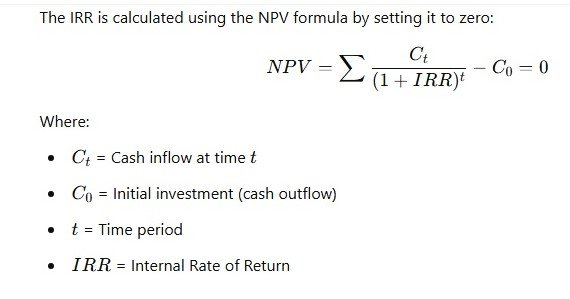
The Internal Rate of Return (IRR) is the discount rate that makes the Net Present Value (NPV) of a project equal to zero. It is the rate at which the present value of future cash inflows equals the present value of cash outflows.

Formula for IRR:

The IRR is calculated using the NPV formula by setting it to zero:

Decision Rules Of IRR:

If projects are independent

* Accept the project which has higher IRR than cost of capital(IRR> k).

* Reject the project which has lower IRR than cost of capital(IRR

If projects are mutually exclusive

* Accept the project which has higher IRR

* Reject other projects

For the acceptance of the project, IRR must be greater than cost of capital. Higher IRR is accepted among different alternatives.

Net Present Value (NPV), Formula, Advantages, Disadvantages

Net Present Value (NPV) method is a capital budgeting technique used to evaluate investment projects by calculating the present value of expected future cash flows. It discounts future cash inflows and outflows to their present value using a predetermined discount rate (usually the cost of capital). A positive NPV indicates that a project is expected to generate more value than its cost, making it a worthwhile investment, while a negative NPV suggests potential losses. NPV considers the time value of money (TVM) and provides a clear profitability measure, making it one of the most reliable investment appraisal methods.

Formula:

Net Present Value (NPV) = Total present valueNet cash outlay

Calculation Of Net Present Value (NPV)

Suppose,

The net investment = $ 50,000

Cash flow per year = $ 16,000

Period(No. of years)= 5 years

minimum required rate of return = 10%

Required: Net present value (NPV) 

Solution,

Net present value (NPV) = Total present value – Net investment = (16000 x 3.972) – 50000 = $ 10,656

Decision Rules Of Net Present Value

  • If projects are independent

    Accept the project with positive NPV.

    Reject the project with negative NPV.

  • If projects are mutually exclusive

    Accept the project with high NPV.

    Reject other projects.

Advantages of Net Present Value (NPV):

  • Considers the Time Value of Money (TVM)

NPV method accounts for the time value of money, recognizing that a rupee received today is more valuable than a rupee received in the future. It discounts future cash flows to their present value, ensuring a more accurate assessment of an investment’s profitability. This makes NPV superior to non-discounting techniques like the Payback Period or Accounting Rate of Return (ARR), as it factors in the depreciation of money’s purchasing power over time, providing a realistic estimate of expected returns.

  • Evaluates Total Profitability

NPV considers the entire lifespan of a project. It evaluates all expected cash inflows and outflows over the investment period, ensuring a comprehensive financial analysis. This long-term perspective helps businesses make better investment decisions by giving a complete picture of the project’s financial viability, ensuring that projects generating higher total returns are prioritized over those with short-term gains.

  • Helps in Comparing Investment Options

NPV is a reliable tool for comparing multiple investment opportunities by assessing their expected profitability. Investors and companies can use NPV to rank projects based on their net present values, selecting the option that maximizes wealth. Since it quantifies returns in absolute terms, it eliminates subjectivity in decision-making and ensures that capital is allocated efficiently, especially when there are constraints on available resources.

  • Considers Risk and Required Rate of Return

The discount rate used in NPV calculations often reflects the cost of capital, incorporating the risk associated with the investment. Higher risk projects are assigned a higher discount rate, ensuring that future cash flows are adjusted accordingly. This helps businesses assess whether the project’s returns are sufficient to compensate for the risks undertaken, making NPV a risk-sensitive measure that provides a realistic estimate of financial performance.

  • Indicates Value Addition to Shareholders

Since NPV measures the present value of net cash flows, a positive NPV implies that the project is expected to enhance shareholder wealth. This makes it particularly useful for businesses aiming to maximize firm value. NPV directly reflects the financial benefits that a project can generate for investors, ensuring that corporate financial decisions align with the goal of wealth maximization.

  • Works Well for Mutually Exclusive Projects

When choosing between mutually exclusive projects (where only one project can be selected), NPV helps determine the most beneficial investment. Since it provides a direct measure of absolute profitability, it allows businesses to select the option that generates the highest value. This ensures that companies invest in projects that yield the best long-term financial returns, leading to better capital allocation and sustainable business growth.

Disadvantages Net Present Value (NPV):

  • Complexity in Calculation

NPV method requires accurate estimation of cash flows, discount rates, and project duration, making it more complex than simpler methods like the Payback Period. It demands detailed financial forecasting, which may not always be precise. Small changes in discount rates or future cash flow estimates can significantly impact the results, making the decision-making process more challenging. Businesses with limited financial expertise may find it difficult to apply NPV effectively, leading to potential miscalculations and incorrect investment decisions.

  • Difficulty in Determining the Discount Rate

Choosing the appropriate discount rate is a major challenge in NPV calculations. The discount rate usually represents the company’s cost of capital, but estimating this rate accurately can be difficult due to market fluctuations, risk factors, and economic conditions. If the discount rate is set too high, it may incorrectly reject profitable projects, whereas a low discount rate may lead to poor investment choices. Since different stakeholders may have varying opinions on the appropriate rate, this can lead to inconsistency in project evaluations.

  • Ignores Project Size Differences

NPV evaluates the total absolute profitability of a project but does not consider the size of the investment required. A larger project with a higher NPV may seem more attractive, even if a smaller project with a lower NPV offers better returns in percentage terms. This limitation makes it difficult to compare projects of different scales, especially when capital is limited. Decision-makers may need to use additional methods like Profitability Index (PI) to assess relative investment efficiency.

  • Requires Accurate Cash Flow Estimations

NPV is highly dependent on accurate future cash flow projections, which can be difficult to predict. Unexpected market changes, inflation, interest rate fluctuations, and economic downturns can make initial projections unreliable. If actual cash flows deviate significantly from estimates, the calculated NPV may become misleading, resulting in incorrect investment decisions. Over-optimistic or conservative estimates can skew the analysis, leading businesses to accept or reject projects based on inaccurate financial expectations.

  • Does Not Consider Liquidity and Short-Term Gains

NPV focuses on long-term profitability, potentially overlooking a company’s short-term financial needs. Some projects with a high NPV may take several years to generate positive cash flows, which could strain a company’s working capital. Businesses needing quick liquidity might prefer investments with faster payback, even if they have a lower NPV. Thus, companies may need to use additional financial tools to ensure short-term stability while planning for long-term growth.

  • Difficult to Compare Projects with Unequal Lifespans

When comparing projects with different durations, NPV may not provide a fair evaluation. A longer project may show a higher total NPV simply because it runs for a longer period, even if a shorter project offers better value in a shorter time frame. This makes it challenging for decision-makers to compare investment opportunities fairly. To address this, businesses often use Equivalent Annual Annuity (EAA) to normalize NPVs across different time horizons for better comparisons.

EBIT-EPS analysis for Capital Structure Decision

EBIT-EPS Analysis is a financial tool used to determine the impact of different financing options (debt and equity) on a company’s Earnings Per Share (EPS) at various levels of Earnings Before Interest and Taxes (EBIT). It helps in capital structure decision-making, allowing firms to choose between debt financing (which increases financial leverage) and equity financing (which avoids fixed interest costs but dilutes ownership). The analysis involves computing EPS for different EBIT levels to identify the indifference point, where EPS remains the same regardless of financing choice. Companies aim to maximize EPS while managing financial risk and shareholder value.

Meaning of EBIT

Earnings Before Interest and Taxes (EBIT) refers to the operating profit of the firm.
It is the income earned from business operations before deducting interest on loans and income tax.

EBIT = OperatingRevenue – OperatingExpenses

It measures the earning capacity of the firm independent of financing decisions.

Meaning of EPS

Earnings Per Share (EPS) represents the earnings available to each equity shareholder.
It indicates the profitability of the company from the shareholders’ point of view.

EPS = Earnings available to equity shareholders / Number of equity shares

Higher EPS means higher return to shareholders and increased market value of shares.

Financial Leverage and EBIT–EPS

The analysis is closely related to financial leverage.

Financial leverage means the use of debt in capital structure to increase return to equity shareholders.

  • If EBIT is high → Debt financing increases EPS

  • If EBIT is low → Debt financing decreases EPS

Therefore, proper use of debt can increase shareholders’ wealth.

Advantages of EBIT-EPS Analysis

  • Helps in Selecting Optimum Capital Structure

EBIT–EPS analysis helps management compare different financing alternatives such as equity shares, preference shares and debt. By calculating earnings per share under each plan, the company can identify the most profitable financing option. The plan that provides higher EPS at a particular level of EBIT is selected. Thus, it guides the finance manager in designing an optimum capital structure that balances cost and return while improving the financial performance of the organization.

  • Maximizes Shareholders’ Earnings

The main objective of financial management is to maximize the wealth of equity shareholders. EBIT–EPS analysis directly focuses on earnings available to shareholders. It shows how different financing plans affect EPS and helps management select the alternative that produces higher earnings per share. By choosing the plan with the highest EPS, the firm increases returns to shareholders, enhances investor confidence and improves the market value of shares.

  • Measures the Effect of Financial Leverage

EBIT–EPS analysis clearly explains the effect of financial leverage on shareholders’ earnings. It shows how the use of borrowed funds can increase EPS when operating profits are high. At the same time, it also reveals the negative impact when profits decline. Therefore, it helps management understand both benefits and dangers of debt financing. This knowledge assists in maintaining a proper balance between risk and return while planning the capital structure.

  • Useful in Financial Planning

The analysis is very helpful in financial planning and forecasting. It enables the company to estimate the level of operating profit required to meet interest and dividend obligations. Management can predict future earnings and evaluate the financial viability of proposed financing plans. This makes planning more systematic and reduces uncertainty in financial decision-making. As a result, the company can arrange funds in advance and avoid financial difficulties.

  • Facilitates Comparison of Financing Alternatives

A company often has several alternatives for raising funds, such as issuing shares or taking loans. EBIT–EPS analysis provides a numerical comparison of these alternatives. It presents the impact of each option on EPS in a clear and measurable form. This makes decision-making logical and objective rather than based on assumptions. Hence, management can select the most beneficial financing source after evaluating all possible alternatives.

  • Identifies the Indifference Point

EBIT–EPS analysis helps determine the indifference point, which is the level of EBIT where EPS remains the same under two financing plans. This point guides management in understanding the level of operating income required for debt financing to become advantageous. Above this level, debt financing is preferable, while below it equity financing is safer. Therefore, the indifference point provides a clear basis for selecting suitable financial strategies.

  • Improves Decision-Making

The technique promotes scientific and rational financial decision-making. Instead of relying on guesswork, management uses calculated figures of EPS to choose financing sources. It provides a clear picture of expected returns and financial obligations. This reduces uncertainty and improves confidence in financial decisions. Consequently, the organization can adopt policies that are more effective, practical and aligned with long-term business goals.

  • Assists in Profit Planning

EBIT–EPS analysis also helps in profit planning. By analyzing different EBIT levels, the firm can set profit targets required to achieve desired EPS. Management can evaluate whether expected operating profits are sufficient to cover fixed financial charges. This enables better budgeting and performance evaluation. Therefore, the analysis acts as a useful tool for planning profitability and monitoring the financial performance of the business.

Limitations of EBIT-EPS Analysis


Although EBIT–EPS analysis is a useful technique for selecting an appropriate financing plan and capital structure, it is not free from defects. The analysis mainly concentrates on earnings per share and ignores several practical aspects of financial decision-making. Therefore, it should not be used as the only basis for financing decisions.

The major limitations of EBIT–EPS analysis are explained below:

  • Ignores Business Risk

EBIT–EPS analysis assumes that the operating income (EBIT) is known and stable. In reality, business earnings fluctuate due to changes in demand, competition, economic conditions and technology. If EBIT decreases unexpectedly, the company may not be able to meet interest obligations on debt. Hence, the analysis does not properly consider business risk, which is an important factor in financial planning.

  • Focuses Only on EPS

The technique gives importance only to earnings per share. However, maximizing EPS does not always mean maximizing shareholders’ wealth. Shareholders are also concerned with share price, dividends, safety of investment and future growth. A plan with higher EPS may involve higher risk and may reduce the market value of shares. Therefore, EPS alone is not a complete measure of financial performance.

  • Neglects Financial Risk

EBIT–EPS analysis encourages the use of debt because it often increases EPS at higher levels of EBIT. However, excessive debt increases financial risk and the possibility of insolvency. The company must pay interest regardless of profit. The analysis does not give adequate weight to the risk arising from heavy borrowing, which may endanger the long-term stability of the firm.

  • Assumes Constant Interest and Tax Rates

The analysis assumes that interest rates and tax rates remain constant. In actual business conditions, interest rates change due to market fluctuations and government policies. Similarly, tax rates may also vary. Changes in these rates directly affect EPS and the cost of capital. Hence, results of the analysis may become unrealistic or misleading.

  • Ignores Market Conditions

EBIT–EPS analysis does not consider the condition of the capital market. Sometimes it may not be possible to issue shares or debentures due to unfavorable market situations. Investor preferences, economic recession and stock market trends also affect financing decisions. Since these practical aspects are ignored, the analysis may not always be applicable in real situations.

  • No Consideration of Control

Issue of equity shares reduces the ownership control of existing shareholders. Many companies avoid issuing new shares to maintain management control. EBIT–EPS analysis does not consider this important aspect. It only compares EPS and ignores the effect of financing decisions on voting rights and managerial control.

  • Unrealistic Assumption of Fixed EBIT Levels

The technique compares financing plans at different EBIT levels, but predicting exact EBIT in advance is difficult. Business profits are uncertain and affected by several external factors. If the actual EBIT differs from estimated EBIT, the selected financing plan may not be suitable. Therefore, the analysis may lead to wrong decisions when profit estimates are inaccurate.

  • Does Not Consider Cash Flow Position

EBIT–EPS analysis is based on accounting profits rather than cash flows. However, interest and loan repayments require actual cash payments. A firm may show high EPS but may still face cash shortage. Ignoring liquidity position may create financial difficulties and even bankruptcy.

  • Short-Term Perspective

The analysis mainly focuses on immediate effect on EPS and does not consider long-term consequences such as growth opportunities, financial flexibility and sustainability. A financing plan beneficial in the short run may harm the company in the long run. Therefore, it provides only a partial view of financial decision-making.

Indifference Points:

The indifference point, often called as a breakeven point, is highly important in financial planning because, at EBIT amounts in excess of the EBIT indifference level, the more heavily levered financ­ing plan will generate a higher EPS. On the other hand, at EBIT amounts below the EBIT indifference points the financing plan involving less leverage will generate a higher EPS.

Indifference points refer to the EBIT level at which the EPS is same for two alternative financial plans. According to J. C. Van Home, ‘Indifference point refers to that EBIT level at which EPS remains the same irrespective of debt equity mix’. The management is indifferent in choosing any of the alternative financial plans at this level because all the financial plans are equally desirable. The indifference point is the cut-off level of EBIT below which financial leverage is disadvanta­geous. Beyond the indifference point level of EBIT the benefit of financial leverage with respect to EPS starts operating.

The indifference level of EBIT is significant because the financial planner may decide to take the debt advantage if the expected EBIT crosses this level. Beyond this level of EBIT the firm will be able to magnify the effect of increase in EBIT on the EPS.

In other words, financial leverage will be favorable beyond the indifference level of EBIT and will lead to an increase in the EPS. If the expected EBIT is less than the indifference point then the financial planners will opt for equity for financing projects, because below this level, EPS will be more for less levered firm.

  • Computation:

We have seen that indifference point refers to the level of EBIT at which EPS is the same for two different financial plans. So the level of that EBIT can easily be computed. There are two approaches to calculate indifference point: Mathematical approach and graphical approach.

  • Graphical Approach:

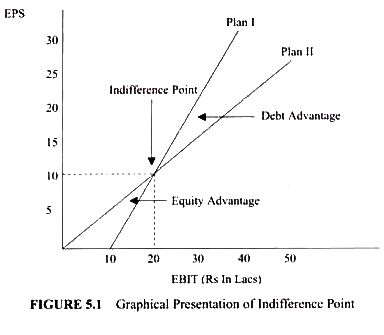
The indifference point may also be obtained using a graphical approach. In Figure 5.1 we have measured EBIT along the horizontal axis and EPS along the vertical axis. Suppose we have two financial plans before us: Financing by equity only and financing by equity and debt. Dif­ferent combinations of EBIT and EPS may be plotted against each plan. Under Plan-I the EPS will be zero when EBIT is nil so it will start from the origin.

The curve depicting Plan I in Figure 5.1 starts from the origin. For Plan-II EBIT will have some positive figure equal to the amount of interest to make EPS zero. So the curve depicting Plan-II in Figure 5.1 will start from the positive intercept of X axis. The two lines intersect at point E where the level of EBIT and EPS both are same under both the financial plans. Point E is the indifference point. The value corresponding to X axis is EBIT and the value corresponding to 7 axis is EPS.

These can be found drawing two perpendiculars from the indifference point—one on X axis and the other on Taxis. Similarly we can obtain the indifference point between any two financial plans having various financing options. The area above the indifference point is the debt advantage zone and the area below the indifference point is equity advantage zone.

Above the indifference point the Plan-II is profitable, i.e. financial leverage is advantageous. Below the indifference point Plan I is advantageous, i.e. financial leverage is not profitable. This can be found by observing Figure 5.1. Above the indifference point EPS will be higher for same level of EBIT for Plan II. Below the indifference point EPS will be higher for same level of EBIT for Plan I. The graphical approach of indifference point gives a better understanding of EBIT-EPS analysis.

Financial Breakeven Point:

In general, the term Breakeven Point (BEP) refers to the point where the total cost line and sales line intersect. It indicates the level of production and sales where there is no profit and no loss because here the contribution just equals to the fixed costs. Similarly financial breakeven point is the level of EBIT at which after paying interest, tax and preference dividend, nothing remains for the equity shareholders.

In other words, financial breakeven point refers to that level of EBIT at which the firm can satisfy all fixed financial charges. EBIT less than this level will result in negative EPS. Therefore EPS is zero at this level of EBIT. Thus financial breakeven point refers to the level of EBIT at which financial profit is nil.

Financial Break Even Point (FBEP) is expressed as ratio with the following equation:

Calculation of Weighted Cost of Capital

Weighted average Cost of Capital (WACC) is a financial metric used to determine the cost of financing a company’s operations. It reflects the average cost of all sources of financing, including debt and equity, weighted by their proportion in the company’s capital structure. The WACC is an important factor in determining a company’s value and profitability, and is used in various financial analysis and decision-making processes.

Components of WACC:

The WACC is composed of two main components:

  • Cost of equity
  • Cost of debt

Cost of Equity:

The cost of equity is the return required by investors in exchange for owning a company’s stock. It reflects the risk associated with owning the stock and is influenced by factors such as market conditions, the company’s financial performance, and the company’s growth prospects. The cost of equity can be calculated using various models, including the dividend discount model, the capital asset pricing model (CAPM), and the arbitrage pricing theory.

Cost of Debt:

The cost of debt is the interest rate paid by a company on its debt financing. It reflects the creditworthiness of the company and market conditions, and is typically lower than the cost of equity. The cost of debt can be calculated using the yield to maturity of the company’s existing debt or by estimating the interest rate the company would have to pay on new debt.

Calculation of WACC:

WACC is calculated by weighting the cost of equity and cost of debt based on their proportion in the company’s capital structure.

WACC = (E/V x Re) + (D/V x Rd x (1 – Tc))

Where:

E = Market value of equity

D = Market value of debt

V = Total market value of the company (E + D)

Re = Cost of equity

Rd = Cost of debt

Tc = Corporate tax rate

The first part of the equation (E/V x Re) represents the cost of equity weighted by the proportion of equity in the company’s capital structure. The second part of the equation (D/V x Rd x (1 – Tc)) represents the cost of debt weighted by the proportion of debt in the company’s capital structure, adjusted for the tax deductibility of interest payments.

Advantages of WACC:

  • Considers all Sources of Financing:

WACC considers the cost of all sources of financing, including debt and equity, which provides a more comprehensive view of the company’s cost of capital.

  • Useful in Decision-making:

WACC is used in various financial analysis and decision-making processes, such as determining whether to undertake a new project or make an acquisition.

  • Reflects Market Conditions:

WACC reflects current market conditions, such as interest rates and the risk premium for equity, which helps companies make informed financial decisions.

  • Easy to Calculate:

WACC is a relatively simple calculation that can be easily understood and communicated to stakeholders.

Limitations of WACC:

  • Assumes constant Capital Structure:

WACC assumes a constant capital structure, which may not be realistic for companies that frequently issue or retire debt or equity.

  • Sensitive to input assumptions:

WACC is sensitive to input assumptions, such as the cost of debt and equity, which can vary depending on the method used to calculate them.

  • Ignores other factors:

WACC does not consider other factors that may affect a company’s cost of capital, such as market risk and company-specific risk.

  • Does not account for Project risk:

WACC is based on the company’s overall risk, and may not accurately reflect the risk associated with a specific project or investment.

Combined Leverage, Significance, Formula

Combined Leverage refers to the total impact of both operating leverage and financial leverage on a company’s earnings. It measures how changes in sales affect Earnings Per Share (EPS) by considering both fixed operating costs and fixed financial costs (interest on debt). A firm with high combined leverage experiences significant changes in net income when sales fluctuate, making it riskier but potentially more profitable. The Degree of Combined Leverage (DCL) is calculated as the product of the Degree of Operating Leverage (DOL) and the Degree of Financial Leverage (DFL), helping firms assess their overall risk and return potential.

Example:

It should be observed that the leverage is ascertained from a particular sales point. When different levels of sales are adopted, different degrees of composite leverages are obtained. When the volume of sales increases, fixed expenses remains same, the degree of leverage falls. This happens because of existence of fixed charges in the cost structure.

Significance of Combined Leverage

  • Measures Total Risk Exposure

Combined leverage helps assess a company’s overall risk by considering both operating and financial leverage. It indicates the extent to which a firm’s fixed costs (both operational and financial) impact earnings. A higher combined leverage suggests greater sensitivity of Earnings Per Share (EPS) to changes in sales, making it a crucial measure for risk assessment. Companies with high combined leverage must be cautious during economic downturns as small declines in revenue can lead to significant losses, affecting financial stability and investor confidence.

  • Aids in Decision-Making on Capital Structure

Businesses use combined leverage to determine an optimal capital structure by balancing debt and equity. A firm with high operating leverage should maintain low financial leverage to minimize financial risk, whereas firms with low operating leverage may take on more debt. This evaluation helps finance managers decide how much debt financing is suitable while ensuring the firm can cover both operating and financial costs, leading to sustainable growth and profitability.

  • Helps in Profitability Forecasting

By understanding combined leverage, companies can forecast how changes in sales volume will impact their profitability. Since combined leverage magnifies the effect of revenue changes on net income, firms can use this analysis to predict earnings fluctuations and take proactive measures to stabilize cash flows. This is particularly useful for investors and financial analysts in estimating future EPS and making informed investment decisions based on risk and return expectations.

  • Indicates Business Stability and Risk

A firm with high combined leverage is more vulnerable to economic fluctuations, as both high fixed operating costs and high financial obligations increase financial strain. This makes combined leverage an essential indicator of business stability. Companies with lower combined leverage are seen as financially stable since they have more flexibility to manage downturns. Investors and lenders use this measure to assess a company’s ability to withstand economic cycles and make strategic financial decisions accordingly.

  • Assists in Financial Planning

Financial managers use combined leverage to design effective financial strategies that align with the company’s growth objectives. By analyzing leverage levels, businesses can plan for capital expenditures, debt financing, and profit distribution more effectively. A well-balanced leverage structure ensures that firms maximize returns on investment while keeping financial risk at manageable levels. Proper financial planning based on combined leverage helps maintain long-term financial health and stability.

  • Enhances Shareholder Value

Combined leverage plays a crucial role in maximizing shareholder wealth by ensuring a balance between risk and return. A well-structured capital mix enhances earnings per share (EPS) while minimizing financial distress. If managed correctly, combined leverage can lead to higher profitability, attracting more investors and increasing the firm’s market valuation. However, excessive leverage may pose risks, making it essential for firms to maintain a balanced financial structure that supports both growth and stability.

  • Helps in Managing Cost Structure

Businesses must maintain a balance between fixed and variable costs to ensure financial sustainability. Combined leverage helps identify whether a company is relying too much on fixed costs, which could become burdensome during low sales periods. By understanding the proportion of fixed and variable costs, firms can take strategic steps to reduce financial risk, such as renegotiating debt terms, adjusting pricing strategies, or optimizing resource utilization to maintain a competitive edge.

  • Supports Business Expansion Strategies

Companies planning for growth and expansion must carefully evaluate their leverage levels to ensure financial sustainability. High combined leverage can indicate potential constraints on raising additional funds, while lower leverage may signal opportunities for expansion through debt financing. Understanding combined leverage allows businesses to strategically plan expansion without overburdening themselves with excessive debt, ensuring smooth operations and long-term success.

Formula:

Combined leverage considers both financial leverage and operating leverage to assess the overall risk and impact on a company’s earnings. The combined leverage can be calculated using the degree of combined leverage (DCL) or the combined leverage ratio.

  1. Degree of Combined Leverage (DCL):

DCL = DOL × DFL

Where:

  • DOL is the Degree of Operating Leverage.
  • DFL is the Degree of Financial Leverage.

The degree of combined leverage provides a measure of how sensitive a company’s earnings per share (EPS) is to changes in sales.

  1. Combined Leverage Ratio:

Combined Leverage Ratio = % Change in EPS / % Change in Sales​

The combined leverage ratio is another way to express the combined impact of operating and financial leverage on earnings per share.

These formulas help assess how changes in sales can affect a company’s profitability, factoring in both its operating structure (operating leverage) and financing structure (financial leverage). A higher degree of combined leverage means that a company’s earnings are more sensitive to changes in sales, both positively and negatively.

It’s important to note that while leverage can enhance returns, it also introduces additional risk. Therefore, understanding the combined leverage is crucial for effective risk management and financial decision-making. Companies need to strike a balance between leveraging to maximize returns and maintaining financial flexibility to navigate potential challenges.

Operating Leverage, Formula, Uses

Operating Leverage refers to the extent to which a company uses fixed costs in its cost structure to magnify changes in operating profit (EBIT) relative to changes in sales revenue. A firm with high operating leverage has a larger proportion of fixed costs, meaning that a small increase in sales leads to a higher increase in EBIT, but a decline in sales can also result in greater losses. Companies with low operating leverage have more variable costs, making them less risky but with lower profit potential. Measuring Degree of Operating Leverage (DOL) helps in financial planning and risk assessment.

Formula

The operating leverage formula is calculated by multiplying the quantity by the difference between the price and the variable cost per unit divided by the product of quantity multiplied by the difference between the price and the variable cost per unit minus fixed operating costs.

DOL = [Quantity x (Price – Variable Cost per Unit)] / Quantity x (Price – Variable Cost per Unit) – Fixed Operating Costs

By breaking down the equation, you can see that DOL is expressed by the relationship between quantity, price and variable cost per unit to fixed costs. If operating income is sensitive to changes in the pricing structure and sales, the firm is expected to generate a high DOL and vice versa.

You can also rephrase this equation in more general terms like this:

Managers need to monitor DOL to adjust the firm’s pricing structure towards higher sales volumes as a small decrease in sales can lead to a dramatic decrease in profits.

Uses of Operating Leverage:

  • Profit Maximization

Operating leverage helps companies maximize profits by utilizing fixed costs effectively. When sales increase, firms with high operating leverage experience a proportionally larger rise in EBIT (Earnings Before Interest and Taxes), as fixed costs remain constant while revenue grows. This leverage effect allows businesses to enjoy higher profit margins without incurring additional fixed costs. However, firms must carefully manage this leverage since a decline in sales could significantly impact earnings, making profit maximization a delicate balance of cost management and revenue growth strategies.

  • Cost Control and Efficiency

Understanding operating leverage enables firms to focus on cost control and efficiency. Businesses with high fixed costs must ensure that their production processes and operational workflows are optimized to achieve the best possible returns. By closely monitoring cost structures, companies can identify inefficiencies and take corrective actions to improve profitability. This approach also helps in deciding the optimal pricing strategy, ensuring that products are priced competitively while covering fixed costs and generating profits efficiently.

  • Decision-Making in Business Expansion

Operating leverage plays a crucial role in business expansion decisions. Companies with high fixed costs need to evaluate whether increasing production capacity or entering new markets would be financially viable. By analyzing the Degree of Operating Leverage (DOL), firms can predict how additional investments in fixed assets will affect profitability. If an expansion can lead to a significant increase in revenue without proportionally increasing fixed costs, it can be a profitable growth strategy.

  • Risk Assessment and Management

Companies use operating leverage as a tool for risk assessment and management. Businesses with high operating leverage are more sensitive to sales fluctuations, making them riskier in uncertain market conditions. By understanding their leverage position, firms can take measures to mitigate risks, such as diversifying revenue streams, adjusting pricing strategies, or implementing cost-saving measures. A well-managed operating leverage strategy helps in maintaining financial stability during economic downturns.

  • Investment Decision-Making

Investors analyze a company’s operating leverage to assess its profitability potential and financial stability. Firms with high operating leverage offer higher returns when sales increase but also pose greater risks during downturns. Investors evaluate the DOL ratio to determine if a company’s earnings are stable and whether it can generate consistent profits in varying economic conditions. Businesses with a balanced operating leverage approach are often considered safer investment options.

  • Competitive Advantage

Operating leverage helps firms establish a competitive advantage by allowing them to optimize production costs and maintain stable profit margins. Businesses that effectively manage fixed and variable costs can offer competitive pricing while maintaining profitability. This advantage is particularly useful in industries with price-sensitive customers, where companies need to reduce costs while delivering value. A strong operating leverage strategy can help firms outperform competitors and sustain long-term market growth.

  • Budgeting and Financial Planning

Operating leverage is essential in budgeting and financial planning, as it helps businesses forecast profitability under different sales scenarios. Financial managers use operating leverage analysis to prepare budgets that ensure fixed costs are covered even in low-revenue periods. This planning approach helps in making informed decisions regarding cost allocation, production adjustments, and capital investments, ensuring that the company maintains a stable financial position over time.

  • Pricing and Sales Strategy

Companies leverage operating leverage insights to develop effective pricing and sales strategies. High fixed costs require firms to achieve higher sales volumes to break even and generate profits. By understanding their cost structure, businesses can set optimal pricing levels that attract customers while covering operational expenses. Additionally, firms with high operating leverage can implement aggressive marketing and sales strategies to drive revenue growth, ensuring profitability even in competitive markets.

Business Finance, Features, Scope, Challenges

Business finance is the art and science of managing a company’s money to achieve its objectives and maximize shareholder value. Its core principle is the time value of money, which states that a dollar today is worth more than a dollar in the future. Key functions include making strategic investment decisions (capital budgeting), determining the optimal mix of debt and equity financing (capital structure), and managing day-to-day operational cash flows (working capital management). The overarching goal is to ensure the firm has the necessary funds to operate, grow, and generate profits while carefully balancing risk against potential returns. Sound financial management is thus fundamental to the survival, stability, and long-term success of any business.

Features of Business Finance:

  • Essential for Business Operations

Finance is the lifeblood of any business, as it ensures smooth functioning of day-to-day operations. Businesses need funds to purchase raw materials, pay wages, cover overhead expenses, and manage working capital requirements. Without adequate finance, even profitable businesses may face liquidity crises and operational difficulties. Proper financial planning helps in timely availability of funds, avoiding disruptions in production and services. Hence, finance acts as the foundation upon which all other business activities—such as production, marketing, and distribution—are built. Inadequate finance can restrict growth, while efficient financial management ensures stability and continuity of business operations.

  • Wide Scope

Business finance covers a broad range of activities, extending beyond just arranging funds. It includes estimating financial requirements, determining the sources of funds, allocating them efficiently, managing working capital, and ensuring proper utilization of financial resources. The scope also involves investment decisions, financing decisions, and dividend policies that impact the long-term growth and profitability of the enterprise. Additionally, it covers risk management, cost control, and compliance with financial regulations. Thus, business finance is not confined to raising money but also ensures that funds are used effectively to maximize returns, reduce risks, and enhance the overall value of the firm.

  • Involves Raising and Using Funds

One of the key features of business finance is that it deals with both raising funds and their effective utilization. Businesses raise finance from various sources such as equity, debt, retained earnings, or external borrowings. Once funds are raised, financial managers must allocate them in the most productive areas, ensuring maximum return at minimum risk. Merely raising funds is not enough; their proper utilization is critical to avoid wasteful expenditure and achieve financial goals. Therefore, business finance emphasizes not only mobilization of resources but also their efficient management to ensure profitability, liquidity, and long-term sustainability of the business.

  • Involves Risk and Uncertainty

Business finance is always associated with risk and uncertainty, as future returns on investments cannot be predicted with absolute certainty. Market fluctuations, changing interest rates, inflation, and unforeseen events like economic slowdowns or policy changes affect financial decisions. Investment in projects may or may not yield expected returns, and sources of finance may carry risks such as repayment obligations or shareholder pressure. Financial managers must evaluate risk factors before making decisions to balance profitability and safety. Effective risk analysis and planning are therefore essential in business finance to minimize potential losses and maximize long-term wealth creation for stakeholders.

  • Continuous Process

Finance in business is not a one-time activity but a continuous and ongoing process. From the inception of a business, funds are required for setup, and as the business grows, additional finance is needed for expansion, modernization, and diversification. Similarly, businesses need to manage working capital requirements daily to pay salaries, purchase raw materials, and meet routine expenses. Financial planning, raising funds, allocation, monitoring, and reinvestment continue throughout the life of the business. Since financial needs evolve with changing business conditions, business finance remains a dynamic and continuous function, crucial for maintaining growth and sustainability over time.

Scope of Business Finance:

  • Investment Decision (Capital Budgeting)

This involves the long-term allocation of a firm’s capital to viable projects and assets. It encompasses identifying, evaluating, and selecting investment opportunities that are expected to yield returns greater than the company’s cost of capital. Techniques like Net Present Value (NPV) and Internal Rate of Return (IRR) are used to assess the profitability and risk of proposals such as new machinery, plants, or product lines. This decision is crucial as it shapes the company’s future earning potential and strategic direction, committing large funds for long periods.

  • Financing Decision (Capital Structure)

This scope deals with procuring the necessary funds for investments and operations. It involves determining the optimal mix of debt and equity—known as the capital structure—to finance the firm’s assets. The goal is to minimize the overall cost of capital (WACC) while balancing the risk of bankruptcy associated with debt against the dilution of ownership from equity. Decisions include choosing between short-term and long-term financing, public issues, loans, and retained earnings to ensure funds are available at the right time and cost.

  • Dividend Decision (Profit Allocation)

This area focuses on determining the proportion of a company’s earnings to distribute to shareholders as dividends versus the amount retained within the business for reinvestment. The decision directly impacts shareholder wealth and the firm’s internal financing capacity (retained earnings). Management must strike a balance between providing immediate returns to investors and funding future growth opportunities, all while considering the “dividend policy” that signals financial health and prospects to the market.

  • Working Capital Management (Liquidity Decision)

This involves managing the firm’s short-term assets and liabilities to ensure smooth day-to-day operations. It includes managing cash, inventory, and receivables (current assets) against payables and short-term debt (current liabilities). The primary goal is to maintain sufficient liquidity to meet operational expenses and short-term obligations without tying up excessive capital in unproductive assets. Effective management ensures operational efficiency and protects the company from the risk of insolvency.

  • Risk Management

This scope involves identifying, analyzing, and mitigating various financial risks that threaten the firm’s profitability and survival. Key risks include market risk (from price fluctuations), credit risk (from customer non-payment), operational risk (from internal failures), and liquidity risk. Firms use tools like hedging with derivatives, insurance, diversification, and internal controls to manage these exposures. The objective is not to eliminate all risk but to understand it, ensure it is appropriately compensated, and protect the company’s assets and earnings from unforeseen events.

  • Financial Analysis and Planning

This is the foundational scope that involves analyzing historical performance and forecasting future financial needs. It includes interpreting financial statements through ratio analysis (profitability, liquidity, leverage), creating budgets, and formulating proforma financial statements. This analytical process is essential for setting financial goals, evaluating past decisions, and creating a roadmap for future growth. It ensures that the firm’s strategic objectives are translated into concrete financial targets and that resources are allocated efficiently to achieve them.

  • Corporate Restructuring and Governance

This area deals with major strategic financial actions that alter a company’s structure or ownership to enhance value. It includes activities like mergers and acquisitions (M&A), divestitures, spin-offs, and leveraged buyouts. Furthermore, it encompasses corporate governance—the system of rules and practices by which a company is directed and controlled. This ensures that management acts in the best interests of shareholders, maintains ethical standards, and provides accurate financial disclosure, which is crucial for maintaining investor confidence and access to capital.

Challenges of Business Finance:

  • Maintaining adequate cash flow

The paramount challenge is ensuring sufficient cash is available to meet immediate obligations like payroll, supplier payments, and rent. Profitability on paper does not guarantee liquidity. Late customer payments, high inventory levels, and unexpected expenses can quickly create a cash crunch, even for thriving businesses. Meticulous cash flow forecasting and active working capital management are essential to avoid insolvency, where a company fails not from lack of potential but from a lack of accessible funds.

  • Managing Financial Risks

Businesses face a multitude of financial risks, including fluctuating interest rates on debt, foreign exchange movements for importers/exporters, customer defaults (credit risk), and changing commodity prices. A significant challenge is identifying these exposures and implementing effective, cost-efficient strategies to hedge against them. Failure to manage these risks can lead to devastating losses, eroding profit margins and jeopardizing financial stability, requiring constant vigilance and sophisticated financial tools.

  • Accessing Capital and Funding

Securing affordable financing for operations and growth is a persistent hurdle. The challenge is choosing the right source (debt vs. equity) and convincing lenders or investors of the business’s viability. New ventures and SMEs often struggle with this, facing high interest rates or demanding repayment terms. The cost of capital must be low enough to allow for profitable investment, making this a critical barrier to expansion and innovation for many firms.

  • Navigating Economic Uncertainty

Macroeconomic factors like inflation, recession, changing government policies, and geopolitical events create an unpredictable environment. These conditions make accurate financial planning, forecasting, and budgeting extremely difficult. Inflation erodes purchasing power and can increase costs faster than prices can be adjusted. A challenge is building financial resilience and flexibility into the business model to withstand economic shocks and volatility beyond the company’s control.

  • Making Optimal Investment Decisions (Capital Budgeting)

Choosing which long-term projects to invest in is fraught with challenge. It requires accurately forecasting future cash flows, assessing project-specific risks, and selecting the correct hurdle rate. There is always the risk of over-investing in a failing project or under-investing and missing a key opportunity. The complexity of evaluating intangible benefits and the potential for biased projections make this a critical test of strategic financial management.

  • Achieving Optimal Capital Structure

Striking the perfect balance between debt and equity financing is a complex challenge. Too much debt increases financial risk and interest burdens, potentially leading to bankruptcy. Too much equity dilutes ownership and can be more expensive. The challenge is to find the mix that minimizes the overall cost of capital while maintaining financial flexibility and acceptable risk, a balance that shifts with market conditions and the business’s life cycle stage.

  • Compliance and Regulatory Adherence

The financial landscape is governed by a complex web of ever-changing laws, accounting standards (like IFRS or GAAP), and tax regulations. The challenge is twofold: the cost of ensuring compliance (hiring experts, implementing systems) and the risk of severe penalties, legal issues, and reputational damage for non-compliance. This burden is particularly heavy for businesses operating across multiple jurisdictions, each with its own unique regulatory framework.

error: Content is protected !!