Drivers of Global Service Marketing, Advantages and Disadvantages of Global Service Marketing, Service Culture

Drivers of Global Service Marketing

One factor of particular significance to many service industries is the presence of global customers who demand consistent service from suppliers around the world, and the availability of global channels in the form of fast-developing physical supply chains or electronic networks. As large corporate customers themselves become global, they often seek to standardize and simplify the suppliers they use in different countries for a wide array of business-to-business services.

A related trend can be found among some of the people-processing services used by interna­tional business travellers and tourists, who often feel more comfortable with predictable standards of performance worldwide for such travel-related services as airlines and lodging.

In possession-processing services, the development of global logistics capabilities by firms such as Federal Express has encouraged a number of manufacturers to outsource responsibility for their logistics function to a single firm, which then coordinates transportation and warehousing operations around the world.

Competition drivers:

These exercise a powerful force in many service industries. To the extent that customers who operate around the world are known to value global provision of services, a firm may be obliged to follow its competitors into new markets in order to protect its position in existing markets.

Similarly, once a major player moves into a new foreign market, a scramble for territory among competing firms may ensue, particularly if the preferred mode of expansion involves pur­chasing or licensing the most successful local firms in each market.

Technology drivers:

For information-based services, the growing availability of broadband telecommunication channels, capable of moving vast amounts of data at great speed, is playing a major role in opening up new markets. Access to the Internet or World Wide Web is accelerating around the world.

But there may be no need to duplicate all informational elements in each new location. Significant economies may be gained by centralizing “information hubs” on a global basis. It may also be advantageous to take advantage of favorable labour costs and exchange rates by consolidating operations of supplementary services (such as reservations) or back office functions (such as accounting) in just one or a few selected countries.

Cost drivers:

The effect of these drivers varies according to the level of fixed costs required to enter an industry and the potential for cost efficiencies. Lower operating costs for telecommunica­tions and transportation, accompanied by improved performance, serve to facilitate entry into global markets.

Barriers to entry caused by the upfront cost of equipment and facilities may be reduced by such strategies as equipment leasing (as in airlines), seeking investor-owned facilities such as hotels and then selling them on management contracts, or awarding franchises to local entrepreneurs.

How­ever, cost drivers may be less applicable for services that are primarily people based and so require recreating most element of the “Service factory” in multiple locations. Under such circumstances, scale economies tend to be lower and experience curves relatively flatter. In service business on which new product development costs are low, cost drivers are also likely to be less significant.

Government drivers:

We can expect government drivers to be more favourable for people- processing and possession-processing services that require a significant local presence, because these services can create local employment opportunities. In contrast, governments often impose regula­tions to protect home-based services, such as passenger and freight transportation, from attacks by foreign carriers operating on the same routes.

A typical action involves restricting foreign airline’s landing rights or their ability to pick up passengers at an intermediate stop on a scheduled flight between two other countries.

If transportation services are easily exported, information-based services are even more so. Data, after all, can move around the world almost instantaneously through electronic channels. Govern­ments can play an important role in requiring adoption of internationally compatible technical stan­dards.

However, unrestricted imports of services in categories ranging from entertainments to fi­nance are often seen as both an economic and cultural threat. Hence such government actions as regulating international banking (widely practiced), banning private ownership of satellite dishes (already implemented in China, Iran, Singapore and Saudi Arabia), or seeking to limit access to ser­vices on the Internet.

Overall Assessment of Drivers:

The impact of each of the five groups of drivers. However, government drivers, expressed in terms of economic policy, regulation, and protections, are often specific to individual industries. Hence, it’s important to evaluate globalization drivers at the level of individual industries, as well as in terms of broader service categories.

Advantages of Global Service Marketing

Lower Costs:

With a common messaging to be done across the globe, marketing budget reduces significantly which helps to maintain profit margins.

Global Reach:

With the free availability of the internet, the reach of business has grown multiple-folds. Companies like Alibaba and Amazon which operate in China have managed to reach worldwide only with the help of internet. Ease of reach helps in building brand image to a wide array of customers.

Global Feedback:

 With uniform messaging throughout the world, the feedback received is equally important for companies and Global Marketing enables them to receive valuable feedback and adapt and change according to customer feedback.

Overcoming Time constraints:

Unlike traditional marketing, where the print requires days and weeks to approve and then distribute the end customer, in this case, the campaign reaches the customers within a few mouse clicks reducing the time to implement. Faster implementation of marketing campaigns means faster results and ultimately faster profits.

Disadvantages of Global Service Marketing

Limited Audience:

 Not everyone will be wanting the product and they may not be the suitable target audience. In those cases, the company can cater to only a limited percentage losing out on the other chunk of customers. For ex: Most of the business persons in the US may be seen taking a coffee to work – mostly Starbucks. While Starbucks works well over there, the same may not be the case in African countries where although there is a presence of Starbucks it has not been able to penetrate the usage limits like in the United States and other European countries.

Cultural barriers:

This is a major hurdle in cross country marketing. Not every culture is suitable for the products of the company. Crossing these cultural barriers can be cumbersome and costly for the company and it may have to adopt certain specific rules for specific countries. Managing them in global marketing can be challenging. For ex. McDonald’s has customized its menu for Arabic countries without Pork while for India without beef. Burger King and KFC have followed a similar trend.

Political and Legal Constraints:

President Trump launched the campaign Make America Great Again due to which a lot of international companies suffered and some had to shift their manufacturing plants back in the US. In such cases, huge costs are to be borne by the companies.

Inventory management:

 Huge unused stocks may pile up with company skyrocketing inventory costs. This may happen due to over or underestimation of projections or misjudging the locality or hurrying in launching without proper global marketing research.

Service Culture

A service culture exists when you motivate the employees in your organization to take a customer-centric approach to their regular duties and work activities. Sales and service employees put customer needs first when presenting solutions and providing support. Other employees work behind the scenes to ensure customers get a good product experience. Developing a service culture requires time and consistency.

Seek Feedback

The first step in developing a service culture is to show genuine interest in finding out what your customers want from your company, products and services. Ongoing research can help you gain insight as to how your company currently performs and what improvements you must make to strength loyal relationships. Your employees can more easily by into the customer-first mentality you project if they see you working to gather information about your customers.

Communicate and Establish Consistency

Most elements of a company culture begin at the top. As a business owner or manager, your actions and words set the tone for what employees view as core philosophies of the business. If you project a service attitude in your dealings with customers or clients, that helps. You can establish a vision and company objectives that emphasize customer service. In delegating responsibilities to departments, work teams and employees, you want to convey the specific duties each holds in the bigger picture.

Reward and Recognize

No matter what you say to instill viability in any cultural component, you must reinforce its importance through action. To perpetuate a service culture, you need to include service standards in job descriptions, employee evaluations and compensation. If you emphasize customer service in assessments, raises and promotion decisions, even above other production and sales standards, it strengthens your commitment. Publicly recognizing top service performers with praise and awards may encourage workers to work on their reputations as elite service performers. You may also have to eliminate workers that don’t fit into or desire to fit into the culture.

Set Policies and Train

You service culture is also developed through formal written documents and communications. Your company mission, website, employee policy manual and customer service policy all provide opportunities to infuse customer-oriented policies for internal or external communication. Once you establish customer-friendly policies, you need to orient and train new employees to accept the standards. Part of developing an enduring service culture is getting new hires to quickly assimilate into it.

Steps to create a Service culture:

1) Create a relentless strategy. A relentless strategy is a lifetime commitment to customer service. It is a propulsive, self-directed passion to continue to learn, improve, and exceed expectations in everything you do. You have to be relentless in serving your customers; it has to be a way of life.

2) Reduce friction. Remove stupid rules, policies, and procedures. Most rules are put in place to prevent customers from “taking advantage” of a company. What most managers and executives don’t understand is that those rules actually reduce the chances a customer will do business with you. Advertising and prices might get customers through the doors of your business once, but if they have a problem with a product or service – and if your rules don’t allow you to quickly solve it for them they won’t be back. Make it easy to do business with you.

3) Empower employees. Empowerment is the backbone of great service. Everyone must be empowered. If a front-line employee (your most important employee) does not have the power to satisfy a customer on the spot and to the customer’s satisfaction that customer will do one of two things: move the complaint up the ladder, often all the way to the CEO, which costs a lot in terms of time and money; or simply never do business with you again.

4) Do everything with speed. People today expect and want speed. You must drastically reduce the time for everything you do. This includes everything from answering the phone within the first ring or two to meeting or exceeding the deadline for a customer’s project. If something normally takes three weeks, do it in two. If you say you’ll get back to a customer within a week, do it within days. To focus on speed, all employees must organize, prioritize, manage their time, and look for efficiencies.

5) Train your employees. Employees at every level of your business must be trained on customer service every few months. Ninety-nine percent of customer interaction takes place with your front-line employees, yet they are the least trained, least empowered, and least valued. When you spend the time and money to train your employees and do it continuously you’ll realize a return on that investment that will drive your business to new heights.

6) Remember customers’ names. The most precious things customers have are their names. Our names are precious to us. Call your customers by name whenever you interact with them. Doing this lets the customer know that you value them and their business, that you acknowledge and respect them, and that they are important to you.

7) Practice service recovery. When you make a mistake, admit it and do whatever it takes to correct it. All employees must practice the four skills of service recovery: act quickly, take responsibility, make an empowered decision, and compensate fairly.

8) Reduce costs. Price is critical to all customers. Service leaders are frugal and always looking for ways to reduce costs. My research shows that service leaders are aggressive at eliminating waste and costs. When you reduce costs, you improve your bottom line. To realize even greater benefits, pass at least a portion of those savings on to your customers. It will give you an edge over your competitors.

9) Measure results. To keep management passionate about the process of creating a service culture and the financial investment and time required to do so, you must measure the results of your efforts. It’s critical to know where you came from and where you are now. When you can prove that what you are doing is having a positive impact, you will gain support throughout the company.

Examining International Organisational Design

Organizational design is the administration and execution of an organization’s strategic plan. This means that the organization’s strategy determines the optimal organizational design. In addition, it also means that there aren’t really any organizational design best practices. As we discuss in our Organizational Development Certificate Program, organizational design is more about creating the best fit between the strategic choices of the organization and the organizational setting.

This is represented in the figure below. Organizational design is determined by the strategic direction of the company, a.k.a. the vision, mission, and goals of the company. These lead to strategies that the company competes on which are enabled through the organizational design.

Types of Organizational Structure

Companies may adopt one of six organizational structures based upon company size and diversity of scope of operations.

Pre-bureaucratic

Ideal for smaller companies, the pre-bureaucratic structure deliberately lacks standardized tasks and strategic division of responsibility. Instead, this is an agile framework aimed at leveraging employees in any and all roles to optimize competitiveness.

Bureaucratic

A bureaucratic framework functions well in large corporations with relatively complex operational initiatives. This structure is rigid and mechanical, with strict subordination to ensure consistency across varying business units.

Post-bureaucratic

This structure is a combination of bureaucratic and pre-bureaucratic, where individual contribution and control are coupled with authority and structure. In this structure, consensus is the driving force behind decision making and authority. Post-bureaucratic structure is better suited to smaller or medium-sized organizations (such as nonprofits or community organizations) where the importance of the decisions made outweighs the importance of efficiency.

Functional

A functional structure focuses on developing highly efficient and specific divisions which perform specialized tasks. This structure works well for large organizations pursuing economies of scale, usually through production of a large quantity of homogeneous goods at the lowest possible cost and highest possible speed. The downside of this structure is that each division is generally autonomous, with limited communication across business functions.

Divisional

A divisional structure is also a framework best leveraged by larger companies; instead of economies of scale, however, they are in pursuit of economies of scope. Economies of scope simply means a high variance in product or service. As a result, different divisions will handle different products or geographic locations/markets. For example, Disney may have a division for TV shows, a division for movies, a division for theme parks, and a division for merchandise.

Matrix

A matrix structure is used by the largest companies with the highest level of complexity. This structure combines functional and divisional concepts to create a product-specific and division-specific organization. In the Disney example, the theme park division would also contain a functional structure within it (i.e., theme park accounting, theme park sales, theme park customer service, etc.).

Strategic Organizational Design

Structure becomes more difficult to change as companies evolve; for this reason, understanding which specific structure will function best within a given company environment is an important early step for the management team. Smaller companies function best as pre-bureaucratic or post-bureaucratic; the inherent adaptability and flexibility of the pre-bureaucratic structure is particularly effective for small companies aspiring to expand. Larger companies, on the other hand, achieve higher efficiency through functional, bureaucratic, divisional, and matrix structures (depending on the scale, scope, and complexity of operations).

McDonald’s fast-food restaurants departmentalize varying elements of their operation to optimize efficiency. This structure is divisional, meaning each specific company operation is segmented (for example, operations, finance/accounting, marketing, etc.).

Principles:

Specialization principle. This principle states that boundaries should exist to encourage the development of specialist skills. The test here is if any specialist cultures, which are entities that have to be different from the rest of the organization, have sufficient protection from the influence of the dominant culture.

Co-ordination principle. This principle states that activities that are done should be coordinated in a single unit. This unit can be a business unit, business function, (horizontally coordinating) overlay unit, sub-business, core resource unit, shared service unit, project unit, or parent unit. The test here is if there needs to be coordination between departments that is hard to do. These ‘difficult links’ are links where normal networking will not provide coordination benefits. In that case, coordination should be made easier, or responsibility should be put in within a single unit. There are many different units that can be used in organizational design, as we will show below.

Knowledge and competence principle. This principle states that responsibilities should be allocated to the person or team best fit to do them. This means that tasks are retained by higher levels based on their knowledge and competitive advantage. If this is not the case, they should be positioned lower in the organization.

This means that the CEO should not be involved in every decision especially not decisions that involve specialists with much more subject-matter knowledge. The CEO is there for the big picture and to balance complex decisions that impact the organization and strategy.

Control and commitment principle. This principle is about having effective control on the one hand while maintaining engagement and commitment on the other hand. This is always a balance. The test here is to have a control process that is aligned with the unit’s responsibility, cost-efficient to implement, and motivating for the people in the unit.

This means that the CEO is not giving the ‘go’ on the purchase decision for a Rs. 3000/- keyboard this would be highly demotivating and control on such small expenditures should be put lower in the organization to be adaptive anyway.

Innovation and adaptation principle. This principle states that organizational structures should be sufficiently flexible to adapt to an ever-changing world. The test here is that the organizational design will help the development of new strategies and to adapt to future changes. Later in this article, we will give a case study of an organization that was unable to adapt to a rapidly changing environment, hurting its internal processes and bottom line.

International Strategies, Need for International Strategies, Types of International Strategies

Any company that ships worldwide or provides services to consumers or businesses in other countries is considered a global company. An international strategy is usually the first approach most businesses take with global expansion: exporting or importing goods and services while maintaining a head office or offices in their home country.

A firm that has operations in more than one country is known as a multinational corporation (MNC). The largest MNCs are major players within the international arena. Walmart’s annual worldwide sales, for example, are larger than the dollar value of the entire economies of Austria, Norway, and Saudi Arabia. Although Walmart tends to be viewed as an American retailer, the firm earns 35% of its revenues outside the United States. Walmart owns significant numbers of stores in Mexico, Central America, Brazil, Japan, the United Kingdom, Canada, Chile, Botswana, and Argentina. Walmart also participates in joint ventures in China and India. Even more modestly sized MNCs are still very powerful.

Global expansion as a business doesn’t have a one-size-fits-all approach. As companies grow and scale, they may choose to invest more in their target markets.

The three most prevalent philosophies of international business strategy are:

Industry-based which argues that conditions within a particular industry determine strategy.

Resource-based which argues that firm-specific differences determine strategy.

Institution-based which argues that the industry- and resource-based views need to be supplemented by accounting for relevant societal differences of the types mentioned above.

Need:

In marketing and strategy, the market of operation is a very crucial parameter. Thus, a company operating in India cannot employ the same strategies should it want to expand to Russia. So, for a company seeking international foothold, framing of an international strategy assumes a very crucial role. Depending upon the business strategy decided, companies either become aggressive exporters and start exporting goods or open their business units in the market they want to capture

Types:

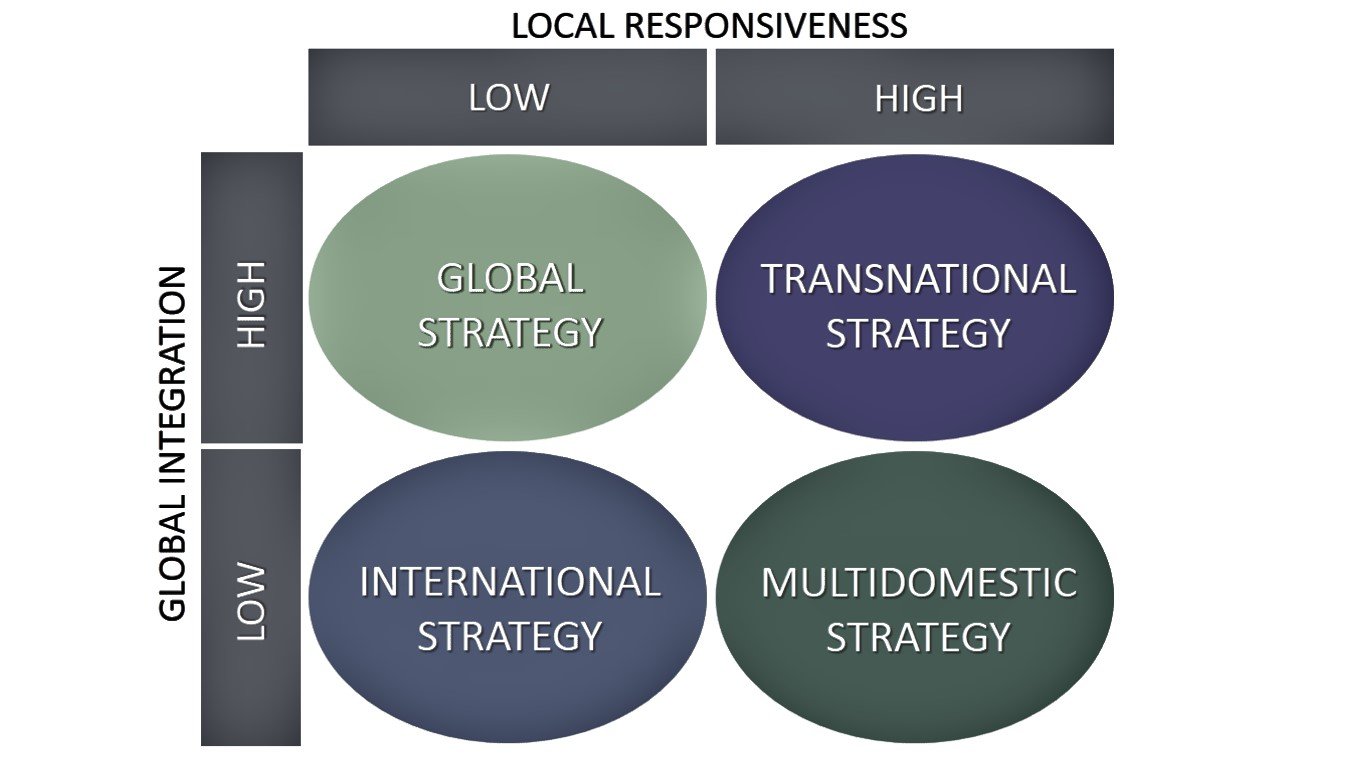
Transnational Strategy: Transnational businesses operate with a central or head office in one country that coordinates local subsidiaries in international markets. This organizational structure means that there is one overarching brand and center of operations that determine overall decision-making and supply chain management, harnessing the power of scale. Companies McDonald’s, Nike, and Coca-Cola use this model.

Multi-Domestic Strategy: When businesses use completely different sales, marketing, and product strategies based on the specific companies they’re operating in. Rather than one global brand, there are many smaller, country-specific brands tailored to local tastes and local customers. Big-name wellness brands like Johnson and Johnson use this model. Netflix customizes the programming that is shown on its channels within dozens of countries, including New Zealand, Portugal, Pakistan, and India. Similarly, food company H. J. Heinz adapts its products to match local preferences. Because some Indians will not eat garlic and onion, for example, Heinz offers them a version of its signature ketchup that does not include these two ingredients. Outback Steakhouse uses the multi-domestic strategy in the multiple countries where it operates, adapting to local eating preferences but not lowering prices significantly.

Global Strategy: When businesses define one global brand, making little to zero changes for other markets. Tech giant Apple is a great example of this; the technology is the same (with a few minor changes in keyboards) wherever you go. Microsoft, for example, offers the same software programs around the world but adjusts the programs to match local languages. Similarly, consumer goods maker Procter & Gamble attempts to gain efficiency by creating global brands whenever possible. Global strategies also can be very effective for firms whose product or service is largely hidden from the customer’s view, such as silicon chip maker Intel. Lenovo also uses this strategy. For such firms, variance in local preferences is not very important, but pricing is.

Firms pursuing an international strategy are neither concerned about costs nor adapting to the local cultural conditions. They attempt to sell their products internationally with little to no change. When Harley Davidson sells motorcycles abroad, they do not need to lower their prices or adapt the bike to local motorcycle standards. People in other countries buy a Harley particularly because it is different from the local motorcycles. Buyers want the American look and the sound and power of a Harley, and will pay for that differentiation. Belgium chocolate exporters do not lower their price when exporting to the American market to compete with Hershey’s, nor do they adapt their product to American tastes. They use an international strategy. Starbucks and Rolex watches are other examples of firms pursuing the international strategy.

Concept of International Pricing, Objectives of International Pricing, Factors Affecting International Pricing

Price may be defined as the exchange of goods or services in terms of money. Without price there is no marketing, in the society. To a manufacturer, price represents quantity of money (or goods and services in a barter trade) received by the firm or seller. To a customer, it represents sacrifice and hence his perception of the value of the product. Conceptually, it is:

Price = Quantity of money received by the seller/Quantity of goods and services rendered received by the buyer

The term ‘price’ needs not be confused with the term ‘pricing’. Pricing is the art of translating into quantitative terms (rupees and paise) the value of the product or a unit of a service to customers at a point in time.

According to Prof. K.C. Kite, “Pricing is a managerial task that involves establishing pricing objectives, identifying the factors governing the price, ascertaining their relevance and significance, determining the product value in monetary terms and formulation of price policies and the strategies, implementing them and controlling them for the best results”.

Pricing refers to the value determination process for a good or service, and encompasses the determination of interest rates for loans, charges for rentals, fees for services, and prices for goods. Pricing decisions are difficult to make even when a company operates only in a domestic market, and the difficulty is still greater in international markets. Multiple currencies, trade barriers, additional cost considerations, and longer distribution channels make price determination more complex in international markets.

Globalisation of business has put increased pressure on the pricing systems of companies which enter international markets. These companies have to adapt their pricing structures as they graduate from being purely domestic players to exporters, and then to overseas manufacturers.

The earlier pricing structures used by them may no longer be appropriate in the complex international environment characterized by high competition, more global players, rapid changes in the technology, and high-speed communication between markets.

Companies operating in international markets have to identify:

1) The best approach for setting prices worldwide.

2) The variables those are important in determining prices in international markets.

3) The level of importance that needs to be given to each variable.

4) The variance in prices across markets.

5) The variance in prices across customer types.

6) The factors to be considered while determining transfer prices,

Pricing decisions cannot be made in isolation because pricing affects other marketing decision variables and determines:

1) The customer’s perception of value.

2) The level of motivation of intermediaries.

3) Promotional spending and strategy.

Pricing, an important decision in any business, be it domestic or international, directly affects revenue and thus profitability. Further, appropriate pricing aids proper growth, as development of a mass market depends to a large extent on price. For businesses dependent on acquiring business contracts through competitive bidding, such as the construction and mining industries and drilling companies, a poor pricing decision threatens survival. Too high a price may mean no business, while a lower price may lead to a unprofitable operation. In many cases, the price indicates a product’s quality. If the Mercedes car, e.g., were priced in the same range as the Oldsmobile, the Mercedes would lose some of its quality image. Finally, price affects the extent of promotional support to be allocated to a product.

Objectives of International Pricing

Penetration:

The first objective of a new entrant to an international market is to create demand for the product. For this, the firm will be tempted to adopt low-price strategy, which may divert demand from a regular channel of supply or to generate new demand. Low price strategy is justified for the new entrant in the light of his image disadvantage and the nature of his product. However, the danger of this strategy is that it may invite anti-dumping charges from foreign competitors apart from yielding low profits for the exporter.

Skimming:

Another objective of pricing policy may be to use a very high price to skim the cream of the demand. High price strategy is generally used if the export firm is selling a unique or a new product, or the exporter intends to establish a high-quality image for the product. The advantage of this strategy is that the exporter can earn higher profit margins but it can limit the product’s marketability. This may also attract more competition in the market for that product. Hence, this strategy should be used only when an exporter has gained a strong foothold in a foreign market and has built up a good image for his product and himself.

Holding Market Share:

Another objective of pricing in international marketing is to maintain their share in the market, i.e., to survive in the face of strong competition in the market. In a market where there is strong competition, weaker export firms will disappear and the stronger ones will survive the competition. Price of the product should be fixed keeping in mind the competitive situation. Hence, the export firm likes to fix a relatively low price for its product to discourage potential customers.

Enhancing the Share:

One of the objectives of pricing decision maybe capturing the export market. A company fixes comparatively lower prices for its products. Sometimes, prices are fixed at the lowest. which may result in no profit to the business, but the main aim is to enhance the market share of the product and the firm. Besides above-mentioned objectives, other objectives of pricing of international marketing may be listed as under:

  • Preventing new entry
  • Fighting competition
  • Shortening pay back period
  • Optimum capacity utilization
  • Early cash recovery
  • Profit maximization.

Factors Affecting International Pricing

It is far more difficult to fix price in international market as compared to domestic market.

The following are the main factors to be considered while fixing prices in international market:

  1. International Marketing Objectives:

Mostly price is decided with a view to capture international market, e.g., when a company wants to enter in the market the product is sold at lower rates. When it intends to maximise use of its additional production capacity, marginal cost of production is considered. When an export target is to be achieved then in that context price is determined. Other motives like getting entry in market, to get a certain share in market, to get definite return on investment, etc., are also of special importance.

  1. Cost of Product:

Price in international marketing cannot be determined without considering the cost of the product. Fixed and variable costs of production, marketing and transport expenses are included in the cost of production. Sometimes a company sells at a price lower than cost and increases its share in market. It aims to recover production cost in long run. Price depends on production cost. Hence, it is necessary to analyse the cost and to consider the fixed and variable costs while fixing the price.

But cost alone cannot fix the price. It is true that the price cannot be fixed below cost for long. Cost determines the floor price below which an exporter may not agree to sell the goods. But this principle does not always hold good. An increase in costs may justify the increase in prices, yet it may not be possible to do so because of the marketing conditions, i.e., demand and supply. On the other hand, it may also be possible that any increase in demand may lead to an increase in price without an increase in costs.

Although the costs-price relationship is important, it does not support the claim that costs determine the price. In some cases, the prevalent price may determine the costs that may be increased. The manufacturer-exporter cuts the cost according to the prices prevailing in the market.

Another factor that proves that the costs do not determine the price is that costs of each producer differ substantially due to different internal and external factors. If cost is the determining factor, the price must also vary substantially. Again, if costs are to determine the price, no firm would suffer a loss. It does not mean that costs should be completely ignored while setting price. Cost is one of the most important factors in setting price.

  1. Demand:

Demand is another factor that determines the prices in the international markets. The demand in international markets is also affected by a number of factors which are different from those operating in domestic market. Customs and tastes of foreign customers may differ widely.

Elasticity of demand is another factor which affects the pricing. If the demand of the product is elastic, a reduction in price may increase the sales volume. On the other hand, higher price may be fixed if the demand is inelastic and the supply is limited.

  1. Business Competition:

Competition in the foreign market is also an important factor. Competition in foreign market may be so severe that the exporter has no other option except to follow the market leader. In monopoly an exporter can fix high price of its patented product. Greater competition reduces freedom for fixing the price. Price cannot be determined without considering the strategy of competitors.

  1. Exchange Rate:

Foreign exchange rate plays a vital role in the price fixing in international marketing. For example, when rupee falls against dollar an importer hesitates in filling tender. An importer has to pay more rupees per dollar. In such circumstances rupee is considered to have become weaker against dollar.

  1. Product Differentiation:

This factor plays a vital role in price fixing. When a product has specialities or is totally different compared to those of its competitors, the company is more-free to decide price. Usually, prices of such products are quoted higher than that of others up to certain extent.

  1. Prestige:

Prestige of the producer and of the country is reflected in the price of the product. Prestigious companies determine higher price for their products. Underdeveloped countries cannot quote high price, even if their product is better than that of the developed country. In foreign markets, as a developing country India finds it difficult to keep prices high though our many items like H.M.T. watches, woollen garments, readymade wear, leather bags and Ayurvedic medicines are of superb quality.

  1. Market Characteristics:

In addition to competition the following are some other factors which also affect price:

(i) Trend of demand

(ii) Consumer income levels

(iii) Importance of the product to the consumer

(iv) Margins of profit.

  1. Government Factors:

Government’s policy and laws affect pricing as under:

(i) Ceiling and Floor Prices:

Some countries fix top and bottom prices of their products. When government regulates the price, one has to keep its price between them. India had fixed minimum export prices of cotton cloth and other products. Normally, such a policy may be applied for national development, industries position, stock of goods, and protection of industries.

(ii) Regulation of Margins:

Sometimes government decides the profit margin or percentage of mark-up for producers or distributors. As a result, marketer loses most of the freedom of pricing.

(iii) Taxes:

While deciding price of an exportable product, custom duties and other taxes have to be considered. When import duties are levied, an exporter has to reduce his price. In foreign markets price has to be kept up because of such taxes.

(iv) Tax Concessions, Exemptions and Subsidies:

To promote exports many countries give tax reliefs or freedom. Products can be exported at lower prices in such cases. For example, under Duty Draw Back Scheme, if raw-materials are imported for production of export goods, the import duty or excise duty paid for this is refundable. To promote export, Govt., gives financial subsidies also. Such subsidies also affect price determination in export market.

(v) Other Incentives:

To promote export the government gives many incentives. Among these, supply of raw-materials, electricity and water supply at lower rates, aid in selling etc. are main incentives. While fixing prices of export goods these factors are kept in view.

(vi) Government Competition:

Sometimes the government enters in market to keep control on international prices. For example, the American Government sells aluminium from its stock at a fixed price to American companies. The companies are unable to increase prices in such circumstances. Hence, while fixing price Government competition should also be considered.

(vii) International Agreement:

Prices of some products are controlled by international agreements about stock, buffer stock agreement, bilateral or multilateral agreements. In view of such agreements companies have to fix prices in international market.

International Pricing Methods: Cost Based, Demand Based, Competition Based, Value Pricing, Target Return Pricing and Going Rate Pricing

Cost Based

The most frequently used pricing method in exports is cost-plus method. This method is based on the full cost or total cost approach. In arriving at the export pricing under this method, the total cost of production of the article (fixed and variable) is taken into account.

Over and above the fixed and variable costs incurred in the production of exportable articles, all direct and indirect expenses incurred for the development of product such as research and development expenses and other expenses necessary for the export of the articles such as transportation cost, freight, customs duties, insurance etc., are included.

Then a reasonable profit margin is added to the costs and the value of the subsidy and assistance from the Government or other bodies of the country, if any, is deducted. The net result is the total export price for the commodities produced. Price per unit may be calculated by dividing the total price, thus arrived, by the number of units manufactured.

The various elements of cost, forming part of the total cost are:

(i) Direct Costs:

(a) Variable Costs:

Direct materials, direct labour, variable production overheads, variable administrative overheads.

(b) Other Costs Directly Related to Exports:

Selling costs: Advertising support to importers abroad, special packing, labelling, etc., commission to overseas agent, export credit insurance, bank charges, inland freight, forward charges, inland insurance, port charges, export duties, warehousing at port, documentation and incidentals, interests on funds involved, costs of after-sale service.

(ii) Fixed Costs or Common Costs:

It includes production overheads, administration overheads, publicity and advertising (general), travel abroad and after-sale service minus Govt., assistance, duty drawback and import subsidy etc., received and then freight and insurance are added to arrive at the final cost.

Advantages:

(i) Under this method the exporter realises the total cost in marketing the product in a foreign market.

(ii) Marginal targets are thought of.

(iii) No chances of loss.

(iv) This is logical and universally accepted method.

(v) It is easier to understand and calculate.

Disadvantages:

(i) Cost is considered in advance. But there is difference between estimated and real cost. So, this method does not give exact result.

(ii) When a company’s cost is higher than its competitors, this method is of no help.

(iii) In this method only cost and expected profit are considered. Hence, chances of increasing price are often lost.

(iv) Change in demand and supply is not taken care of.

(v) It does not help in competition.

(vi) There is little scope for change according to time and circumstances and hence, this method of pricing is not useful.

Demand Based

Competition Based

Both the methods are based on cost considerations, while under market- oriented pricing, price is changed in accordance with market changes. The costs are, no doubt, important but the competitive prices should also be considered before fixing the export price. Competitive prices mean the prices that are charged by the competitors for the same product or for the substitute of the product in the target market. Once this price level is established, the base price or what the buyer can afford, should be determined.

The base price can be determined by following the three basic steps:

(i) First, relevant demand schedules (quantities to be bought) at various prices should be estimated over the planning period;

(ii) Then, relevant costs (total and incremental) of production and marketing should be estimated to achieve the target sales volume as per demand schedules prepared; and

(iii) Lastly, the price that offers the highest profit contribution, i.e., sales revenues minus ‘all fixed and variable costs.

The final determination of base price should be made after considering all other elements of marketing mix. Within these elements, the nature and length of channel of distribution is the most important factor affecting the final cost of the product?

The above three steps, though appear to be very simple, is actually not so because there are various other factors that should be considered. The most appropriate method to estimate the demand of the product shall be the judgemental analysis of company and trade executives. One other way may be the extrapolation of demand estimates for target markets from actual sales in identical markets in terms of basic factors.

Advantages:

(i) This method is more flexible, hence benefits of market opportunity can be obtained.

(ii) Business unit can face competition as price is fixed as per market position.

(iii) When product life is short, this method is most suitable.

(iv) Capital is regained quickly.

(v) We make sales quickly and cash flow can be maintained.

(vi) Risk of product becoming out of date decreases.

Disadvantages:

(i) It is not easy to estimate market changes.

(ii) It is possible to overlook relation between price and demand.

(iii) If demand is less in a market compared to others, it may mislead.

Value Pricing

Value-based price (also value optimized pricing and charging what the market will bear) is a pricing strategy which sets prices primarily, but not exclusively, according to the perceived or estimated value of a product or service to the customer rather than according to the cost of the product or historical prices. Where it is successfully used, it will improve profitability through generating higher prices without impacting greatly on sales volumes.

The approach is most successful when products are sold based on emotions (fashion), in niche markets, in shortages (e.g. drinks at open air festival on a hot summer day) or for complementary products (e.g. printer cartridges, headsets for cell phones). Goods which are very intensely traded (e.g. oil and other commodities) are often sold using cost-plus pricing. Goods which are sold to highly sophisticated customers in large markets (e.g. automotive industry) have also in the past been sold using cost-plus pricing, but thanks to modern pricing software and pricing systems and the ability to capture and analyze market data, more and more markets are migrating towards market- or value-based pricing.

Value-based pricing in its literal sense implies basing pricing on the product benefits perceived by the customer instead of on the exact cost of developing the product. For example, a painting may be priced as much more than the price of canvas and paints: the price in fact depends a lot on who the painter is. Painting prices also reflect factors such as age, cultural significance, and, most importantly, how much benefit the buyer is deriving. Owning an original Dalí or Picasso painting elevates the self-esteem of the buyer and hence elevates the perceived benefits of ownership.

Target Return Pricing

The Target-Return Pricing is a method wherein the firm determines the price on the basis of a target rate of return on the investment i.e. what the firm expects from the investments made in the venture.

Target-Return Pricing = Unit cost + (Desired return x invested capital) /Unit sales

The target-return pricing is easy to calculate and understand. Also, it gives direction towards which the efforts of all the team members should be directed, to accomplish the set ROI.

But however, the major limitation of this method is the accuracy with which the amount of sales is estimated. It is not necessary that the quantity for which the set ROI is achievable will be same for all the other quantities.

Going Rate Pricing

The Going-Rate Pricing is a method adopted by the firms wherein the product is priced as per the rates prevailing in the market especially on par with the competitors.

Basically, the company sets a price of its products and services in line with the competitor’s prices, and may sometimes charge more or less depending on the value, product offers.

This type of pricing is mostly followed in Oligopolistic industries where they deal in homogenous goods, and in which less variation is seen from one producer to another. Such products are steel, aluminium, paper, fertilizer, etc., the firms dealing with these usually charge the same price from the customers.

With a going-rate pricing method, companies feel secure as they are sure to get the customers because of the same rates prevailing in the industry. But however, it is difficult to determine the changing trends of the competitor and often it is not possible to match the cost of a product with the price that others are following.

Advantages

  • Competitor’s price is taken as base.
  • Uniform price in market.
  • Misguiding customers is protected.

Disadvantages

  • Only competitor price is considered.
  • Inaccurate decisions.
  • Production costs etc. are ignored.

Marginal Cost Pricing:

Another cost oriented method of pricing in international market is to determine the price on the basis of variable cost or direct cost. In this method fixed cost element in the total cost of production is totally ignored and the firm is concerned only with the marginal or incremental cost of producing the goods which are sold in foreign markets.

We know that the fixed cost remains fixed up to a certain level of output irrespective of the volume of output. Variable costs, on the other hand, vary in proportion to the volume of production. Thus, it is the variable or direct or marginal costs that set the price after a certain level of output is achieved, that is, output at Break-Even Point (BEP).

This method is based on the assumption that the export sales are bonus sales and any return over the variable costs contributes to the net profit. Under this system it is assumed that the firm has been producing the goods for home consumption and the fixed costs have already been met or in other words, Break-Even Point has been achieved.

Thus, if the manufacturers are able to realise the direct costs, including those involved in export operations specifically, they would not affect the profitability of their firms. The profitability of firms should be assessed with reference to marginal cost which should normally constitute the basis for export pricing. Other elements in calculating price will remain the same.

Advantages:

(i) Export sales are additional sales hence these should not be burdened with overhead costs which are ordinarily met from the domestic trade.

(ii) This method is advocated for firms from developing countries who are not well-known in foreign markets as compared to their competitors from developed countries, and therefore, lower prices based on variable costs may help them enter a market. Price may be used as a technique for securing market acceptance for products newly introduced into the market.

(iii) Since the buyers of products from developing countries usually are in countries with low national income, it is advisable for the firm to serve a large segment of the market at low prices.

(iv) When fixed cost can be gained from domestic market, total profit can be raised by exporting at a price higher than marginal cost price.

(v) An order which may be refused on the basis of total cost can be accepted on the basis of marginal cost and profit can be increased.

Disadvantages:

(i) Generally, this method is applied only when a company has idle production capacity in addition to optional cost.

(ii) Developing countries might be charged for dumping their products in foreign markets because they would be selling their products below net prices and thus may attract anti-dumping provisions which will take away their competitive advantage.

(iii) The use of this method may give rise to cut-throat competition among exporting firms from developing countries resulting in loss in valuable foreign exchange to the exporting countries.

(iv) Marginal cost pricing is not advisable in the following cases:

(a) If the importers are regularly purchasing the product at a low price, it will be difficult for exporters to increase the price of the commodities later on. It may result in loss of market.

(b) This policy is not useful or is of limited use to industries which are mainly dependent upon export markets and where overheads or fixed costs are insignificant.

Feasibility:

The system of marginal cost pricing is feasible in the following circumstances:

(i) There must be a large domestic market for the product so that the overheads may be charged from products manufactured for domestic market.

(ii) Mass production techniques must have been adopted so that the gap between the full and marginal costs may be reduced.

(iii) The home market has a capacity to bear the higher prices.

(iv) Additional production for exports is possible without increasing overhead costs and within permissible production capacity.

Marginal Cost Sets the Lower Limit:

It is generally advocated that marginal cost should be the basis for export pricing. This method based on marginal cost only sets the lower limit up to which a firm can sell its product without affecting its overall profitability. It does not follow that one should invariably charge the variable cost.

The situation in different markets may be different and in many a case, contribution towards fixed cost might be possible and all efforts should be made to take advantage of this possibility. Even in cases where only marginal cost is possible to realise, the long-term objective of the firm should be to recover direct costs plus some contribution towards overhead costs as well.

International Pricing Strategies: Skimming Pricing, Penetration Pricing, Predatory Pricing

Pricing is one of the most relevant elements of the marketing mix. Price is defined as the amount of money required for a product or service. Generally, this should reflect the cost of producing the product, the cost of providing any necessary or ancillary services, a return for the firm, as well as the quality of the product.

Skimming Pricing

Under high pricing policy, higher prices are charged during the initial stage of the introduction of a new product. The manufacturer fixes, higher price of his product in order to recover his initial investment quickly. This type of pricing is resorted to by an exporter who has gained a strong foothold (a near monopoly position), in a foreign market and has acquired a highly competitive position with an image of a dependable supplier of quality product.

With the help of a well thought out promotion program, emphasizing the value derivable from the product, higher price may be charged to maximize gain. Vanity items or items that involve high research development expenditure for manufacturing and marketing or items that are unique to a particular company or country which cannot be easily copied by competitors are amenable to skimming pricing.

Producers of smart phones used a skimming strategy. Once other producers penetrated into the market and the smart phones were manufactured at a lower unit price, other marketing approaches and pricing approaches were executed. New products were launched and the market for smart phones earned a reputation for innovation.

Penetration Pricing

Under this pricing policy, prices are fixed below the competitive level to obtain a larger share of the market and to develop popularity of the brand. Unlike skimming price policy, it facilitates higher volume of sales even during the initial stages of a product’s life cycles. This policy helps in developing the brand preference and is useful in marketing the products which are expected to have a steady long-term market.

Penetration pricing is an aggressive pricing strategy which results in lower profits or even losses during the initial stages. But once the product is established in the market, profit level goes up because of economies of large scale production.

After getting large number of subscribers, rates gradually go up. For example, Tata Sky or any cable or satellite company, when there is a premium movie or sporting event rates are at their highest. Thus, they shift from penetration strategy to more of a skimming or premium pricing strategy.

Predatory Pricing

Predatory pricing is a pricing strategy, using the method of undercutting on a larger scale, where a dominant firm in an industry will deliberately reduce its prices of a product or service to loss-making levels in the short-term. The aim is that existing or potential competitors within the industry will be forced to leave the market, as they will be unable to effectively compete with the dominant firm without making a loss. Once competition has been eliminated, the dominant firm now with having a majority share of the market can then raise their prices to monopoly levels in the long-term to recoup their losses.

The difference between predatory pricing and competitive pricing is during the recouping phase of lost profits by the dominant firm charging higher prices. With there being fewer firms in the market causing consumers to have fewer choices between these products or services these higher prices result in consumer harm. Predatory pricing usually will cause consumer harm and is considered anti-competitive in many jurisdictions making the practice illegal under some competition laws.

Here, the rates of marketing and advertising a product are kept as low as possible. Supermarkets often have economy brands for soups, spaghetti, biscuits, etc.

Budget airlines are popular for keeping their overheads as low as possible and then providing the customer a comparative lower rate to fill an aircraft. The first few seats are sold at a very low rate almost an advertisement rate price and the middle majority are economy seats, with the highest rate being sold for the last few seats on a flight i.e., in the premium pricing strategy. During times of recession, economy pricing records more purchase.

Legal features

  • The principal part of predatory pricing is the operator in the seller’s market, and the operator has certain economic or technical strength. This feature distinguishes it from price discrimination, which includes not only competition between sellers but also competition among buyers.
  • The geographical market of predatory pricing is the country’s domestic market. This feature distinguishes it from “dumping“. “Dumping” refers to the act of selling commodities in overseas markets at a lower price than the domestic market. It can be seen that these two have similarities in terms of “low-cost sales” and “exhaustion of competitors”, but their differences are obvious.

(1) The scopes of application of the two are different. “Predatory pricing” applies to domestic trade, and “dumping” applies to international trade. The standards for the identification of the two are different. “Predatory pricing” is based on cost, while “dumping” is based on the price applicable to the normal trading of domestic similar products.

(3) The laws applicable to both are different. “Predatory pricing” mainly applies to domestic laws, while “dumping” mainly applies to international treaties or the laws of other countries.

(4) The consequences of the two are different. Legal sanctions on “predatory pricing” are compensating damages or administrative penalties, while “dumping” is levying anti-dumping duties.

The objective performance of predatory pricing is a company temporarily sells goods or services below cost. Its essence is that it temporarily loses money, but squeezes competitors out of a certain market to form an exclusive situation. Then the predatory pricing company can sell goods and services at monopoly prices to make up for the losses from its low price sales.

A dominant firm’s subjective intention may be to eliminate competition to gain a monopoly advantage. Under EU law, if a dominant firm prices above AVC but below average total costs (ATC), proving intention can be useful evidence for a finding of predatory pricing. However, it can be difficult to distinguish an intention to eliminate competitors from a legitimate intention to win competition. Therefore, the European Commission do not have to establish an undertaking’s subjective intention to show Article 102 applies, especially as abuse is an “objective” rather than a subjective concept.

International Pricing Issues: Gray Market, Counter Trade, Dumping, Transfer Pricing

Setting prices for international markets is not an easy task. Decisions with regards to product, price, and distribution for international markets are unique to each country and will inevitably differ from those in the domestic market.

Furthermore, other factors such as: the rate of return, market stabilization, demand and competition-led pricing, market penetration, early cash recovery, prevention of competitive entry, company and product factors, market and environmental factors are all important in the decision-making process.

When pricing for international markets, one has to take into consideration local culture, language, geography, climate, education, religion, attitudes and values. Firms need to examine carefully target market country’s characteristics and purchasing behaviours, to select an appropriate pricing strategy.

Gray Market

A grey market or dark market (sometimes confused with the similar term “parallel market”) is the trade of a commodity through distribution channels that are not authorized by the original manufacturer or trade mark proprietor. Grey market products (grey goods) are products traded outside the authorized manufacturer’s channel.

Manufacturers of computers, telecom, and technology equipment often sell these products through distributors. Most distribution agreements require the distributor to resell the products strictly to end users. However, some distributors choose to resell products to other resellers. In the late 1980s, manufacturers labelled the resold products as the “grey market”.

The legality of selling “Grey market” products depends on a number of factors. Courts in the United States and in the EU make a number of assessments, including an examination of the physical and non-physical differences between the “Grey market” and authorized products to determine whether there are material differences. The legality of the products oftentimes turns on this examination.

In November 2016, the Court of Appeal of England and Wales confirmed a ruling in the case of R v C and Others that the sale of grey goods can be met by criminal sanctions under section 92 of the UK Trade Marks Act 1994, with a potential penalty of up to 10 years in prison.

It is worth mentioning that the goods sold in this case were, in fact, counterfeit and infringed on trademarks; as such, people would consider this to be black market goods, rather than grey. The simple fact is that selling or reselling any products one has bought is not generally considered a crime, and most traders rely on their right to resale and thus trade.

The parties most opposed to the grey market are usually the authorised agents or importers, or the retailers of the item in the target market. Often this is the national subsidiary of the manufacturer, or a related company. In response to the resultant damage to their profits and reputation, manufacturers and their official distribution chain will often seek to restrict the grey market. Such responses can breach competition law, particularly in the European Union. Manufacturers or their licensees often seek to enforce trademark or other intellectual-property laws against the grey market. Such rights may be exercised against the import, sale and/or advertisement of grey imports. In 2002, Levi Strauss, after a 4-year legal case, prevented the UK supermarket Tesco from selling grey market jeans. However, such rights can be limited. Examples of such limitations include the first-sale doctrine in the United States and the doctrine of the exhaustion of rights in the European Union.

When grey-market products are advertised on Google, eBay or other legitimate web sites, it is possible to petition for removal of any advertisements that violate trademark or copyright laws. This can be done directly, without the involvement of legal professionals. For example, eBay will remove listings of such products even in countries where their purchase and use is not against the law. Manufacturers may refuse to supply distributors and retailers (and with commercial products, customers) that trade in grey market goods. They may also more broadly limit supplies in markets where prices are low. Manufacturers may refuse to honour the warranty of an item purchased from grey market sources, on the grounds that the higher price on the non-grey market reflects a higher level of service even though the manufacturer does of course control their own prices to distributors. Alternatively, they may provide the warranty service only from the manufacturer’s subsidiary in the intended country of import, not the diverted third country where the grey-market goods are ultimately sold by the distributor or retailer. This response to the grey market is especially evident in electronics goods. Local laws (or customer demand) concerning distribution and packaging (for example, the language on labels, units of measurement, and nutritional disclosure on foodstuffs) can be brought into play, as can national standards certifications for certain goods.

Manufacturers may give the same item different model numbers in different countries, even though the functions of the item are identical, so that they can identify grey imports. Manufacturers can also use supplier codes to enable similar tracing of grey imports. Parallel market importers often decode the product in order to avoid the identification of the supplier. In the United States, courts have ruled decoding is legal, however manufacturers and brand owners may have rights if they can prove that the decoding has materially altered the product where certain trademarks have been defaced or the decoding has removed the ability of the manufacturer from enforcing quality-control measures. For example, if the decoding defaces the logo of the product or brand or if the batch code is removed preventing the manufacturer from re-calling defective batches.

The development of DVD region codes, and equivalent regional-lockout techniques in other media, are examples of technological features designed to limit the flow of goods between national markets, effectively fighting the grey market that would otherwise develop. This enables movie studios and other content creators to charge more for the same product in one market than in another, or alternatively withhold the product from some markets for a particular time.

Counter Trade

Countertrade means exchanging goods or services which are paid for, in whole or part, with other goods or services, rather than with money. A monetary valuation can however be used in countertrade for accounting purposes. In dealings between sovereign states, the term bilateral trade is used.

Types of countertrade

Barter: Exchange of goods or services directly for other goods or services without the use of money as means of purchase or payment.

Barter is the direct exchange of goods between two parties in a transaction. The principal exports are paid for with goods or services supplied from the importing market. A single contract covers both flows, in its simplest form involves no cash. In practice, supply of the principal exports is often held up until sufficient revenues have been earned from the sale of bartered goods. One of the largest barter deals to date involved Occidental Petroleum Corporation’s agreement to ship sulphuric acid to the former Soviet Union for ammonia urea and potash under a 2-year deal which was worth 18 billion euros. Furthermore, during negotiation stage of a barter deal, the seller must know the market price for items offered in trade. Bartered goods can range from hams to iron pellets, mineral water, furniture or olive-oil all somewhat more difficult to price and market when potential customers must be sought.

  • Switch trading: Practice in which one company sells to another its obligation to make a purchase in a given country.
  • Counter purchase: Sale of goods and services to one company in other country by a company that promises to make a future purchase of a specific product from the same company in that country.
  • Buyback: occurs when a firm builds a plant in a country – or supplies technology, equipment, training, or other services to the country and agrees to take a certain percentage of the plant’s output as partial payment for the contract.
  • Offset: Agreement that a company will offset a hard – currency purchase of an unspecified product from that nation in the future. Agreement by one nation to buy a product from another, subject to the purchase of some or all of the components and raw materials from the buyer of the finished product, or the assembly of such product in the buyer nation.
  • Compensation trade: Compensation trade is a form of barter in which one of the flows is partly in goods and partly in hard currency.

Dumping

Dumping, in economics, is a kind of injuring pricing, especially in the context of international trade. It occurs when manufacturers export a product to another country at a price below the normal price with an injuring effect. The objective of dumping is to increase market share in a foreign market by driving out competition and thereby create a monopoly situation where the exporter will be able to unilaterally dictate price and quality of the product.

A standard technical definition of dumping is the act of charging a lower price for the like product in a foreign market than the normal value of the product, for example the price of the same product in a domestic market of the exporter or in a third country market. This is often referred to as selling at less than “normal value” on the same level of trade in the ordinary course of trade. Under the World Trade Organization’s Antidumping Agreement, full name Agreement on Implementation of Article VI of the General Agreement on Tariffs and Trade 1994, dumping is not prohibited unless it causes or threatens to cause material injury to a domestic industry in the importing country. Dumping is also prohibited when it causes “material retardation” in the establishment of an industry in the domestic market.

Anti-dumping actions

Legal issues

If a company exports a product at a price that is lower than the price it normally charges in its own home market, or sells at a price that does not meet its full cost of production, it is said to be “dumping” the product. It is a sub part of the various forms of price discrimination and is classified as third-degree price discrimination. Opinions differ as to whether or not such practice constitutes unfair competition, but many governments take action against dumping to protect domestic industry. The WTO agreement does not pass judgment. Its focus is on how governments can or cannot react to dumping it disciplines anti-dumping actions, and it is often called the “anti-dumping agreement”. (This focus only on the reaction to dumping contrasts with the approach of the subsidies and countervailing measures agreement.)

The legal definitions are more precise, but broadly speaking, the WTO agreement allows governments to act against dumping where there is genuine (“material”) injury to the competing domestic industry. To do so, the government has to show that dumping is taking place, calculate the extent of dumping (how much lower the export price is compared to the exporter’s home market price), and show that the dumping is causing injury or threatening to cause injury.

Definitions and extent

While permitted by the WTO, General Agreement on Tariffs and Trade (GATT) (Article VI) allows countries the option of taking action against dumping. The Anti-Dumping Agreement clarifies and expands Article VI, and the two operate together. They allow countries to act in a way that would normally break the GATT principles of binding a tariff and not discriminating between trading partners typically anti-dumping action means charging extra import duty on the particular product from the particular exporting country in order to bring its price closer to the “normal value” or to remove the injury to domestic industry in the importing country.

There are many different ways of calculating whether a particular product is being dumped heavily or only lightly. The agreement narrows down the range of possible options. It provides three methods to calculate a product’s “normal value”. The main one is based on the price in the exporter’s domestic market. When this cannot be used, two alternatives are available the price charged by the exporter in another country, or a calculation based on the combination of the exporter’s production costs, other expenses and normal profit margins. And the agreement also specifies how a fair comparison can be made between the export price and what would be a normal price.

Five-percent rule

According to footnote 2 of the Anti-Dumping Agreement, domestic sales of the like product are sufficient to base normal value on if they account for 5 percent or more of the sales of the product under consideration to the importing country market. This is often called the five-percent or home-market-viability test. This test is applied globally by comparing the quantity sold of a like product on the domestic market with the quantity sold to the importing market.

Normal value cannot be based on the price in the exporter’s domestic market when there are no domestic sales. For example, if the products are only sold on the foreign market, the normal value will have to be determined on another basis. Additionally, some products may be sold on both markets but the quantity sold on the domestic market may be small compared to quantity sold on foreign market. This situation happens often in countries with small domestic markets like Hong Kong and Singapore, though similar circumstances may also happen in larger markets. This is because of differences in factors like consumer taste and maintenance.

Calculating the extent of dumping on a product is not enough. Anti-dumping measures can only be applied if the act of dumping is hurting the industry in the importing country. Therefore, a detailed investigation must first be conducted according to specified rules. The investigation must evaluate all relevant economic factors that have a bearing on the state of the industry in question; if it is revealed that dumping is taking place and hurting domestic industry, the exporting company can raise its price to an agreed level in order to avoid anti-dumping import duties.

Procedures in investigation and litigation

Detailed procedures are set out on how anti-dumping cases are to be initiated, how the investigations are to be conducted, and the conditions for ensuring that all interested parties are given an opportunity to present evidence. Anti-dumping measures must expire five years after the date of imposition, unless a review shows that ending the measure would lead to injury.

Generally speaking, an anti-dumping investigation usually develops along the following steps: domestic producers make a request to the relevant authority to initiate an anti-dumping investigation. Then investigation to the foreign producer is conducted to determine if the allegation is valid. It uses questionnaires completed by the interested parties to compare the foreign producer’s (or producers’) export price to the normal value (the price in the exporter’s domestic market, the price charged by the exporter in another country, or a calculation based on the combination of the exporter’s production costs, other expenses and normal profit margins). If the foreign producer’s export price is lower than the normal price and the investigating body proves a causal link between the alleged dumping and the injury suffered by the domestic industry, it comes to a conclusion that the foreign producer is dumping its products. According to Article VI of GATT, dumping investigations shall, except in special circumstances, be concluded within one year, and in no case more than 18 months after initiation. Anti-dumping measures must expire five years after the date of imposition, unless a review shows that ending the measure would lead to injury.

Anti-dumping investigations are to end immediately in cases where the authorities determine that the margin of dumping is, de minimis, or insignificantly small (defined as less than 2% of the export price of the product). Other conditions are also set. For example, the investigations also have to end if the volume of dumped imports is negligible (i.e., if the volume from one country is less than 3% of total imports of that product although investigations can proceed if several countries, each supplying less than 3% of the imports, together account for 7% or more of total imports).

The agreement says member countries must inform the Committee on Anti-Dumping Practices about all preliminary and final anti-dumping actions, promptly and in detail. They must also report on all investigations twice a year. When differences arise, members are encouraged to consult each other. They can also use the WTO’s dispute settlement procedure.

Actions in India

The current set of anti-dumping laws in India is defined by Section 9A and 9B of Customs and Tariffs Act, 1975 (Amended 1995) and The Anti-dumping rules such as (Identification, Assessment and Collection of Anti-dumping Duty on Dumped Articles and for Determination of Injury) Rules of 1995, Section 9A of customs and tariffs Act 1975 states that “If any article is exported from any country or territory to India at less than its normal value, then, upon the importation of such article into India, the central government may by notification in the official gazette, impose an anti-dumping duty not exceeding the margin of dumping in relation to such article.” As of November 28, 2016, 353 anti-dumping cases has been initiated by Directorate General of Anti-Dumping and Allied Duties (DGAD) out of which in one hundred and thirty cases, anti-dumping measures are in force. In January 2017, the Indian government imposed anti-dumping duty on colour coated steel products imported from the European Union and China for 6 months.

Though, the move was applauded by Essar Steel India Commercial Director, H Shivram Krishnan but, importers expressed their concern regarding protective measures like minimum import price and anti-dumping duty especially when domestic is narrowing and imports are falling.

On July, 2015, the government imposed anti-dumping duty on fibreboard imported from Indonesia and Vietnam. This came after CEO and joint-Managing Director of Greenply Industries, Shobhan Mittal filed an application for anti-dumping probe initiation. The primary reason behind the probe was that the price differential between domestic and imported MDF stood at 5–6 percent and net MDF imports was at around 30–35 percent, majority of which came from Indonesia and Vietnam.

On 8 March 2017, government of India imposed anti-dumping duty ranging from US$6.30 to US$351.72 per tonne on imports of jute and its products from Bangladesh and Nepal. Later the government of India withdrew the anti-dumping duty in case of Nepal.

On 26 October 2017, India imposes anti-dumping duty on stainless steel from US, EU and China.

India has imposed anti-dumping duty on certain stainless steel products from the European Union and other nations including China and Korea, in order to protect the domestic industry from cheap imports.

The duty was imposed by the Revenue department following the recommendation by the Directorate General of Anti-Dumping and Allied Duties (DGAD).

  • The levied duty will range between 4.58 per cent and 57.39 per cent of the landed value of cold-rolled flat products of stainless steel.
  • The anti-dumping duty will be in effect until 10 December 2020.
  • The direction however, exempts certain grades of stainless steel from the duty.
  • The duty will be levied on the imports of stainless steel products from China, Taiwan, South Korea, South Africa, Thailand, the United States and the European Union.

Transfer Pricing

Transfer pricing involves what one subsidiary will charge another for products or components supplied for use in another country. Firms will often try to charge high prices to subsidiaries in countries with high taxes so that the income earned there will be minimised.

Transactions may include the trade of supplies or labour between departments. Transfer prices are used when individual entities of a larger multi-entity firm are treated and measured as separately run entities.

Therefore, when divisions are required to transact with each other, a transfer price is used to determine costs. Transfer prices tend not to differ much from the price in the market because one of the entities in such a transaction will lose out: they will either be buying for more than the prevailing market price or selling below the market price, and this will affect their performance.

Concept of International Distribution Channels, Types of International Distribution Channels

The sole objective of production of any commodity is to help the goods reach the ultimate consumers. In the era of modem large scale production and specialization it is not possible for the producer to fulfil this work in all circumstances. The size of market has become quite large. Therefore, the producer has to face numerous difficulties if he undertakes the distribution works himself.

Besides, in the age of specialization it is not justified on the part of a single person or organisation to entertain both production as well as distribution work. Thus, the producer has to take help of many distribution channels to transfer the goods to the ultimate consumers. In other words, many different distribution channels are needed between producers and consumers for effective distribution of products.

“A distribution channel, in other words, is a set of fhs and individuals that take title, or assist in transferring title to a particular good or service as it moves from the producer to the consumers. Channels of distribution consist of two categories of intermediaries or middlemen, namely:

i) Merchants who take title to the goods.

ii) Agents who do not take title to the goods but assist in the transferring of the title.

The economic development of a country may influence the channels of distribution in the following way,

i) The more developed countries have more levels of distribution, more specially stores and supermarkets, more department stores and more stores in the rural areas.

ii) The influence’ of foreign agents declines with economic development.

iii) The manufacturer, wholesaler, retailer functions become separated with increasing economic development.

iv) Financing function of wholesalers decline and wholesale markets increase with increasing development.

v) The number of small stores declines and the size of the average store increases with increasing development.

vi) RetaiI margins improve with increasing economic development.

According to Philip Kotler, “Every producer seeks to link together the set of marketing intermediaries that best fulfil the firm’s objectives. This set of marketing intermediaries is called the marketing channel.”

According to Richard Buskirk, “Distribution channels are the systems of economic institutions through which a producer of goods delivers them into the hands of their users.”

According to William J. Stanton, “A channel of distribution for a product is the route taken by the title to the goods as they move from the producer to the ultimate consumers or industrial user.”

According to McCarthy, “Any sequence of institutions from the producer to the consumer, including none or any number of middlemen is called a channel of distribution.”

Types of International Distribution Channels

Distribution Channel of Consumer Goods:

The channels of distribution for consumer products may be as follows:

  1. Manufacturer → Agent → Wholesaler → Retailer → Consumer:

In this method of distribution channel, product reaches the agent from the manufacturers and from the agent to wholesaler and then to consumers through retailers. In India, most of the textile manufacturers adopt this method of distribution.

  1. Manufacturer → Agent → Retailer → Consumer:

In this method of distribution, the wholesaler is eliminated and goods reach from manufacturer to agent and then consumers through retailers only. Manufacturers who want to reduce cost of distribution adopt this method.

  1. Manufacturer → Agent → Consumer:

As per this method of distribution channel, there is only one middleman that is the agent. In India, for the distribution of medicines and cosmetics, this channel of distribution is commonly adopted.

  1. Manufacturer → Wholesaler → Retailer → Consumer:

A manufacturer may choose to distribute his goods with the help of two middlemen. These two middlemen may be wholesalers and retailers.

  1. Manufacturers → Retailer → Consumer:

In this method of distribution channel, manufacturers sell their goods to retailers and retailers to consumers. In India, Gwalior Cloth Mills and Bombay Dyeing adopt this channel of distribution to sell textiles.

  1. Manufacturers → Consumers:

A producer of consumer goods may distribute his products directly to consumers. The goods may be sold directly to consumers through vending machines, mail order business or from mill’s own shops.

Distribution Channel of Industrial Products:

The channels for industrial products are generally short as retailers are not needed.

However, following methods may be adopted:

  1. Manufacturer → Agent → Wholesaler → Industrial Consumer:

Under this method, product reaches from manufacturer to agent and then to industrial consumer through the wholesaler.

  1. Manufacturer → Agent → Industrial Consumer:

Under this system, goods reach industrial consumer through the agent. Thus, there is only one middleman.

  1. Manufacturer → Wholesaler → Industrial Consumer:

This distribution channel is the same as above, the only difference is that in place of agent, there is wholesaler.

  1. Manufacturer → Industrial Consumer:

Under this channel there is no middleman and goods are directly sold to industrial consumer. Railway engines, electric production equipment are sold by this system.

Direct channel is popular for selling industrial products since industrial users place orders with the manufacturers of industrial products directly.

To plan about an export distribution, knowledge on two different aspects are a must:

(i) The marketing channel that is available in the Foreign Market.

(ii) The most appropriate channel is to link the domestic operations to the overseas channels.

The principal forms of penetrating exports markets are selling to local export houses or buying organisations for indirect exporting and appointing agents or distributors for direct exporting.

If these forms are combined with the domestic channel of distribution in the importing country, the export distribution channel can be identified as follows:

Direct Distribution Channel:

This figure is illustrative of distribution of channel of consumer goods. In case of industrial products, the channel will be shorter because there is no need of retailers. In fact, in many cases, there may not be any wholesaler.

Producer → Agent → Industrial buyer

Indirect Distribution Channel:

In indirect exporting, the firm delegates the task of selling products in a foreign country to an agent or export house.

This figure is illustrative of distribution channel of goods. In case of industrial products, the channel will be shorter because there is no need of retailers. In fact, in many cases, there may not be any wholesaler.

Factors Influencing Selection of International Distribution Channel

International marketing channels deal with channels within which goods and services pass to reach their foreign consumers. This implies that manufacturers and consumers must be located in either the manufacturers or consumers country or having presence in both countries.

The choice of the channel to use is a fundamental decision for the manufacturer where a number of factors and objectives have to be considered as a basis for such decision. The international marketer needs a clear understanding of market characteristics and must have established operating policies before beginning the selection of channel middlemen. The following points should be addressed prior to the selection process:

1) Identify specific target markets within and across countries.

2) Specify marketing goals in terms of volume, market share, and profit margin requirements.

3) Specify financial and personnel commitments to the development of international distribution.

4) Identify control, length of channels, terms of sale, and channel ownership.

There are a number of factors both objective and subjective and varying from company to company which govern choice or selection of channel of distribution. But there are some which stand out and influence channel of distribution choice in all cases. They are as follows:

1) Factors Relating to Product Characteristics:

Product manufactured by a company itself is a governing factor in the selection of the channel of distribution. Product characteristics are as follows:

i) Industrial/Consumer Product:

When the product being manufactured and sold is industrial in nature, direct channel of distribution is useful because of the relatively small number of customers, need for personal attention, salesman’s technical qualifications and after-sale servicing etc. However, in case of a consumer product indirect channel of distribution, such as wholesalers, retailers, is most suitable.

ii) Perishability:

Perishable goods, such as, vegetables, milk, butter, bakery products, fruits, sea foods etc. require direct selling as they must reach the consumers as easily as possible after production because of the dangers associated with delays in repeated handling.

iii) Unit Value:

When the unit value of a product is high, it is usually economical to choose direct channel of distribution such as company’s own sales force than middlemen. On the contrary, if the unit value is low and the amount involved in each transaction is generally small, it is desirable to choose indirect channel of distribution, i.e. through middlemen.

iv) Style Obsolescence:

When there is high degree of sty obsolescence in products like fashion garments, it is desirable to sell direct to retailers who specialize in fashion goods.

v) Weight and Technicality:

When the products are bulky, large in size and technically complicated, it is useful to choose direct channel of distribution.

vi) Standardized Products:

When the products are standardized, each unit is similar in shape, size, weight, colour and quality etc. it is useful to choose indirect channel of distribution. On the contrary, if the product is not standardized and is produced on order, it is desirable to have direct channel of distribution.

vii) Purchase Frequency:

Products that are frequently purchased need direct channel of distribution so as to reduce the cost and burden of distribution of such products.

viii) Newness and Market Acceptance:

For new products with high degree of market acceptance, usually there is need for an aggressive selling effort. Hence indirect channels may be used by appointing wholesalers and retailers as sole agents. This may ensure channel loyalty and aggressive selling by intermediaries.

ix) Seasonally:

When the product is subject to seasonal variations, such as woolen textiles in India, it is desirable to appoint sole selling agents who undertake the sale of production by booking orders from retailers and direct mills to dispatch goods as soon as they are ready for sale as per the order.

x) Product Breadth:

When the company is manufacturing a large number of product items, it has greater ability to deal directly with customers because the breadth of the product line enhances its ability to clinch the sale.

2) Factors Relating to Company Characteristics:

The choice of channel of distribution is also influenced by company’s own characteristics as to its size, financial position, reputation, past channel experience, current marketing policies and product mix etc. In this connection, some of the main factors are as follows:

i) Financial Strength:

A company which is financially sound may engage itself in direct setting. On the contrary, a company which is financially weak has to depend on intermediaries and, therefore, has to select indirect channel of distribution, such as Wholesalers, retailers, with strong financial background.

ii) Marketing Policies:

The Policies relevant to channel decision may relate to delivery, advertising, after-sale service and pricing, etc. For example, a company which likes to have a policy of speedy delivery of goods to ultimate consumers may prefer direct selling and thus avoid intermediaries and will adopt a speedy transportation system.

iii) Size of the Company:

A large-sized company handling a wide rang of products would prefer to have a direct channel for selling its products. On the contrary, a small-sized company would prefer indirect selling by appointing wholesalers, retailers etc.

iv) Past Channel Experience:

Past Channel experience of the company also influences the choice of selection of channel distribution. For instance, an old and established company with its past good experience of working with certain kinds of intermediaries will like to opt for the same channel. However, different will be the case in reverse situation.

v) Product Mix:

The wider is the company’s product mix, the greater will be its strength to deal with its customers directly. Similarly, consistency in the company’s product mix ensures greater homogeneity or uniformity and similarity in its marketing channels.

vi) Reputation:

It is said that reputation travels faster than the man. It is true in the case of companies also who wish to select channel of distribution. In case of companies with outstanding reputation like Tata Steel, Bajaj Scooters, Hindustan Levers etc indirect channel of distribution (wholesalers, retailers, etc.) is more desirable and profitable.

3) Factors Relating to Market or Consumer Characteristics:

Market or consumer characteristics refer to buying habits, location of market, size of orders, etc. They influence the channel choice significantly. They are:

i) Consumer Buying Habits:

If the consumer expects credit facilities or desires personal services of the salesman or desires to make all purchases at one place, the channel of distribution may be short or long depending on the capacity of the company for providing these facilities. If the manufacturer can afford those facilities, the channel will be shorter, otherwise longer.

ii) Location of the Market:

When the customers are spread over a wide geographical area, the long channel of distribution is most suitable. On the contrary, if the customers are concentrated and localized, direct selling would be beneficial.

iii) Number of Customers:

If the number of customers is quite large, the channel of distribution may be indirect and long, such as wholesalers, retailers, etc. On the contrary, if the number of customers is small or limited, direct selling may be beneficial.

iv) Size of Orders:

Where customers purchase the product in large quantities, direct selling may be preferred. On the contrary, where customers purchase the product in small quantities frequently and regularly, such as cigarettes, matches, etc., long (wholesalers, retailers, etc.) of distribution may be preferred.

4) Factors Relating to Middlemen Considerations:

The choice of the channel of distribution is also influenced by the middlemen considerations. They may include the following:

i) Sales Volume Potential:

In selecting channel of distribution, the company should consider the capability of the middlemen to ensure a targeted sales volume. The sales volume potential of the channel may be estimated through market surveys.

ii) Availability of Middlemen:

The company should make efforts to select aggressively oriented middlemen. In case they are not available, it is desirable to wait for some time and then to pick up. In such cases, the company should manage its own channel so long the right types of middlemen are not available.

iii) Middlemen’s Attitude:

If the company follows the resale price maintenance policy, the choice is limited. On the contrary, if the company allows the middlemen to adopt their own price policy, the choice is quite wide. Quite a large number of middlemen would be interested in selling company’s products.

iv) Services Provided by Middlemen:

If the nature of product requires after-sale services, repair services, etc., such as automobiles, cars, scooters etc, only those middlemen should be appointed who can provide such services, otherwise the company will adopt direct selling channel.

v) Cost of Channel:

Direct selling generally is costlier and thus distribution arranged through middlemen is more economical.

5) Factors Relating to Environmental Characteristics:

The environmental factors which include competitors’ channels, economic conditions, legal restrictions, fiscal structure etc., as given below, affect significantly the channel choice.

i) Economic Conditions:

When economic conditions are bright such as inflation, it is desirable to opt for indirect channel of distribution because there is an all-round mood of expectancy, market tendencies are bullish and favourable. On the contrary, if the market is depressed (such as deflation), shorter channel may be preferred.

ii) Legal Restrictions:

The legislative and other restrictions imposed by the state are extremely formidable and give final shape to the channel choice. For example, in India M.R.TP. Act, 1969 prevents channel arrangements that tend to substantially lessen competition, create monopoly and are otherwise prejudicial to public interest. With these objectives at the backdrop, it prevents exclusive distributorship, territorial restrictions, resale price maintenance etc.

iii) Competitors’ Channel:

This also influences the channel choice decision. Mostly, in practice, similar types of channels of distribution used by the competitors are preferred.

iv) Fiscal Structure:

Fiscal structure of a country also influences the channel choice decision. For example, in India, State Sales Tax rates vary from state to state and form a significant part of the ultimate price payable by a consumer. As a result, it becomes an important factor in evolving channel arrangements.

Differences in the sales tax rates in two different states would not only bring about difference in the price payable by a consumer but also in the distribution channel selected. Hence the company should appoint the channel in that stale where the sales tax rates are quite low, such as in Delhi, and that would give price advantage to the buyers of those states where the sales tax rates are high.

International Pricing Decision

Price may be defined as the exchange of goods or services in terms of money. Without price there is no marketing, in the society. To a manufacturer, price represents quantity of money (or goods and services in a barter trade) received by the firm or seller. To a customer, it represents sacrifice and hence his perception of the value of the product. Conceptually, it is:

Price = Quantity of money received by the seller/Quantity of goods and services rendered received by the buyer

The term ‘price’ needs not be confused with the term ‘pricing’. Pricing is the art of translating into quantitative terms (rupees and paise) the value of the product or a unit of a service to customers at a point in time.

According to Prof. K.C. Kite, “Pricing is a managerial task that involves establishing pricing objectives, identifying the factors governing the price, ascertaining their relevance and significance, determining the product value in monetary terms and formulation of price policies and the strategies, implementing them and controlling them for the best results”.

Pricing refers to the value determination process for a good or service, and encompasses the determination of interest rates for loans, charges for rentals, fees for services, and prices for goods. Pricing decisions are difficult to make even when a company operates only in a domestic market, and the difficulty is still greater in international markets. Multiple currencies, trade barriers, additional cost considerations, and longer distribution channels make price determination more complex in international markets.

Globalisation of business has put increased pressure on the pricing systems of companies which enter international markets. These companies have to adapt their pricing structures as they graduate from being purely domestic players to exporters, and then to overseas manufacturers.

The earlier pricing structures used by them may no longer be appropriate in the complex international environment characterized by high competition, more global players, rapid changes in the technology, and high-speed communication between markets.

Companies operating in international markets have to identify:

1) The best approach for setting prices worldwide.

2) The variables those are important in determining prices in international markets.

3) The level of importance that needs to be given to each variable.

4) The variance in prices across markets.

5) The variance in prices across customer types.

6) The factors to be considered while determining transfer prices,

Pricing decisions cannot be made in isolation because pricing affects other marketing decision variables and determines:

1) The customer’s perception of value.

2) The level of motivation of intermediaries.

3) Promotional spending and strategy.

Pricing, an important decision in any business, be it domestic or international, directly affects revenue and thus profitability. Further, appropriate pricing aids proper growth, as development of a mass market depends to a large extent on price. For businesses dependent on acquiring business contracts through competitive bidding, such as the construction and mining industries and drilling companies, a poor pricing decision threatens survival. Too high a price may mean no business, while a lower price may lead to a unprofitable operation. In many cases, the price indicates a product’s quality. If the Mercedes car, e.g., were priced in the same range as the Oldsmobile, the Mercedes would lose some of its quality image. Finally, price affects the extent of promotional support to be allocated to a product.

error: Content is protected !!
