Meaning/Definition of Project Organizational Structure, Types of Organizational Structure

A project organisation is one, in which a project structure is created as a separate unit or division within a permanent functional structure; drawing specialists and workers from various functional departments who work under the overall leadership, control and co-ordination of a project manager to complete projects of a technical and costly nature.

Under a project organisation, a team of specialists and workers is drawn from various functional areas, out of the permanent functional structure of the organisation to work on a project. The project manager may taker assistance from outside sources also.

The project team functions under the overall control and leadership of the project manager. During the continuance of the project, functional managers renounce their authority over subordinates (comprised in the project team) in favour of the project manager.

Conditions requiring the creation of a project organisation are as follows:

(i) Project completion requires huge cost.

(ii) Project is of a technical nature, requiring utmost precision and accuracy e.g. ship-building, designing and launching of satellites, aircraft manufacture etc.

(iii) Time factor is a critical factor; requiring project-completion within a limited prescribed time. Any delays in completion of project within time may tell upon the reputation of the organisation.

Types of Organizational Structure

Organic or Simple Organization

This type of organizational structure is the simplest. Businesses composed of only one person are also included in this category.

In this type of organization also freelancers are included. Of course, the role of the project manager is partly covered by the owner or the professional, who personally manage the workflows.

Functional or Centralized Organization

This type of organizational structure is the most commonly used.

In a functional organizational structure, the organization is divided into various departments where people with similar skills gather together.

It is the classic configuration in which the staff is structured in areas and departments such as the sales department, marketing department, finance department, etc.

This structure is functional as it improves the efficiency of each working group.

Multi-divisional Organization

In an organization of this kind, you can have many functional divisions with a small centralization.

Most of the time these divisions are independent of each other.

Here, an organization is structured in various divisions in which people, with different skills, are held together according to a similar product, service or geographic location.

ach division has the resources necessary in order to work and can carry out the task autonomously.

Matrix Organization

A matrix organizational structure is a hybrid between the functional organization and the project-oriented organization.

In a matrix organization, there can be two main structures: vertical and horizontal.

Here, an employee can be part of a functional group, but can also work on a project.

In turn, a matrix organization can be of three types:

  • A strong matrix
  • A weak matrix
  • A balanced matrix

Stronger organizations are closer to a project oriented organization and here the project manager has most of the authority and has a full-time team.

On the other hand, weak matrix organizations are closer to a functional structure. in this case, the project manager has low authority, no budget control, and often runs a part-time project team.

Instead, balanced matrix organizations unifies the properties of both previous types. Here, the project manager has a medium-low authority and a part-time team, while the budget is managed both directly by him and by the functional manager.

Project oriented (composite or hybrid) Organization

An organization of this type considers every job as a project. Here, the project manager has full authority to complete the project successfully, has a full-time role, budget control, and a full-time team available.

A team-based organization is another name for a project-oriented organization.

Virtual Organization

This structure is also known as virtual society. Here, the central organization is connected to external companies (such as vendors, customers, associates) with a network connection that allows to achieve business growth and profitability. This structure allows the organization to work as a unit.

In a virtual structure, the organization maintains its core business, while the rest of the processes are outsourced. Sometimes, this type of organization is also known as an empty organization.

Here, the project manager has a low-moderate authority and mixed power over the budget. The project team can be full or part-time depending on the situation.

Hybrid

In a hybrid organization, a combination of the above-mentioned structure types can be used.

Responsibility, authority, and other factors are also mixed depending on the structure.

PMO

The PMO is also a mixed type of organizational structure, but here the project manager has the highest authority, controls the budget, and has a team completely at his disposal.

Meaning/Definition of Project & Project Management, Classification of Projects

A project is an activity to meet the creation of a unique product or service and thus activities that are undertaken to accomplish routine activities cannot be considered projects. For instance, if your project is less than three months old and has fewer than 20 people working on it, you may not be working in what is called a project according to the definition of the term.

It has to be remembered that the term temporary does not apply to the result or service that is generated by the project. The project may be finite but not the result. For instance, a project to build a monument would be of fixed duration whereas the result that is the monument may be for an indefinite period in time.

A project is an activity to create something unique. Of course, many of the office buildings that are built are similar in many respects but each individual facility is unique in its own way.

Finally, a project must be progressively elaborated. This means that the project progresses in steps and continues by increments. This also means that the definition of the project is refined at each step and ultimately the purpose of the progress is enunciated. This means that a project is first defined initially and then as the project progresses, the definition is revisited and more clarity is added to the scope of the project as well as the underlying assumptions about the project.

Project management is the process of leading the work of a team to achieve all project goals within the given constraints. This information is usually described in project documentation, created at the beginning of the development process. The primary constraints are scope, time, and budget. The secondary challenge is to optimize the allocation of necessary inputs and apply them to meet pre-defined objectives.

The objective of project management is to produce a complete project which complies with the client’s objectives. In many cases the objective of project management is also to shape or reform the client’s brief to feasibly address the client’s objectives. Once the client’s objectives are clearly established, they should influence all decisions made by other people involved in the project for example project managers, designers, contractors and sub-contractors. Ill-defined or too tightly prescribed project management objectives are detrimental to decision making.

A project is a temporary endeavor designed to produce a unique product, service, or result with a defined beginning and end (usually time-constrained, and often constrained by funding or staffing) undertaken to meet unique goals and objectives, typically to bring about beneficial change or added value. The temporary nature of projects stands in contrast with business as usual (or operations), which are repetitive, permanent, or semi-permanent functional activities to produce products or services. In practice, the management of such distinct production approaches requires the development of distinct technical skills and management strategies.

Project management Types

Project management methods can be applied to any project. It is often tailored to a specific type of projects based on project size, nature, industry or sector. For example, the construction industry, which focuses on the delivery of things like buildings, roads, and bridges, has developed its own specialized form of project management that it refers to as construction project management and in which project managers can become trained and certified. The information technology industry has also evolved to develop its own form of project management that is referred to as IT project management and which specializes in the delivery of technical assets and services that are required to pass through various lifecycle phases such as planning, design, development, testing, and deployment. Biotechnology project management focuses on the intricacies of biotechnology research and development. Localization project management includes application of many standard project management practices to translation works even though many consider this type of management to be a very different discipline. There is public project management that covers all public works by the government which can be carried out by the government agencies or contracted out to contractors. Another classification of project management is based on the hard (physical) or soft (non-physical) type.

Common among all the project management types is that they focus on three important goals: time, quality, and budget. Successful projects are completed on schedule, within budget, and according to previously agreed quality standards i.e. meeting the Iron Triangle or Triple Constraint in order for projects to be considered a success or failure.

For each type of project management, project managers develop and utilize repeatable templates that are specific to the industry they’re dealing with. This allows project plans to become very thorough and highly repeatable, with the specific intent to increase quality, lower delivery costs, and lower time to deliver project results.

Approaches of project management

A 2017 study suggested that the success of any project depends on how well four key aspects are aligned with the contextual dynamics affecting the project, these are referred to as the four P’s:

  • Aim & Expectations: What are the aims & Expectations of the project.
  • Plan: The planning and forecasting activities.
  • Process: The overall approach to all activities and project governance.
  • People: Including dynamics of how they collaborate and communicate.
  • Power: Lines of authority, decision-makers, organograms, policies for implementation and the like.

Classification of Projects

According to the source of capital:

  • Public: Financing comes from Governmental institutions.
  • Private: Financing comes from businesses or private incentives.
  • Mixed: Financing comes from a mixed source of both public and private funding.

According to complexity:

  • Easy: A project is classified as easy when the relationships between tasks are basic and detailed planning or organisations are not required. A small work team and a few external stakeholders and collaborators are common in this case. The tasks of the projects can be undertaken by a small team.
  • Complicated: The project network is broad and complicated. There are many task interdependencies. With these projects, simplification where possible is everything. The task of executing this type of project requires proper planning. Cloud-based apps such as Sinnaps will immensely help to simplify complicated projects by automatically calculating the project’s best work path and updating any changes introduced through its use of different types of project management tools. Here, the importance of project management and how an effective tool could help you.

According to Project content:

  • IT: Any project that has to do with software development, IT system, etc. The types of project management information systems vary across the board, but in today’s world are very common.
  • Construction: These are projects that have anything to do with the construction of civil or architectural work. Predictive methods are used along with agile techniques which will be explained later on. Furthermore, construction is an engineering project and the process of planning its execution must be painstakingly done to achieve the desired outcome.
  • Business: These projects are involved with the development of a business idea, management of a work team, cost management, etc., and they usually follow a commercial strategy.
  • Service or product production: These are projects that involve the development of an innovative product or service, design of a new product, etc. They are often used in the R & D department.

According to those involved:

  • Internal: When a whole company itself is involved in the project’s development.
  • Matriarchal: When there is a combination of departments involved.
  • Departmental: When a certain department or area of an organisation is involved.
  • External: When a company outsources external project manager or teams to execute the project. This is common in digital transformations, process improvements and strategy changes, for example.

According to its objective:

  • Production: Oriented at the production of a product or service taking into consideration a certain determined objective to be met by an organization.
  • Social: Oriented at the improvement of the quality of life of people. This can be in the form of rendering corporate social responsibility (CSR) to the people.
  • Educational: Oriented at the education of others. This is always done to make them better.
  • Community: Oriented at people too, however with their involvement.
  • Research: Oriented at innovation and the gaining of knowledge to enhance the operational efficiency of an organization.

Types:

Agile Project Management

The computer software industry was one of the first to use this methodology. With the basis originating in the 12 core principles of the Agile Manifesto, agile project management is an iterative process focused on the continuous monitoring and improvement of deliverables. At its core, high-quality deliverables are a result of providing customer value, team interactions, and adapting to current business circumstances.

Agile project management does not follow a sequential stage-by-stage approach. Instead, phases of the project are completed in parallel to each other by various team members in an organization. This approach can find and rectify errors without having to restart the entire procedure.

Waterfall Project Management

This is similar to traditional project management but includes the caveat that each task needs to be completed before the next one starts. Steps are linear and progress flows in one direction like a waterfall. Because of this, attention to task sequences and timelines are very important in this type of project management. Often, the size of the team working on the project will grow as smaller tasks are completed and larger tasks begin.

Lean Project Management

This methodology is all about avoiding waste, both of time and of resources. The principles of this methodology were gleaned from Japanese manufacturing practices. The main idea behind them is to create more value for customers with fewer resources.

There are many more methodologies and types of project management than listed here, but these are some of the most common. The type used depends on the preference of the project manager or the company whose project is being managed.

Need for Project Management (Objectives), History of Project Management

Need for Project Management (Objectives)

project management objectives are the successful development of the project’s procedures of initiation, planning, execution, regulation and closure as well as the guidance of the project team’s operations towards achieving all the agreed upon goals within the set scope, time, quality and budget standards.

Projects are temporary and, in a sense, unique endeavors. Temporary because they only happen once and have a specific duration and unique in that they are not routine enterprises, but a set of procedures intended to produce a singular product, outcome, service or result.

At the core of all projects lies the element of collaboration and communication, with all stakeholders, the clients, the project team, the organization or even the wider community. To this end, project management is where all processes meet, the central focal point from which all procedures derive, are specifically defined, scheduled and organized, following which they are communicated and assigned and subsequently followed up on and evaluated.

The successful development and implementation of all project’s procedures. A project, regardless of its size, generally involves five distinctive phases of equal importance: Initiation, Planning and Design, Construction and Execution, Monitoring and Control, Completion. The smooth and uninterrupted development and execution of all the above phases ensures the success of a project.

Productive guidance, efficient communication and apt supervision of the project’s team. Always keep in mind that the success or failure of a project is highly dependent on teamwork, thus, the key to success is always in collaboration. To this end, the establishment of good communication is of major importance. On one hand, information needs to be articulated in a clear, unambiguous and complete way, so everything is comprehended fully by everyone and on the other hand, is the ability to be able listen and receive constructive feedback.

The achievement of the project’s main goal within the given constraints. The most important constraints are, Scope in that the main goal of the project is completed within the estimated Time, while being of the expected Quality and within the estimated Budget. Staying within the agreed limitations always feeds back into the measurement of a project’s performance and success.

Optimization of the allocated necessary inputs and their application to meeting the project’s pre-defined objectives, is a matter where is always space for improvement. All processes and procedures can be reformed and upgraded to enhance the sustainability of a project and to lead the team through the strategic change process.

Production of a complete project which follows the client’s exclusive needs and objectives. This might mean that you need to shape and reform the client’s vision or to negotiate with them as regards the project’s objectives, to modify them into feasible goals. Once the client’s aims are clearly defined they usually impact on all decisions made by the project’s stakeholders. Meeting the client’s expectations and keeping them happy not only leads to a successful collaboration which might help to eliminate surprises during project execution, but also ensures the sustainability of your professional status in the future.

Project management is a flourishing field that keeps growing in knowledge and interest at a considerable rate. Understanding project management objectives in-depth is the first step to success, as you will fully realize what it takes to be efficient, effective and competitive in a shifting, complex and at times unpredictable environment. Due to the nature of project management, which differs from typical management by the innovative, unique and multidisciplinary character of most projects, it is generally agreed that it requires its own tools and techniques. Keep in mind that these tools and techniques do not apply to all projects, so make sure you choose wisely and adjust accordingly.

History of Project Management

Until 1900, civil engineering projects were generally managed by creative architects, engineers, and master builders themselves, for example, Vitruvius (first century BC), Christopher Wren (1632–1723), Thomas Telford (1757–1834) and Isambard Kingdom Brunel (1806–1859). In the 1950s organizations started to systematically apply project-management tools and techniques to complex engineering projects.

As a discipline, project management developed from several fields of application including civil construction, engineering, and heavy defense activity. Two forefathers of project management are Henry Gantt, called the father of planning and control techniques, who is famous for his use of the Gantt chart as a project management tool (alternatively Harmonogram first proposed by Karol Adamiecki); and Henri Fayol for his creation of the five management functions that form the foundation of the body of knowledge associated with project and program management. Both Gantt and Fayol were students of Frederick Winslow Taylor’s theories of scientific management. His work is the forerunner to modern project management tools including work breakdown structure (WBS) and resource allocation.

The 1950s marked the beginning of the modern project management era where core engineering fields come together to work as one. Project management became recognized as a distinct discipline arising from the management discipline with engineering model. In the United States, prior to the 1950s, projects were managed on an ad-hoc basis, using mostly Gantt charts and informal techniques and tools. At that time, two mathematical project-scheduling models were developed. The “Critical path method” (CPM) was developed as a joint venture between DuPont Corporation and Remington Rand Corporation for managing plant maintenance projects. The “Program evaluation and review technique” (PERT), was developed by the U.S. Navy Special Projects Office in conjunction with the Lockheed Corporation and Booz Allen Hamilton as part of the Polaris missile submarine program.

PERT and CPM are very similar in their approach but still present some differences. CPM is used for projects that assume deterministic activity times; the times at which each activity will be carried out are known. PERT, on the other hand, allows for stochastic activity times; the times at which each activity will be carried out are uncertain or varied. Because of this core difference, CPM and PERT are used in different contexts. These mathematical techniques quickly spread into many private enterprises.

At the same time, as project-scheduling models were being developed, technology for project cost estimating, cost management and engineering economics was evolving, with pioneering work by Hans Lang and others. In 1956, the American Association of Cost Engineers (now AACE International; the Association for the Advancement of Cost Engineering) was formed by early practitioners of project management and the associated specialties of planning and scheduling, cost estimating, and cost/schedule control (project control). AACE continued its pioneering work and in 2006 released the first integrated process for portfolio, program and project management (total cost management framework).

In 1969, the Project Management Institute (PMI) was formed in the USA. PMI publishes the original version of A Guide to the Project Management Body of Knowledge (PMBOK Guide) in 1996 with William Duncan as its primary author, which describes project management practices that are common to “Most projects, most of the time.”

Organizational Work Flow, Developing Work Integration Positions

Organizational Work Flow

“A workflow consists of an orchestrated and repeatable pattern of business activity enabled by the systematic organization of resources into processes that transform materials, provide services, or process information. It can be depicted as a sequence of operations, the work of a person or group, the work of an organization of staff, or one or more simple or complex mechanisms.”

There is a wide variety of workflows in organizations, starting with the recruitment process, employee onboarding to purchase process, invoicing process, accounts payable and employee exit.

Each of the above processes involves multiple people providing information or approvals. Other departmental processes such as marketing collateral preparation, sales discount process, product promotions, project management, and operations management also require collaboration for effective decision making.

During the initial stage of an organization, the processes are simple and can be completed in just a couple of steps. Spreadsheets and emails are good enough to manage all processes efficiently. But as the organization grows, the processes evolve and there is a need for a sophisticated tool that is more business-specific, yet as user-friendly as a spreadsheet.

These tools need to be flexible enough to accommodate a wide variety of use cases and still be cost-effective and add significant value to the organization. Automation of workflows become a necessity and help the organization keep stride with the growth and handle the rapid increase in customers.

Processes Every Organization Should Automate

  1. Document Approval Workflow

A document approval process begins with creating the draft, review by self, and send to the manager for approval. If rejected, the document will be sent back with comments to update and the updated document will be sent again for approval. Once approved, the final document will be saved and sent to the respective stakeholders.

  1. Expense Approval Process

Expense claim is an important activity in every company, for all teams including Sales, HR, and IT.

The finance team can reduce their burden with a streamlined workflow for the review process. An expense form with relevant fields should be filled, along with receipts attached with comments, and sent for approval. The process may have the option to reject or clarify the items in the expense request.

  1. New Employee Onboarding Workflow

This business process workflow simplifies the HR department’s job. It starts by collecting an employee’s personal information in a form, along with a digital signature, and routes information and approval to various interested parties, such as IT, Department Manager, and HR, so that the HR team has everything ready when the employee comes into the office on the first day.

  1. Leave Approval Workflow

Having an automated and transparent system that provides visibility to the employees helps increase morale and loyalty in an organization. The leave approval workflow is one of the simplest workflows a company can automate. Leave request forms filled in by an employee can be quickly reviewed and acted upon by the respective manager. The system can automatically notify the employees so that they can plan their vacation.

  1. New Customer or Vendor Addition Workflow

The strength of a business lies in the type of customers a company has and the vendors who help them bring out products or services.

A simplified workflow process will allow a new customer or vendor to simply fill in a couple of basic details in a form on the website. The information will seamlessly flow into the application and be routed to a manager for approval. A unique identification number will be generated and a welcome kit will be sent to the customer. These speeds up the vendor approval process and streamlines new additions.

  1. Invoice Approval Workflow

It is easier than ever to send invoices to a customer with a business process workflow.

The template will have the invoice details to be filled in before you send the invoice to a customer for the services rendered. Once payment is received, the system can automatically reconcile. The automation software can also send reminders and follow up with the customers for payments that are overdue.

Developing Work Integration Positions

For the energy company to achieve organizational integration, it must align its company strategy, culture, staff skills, technology, structure and management style with its goal of producing energy in an ecologically sustainable manner. Alignment includes ensuring the entire organization, from CEO to new entry-level employee, is working toward the same goals. It also involves providing insight and transparency to stakeholders regarding decision-making.

This process involves training employees, using public relations to educate stakeholders, and maintaining communication and verification systems. Stevens Institute of Technology emphasizes alignment and integration as a serious business need.

Integration relates to how the different areas of the company coordinate their operations. A highly-integrated company has strong connections between departments and product lines, with each section working under a cohesive set of rules and strategies. Integrated companies are highly vertical and hierarchical in nature. These companies operate from a “top-down” mindset, where the management dictates the structure of each department rather than allowing the individual departments to set their own agendas.

Many Japanese firms are well-known for their practices in creating highly integrated corporate cultures. Employees may be expected to participate in group exercises, recitations of company mottos, and a style of dressing or behaving all meant to instill an integrated sense of corporate identity.

Prioritization and Time Constraints

One factor that determines whether a company practices differentiation or integration is how each department sorts its priorities. For instance, sales staff focus on bringing in revenue, while accountants place their attention on reducing costs, but both priorities contribute to increasing the company’s profits. Another type of prioritization involves how departments handle time constraints. In a software company, the development staff work in terms of months or years, while the customer support staff must come up with solutions in hours or days.

Communication Methods Dictate the Approach

Communication methods also dictate whether a company employs a more differentiated or more integrated approach. As an example, sales staff deal primarily in face-to-face or telephone communications, while information technology workers depend on e-mail and text messages. The marketing department may also use less formal language when communicating, where legal staffers are trained to parse every word for multiple meanings. When departments must work together, they must develop an integrated communication strategy to achieve their goals.

Project Manager, Meaning of Project Manager, Role of Project Manager, Importance of Project Manager

A Project Manager is a professional in the field of project management. Project managers have the responsibility of the planning, procurement and execution of a project, in any undertaking that has a defined scope, defined start and a defined finish; regardless of industry. Project managers are first point of contact for any issues or discrepancies arising from within the heads of various departments in an organization before the problem escalates to higher authorities, as project representative.

Project management is the responsibility of a project manager. This individual seldom participates directly in the activities that produce the result, but rather strives to maintain the progress, mutual interaction and tasks of various parties in such a way that reduces the risk of overall failure, maximizes benefits, and minimizes costs.

A Project Manager is the person responsible for accomplishing the project objectives. Key project management responsibilities include

  • Defining and communicating project objectives that are clear, useful and attainable
  • Procuring the project requirements like workforce, required information, various agreements and material or technology needed to accomplish project objectives
  • Managing the constraints of the project management triangle, which are cost, time, scope and quality

Role of Project Manager

Planning the activities

A project manager needs to set an impact strategy that includes a full list of activities that are important for the project. The key responsibility of a project manager includes planning. The project manager needs to define the scope of the project and develop a project schedule accordingly. In general, when a project manager is planning the activities it is important to target the activities effectively to do less but well. The procedures should be efficient enough to deliver the projects within specified time and budget. Also, a backup plan should be created if the situation demands.

Delegating the teams

In many situations like a big project, or various tasks involved in a project, it becomes critical to delegate responsibilities to teams wisely. It is a leadership style that every project manager has to abide with and be good at it and eventually it becomes the responsibility of a project manager that needs to be learned over time. A manager should not misuse this responsibility in putting blames or degrading the team members. The tasks need to prioritize the tasks so prioritized to the team members so that they become more effective in their abilities. The managers should also understand the strength and weakness of their teams and accordingly delegate the tasks to them. So, be a good leader who creates an environment that fosters trust through meaningful delegation.

Managing deliverables

The Project Manager is also responsible for ensuring that the deliverables are delivered on time and within budget as per the business requirements.

Establish Regular Meetings

Scheduling regular meetings are difficult for all project managers and it doesn’t work well for every project. But a good for successful projects you probably need one team meeting per week. Or some project managers prefer to have daily standup meetings for a unique project methodology. The objective of the meeting should be met by communicating the rules of the project clearly to the entire team. The project managers should be ready from the beginning to prepare for meeting the objectives. They can set meeting calendar and try to stick to it until there is an emergency to cancel the plan out.

Managing reports and necessary documentation

Finally, when the project is completed on time and on a budget, the project manager has to then provide an appropriate documentation to present the final reports to clients and identify the areas where there is a need for future development. This is also a major responsibility of a project manager for project development.

Organizing a Project team to perform work

Another major role of project managers has focused their team’s efforts on elaborate spreadsheets, long checklists, and whiteboards. They need to develop a plan that will support the team to reach their goal easily without hindering the performance. It is their duty to organize their team to show their full potential. A project manager will have have to sometimes put on the duties of human resources like negotiating current employees’ job responsibilities, managing their times and achieving their commitment to the project, bids may be required and contracts will need to be reviewed and keeping everyone in check to make sure that the team’s moves along in accordance with the plan.

Controlling time management

To make a good impression on stakeholders and clients, the project managers need to look for whether the project has succeeded or failed. A project manager needs to be able to negotiate achievable deadlines and discuss the same with the team.  They need to develop a project that has the following features:

  • Objective
  • Process
  • Estimating duration
  • Schedule development
  • Schedule control

Monitor progress

Most of the project manager’s time revolves around monitoring the status of projects. After the project has been started, a project manager has to see how much is done and if it is being done as expected. The progress of the project is made during the middle stages of the project through multiple systems like status reports, meetings and informal updates. This responsibility will become easier if a proper management system is selected by the project managers.

Communicate a vision with the team

A project manager should have a vision of where to go and the skills to understand the big picture related to any project. The vision should be conveyed to the entire team so that they understand the importance of their role to achieve the end results. The team should understand the load of work and do the possible efforts to convert goal into a mission. The appropriate tone should be set by the manager for smoother sailing down the road.

Importance of Project Manager

Alignment

A project manager is important as s/he ensures that the deliverable is what the concerned client wants, it is in the right shape and the real value is delivered to the client. S/he makes sure that the project architectural design is rigid and fits the broader picture of the client and its strategic framework. The project manager ensures that the objectives of the final deliverable are well aligned with the strategic goals of the client. The project is aligned and re-aligned in its entire course. Therefore, Alignment is counted as the importance of project managers.

Clear Purpose

A clear purpose is an important factor of a project manager that ensures there is proper planning in order to execute the project efficiently and the final goals are achieved. In the absence of a project manager, one can find the team working without any direction. They do not know what they are doing, do not have a purpose, work on vague project goals, no proper co-ordination and they are not sure what are they supposed to do. Project managers make the projects under them time-bound and make the functioning feasible by breaking the project into smaller chunks where every team member is given each chunk. A good project manager needs to have the vision to adopt such an approach.

Quality

When a team works on any project for any client then the first thing expected out of them is quality. If the project quality has been compromised, the team, and particularly, the project manager is answerable to the client, stakeholders, and the management as s/he is the one responsible and accountable for the project. It will not just lead to dissatisfaction of the client but also losing out on business and the business is not limited and restricted to the concerned client but also other clients. This is because of word of mouth which plays an important role in establishing a firm and its professionalism.

Expertise on the Subject

A project manager is an expert in his area and knows every aspect of project management very well. S/he can handle crisis situation very well too. A project manager observes the project process meticulously and keeps it moving smoothly and swiftly. Any risk or hindrance is known to him/her in advance and s/he devises a plan to tackle it head-on as there is the time in hand to resolve it.

Meticulousness

Just like it is very important to keep your house in order, it is also very important to keep the project process in order. When things at home are in order any discrepancy can be easily noticed. Similarly, when the project process is in order any lacuna in the project can be immediately spotted.

Leadership

Leadership is one of the Importance of Project managers. As a project manager brings in leadership to the project and then the entire process. If the project manager is absent then the project is like a ship without its captain-moving without any direction, control, and motive. A project manager and leadership both bring the best out of a team. Leader provides leadership, motivation, direction, and inspires the entire team to do their best work. With leadership also comes accountability and responsibility. A project manager ensures there is no confusion, no hassles in the course of the project and it is completed smoothly.

Achievable Objectives

Effective project managers negotiate achievable deadlines with the client, team, and management. Generally, the urgency of a certain delivery leads to compromising the necessary process and the quality of the final project goal. Most of the tasks take longer than anticipated. A good project manager is able to analyze and balance the required timeline with all the available resources and come up with a realistic schedule. A good project manager plans a flawless process, with realistic deadlines, that enables everyone in the team to work within limitations, and not unjustifiable expectations.

Managing Risk Involved

A project manager helps to avoid risk against various hassles that come in the way of project completion. S/he takes all the possible project risks head on and does not avoid them because managing risk is the importance of project managers. The client, stakeholders, and management are also informed about the risk and crisis involved. An efficient and pro-active project manager analyzes the project well and notes down all the anticipated risks and issues beforehand. This allows time to resolve them before they become hindrances in the way of successful project completion.

Continuous Supervision

A project manager continuously tracks a project on a daily basis and maintains status que. S/he constantly reports to the client and ensures a favorable outcome. If the outcome is not as desired, then s/he learns from it and improvises upon it.

Project Planning, Importance of Project Planning, Functions of Project Planning, System Integration

Project planning is part of project management, which relates to the use of schedules such as Gantt charts to plan and subsequently report progress within the project environment. Project planning can be done manually or by the use of project management software.

A project plan is a series of formal documents that define the execution and control stages of a project. The plan includes considerations for risk management, resource management and communications, while also addressing scope, cost and schedule baselines. Project planning software is used by project managers to ensure that their plans are thorough and robust.

Initially, the project scope is defined and the appropriate methods for completing the project are determined. Following this step, the durations for the various tasks necessary to complete the work are listed and grouped into a work breakdown structure. Project planning is often used to organize different areas of a project, including project plans, work loads and the management of teams and individuals. The logical dependencies between tasks are defined using an activity network diagram that enables identification of the critical path. Project planning is inherently uncertain as it must be done before the project is actually started. Therefore, the duration of the tasks is often estimated through a weighted average of optimistic, normal, and pessimistic cases. The critical chain method adds “buffers” in the planning to anticipate potential delays in project execution. Float or slack time in the schedule can be calculated using project management software. Then the necessary resources can be estimated and costs for each activity can be allocated to each resource, giving the total project cost. At this stage, the project schedule may be optimized to achieve the appropriate balance between resource usage and project duration to comply with the project objectives. Once established and agreed, the project schedule becomes what is known as the baseline schedule. Progress will be measured against the baseline schedule throughout the life of the project. Analyzing progress compared to the baseline schedule is known as earned value management.

The inputs of the project planning phase 2 include the project charter and the concept proposal. The outputs of the project planning phase include the project requirements, the project schedule, and the project management plan.

Project plan consists of the following documents:

  • Statement of Work: A statement of work (SOW) defines the project’s scope, schedule, deliverables, milestones, and tasks.
  • Project Charter: Provides a general overview of the project. It describes the project’s reasons, goals, objectives, constraints, stakeholders, among other aspects.
  • Project Plan: The project plan document is divided in sections to cover the following: Scope management, Quality management, Risk assessment, Resource management, Stakeholder management, Schedule management and the change management plan.
  • Work Breakdown Structure: Breaks down the project scope into the project phases, subprojects, deliverables, and work packages that lead to your final deliverable.

Importance of Project Planning

Scheduling

A project plan should include a fairly accurate project schedule. This schedule allows you to understand the true time commitment a project requires. If you anticipate project completion within two months and the project team delivers a schedule that calls for a minimum of four months, you may need to reassess whether you want to move forward. On the other hand, if the team delivers a six-week schedule, you may decide to start the project immediately.

Reality Check

A project plan functions, at the outset, as a firm reality check. For example, maybe you want to change operating systems on every computer in your business because the switch will provide better program integration. If the business rushes into the switch, you might discover higher than expected licensing fees or crippled data transfer between computers running different operating systems. Project planning will alert you to issues like total cost and potential pitfalls before you commit the business.

Coherence

A project plan keeps all the players on the same page. Without a project plan in place, the project team members may misinterpret the overall goals of the project. This can lead them to purchase inappropriate equipment, hire unnecessary consultants or deliver a useless final product. The absence of a clear project plan also puts you in the position of not understanding the activities of your employees. With the plan in place, everyone remains clear on the goals and the expected path to the goals. Employees can identify what they’re working on and why, while you can reference the plan to measure progress.

Resource Requirements

Projects typically call for financial, material and human resources. In most cases, financial and material resources boil down to a simple yes or no. Either the company can supply the resources or the company cannot supply them. Human resources represent a more complex problem. Even appropriately staffed project teams often need to borrow human resources throughout the life of the project. Borrowing these human resources may set back other projects or call for hiring additional staff for periods of time. Understanding these resource requirements better equips you to make a final decision about when or if to move forward.

Functions of Project Planning

Time

When planning a project, its expected duration is defined and each of the tasks and activities making up the project are fitted into the specified timeline. Sinnaps is an effective time management tool that clearly highlights when an activity should be stared and by what date and time it should be completed. Weekly progress reports keep team members up to date on whether they are keeping with the time constraints or not.

An activity that is overdue is automatically highlighted so that the persons responsible are aware. KPIs also serve as a visualisation of whether timing is on track or should be revised. Time is of the essence and Sinnaps understands this.

Cost

Every project will incur some amount of costs. These costs are agreed upon in project scope management and should be monitored and followed throughout the project. Tools such as KPIs which are included in Sinnaps help you to keep control over project costs, what you are spending and on what and whether you are keeping with the defined budget.

Team Building

A project cannot be carried out without a team. People are an essential part of any project and should be valued accordingly. Team members are added to the project on Sinnaps and they have constant access to the project no matter where they are and what time it is. This is because all you need to access Sinnaps is a web browser.

Quality

Often, projects are completed in-house for an organisation or for an external client. The reality of the situation is that if you want a repeat customer (who doesn’t?), your project result need to meet and if possible, go beyond certain quality standards.

Risk

Change and risk is constant in the field of project management. Thankfully project management functions such as risk management allow project teams to take back control over the risks and to face them in a collected and organised manner. As the saying goes ‘fail to prepare, prepare to fail’ and this stands true for risk management.

Communication

Clear and honest communication is crucial to effective project management and is one of the most important project management functions. Sinnaps includes a number of communication tools that emphasise its importance.

A project wall demonstrates in real time any project changes that have been introduced or any completed tasks, so that any dependent tasks can be started.

A live in-chat feature allows team member to communicate under specific tasks and to resolve any issues or doubts or to simply chat with other people.

System Integration

Project integration management is the coordination of all elements of a project. This includes coordinating tasks, resources, stakeholders, and any other project elements, in addition to managing conflicts between different aspects of a project, making trade-offs between competing requests, and evaluating resources. One example would be if a project is not on track, you may need to choose between going over budget or finishing the project late. Assessing the situation and making an informed decision is a key part of project integration management. Integrated project management ensures projects are not managed in isolation. It takes into account not only how aspects of your project relate to each other but also how other parts of the organization relate to your project.

Projects are complex, with a lot of different parts that need to be managed. For example, a project manager needs to oversee all of the following:

  • Schedule
  • Cost
  • Scope
  • Quality
  • Resources
  • Risks
  • Changes
  • Stakeholders

Processes should be followed for Successful project integration management:

  • Develop the project charter
  • Develop the project management plan
  • Direct and manage project work
  • Manage project knowledge
  • Monitor and control project work
  • Perform integrated change control
  • Close the project (or project phase)

Integration management requires the ability to evaluate resources, make trade-offs and dealing with competing activities, project managers need to have a combination of soft skills and hard skills. These include the following:

  • Planning
  • Organization
  • Communication
  • Leadership
  • Relationship management
  • Critical thinking ability
  • Data analysis
  • Impact assessments
  • Scheduling
  • Budgeting
  • Change management
  • Risk management

Project Selection, Importance, Process

Project Selection is a process to assess each project idea and select the project with the highest priority.

Projects are still just suggestions at this stage, so the selection is often made based on only brief descriptions of the project. As some projects will only be ideas, you may need to write a brief description of each project before conducting the selection process.

Benefits of Project Selection and Prioritization

Project selection and prioritization are all about having a game plan that accounts for both capacity and strategy. Let’s take a look at the benefits that companies stand to gain when these are balanced right.

Increased efficiencies: By investing effort upfront to evaluate the project pool, companies weed out inefficiencies that may creep up later due to not having enough capacity for execution.

Strategic alignment: A project that does not cater to organizational goals, even if executed flawlessly, is a waste of time. The right selection helps companies stay on track with their goals.

Importance

Better ROI: The fundamental outcome of any project selection process is to increase the ROI. Several selection criteria and prioritization methods, discussed later in the article, can be used to weigh projects against each other, based on their returns.

Consistency and transparency: A standard selection approach helps the PMO benchmark projects against well-defined criteria rather than use ad-hoc processes that lead to inconsistent approvals. The upside of this consistent approach is transparent downstream communication, as project managers get clarity on why a certain project was approved or rejected.

Shorter time-to-market: As companies become larger, they struggle to maintain an aggressive time-to-market, with a sea of projects competing for attention. Prioritization of projects gives companies the first-mover advantage, enabling them to reach customers before competition.

Successful project delivery: When organizations have good project selection and prioritization processes in place, it leads to the successful delivery of projects.

Selection of projects is based on

(i) Benefits: A measure of the positive outcomes of the project. These are often described as “the reasons why you are undertaking the project”. The types of benefits of eradication projects include:

  • Biodiversity
  • Economic
  • Social and cultural

Fulfilling commitments made as part of national, regional or international plans and agreements.

(ii) Feasibility: A measure of the likelihood of the project being a success, i.e. achieving its objectives. Projects vary greatly in complexity and risk. By considering feasibility when selecting projects it means the easiest projects with the greatest benefits are given priority.

Reason of Project Selection

Often you will have a number of suggested projects but not enough resources, money or time to undertake all of the projects. The ideas for eradication projects may have come from many sources including: the community, funders, local and national governments and Non-Governmental Organizations (NGOs). You will therefore need a way of deciding on a priority order and choosing a project.

If your organization has limited experience in conducting eradications then it is recommended to concentrate on a small number of projects, ideally one project at a time, until the people in your organization have developed the skills and experience. Grow capacity and build up to undertaking multiple projects at any one time. Do the easy projects first. Work towards the most difficult and rewarding projects. Use the easy projects to help answer questions/solve issues for the more difficult projects. Use the best opportunities to learn.

You may have a mix of straight forward and difficult eradication projects and do not know where to start. The Project Selection Stage will assist you by providing a process to compare the importance of the projects and select the most suitable project to undertake.

By following the Project Selection Stage you will follow a step by step objective method for prioritizing projects – this can be used to explain to stakeholders the reasoning behind why you selected a particular project.

The benefits of completing the Project Selection are:

A transparent and documented record of why a particular project was selected

A priority order for projects, that takes into account their importance and how achievable the project is

Involvements:

Agency Management: Set selection criteria to ensure the selection process aligns with agency strategies. Selection processes are often run as a management initiative before the implementing Project Manager is assigned.

Stakeholders: Stakeholder participation at the start of a project creates strong community ownership and support, and increases the chances of a successful outcome. Stakeholder input should be included at the ideas stage; consult widely as you are developing the ideas for projects as the community will be the source of many of the best project ideas. Stakeholders must be informed of the outcome of the Project Selection Stage.

Project Manager: Involving the Project Manager in the Project Selection process will help build ownership in the project and support a successful project in the long run.

Process of Project Selection

(i) Identification of Projects

The first step of this process, identification, requires a clearly defined and communicated strategy. The best option would be to set up a strategy development process that contains project identification and project selection as an integral part (cf. “How to Find the Right Projects” in sub-section White Papers). In fact, we observe that most organizations identify investment projects within their strategy development process, but delegate the identification of customer projects to their key account and sales departments.

(ii) Evaluation and Prioritization of Projects

Central part of the project selection process is evaluation and prioritization of identified projects. There are a couple of methods available:

  • Net Present Value (NPV)
  • Internal Rate of Return (IRR)
  • Benefit / Cost Ratio (BCR)
  • Opportunity Cost (OC)
  • Payback Period (PP)
  • Initial Risk Assessment

These methods require a certain minimum level of “planning” for each one of the projects to be evaluated. We need to know

  • Project life cycle duration, in number of accounting periods.
  • Expected project cost per accounting period.
  • Expected project revenue per accounting period.
  • Overall risk values of the projects to be evaluated.

(iii) Selection and Initiation of Projects

Project selection and initiation is the step that naturally follows evaluation and prioritization. A particularly delicate step of project initiation turns out to be the staffing of project teams. As mentioned earlier, resources are scarce, and in most organizations appear to be the most limiting factor in project selection. If we take in too many projects we overload our resources, if we do not take in enough we do not utilize them economically enough. As discussed in the sub-section Multi Project Management, having too many staff members working in multi-tasking mode, i.e. on two or more projects at the same time, decreases overall productivity of the organization. On a medium / long term scale, it seems to be the better option to initiate projects in a way so that the teams can focus and work on one project at a time, thus, avoiding disturbances of one project by the others. Of course, that needs clear prioritization of the selected projects, based on evaluation done in the previous step.

(iv) Review of Projects

After project selection we need to regularly review projects that are under way in order to find out if they are still in-line with our strategy. Thus, the first way of checking them is repeating the initial evaluation with more accurate estimates as they become available; the second way is holding regular project management review meetings in order to identify major problems on a per-project basis, via project status reports.

Role of Consultants in Project Management, Selecting Criteria for Project Manager

Role of Consultants in Project Management

  • Getting familiar with the client’s business environment in order to lead projects effectively.
  • Coordinating with relevant stakeholders, both inside and outside the organization.
  • Allocating tasks to the project management team and providing regular guidance to team members.
  • Ensuring the scope and schedule of projects are achievable within the given time and budget.
  • Undertaking periodic reviews to make sure that projects are on track.
  • Updating project documentations on a consistent basis and conveying them to the management.
  • Developing positive relationships with associates and clients.
  • Defining the structure of a project, its goals, and resource requirements.
  • Applying theoretical, managerial, and technical skills to fulfill identified objectives and deliverables.
  • Implementing a solid project management strategy for task interdependency.
  • Consulting issues associated with a project with the project management team, clients, and other interested parties.
  • Managing project risks, contingency and mitigation plans.
  • Maintaining high team performance and productivity.

Some of the benefits of becoming a consultant are:

  • You can choose which projects to take on.
  • You’re in charge of your time and typically have more schedule flexibility.
  • You get to set your rates and often make more money per hour.
  • You can work with many different companies and in various industries.

Selecting Criteria for Project Manager

  • Exceptional analytical skills
  • Proficiency in project management tools and software
  • Strong leadership and motivational skills
  • Experience in leading both virtual and physical teams
  • Ability to collaborate with diverse stakeholders in a variety of project environments
  • Excellent time and cost management skills
  • Deep organizational knowledge
  • Superb problem-solving and resource planning skills
  • Expertise in creating project reports
  • Solid interpersonal skills
  • Efficiency in managing and prioritizing tasks
  • First-class verbal and written communication skills

Payback Period

It is a basic selection model that gives you the time a project will require to return the investments. The projects that have a lower payback period are taken over those with a higher payback period.

Scoring Model

The scoring model is an objective selection method. The PMO executives consider every relevant criterion and score them. The value written against each is then cumulatively added to rate the project. The one with the highest score is chosen.

Opportunity Costs

The opportunity cost model tells you about what you will lose if you give up a certain project. In this case, the project with the lowest opportunity costs is taken up.

Discounted Cash Flow

This model evaluates the future value of money against the current one. Of course, USD 2000$ won’t worth the same in the future. It is a critical factor that should be given due importance while selecting a project.

Net Present Value (NPV)

It is the difference between the current cash inflow and the potential outflow of a project. The only difference between the payback period and NPV is that it considers the discounted cash flow rate, enhancing its accuracy. Note that NPV must be positive for the projects you plan to accept.

Internal Rate of Return

The internal rate of return tells you the interest rate at which the NPV becomes zero. It basically means when the inflow and outflow of the project are equal. You will get an idea of project profitability based on the IRR value.

Strategic Business Units (SBU) in Project Management

In business, a strategic business unit (SBU) is a profit center which focuses on product offering and market segment. SBUs typically have a discrete marketing plan, analysis of competition, and marketing campaign, even though they may be part of a larger business entity.

An SBU may be a business unit within a larger corporation, or it may be a business into itself or a branch. Corporations may be composed of multiple SBUs, each of which is responsible for its own profitability. General Electric is an example of a company with this sort of business organization. SBUs are able to affect most factors which influence their performance. Managed as separate businesses, they are responsible to a parent corporation. General Electric has 49 SBUs.

Companies today often use the word segmentation or division when referring to SBUs or an aggregation of SBUs that share such commonalities.

Strategic Business Unit (SBU) implies an independently managed division of a large company, having its own vision, mission and objectives, whose planning is done separately from other businesses of the company. The vision, mission and objectives of the division are both distinct from the parent enterprise and elemental to the long-term performance of the enterprise.

Simply put, an SBU is a cluster of associated businesses which are responsible for its combined planning treatment, i.e. the company engaged in a diversified range of businesses, categorises its multitude of businesses into a few separate divisions, in a scientific way. The task may include analysis and bifurcation of a variety of businesses.

It can be a business division, a product line of the division or even a specific product/brand, targeting a particular group of customers or a geographical location.

Characteristics of Strategic Business Unit

  • Own set of competitors.
  • Separate business or a grouping of similar businesses, offering scope for autonomous planning.
  • A manager who is accountable for strategic planning, profitability and performance of the division.

A SBU is generally defined by what it has in common, as well as the traditional aspects defined by McKinsey: separate competitors; and a profitability bottom line. Four commonalities include:

  • Revenue SBU
  • Like Marketing Cost SBU
  • Like Operations/HR Profit SBU
  • Like sales judged on net sales not gross

Success factors

There are three factors that are generally seen as determining the success of an SBU:

  • The degree of autonomy given to each SBU manager.
  • The degree to which an SBU shares functional programs and facilities with other sbus.
  • The way in which the corporation handles new changes in the market.

The structure of SBU consist of operating units; wherein the units serve as an autonomous business. The top corporate officer assigns the responsibility of the business to the managers, for the regular operations and business unit strategy. So, the corporate officer is accountable for the formulation and implementation of the comprehensive strategy and administers the SBU by way of strategic and financial controls.

In this way, the structure combines related divisions of business into the strategic business unit and the senior executive is empowered for taking decisions for each unit. The senior executive works under the supervision of a chief executive officer.

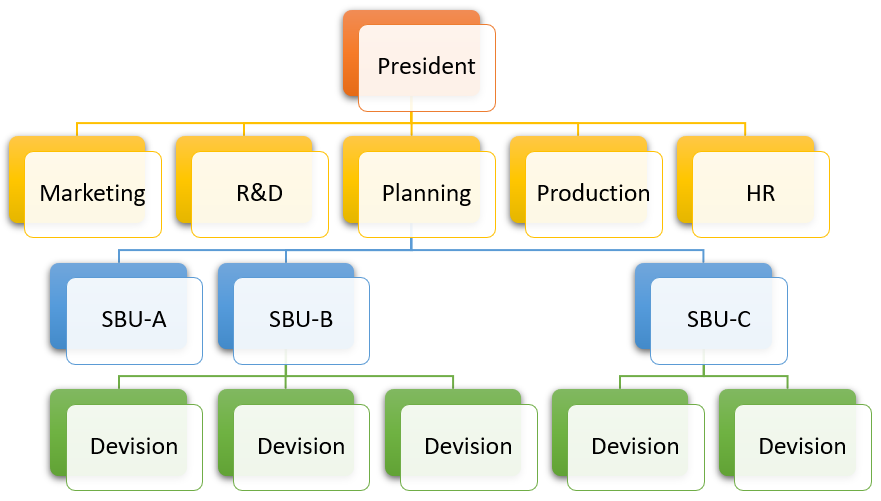
There are three levels in a strategic business unit, wherein the corporate headquarters remain at the top, SBU’s in the middle and divisions clustered by similarity, within each SBU, remain at the bottom. Hence, the divisions within the SBU are associated with each other, and the SBU groups are independent of each other. From the strategic viewpoint, each SBU is an independent business.

A single strategic business unit is considered as a profit centre and governed by the corporate officers. It stresses over strategic planning instead of operational control so that the separate divisions of the SBU can respond as fast as they can, to the changing business environment.

Understanding Risk & Uncertainty in Project Selection

Risk Adjusted Discount Rate Method:

This method calls for adjusting the discount rate to reflect the degree of the risk and uncertainty of the project. The risk adjusted discount rate is based on the assumption that investors expect a higher rate of return on risky projects as compared to less risky projects.

The rate requires determination of:

(i) Risk free rate

(ii) Risk premium rate.

Risk-free rate is the rate at which the future cash inflows should be discounted. It is the borrowing rate of the investor. Risk premium rate is the extra return expected by the investor over the normal rate. The adjusted discount rate is a composite discount rate.

It takes into account both time and risk factors. In this technique, the discount rate is raised by adding a risk margin in it while calculating the NPV of a project. For example, if the rate of discount is 10% for the project, it may be raised to 11% by adding 1% to take account of risks and uncertainties.

The increased discount rate will reduce the discount factor, thereby lowering the NPV. Thus the project would be judged as undesirable. This method is used for ranking of risky projects. But the problem with this method is that there is no ‘specified margin’ which should be added to the free risk rate.

The Certainty Equivalent Method:

According to this method, the estimated cash flows are reduced to a conservative level by applying a correction factor termed as certainty equivalent coefficient. The correction factor is the ratio of riskless cash flow to risky cash flow.

The certainty equivalent coefficient which reflects the management’s attitude towards risk is

Certainty Equivalent Coefficient = Riskless Cash Flow/Risky Cash Flow.

If a project is expected to generate a cash of Rs. 40,000, the project is risky. But the management feels that it will get at least a cash flow of Rs. 24,000. It means that the certainty equivalent coefficient is 0.6.

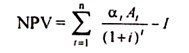
Under the certainty equivalent method, the net present value is calculated as:

Where α= Certainty Equivalent Coefficient

A= Expected Cash Flow for year t

I = Initial outlay on the project

i = Discount rate

Sensitivity Analysis:

The future is not certain and involves uncertainties and risks. The cost and benefits projected over the lifetime of the project may turn out to be different. This deviation has an important bearing on the selection of a project.

If the project can stand the test of changes in the future, affecting costs and benefits, the project will be selected. The technique to find out this strength of the project is covered under the sensitivity analysis of the project. This analysis tries to avoid overestimation or underestimation of the costs and benefits of the project.

In sensitive analysis, a range of possible values of uncertain costs and benefits are given to find out whether the projects desirability is sensitive to these different values. In this analysis, we try to find out the critical elements which have a vital bearing on the costs or benefits of the project.

In investment decision, one has to consider as many elements of uncertainty as possible on costs or benefits side and then arrive at critical elements which affect the expected costs or benefits of the project. How many variables should be tested to carry out the sensitivity analysis in order to find out its impact on costs or benefits of the projects. It is a matter of judgement.

In sensitivity analysis, one has to consider the changes in the various factors correlated with changes in the other. In order to arrive at the degree of uncertainty, the decision maker has to make alternative calculation of costs or benefits of the project.

When there are several uncertain outcomes, three cost-benefit calculations are made in this analysis:

(i) The most pessimistic where all the worst possible outcomes are estimated.

(ii) The most likely where all the middle of the range outcomes are estimated.

(iii) The most optimistic where all the best possible outcomes are estimated.

It explains how sensitive the cash flows are under these three different situations. If the difference is larger between the optimistic and pessimistic cash flows, the more risky is the project. The most likely outcome can give a good guide to how ‘borderline’ is the project.

Probability Method:

Another method for dealing with risks and uncertainties is to estimate the probable value for a result. Here one has to see a range of possible cash flows from the most optimistic to the most pessimistic for each pertinent year. Probability means the likelihood of happening of an event. It is the proportion of times an event occurs i.e. its frequency. It is the ratio of favourable number of events to the total number of events.

In a particular situation, if all possible outcomes of an event are listed and the probability of occurrence is assigned to each outcome, it is called a probability distribution. For any probability distribution there is an expected value. The expected value is the weighted average of the values associated with the various outcomes, using the probabilities of outcome as weights.

If NPV1 NPV2 and NPV3 are three possible estimates of the net present value of a project under uncertainty, and’ the probability of each outcome of NPV is P1 P2 and P3 then the expected net present value is

Ev (NPV) P1 (NPV1) + P2 (NPV2P3 (NPV3).

This method is conceptually sound. But it lacks objectivity as it is not possible to find out the probabilities of different outcomes.

Project Risk Management

Managers can plan their strategy based on four steps of risk management which prevails in an organization. Following are the steps to manage risks effectively in an organization:

  • Risk Identification
  • Risk Quantification
  • Risk Response
  • Risk Monitoring and Control

Risk Identification

Managers face many difficulties when it comes to identifying and naming the risks that occur when undertaking projects. These risks could be resolved through structured or unstructured brainstorming or strategies. It’s important to understand that risks pertaining to the project can only be handled by the project manager and other stakeholders of the project.

Risks, such as operational or business risks will be handled by the relevant teams. The risks that often impact a project are supplier risk, resource risk and budget risk. Supplier risk would refer to risks that can occur in case the supplier is not meeting the timeline to supply the resources required.

Resource risk occurs when the human resource used in the project is not enough or not skilled enough. Budget risk would refer to risks that can occur if the costs are more than what was budgeted.

Risk Quantification

Risks can be evaluated based on quantity. Project managers need to analyze the likely chances of a risk occurring with the help of a matrix.

4 Medium Critical
3
2 Low High
1
  1 2 3 4


Using the matrix, the project manager can categorize the risk into four categories as Low, Medium, High and Critical. The probability of occurrence and the impact on the project are the two parameters used for placing the risk in the matrix categories. As an example, if a risk occurrence is low (probability = 2) and it has the highest impact (impact = 4), the risk can be categorized as ‘High’.

Risk Response

When it comes to risk management, it depends on the project manager to choose strategies that will reduce the risk to minimal. Project managers can choose between the four risk response strategies, which are outlined below.

  • Risks can be avoided
  • Pass on the risk
  • Take corrective measures to reduce the impact of risks
  • Acknowledge the risk

Risk Monitoring and Control

Risks can be monitored on a continuous basis to check if any change is made. New risks can be identified through the constant monitoring and assessing mechanisms.

Risk Management Process

Following are the considerations when it comes to risk management process:

  • Each person involved in the process of planning needs to identify and understand the risks pertaining to the project.
  • Once the team members have given their list of risks, the risks should be consolidated to a single list in order to remove the duplications.
  • Assessing the probability and impact of the risks involved with the help of a matrix.
  • Split the team into subgroups where each group will identify the triggers that lead to project risks.
  • The teams need to come up with a contingency plan whereby to strategically eliminate the risks involved or identified.
  • Plan the risk management process. Each person involved in the project is assigned a risk in which he/she looks out for any triggers and then finds a suitable solution for it.

Risk Register

Often project managers will compile a document, which outlines the risks involved and the strategies in place. This document is vital as it provides a huge deal of information.

Risk register will often consists of diagrams to aid the reader as to the types of risks that are dealt by the organization and the course of action taken. The risk register should be freely accessible for all the members of the project team.

Project Risk; an Opportunity or a Threat?

As mentioned above, risks contain two sides. It can be either viewed as a negative element or a positive element. Negative risks can be detrimental factors that can haphazard situations for a project.

Therefore, these should be curbed once identified. On the other hand, positive risks can bring about acknowledgements from both the customer and the management. All the risks need to be addressed by the project manager.

error: Content is protected !!