Competency Development Meaning, Process

Competencies are characteristics of a job, role, or function. An employee’s ability to apply the core competencies of his or her job is a key factor in successful performance and employee engagement.  Many companies include competencies in position descriptions and job postings without a clear explanation of the skills or level of proficiency required, which can ultimately lead to high turnover and poor cultural fit.

From an organizational perspective, competence development serves two main purposes:

  • To improve the alignment between the competencies of employees and the strategic goals of the organization.
  • To stimulate and develop employee involvement in the organization. The result? Content staff and less attrition.

It helps managers at all levels identify core competencies that are critical for success in a particular position.  This effort completed, documented, and accepted by organization leadership can be used to guide a number of related performance management components in a systematic fashion, such as:

  • Pre-Screening: Creating behavioral-based interview questions relative to competencies.
  • Candidate selection: Confirming strengths/potential challenges of candidate in new role.
  • Ongoing talent management.
  • Managing, appraising, and rewarding performance.
  • Identifying HiPo (high-potential) performers and developing leaders.
  • Designing corporate and individual training and development plans.

Process

Data Collection

A list of relative job competencies is developed via a basic questionnaire, along with a thorough review of the job description. Interviews are conducted with key stakeholders to discuss these identified competencies. If possible, interviews are conducted with successful employees in the same role.

Competency Development

A summary report is created and evaluated in a systematic process with primary stakeholders to gain consensus. Typically, 6 to 10 key competencies are developed per position.

Measurement

A measurement process is established to determine the skill level of an individual (employee or candidate) ranked against each of the identified core competencies. This may include psychological assessments, scenario-based exercises, and/or 360° feedback.

Framework for competence development

How does one develop competence development? The exact approach may vary depending on the organization, but there is an effective framework that consists of several fixed steps.

Step 1: Preparation

Putting competence development into practice begins with sound preparation.

  • First and foremost, determine what goal you want to achieve with competence development.
  • What information do you want to collect?
  • How and for what purpose do you want to use that data?
  • And what scope do you apply?

The answers to these questions allow you to determine what individuals within the organization will be working with the framework for competence development.

Step 2: Collecting information

The next step is information gathering. The more data you’ve got, the more precise and detailed you will be able to organize the process of competence development.

In collecting the necessary information, there are several methods (and combinations of methods) at your disposal.

  • Observe how people go about their job. This method is especially useful when it comes to tasks that require manual labor (factory work, construction, etc.).
  • Talk to your staff. Interviews can be conducted individually or in groups.
  • Design a survey or questionnaire and have it distributed to all relevant employees.
  • Analyze work and business processes. Verify whether they are aligned with the strategic goals of the organization and whether they are efficient enough.

Step 3: Building the framework

You have now collected all the relevant information. Good news, because you can now start building a good framework for competence development.

The steps below serve to make the building process easier and more transparent.

  • Group all the collected information into competence categories.
  • Divide competencies and their associated employees into subcategories. Refine these categories further.
  • Identify and name the competencies at the individual level.

Step 4: Implementing the framework

With the final framework ready to go, the time has come to implement your competence development plan into your organization. Communicate with the employees involved. Generating support is an important precondition for successful competence development.

 Below you will find some tips on framework adoption.

  • Ensure a clear connection between individual competencies and business objectives.
  • Reward competencies with a fitting salary and proper growth opportunities.
  • Provide high-quality coaching and training.
  • Keep it simple. A framework for competence development has to be clear and understandable to all. A complex network of rules beats the purpose.
  • Be honest and transparent with your employees when it comes to the how and the why of competence development.

Concept of Competency and Competence, Competence v/s Competency

Competency

Competency is the capability to apply or use the set of related knowledge, skills, and abilities required to successfully perform ‘critical work functions’ or tasks in a defined work setting. Competencies often serve as the basis for skill standards that specify the level of knowledge, skills, and abilities required for success in the workplace as well as potential measurement criteria for assessing competency attainment. Competence is a measure of both proven skills and proven knowledge.

Approaches

  • Assessment is the formal process of collecting evidence of the competencies (skills and knowledge) a worker has developed through:
  • A structured learning environment
  • On-the-job training
  • Off-the-job training
  • Other relevant workplace experience.

Recognition of prior learning (RPL)

RPL is an assessment pathway to confirm the skills and knowledge that a worker has gained previously through informal or non-formal training, or through life or other work experiences. For example, if a worker has been trained and worked on a piece of plant for several years, but for some reason has never been assessed, the RPL assessment process could be used.

The evidence supplied and assessed for RPL must be valid, sufficient, current and authentic. RPL should never bypass or shortcut the assessment process. It is a means to acknowledge that sufficient evidence has been collected to verify competence.

Recognition of current competency (RCC)

RCC is an assessment pathway for workers who have previously completed an assessment, been deemed competent, and are now required to be reassessed to ensure that competence has been maintained. For example, a worker previously been assessed as competent for issuing work permits on a company’s mine site, may be assessed by RCC when they start work on another mine site of the same company using an identical work permit system.

The evidence supplied and assessed for RCC must be valid, sufficient, current and authentic.

Online and electronic training and assessment

The department does not endorse any specific e-learning technologies for training and assessment. In general, best practice should consider the following.

Participants developing an e-learning community

The e-learning environment should facilitate communication among the participants so that they develop as a student community. Students should also be able to interact easily with their instructors.

Establish how the e-learning environment operates

Students should receive an orientation so they understand how the e-learning environment will operate. The instructor should establish the standards expected for submitted work. Submission deadlines for assignments and delivery methods must be clear.

Incorporate different kinds of learning activities

It is important to incorporate activities that are more interactive, as well as research projects. For example, use webinars (live courses or seminars over the internet) as well as offline coursework.

Competence

Competence is the set of demonstrable characteristics and skills that enable and improve the efficiency or performance of a job. The term “Competence” first appeared in an article authored by R.W. White in 1959 as a concept for performance motivation. In 1970, Craig C. Lundberg defined the concept in “Planning the Executive Development Program”. The term gained traction when in 1973, David McClelland wrote a seminal paper entitled, “Testing for Competence Rather Than for Intelligence”. It has since been popularized by Richard Boyatzis and many others, such as T.F. Gilbert (1978) who used the concept in relationship to performance improvement. Its use varies widely, which leads to considerable misunderstanding.

Some scholars see “Competence” as a combination of practical and theoretical knowledge, cognitive skills, behavior and values used to improve performance; or as the state or quality of being adequately or well qualified, having the ability to perform a specific role. For instance, management competency might include systems thinking and emotional intelligence, and skills in influence and negotiation.

Studies on competency indicate that competency covers a very complicated and extensive concept, and different scientists have different definitions of competency. In 1982, Zemek conducted a study on the definition of competence. He interviewed several specialists in the field of training to evaluate carefully what makes competence. After the interviews, he concluded: “There is no clear and unique agreement about what makes competency.”

Here are several definitions of competency by various researchers:

  • Hayes (1979): Competences generally include knowledge, motivation, social characteristic and roles, or skills of one person in accordance with the demands of organizations of their clerks.
  • Boyatzis (1982): Competence lies in the individual’s capacity which superposes the person’s behavior with needed parameters as the results of this adaptation make the organization to hire him.
  • Albanese (1989): Competences are individual’s characteristics which are used to effect on the organization’s management.
  • Woodruff (1991): Competence is a combination of two topics of personal competence and merit at work. Personal merit is a concept which refers to the dimensions of artificial behavior in order to show the competence performance and merit at work depends on the competences of the person in his field.
  • Mansfield (1997): The personal specifications which effect on a better performance are called competence.
  • Standard (2001) ICB (IPMA Competence Baseline): Competence is a group of knowledge, personal attitudes, skills and related experiences which are needed for the person’s success.
  • Rankin (2002): A collection of behaviors and skills which people are expected to show in their organization.
  • Unido (United Nations Industrial Development Organization) (2002): Competence is defined as knowledge, skill and specifications which can cause one person to act better, not considering his special proficiency in that job.
  • Industrial Development Organization of United States (2002): Competences are a collection of personal skills related to knowledge and personal specifications which can make competence in people without having practices and related specialized knowledge.
  • CRNBC (College Of Registered Nurses Of British Columbia) (2009): Competences are a collection of knowledge, skills, behavior and power of judging which can cause competence in people without having enough practice and specialized knowledge.
  • Hay group (2012): Measurable characteristics of a person which are related to efficient actions at work, organization and special culture.
  • Chan and her team (the University of Hong Kong) (2017, 2019): Holistic competency is an umbrella term inclusive of different types of generic skills (e.g. critical thinking, problem-solving skills), positive values, and attitudes (e.g. resilience, appreciation for others) which are essential for students’ life-long learning and whole-person development.
  • The ARZESH Competency Model (2018): Competency is a series of knowledge, abilities, skills, experiences and behaviors, which leads to the effective performance of individual’s activities. Competency is measurable and could be developed through training. It is also breakable into the smaller criteria.

Competency has multiple different meanings, and remains one of the most diffuse terms in the management development sector, and the organizational and occupational literature.

Competencies are also what people need to be successful in their jobs. Job competencies are not the same as job task. Competencies include all the related knowledge, skills, abilities, and attributes that form a person’s job. This set of context-specific qualities is correlated with superior job performance and can be used as a standard against which to measure job performance as well as to develop, recruit, and hire employees.

Competencies and competency models may be applicable to all employees in an organization or they may be position specific. Identifying employee competencies can contribute to improved organizational performance. They are most effective if they meet several critical standards, including linkage to, and leverage within an organization’s human resource system.

Core competencies differentiate an organization from its competition and create a company’s competitive advantage in the marketplace. An organizational core competency is its strategic strength.

Competencies provide organizations with a way to define in behavioral terms what it is that people need to do to produce the results that the organization desires, in a way that is in keep with its culture. By having competencies defined in the organization, it allows employees to know what they need to be productive. When properly defined, competencies, allows organizations to evaluate the extent to which behaviors employees are demonstrating and where they may be lacking. For competencies where employees are lacking, they can learn. This will allow organizations to know potentially what resources they may need to help the employee develop and learn those competencies. Competencies can distinguish and differentiate your organization from your competitors. While two organizations may be alike in financial results, the way in which the results were achieve could be different based on the competencies that fit their particular strategy and organizational culture. Lastly, competencies can provide a structured model that can be used to integrate management practices throughout the organization. Competencies that align their recruiting, performance management, training and development and reward practices to reinforce key behaviors that the organization values.

Competence v/s Competency

Competence

Competency

Definition It refers to the capability of an individual to carry out a particular task. It focuses on the performance that an individual showcases in having completed a particular task.
Basis It is skill-based.  It is behavior-based.
Characteristics Its characteristics include skills like communication, leadership, etc., and knowledge. Its characteristics include a person’s behavioral attributes like confidence, determination, honesty, etc.
Assessment It assesses the standard of performance that a person shows. It assesses the behavior and way in which the standard has been achieved by a person.
Usage Competence can be used in casual as well as formal situations. Competency is mostly used in professional jargon.

Iceberg Model of Competency

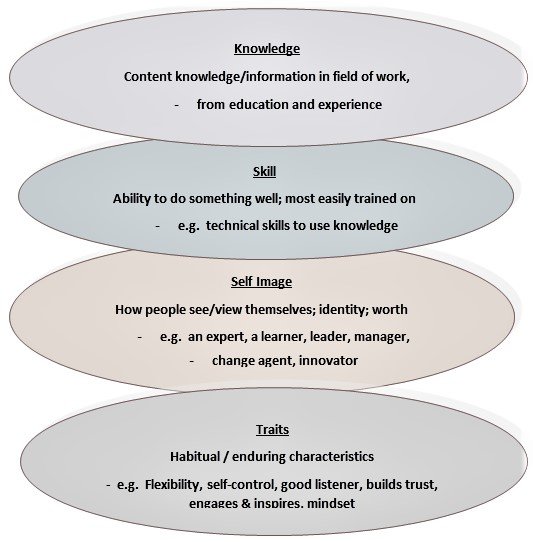
The iceberg model for competencies takes the help of an iceberg to explain the concept of competency. An iceberg which has just one-ninth of its volume above water and the rest remains beneath the surface in the sea. Similarly, a competency has some components which are visible like knowledge and skills but other behavioural components like attitude, traits, thinking styles, self-image, organizational fit etc are hidden or beneath the surface.

Ice-Berg Model

The pictorial representation of the model is as below:

The iceberg model contains six competencies: skill, knowledge, social role, self-image, traits and motives. Skill and knowledge are located on the portion of the iceberg that sits above the water level, which is easily seen. They, are around 20 % of a person’s competencies. So, they are relatively easy to determine. Social role, self-image, traits and motives are positioned on the iceberg below the water level hidden from the human eye. These account for around 80 percent of a person’s competencies, but they’re much more difficult to assess than skill and knowledge.

  • Skills = A learned ability
  • Knowledge = Acquiring information in a particular field
  • Self-Image = Attitudes and values
  • Traits = Why and how we behave a certain way
  • Motives = What drives us, i.e., the need to seek achievement, power/influence, affiliation. etc..

es and traits become more important than the skills and knowledge required to do the job. Think of a soldier at the war front, he knows how to use the weapon he is holding, but thinks that the war is unjust and refuses to fire. In organizations, senior level hiring is therefore a time consuming and elaborate affair as it becomes necessary to establish the alignment between the organizational and individual motivation and aspirations.

Developing the two levels of competencies also takes different routes. The visible competencies like knowledge and skills can be easily developed through training and skill building exercises however the behavioural competencies are rather difficult to assess and develop. It takes more time and effort intensive exercises, like psychotherapy, Counselling, coaching and mentoring, developmental experiences etc.

In the traditional method of hiring, most of the organizations looked at just the visible components of competencies; the knowledge and skills, believing that the behavioural aspects can be developed through proper guidance and good management. However, with major shifts in the conventional methods of people management, the hiring process has also undergone a change therefore a lot of emphasis is being put on the hidden behavioural aspects as well to make a sound decision. Hence, a complete picture regarding the competence of a person consists of both visible and hidden aspects and it becomes necessary to understand both to arrive at identifying the best man for a job.

Methods of Competency Mapping

Competency analysis is concerned with behavioural dimensions of roles while competence analysis considers what people have to do to perform well. In an organisation a tailor-made competency schedule is carried out by specialists or management consultants or both. Line managers may be consulted but the frameworks are issued to them in accordance with procedures laid down for such processes laid down for such processes as performance management. Although the first draft may be developed in-house but when practiced the suggested changes can improve it further.

Approaches

There are 6 approaches to competence analysis:

  1. Expert Opinion
  2. Structured Interviews
  3. Workshops
  4. Critical Incident Techniques
  5. Repertory Grid Analysis
  6. Job Competency Assessment

Approach # 1. Expert Opinion:

This method involves an expert member of the HR dept. possibly discussing with the other experts and referring to the published list to draw up “What counts”. The major drawback of this method is that it lacks detailed analysis and the line managers have not been involved at any step so it may be unacceptable.

Approach # 2. Structured Interviews:

Here we require the list of competences prepared by experts and the job-holders. The key result areas of a particular are identified to analyse the behavioural characteristics, which distinguish performers at different levels of competence.

The positive and negative indicators required for achieving high levels of performance can be analysed as:

  • Personal drive (achievement motivation)
  • Analytical power
  • Creative thinking
  • Team Management
  • Interpersonal skills
  • Communication skills

This approach relies too much on the experts.

Approach # 3. Workshops:

A team of experts (knowledge and experience holders), managers, job-holders along with a facilitator (not from personnel department) or a consultant work together in a workshop. The activities of workshop initiate with defining job related competence area. Then the members of the group develop examples of effective and less effective behaviour recorded on flipcharts. The facilitators’ job is to help the group to analyse its findings and assist generally to set competency dimensions which can be identified by behaviour.

Approach # 4. Critical Incident Technique:

This is a means of eliciting data about effective or less effective behaviour related to actual events- critical incidents.

The technique is used with groups of job holders, their managers and expert in following ways:

  • Explain what the technique is and what are its uses. This helps to gather the real information regarding the behaviours constituting good or poor performance
  • Listing the key areas of responsibilities for a particular job.
  • Each area of job can be discussed and relating to critical incidents
  • Collect information about the critical incidents under the following headings-
  • What were the circumstances?
  • What did an individual do?
  • What was the outcome of the efforts of the individual?
  • Same process is repeated for each area of responsibility and various critical incidents are recorded.
  • On referring to the flipchart, analysing the critical incidents, the recorded behaviour is marked on a scale from one to five.
  • These ratings are discussed and re-discussed for reducing errors.
  • Final analysis; It lists the desired competence, performance indicators for each principal accountability or main task.

Approach # 5. Repertory Grid:

Repertory grid can be used to identify the dimensions that distinguish good from poor standards of performance. This technique is based on Kelly’s personal construct theory. Personal constructs are the ways in which we view the world. They are personal because they are highly individual and they influence the way we behave or view other people’s behaviour. The aspects of the job to which these ‘constructs’ or judgements apply are called ‘elements’.

A group of people concentrate on certain elements (work or task of job holder) and develop constructs for them. This helps to define the qualities which indicate the essential requirements for successful performance.

The procedure being followed by an ‘analyst’ is called ‘triadic’ method of elicitation and involves following steps:

  1. Identify the elements of the job to be analysed.
  2. List the tasks on cards.
  3. Draw three cards randomly from the pack of cards and ask the group members to select the odd one out from the point of view of the qualities and characteristics needed to perform it.
  4. Try to obtain more specific definitions of these qualities in the form of expected behaviour.
  5. Again draw three cards from the pack and repeat step c&d. Repeat the process unless all the cards have been analysed.
  6. List all the constructs and ask the group members to rate each task on every quality using a six or seven point scale.
  7. Collect and analyse the scores in order to assess their relative importance.

The repertory-grid analysis helps people to articulate their views by reference to specific examples. It is easier to identify behavioural competences required in a job by limiting the area through the triadic technique. This method of analysis is quite detailed and time- consuming.

Approach # 6. Job Competency Assessment:

The job competency assessment method as described by Spencer & Spencer (1993) and offered by Hay/McBer, is based on David Mc Clelland’s research on what competency under six clusters-

  • Achievement Cluster
  • Helping/Service
  • Influence
  • Managerial
  • Cognitive
  • Personal Effectiveness

The competency assessment method is used to model the competencies for a generic role i.e. for a position which is similar to many job holders and basic accountabilities are same. The method begins with assembling a panel of expert managers to express their vision of the job, its duties, responsibilities, difficult job components, likely future changes to the role and the criteria against which the job-holders performance is measured. The members do nominate some members to be outstanding or satisfactory.

The next step is to conduct ‘behavioural event interview’ with nominated job-holders to focus upon the distinction between a person’s concept and what a person actually does. This employs a structured probe strategy rather than a standard set of questions. This investigative interview helps to gather most accurate performance data.

Following this analysis, differentiations can be made between superior and average performers in the form of the:

(a) Competencies possessed by superior performers

(b) Activities undertaken by average performers

(c) Competency and average criteria for both superior and average performers.

Tools:

Following these steps, the competency mapping tools are as follows.

  • Interviews
  • Questionnaires
  • Assessment centres
  • Critical incidents Technique
  • Psychometric Tests

Interview

Competency-based interviews may be structured, semi-structured or unstructured depending on the person conducting the competency mapping. Interview should be carefully designed so as to provide information about both the easily observed information and the general disposition and motivation of the employee. Questions prepared should target each competency and give an overview of the tangible skills and knowledge possessed by the employee, how he or she acts under certain conditions, and how they behave with other people. The questions focus on relating past job performance to future on the job performance. Biasness and distortion of flow should be avoided as much as possible. If handled effectively, interviews can prove to be a powerful technique for getting accurate details and obtaining information which may otherwise be unavailable.

Questionnaires

Competency mapping questionnaires consist of a list of questions either standardized or prepared solely for the purpose of competency mapping which the employees are expected to fill. There may be competency mapping questionnaire for employees or for managers depending on the level at which the mapping is being conducted. One form of a questionnaire is the Common Metric Questionnaire (CMQ) that makes use of five domains to examine competencies to improve work performance. These five domains are as follows: background, contact with people, decision making, physical and mechanical activity and work setting. Another form is Functional Job Analysis (FJA) which is a qualitative analysis and breaks the job down to seven parts: things, data, worker instructions, reasoning, people, mathematics and language. The behavior and actions of the employees in the seven areas is a part of FJA.

Assessment Centers

Assessment centers is a process (and not a location) that helps to determine the suitability of employees to specific type of employment or job role. Using validated tests, different elements of the job are simulated. The candidates or employees are expected to complete a number of assessments specifically designed to assess the key competencies required for the job role they are applying. These tests focus on assessing the individual based on their knowledge, skills, attitudes and other behaviors. An essential feature of this process is using situational test to observe job specific behavior.

Critical Incidents Technique

This technique was developed by Flanagan (1954) and involves direct observation of the employee in specific situations. The observations should be recorded as accurately as possible since it would be used to identify behaviors that contribute to success or failure of individual or organization in a specific situation. First step, is to make a list of good and bad on the job behavior. After this, the supervisors should be trained to note down incidents when the employee was successful or not successful in meeting the job requirements. At the end of the year, a balance sheet for each employee is created to find how well the employee has performed.

Psychometric Assessment

These are standardized and scientific tools used to assess the mental capacities and behavioral styles of employees in an organization. The most commonly used psychometric assessment is aptitude, achievement and personality testing. Aptitude tests help to determine the capacity of the individual to acquire with training a particular type of skill or knowledge. Achievement tests help to determine the level of proficiency an individual has achieved in a given area. Personality testing gives a description of the unique traits and characteristics that drive the employee’s behavior. Apart from these, competency mapping rating scale may also be used as a part of assessment.

Types of Competencies, Benefits and Limitations of implementing Competencies

Types of Competencies

Behavioral competencies: Individual performance competencies are more specific than organizational competencies and capabilities. As such, it is important that they be defined in a measurable behavioral context in order to validate applicability and the degree of expertise (e.g. development of talent)

  • Coaching skill
  • Feedback skill
  • Group process skill
  • Negotiation skill
  • Presentation skill
  • Questioning skill
  • Relationship building skill
  • Writing skill.

Core competencies: Capabilities and/or technical expertise unique to an organization, i.e. core competencies differentiate an organization from its competition (e.g. the technologies, methodologies, strategies or processes of the organization that create competitive advantage in the marketplace). An organizational core competency is an organization’s strategic strength.

Functional competencies: Functional competencies are job-specific competencies that drive proven high-performance, quality results for a given position. They are often technical or operational in nature (e.g., “backing up a database” is a functional competency).

Management competencies: Management competencies identify the specific attributes and capabilities that illustrate an individual’s management potential. Unlike leadership characteristics, management characteristics can be learned and developed with the proper training and resources. Competencies in this category should demonstrate pertinent behaviors for management to be effective.

Organizational competencies: The mission, vision, values, culture and core competencies of the organization that sets the tone and/or context in which the work of the organization is carried out (e.g. customer-driven, risk taking and cutting edge). How we treat the patient is part of the patient’s treatment.

Technical competencies: Depending on the position, both technical and performance capabilities should be weighed carefully as employment decisions are made. For example, organizations that tend to hire or promote solely on the basis of technical skills, i.e. to the exclusion of other competencies, may experience an increase in performance-related issues (e.g. systems software designs versus relationship management skills)

  1. Competency identification skill
  2. Computer competencies
  3. Career development theories and techniques understanding
  4. Electronic system skill
  5. Facilities selection skill
  6. Objective’s preparation skill
  7. Performance observation skill
  8. Training and development theories and techniques skill
  9. Research skill.

Business Competencies:

Business competencies include knowledge and skills essentially required for decision-making and to run a business.

Some business competencies are:

  • Business understanding skill
  • Cost benefit analysis skill
  • Delegation skill
  • Organization behaviour understanding
  • Organization understanding
  • Project management skill
  • Marketing skill
  • Concept selling skill
  • Documents and records management skill.

Benefits of competencies

Competency models can help organizations align their initiatives to their overall business strategy. By aligning competencies to business strategies, organizations can better recruit and select employees for their organizations. Competencies have become a precise way for employers to distinguish superior from average or below average performance. The reason for this is because competencies extend beyond measuring baseline characteristics and or skills used to define and assess job performance. In addition to recruitment and selection, a well sound Competency Model will help with performance management, succession planning and career development.

Career paths: Development of stepping stones necessary for promotion and long-term career-growth

  • Clarifies the skills, knowledge, and characteristics required for the job or role in question and for the follow-on jobs.
  • Identifies necessary levels of proficiency for follow-on jobs.
  • Allows for the identification of clear, valid, legally defensible and achievable benchmarks for employees to progress upward.
  • Takes the guesswork out of career progression discussions.

Identifying skill gaps: Knowing whether employees are capable of performing their role in achieving corporate strategy

  • Enables people to perform competency assessments in order to identify skill gaps at an individual and aggregate level.
  • When self-assessments are included, drives intrinsic motivation for individuals to close their own gaps.
  • Identifies re-skilling and upskilling opportunities for individuals, or consideration of other job roles.
  • Ensures organizations can rapidly act, support their people, and remain competitive.

Performance Management: Provides regular measurement of targeted behaviors and performance outcomes linked to job competency profile critical factors.

  • Provides a shared understanding of what will be monitored, measured, and rewarded.
  • Focuses and facilitates the performance appraisal discussion appropriately on performance and development.
  • Provides focus for gaining information about a person’s behavior on the job.
  • Facilitates effectiveness goal-setting around required development efforts and performance outcomes.

Selection: The use of behavioral interviewing and testing where appropriate, to screen job candidates based on whether they possess the key necessary job competency profile:

  • Provides a complete picture of the job requirements.
  • Increases the likelihood of selecting and interviewing only individuals who are likely to succeed on the job.
  • Minimizes the investment (both time and money) in people who may not meet the company’s expectations.
  • Enables a more systematic and valid interview and selection process.
  • Helps distinguish between competencies that are trainable after hiring and those are more difficult to develop.

Succession planning: Careful, methodical preparation focused on retaining and growing the competency portfolios critical for the organization to survive and prosper

  • Provides a method to assess candidates’ readiness for the role
  • Focuses training and development plans to address missing competencies or gaps in competency proficiency levels.
  • Allows an organization to measures its “bench strength” the number of high-potential performers and what they need to acquire to step up to the next level.
  • Provides a competency framework for the transfer of critical knowledge, skills, and experience. prior to succession and for preparing candidates for this transfer via training, coaching and mentoring.
  • Informs curriculum development for leadership development programs, a necessary component for management succession planning.

Training and development: Development of individual learning plans for individual or groups of employees based on the measurable “gaps” between job competencies or competency proficiency levels required for their jobs and the competency portfolio processed by the incumbent.

  • Focuses training and development plans to address missing competencies or raise level of proficiency.
  • Enables people to focus on the skills, knowledge and characteristics that have the most impact on job effectiveness.
  • Ensures that training and development opportunities are aligned with organizational needs.
  • Makes the most effective use of training and development time and dollars.
  • Provides a competency framework for ongoing coaching and feedback, both development and remedial.

Limitations of implementing Competencies

  1. Competency Framework: Can we come out with common competency framework applicable for the organization from different industries/similar industries? No, we can’t have a similar competency framework even if it is similar industry because it differs from organization to organization based on its people, culture, structure, systems and processes, technology, etc. To determine competency framework, its’ essential the HR looks into the vision of the organization, organizations’ future plan, existing employee capability and industry practices and standards.
  2. Identification of competency: The major challenge here is understanding what is competency and how to identify the list of competency. Competency is defined as the knowledge, skills and attitudes that lead to superior performance. Remember competency is not just knowledge, or combination of knowledge and skills or skills and attitude or knowledge and attitude, but it’s the combination of K+S+A. The challenge arises when it is seen either as K/S/A and not as K+S+A.

The next challenge is to list out the competency. It’s a known fact that competency is assessed based on past experience and listed based on the required competency in the future. While we list out the competency, it is essential that we consider the vision of the organization, current roles, expected knowledge, skills to achieve the future goals and how much essential these competencies are to achieve the goals.

3. Developing competency dictionary: Dictionary is the heart of competency based management. If this goes wrong, your assessments, your interpretation and development intervention will take you in a very wrong direction. When you write the dictionary you must look into the following points:

The definition of the competency: This must be broad and comprehensive enough to divide various aspects of the definition into 4 or 5 proficiency levels. Most important it must be relevant to the organizational context.

Behavioural Indicators: When we write the behavioural indicators we have to see the indicators reflects the KSA. In a four point scale we have to see that first two levels indicates the individual need for support and guidance (learning, execution with support) whereas when it comes to third level its’ about ensuring the value adds & results and in the fourth level, more from strategic best practices or from organizational growth perspective

Some of the aspects that needs to be considered in writing a good competency dictionary are:

  • Behavioural indicators are not the JD
  • Behavioural indicators are written in sequence
  • It indicates the individual, team and organizational perspective
  • Language used must be simple and inevitably understood in the same way by all the assessors
  • Able to demonstrate the behavior so that measurement can be done
  1. Assessment development centre: Major challenge comes in probing and getting into details that will aid in correct rating. The rating must not be surprising to the participants and they must not say that they have instances of demonstrated behavior but have either missed or have not been asked. It is important that we give at-least two opportunities to the participant to demonstrate the behavior. Also ensure that your questions are such that it helps the participant to provide relevant information.
  2. Reports: Report writing must be given importance as it can mould an individual behavior in the right direction. It is a tedious process wherein lots of observed facts are analyzed and then arrive at a conclusion. It is often seen that this part of the job is outsourced by giving limited information to whosoever is working on the report. Report is not about the language, it’s not about making the other person feel good or bad on reading the report but it’s about how you place the evidences captured in the right way and how the participants can relate to his development area without a second thought on it.  Reports are the first step for the participant to move towards the development.  Report gives an insight to the participant on what are the competencies that he/she needs to focus on and take up right interventions.  Reports must be essentially be written by the person who has assessed the participant.
  3. IDP: This is an area which is not much explored and highly unorganized approach is adopted. Most of them feel that after feedback the action plans suggested for improvements become only paper records and no actions are taken either by the participant or by the organization.  This happens when the developmental avenues are forced upon on the participant and when the activity is not reviewed periodically.  Based on my experience I feel that organization first must find out what are the various avenues that will aid in developing the competency in the individual.  Once the avenues are listed against the competency, the assessor must facilitate and the participant must take the ownership in the chosen technique for development.  And most important it must be reviewed periodically.  If there are no reviews then most of the participants will be involved in their daily work and not take any initiative for improving.

Creating Business Value through Information Technology

Investing in information technology can play a critical role in your company’s success. In order to create business value with information technology, you need a clear set of goals and mechanisms to track the return on investments.

Create company goals. The goals of your company will define what value means to your business. Gather the major stakeholders of your business including employees, upper level management, major suppliers and company owners. Define a common set of goals for your company that can benefit every stakeholder. Narrow the list to four or five goals in order of importance.

Map out the “Value chain” for each goal. Take each company goal and draw a visual map showing the current state of the process starting from the customer and ending with the product or service delivery. For example, if your goal is to make DVD rentals in your DVD store more accessible to your customers, you would map out how the current customers go about renting a DVD. Information technology usually simplifies repetitive systems. If your customers commonly perform the same actions to rent a DVD, then you could automate the process with technology.

Calculate the benefit of an automated system. This is not always easy to do as financial benefits can be subjective and projections based on faulty assumptions. Take each one of your company goals and place a monetary value to the achievement of each goal. In other words, ask yourself how much money you will make or save if you were to accomplish each one of your company goals. If your company goals are monetary, then you can compare it to the expense of implementing information technology. If the expense of the implementing information technology can help you achieve your company’s financial goals then the technology is creating value. A simple example is being able to accept credit cards. If the cost of buying and setting up the credit card processor helps you close more sales, then the technology is adding value to your business.

Create a trial period for the system. Implement information technology in a small area of your business, and track the results compared with the current system. In some cases this may not be financially feasible since implementing technology for a trial period may be too costly. In this case you should create surveys and focus groups to determine if the customer or employee will embrace the new technology.

Automate repetitive processes. The easiest way to create business value through information technology is to automate or replace old systems with technology. For example, a small business that prints forms to get approval signatures from several departments, can simplify the process by having each department access the document via Google docs, and only print when all the authorizations have been granted. Your company can electronically share databases among many departments where previously only one or two people had access to the files. Minor improvements like these are easy ways to create value through information technology.

The Rise of Innovation

The rise of innovation can be traced to the human race getting smarter. According to the Flynn Effect, general IQ has begun to rise since the 1930s. The average IQ has risen from 80 points to 100 points.

While innovations in travel and multimedia improved collective intelligence, these were mainly passive forms of learning. Today, computer applications and the global brain have switched on active learning and improved how fast people learn new things.

Innovation in Business

Information technology fosters innovation in business. Innovation results in smarter apps, improved data storage, faster processing, and wider information distribution. Innovation makes businesses run more efficiently. And innovation increases value, enhances quality, and boosts productivity.

Innovation through information technology has created the following radical changes in business:

  • Online shopping is more efficient than shopping in a store.
  • Digital marketing is more efficient than high cost newspaper, television, and radio advertising.
  • Social networking is more efficient than going to clubs.
  • VoiP communication is more efficient than legacy telephony.
  • Cloud computing is more efficient than a private computer network.

Businesses that have embraced the innovation paradigm tend to have the following characteristics:

  • They have more accurate business planning
  • They have more effective marketing
  • They have higher global sales
  • They have more systematic management
  • They use real time monitoring
  • They offer instant customer support

In fact, it’s hard to thing of long term business growth without the push of information technology.

5 Reasons for Accelerated Business Growth

The technological revolution has improved businesses this century in the following five primary ways:

  1. Information technology has given business the tools to solve complex problems.

Improved hardware (more memory, faster processors, sharper visual displays, etc) combined with smarter applications (Mindmapping software like X Mind, collaborative software like Kanban boards, organizers like Google calendar, etc) have made it easier to research data, analyze it, and plan scalability. Many tools available to solve complex problems.

  1. Information technology allows businesses to make better decisions.

Good decisions in business are based on solid market research. This can be done through engaging teams through video conferences, reviewing public sentiment on social media and industry forums, and using online surveys to get customer feedback. There are also tools like Microsoft CRM Dynamics and Google Analytics.

  1. Information technology has improved marketing.

Internet marketing using online advertising methods (SEO, PPC, Facebook Ads) are far more accurate ways than traditional marketing of finding target audiences, discovering their needs, and building a marketing campaign to persuade them to buy. It’s difficult to see how many people read a newspaper ad. It’s easy to figure out how many people clicked on an online banner.

  1. Information technology has improved customer support.

Customers can receive support from multiple channels telephone, emails, social media platforms, webinars, and so on. Additionally, customer relationship management systems help businesses understand customer behavior.

  1. Information technology has improved resource management.

Cloud computing allows a company’s employees to use any device anywhere in the world to access their enterprise level software.

Talent Gap Meaning, Strategies to Fill Gaps

Talent gap simply refers to a lack of skilled personnel in an organization. Every organization occasionally faces the tough issue of talent gap. The HR Department makes an all-out effort to fill this gap through various methods, most of which are discussed in subsequent chapters of this tutorial.

Persistent talent gap is likely to hamper the growth and development of an organization. It also has a negative impact on the employees’ motivation as they feel demotivated due to lack of talented people to look up to for necessary instructions and advice to work effectively.

Talent Gap is very important when it comes realizing the need for improvement or training. Skill gap can be based on the job fit or actual gap in technical or functional skills to complete a job. Once we analyze the skill gap, we can work on the improvement plan to fill this gap.

If this gap is allowed to persist, this would be mean the employee would keep doing the job unequipped with right skills required and would lead to loss in productivity. If this problem is evident for a large number of employees or department, it can become an issue for the organization.

Talent gap is expected in any employee or organization. It is more of an opportunity analysis to improve and assess the existing workforce and further improve them through coordinated trainings and grooming during through the job tenure.

Strategies to Fill Gaps

To fill the talent gap in an organization, the HR Department needs to follow certain basic steps. It helps in working out solutions to deal with talent gap. Following are the steps to address talent gap.

  • Know the Knowledge, Skills and Abilities (KSAs) required for the positions or vacancies.
  • Identify the areas where proficiency needed.
  • Look for persons with required KSAs within the industry or market.
  • Select the right or deserving candidates with required proficiency.
  • Identify the skill gap of the candidate to the position.
  • Devise plans to mitigate the skill gap.
  • Provide training and refreshment to the newly-hired employees.
  • Roll out professional development plans to help employees succeed in their role.
  • Periodical assessment of individual performance and identify the areas where extra training or specialized attention is required.

Strategies to Reduce Talent Gap

Following are some of the strategies that can help reduce the talent gap in an organization:

Develop a Culture of Talent Development

Culture is the environment for people at work. Every organization has its own culture. Culture in an organization includes the norms and behavior that outline its shared values. Managers need to build and maintain an effective culture for the larger interest of the organization.

Organizational culture should be so nurtured that it will facilitate to retain, sustain, and grow talent.

Build Sustainable Processes

Managers should coach and develop their people. Every employee knows what areas they need to improve, and for those with particularly high potential, career tracks should be developed that give them a sense of a sustainable relationship with the organization.

Strengthen Shared Values

Every employee should be able to connect their daily work productivity and responsibilities to the values of the organization. They need to understand the job and the reason for completing the job successfully.

Leverage Problems as Opportunities

Problems in the workplace should be seen by employees as opportunities to develop their skills and hone their talent for future performance. Learning the causes and stresses inherent in the problems can be helpful for both the organization and the employees.

Act as a Role Model

Be transparent about your own needs to learn, develop and share. Embrace openness. Leaders are never more powerful than when they are shown to be learning.

Reinforce the Value of Learning

Go beyond the preliminary conversation about goals. Ask employees what they want to accomplish and what they feel their gaps are. When someone completes an assignment, celebrate both the outcome and the learning, especially if the assignment wasn’t completed smoothly. Reinforce shared values.

Build Sustainable Processes

Managers should coach and develop their people. Every employee knows what areas they need to improve, and for those with particularly high potential, career tracks should be developed that give them a sense of a sustainable relationship with the organization.

Strengthen Shared Values

Every employee should be able to connect their daily work productivity and responsibilities to the values of the organization. They need to understand the job and the reason for completing the job successfully.

Leverage Problems as Opportunities

Problems in the workplace should be seen by employees as opportunities to develop their skills and hone their talent for future performance. Learning the causes and stresses inherent in the problems can be helpful for both the organization and the employees.

Talent Gap Analysis

Identifying skill gaps is essential for the companies to ensure that the workforce is well trained, knowledgeable & better equipped to perform the job. This analysis helps achieve the following objectives:

  • Make employees aware about the critical skills they’ll need to grow.
  • Helps one refine and define skills the agency needs, now and in the future.
  • Helps in recruiting efforts when current employees don’t have the skills or the interest.

Talent Value Chain

People are a fundamental resource for any enterprise. Unless top leadership can harness this asset, an organization risks being eclipsed in the so-called war for talent. Executive leadership must be strategic about talent because the most important levers for extending competitive advantage are all related to people.

The concept of the “Value chain,” introduced by Michael Porter in 1985, can be applied to talent in the form of the following “People value chain“: talent attraction, targeted recruiting, high-accuracy hiring, proactive “on-boarding,” talent identification, performance enhancement, career acceleration and succession management. Leadership that really “gets it” takes a strategic, long-term, patient and disciplined approach to creating and maximizing the people value chain.

Attracting and Hiring the Right Talent

Finding and identifying the “best-fit people” and placing them in the “best-fit roles” is basic and intuitive, but it is far from simplistic. There are only two tactics that will deliver on that score: one, having a strategically grounded “culture brand” for attracting and recruiting the best fits; and two, being able to carry out high-accuracy hiring.

The foundation of a strategically grounded culture brand requires crystal clarity about the organization’s reason for being (mission), its idealized future state (vision) and its fundamental cultural principles (core values). With those in hand, the enterprise can craft a compelling call to action (a strategy map and blueprint for execution).

High-accuracy hiring involves knowing how to precisely screen in and screen out, knowing which tools to use to maximize the probabilities that you are accurately identifying a best fit as a best fit and knowing how to standardize the selection process and replicate it throughout the organization.

First, analyze your major job categories and identify their crucial competencies. There is a universe of about 40 competencies, various subsets of which can pinpoint the requirements for efficacy in most work roles. Second, build a set of tools that can measure the desired traits and capabilities for a given candidate. These include a competency model, a behaviorally based interview protocol and guide, a personality test that can measure “softer” indicators and an evaluation matrix that can be used by all members of the hiring team to coordinate and synchronize the assessment process. Third, methodically prepare hiring teams to gauge the answers to three questions about every candidate:

  • Can he/she do this job? (Education, experience and acquired skill sets)
  • Will he/she do this job? (Vocational interests, motivation, work ethic and drive)
  • Will he/she fit here? (Values, sociability, independence, team orientation and leadership/followership styles)

Proactive Onboarding

It is a leap of logic to assume that high-accuracy hiring will protect against misalignment between the new hire and the organization’s culture, its people and all their customs. Failing to consider all the possible hazards that can threaten even the most able new executive’s tenure is a glaring oversight that leads to shortened tenures.

Key objectives of onboarding coaching include aligning the executive with the corporate culture, developing the areas that bear closely on job success, facilitating positive communication and ensuring positive relationships with his or her team and other stakeholders. The onboarding process in a nutshell:

The consultant and new hire evaluate the corporate culture of the organization, interviewing key personnel and examining the strategic documents and various materials that highlight the nature of the organization’s people practices.

The consultant assesses the onboarding candidate. The candidate responds to assessment questionnaires related to emotional intelligence quotient (EQ) abilities and leadership behavior and participates in an in-depth interview.

With these two assessments, cultural and individual, the core of the onboarding process can begin. The candidate goes through an in-depth debriefing with the coach to:

  • Identify blind spots, counterproductive tendencies, key strengths and potential vulnerabilities in certain situations common to the new environment.
  • Create a roadmap for the candidate’s success.
  • Monitor performance during the first year; look for and address disconnects Add new leadership competencies to the candidate’s repertoire.

The new hire and coach are partners in developing strategies to integrate the executive into his or her new role, culture and company. Together, they create an early warning system for identifying emerging problems and initiate the steps necessary to take the executive’s skill sets to the next level. The process is not very different from the typical general executive coaching engagement. It simply has a more specific focus.

Identify and Develop Your Existing Talent

Your mission, vision, core values and “Strategy execution blueprint” will guide your talent identification and development system. Once you understand how they translate into cultural, leadership and talent management requirements, you can make the case for talent management throughout the organization, align all levels of management with the requirements and hold them accountable for delivering. That delivery depends on the accurate use of a powerful weapon: a leadership competency model that captures the essence of your mission, strategic imperatives and talent requirements. Acting as a gyroscope, it describes and quantifies the management and executive profiles you will need in high-value roles in the future.

Simultaneously, accelerate your high potentials’ development. Cleverly and resourcefully exploit the learning value of stretch assignments, along with other development modalities, such as mentoring, executive coaching and action learning.

Keep Them in the Pipeline

Any talent management approach must synchronize with the organization’s strategy. Reverse-engineer your succession management to the organization’s human resources strategy, which, in turn, is reverse-engineered to the overall business strategy. Then, turn the organizational culture into a meritocracy where managers are held accountable, recognized and promoted for being successful talent scouts and developers. Whether your organization seeks leaders from within or without, it is always necessary to build them. The reason is leaders, for the most part, are not born. They are made.

Key elements in the talent management value chain:

  1. Define principles & strategic objectives
  • What are the overall principles and strategic objectives for HR management?
  • What mix of staff should be employed?
  • How should the skill base be developed?
  1. Plan
  • What talent segments will be needed and by when?
  • To what extent will the talent needs be met internally and to what extent will they need to be met through external recruitment?
  • What is the expected rate of talent attrition?
  1. Attract
  • What is the value proposition as an employer?
  • What external recruiting pools should the company target?
  • What recruiting processes should be in place to attract, filter and screen the best available talent?
  • How should offers be converted into acceptances?
  1. Train & Develop
  • What training programs should be in place at the different levels?
  • How should the success of these training programs be measured?
  1. Assess & Promote
  • How should internal talent be evaluated?
  • Who should do the evaluations?
  • What career paths should be defined within the company?
  • How can departing staff be assisted in external job placements?
  1. Engage & Affiliate
  • How can the company drive engagement and commitment to the organization?
  • How can the company maintain affiliation with alumni?
HR level

Focus

How

Level

Level 1 HR organization Focus on cost-saving. Through optimizing HR efficiency Operational
Level 2 HR organization Focus on HR results. Through maximizing HR outcomes. Cost efficiency is secondary Tactical
Level 3 HR organization Focus on business results Through efficient and effective HR policies Strategic

Change in External Aspects on Reorganization: Engagement with Statutory Authorities, Revised ISO Certification and Similar Other Certifications, Revisiting past Government approvals, decisions and other contracts

Engagement with Statutory Authorities

This is one of the important areas that deals with legal requirements and is close to the company secretary. It is essential to identify government authorities that need to be intimated formally about the merger/ amalgamation/takeover e.g. SEBI, Stock Exchange etc.

Restructuring is also likely to require reflection of the changes to various government permissions, licenses, approvals granted in the past e.g. under labour and industrial laws, sales tax and service tax registrations, permissions under SEZ/STPI requirements where a unit of a merging entity now becomes part of the merged entity. Appropriate steps need to be carried out for updating registration of vehicles owned by merging entity prior to merger.

Revised ISO Certification and Similar Other Certifications

Restructuring could lead to changes in existing certifications such as ISO or similar other certifications. With the addition to locations or changes in organization structure, suitable changes need to be reflected to the certifications obtained e.g. post-acquisition, the acquiring company may decide to close down a branch of acquired company located in Bangalore, since acquiring company may have a large set up in Bangalore; which would require intimation to concerned bodies and completing necessary formalities to ensure all locations/ Functions in new set up are certified.

Revisiting past Government approvals

Restructuring is not always about future decisions or actions. One would need to take a look at past decisions or approvals which were conditional and insist for re-visiting earlier decisions e.g. assuming that the Board of Directors of a company had passed a resolution for not paying any remuneration to nonexecutive directors. However, acquiring entity pays certain percentage of its profits to non-executive directors. Post acquisition and to fit into group policy, company would need to pass another resolution for payment of remuneration to non-executive directors. Take another example, where a company had obtained permission from Reserve Bank of India stating a condition that the permission is subject to condition that foreign shareholding in the company does not exceed X%. If post acquisition, the percentage of foreign shareholding passes stipulated percentage, the company would need to refer the matter to RBI and seek appropriate sanction. There would be a few issues which are disputable where the order of Court would operate and no formal process needs to be followed. However, it is recommended that a company should take appropriate steps to avoid multiple interpretation or possible non-compliance in such cases.

Additionally, a company may be subjected to compliance with Operational Challenges Post Corporate Restructuring certain laws of requirements as a result of restructure e.g. a non-listed company acquires a listed company to make the listed company as its subsidiary. Certain provisions of listing agreement/ SEBI regulations would apply which apply to a holding company of a listed company, which was so far not applicable to such a nonlisted company. Or where a merging entity had a unit in SEZ; now the merged entity would need to ensure compliances under regulations applicable to SEZ unit. Assume a company has obtained 100 software licenses required as a part of internal system used for a particular project. Post-merger, if the size of such team increases to 150 members, company would need to procure additional licenses.

Decisions and other contracts

It is a onerous exercise to check provisions in the existing contracts having connection to any form of restructuring. While order of the Hon’ble Court would prevail and shall ensure that the contracts entered by the merging entity shall continue to be transferred in the name of merged entity as if merged entity was the signing party from the relevant date, provisions contained in a contract with third party may require company to inform about such merger or may give rise to the other party to terminate the contract.

A lease agreement having committed period clause (providing for minimum period of lease during which the lease contract is not terminable by the landlord) may release the landlord from such restriction in the event of a restructure of the lessee entity. Likewise, the company may lose the benefits/ concessions under existing contract, unless company is able to re-negotiate those terms to its favor. Or a contract may provide for lifting the restrictions around fixed fees say for a period of three years, consequent to restructure. It is now imperative for the merged entity to check all such provisions triggering from a restructure rather than criticizing how badly the contract was negotiated by merging entity.

Further, the merged entity would need to check various rights and obligations spelt out in the contracts with third parties and should allocate teams to identify and ensure compliance of those requirements. A loan agreement may insist on the borrower company to obtain prior permission from the Bank. Restructuring is likely to trigger termination rights for other party to the contract, which could turn out to be dangerous from business continuity perspective.

Change in the Internal Aspects on Reorganization: Change of Name and Logo, Revised Organization Chart, Communication, Employee Compensation, Benefits and Welfare Activities, Aligning Company Policies, Aligning Accounting and Internal Database Management Systems, Re-Visiting Internal Processes and Re-Allocation of People

Post-merger reorganization is the wide term which covers the reorganization of each & every aspect of the company’s functional areas to achieve objectives planned & aimed at. Parameters of post-merger reorganization are to be established by the management team of each amalgamating company differently depending upon its requirements, objectives of the merger & the management corporate policy.

The merger can join 2 cultures, 2 sets of procedures/processes & protocols, 2 sets of policies & change in the employment environment & the prospects of several hundreds of employees, who are the key to future value.

Factors in the Post-Merger Reorganization

It wouldn’t be appropriate to divide all the actions in restructuring process into 3 stages viz. before, during & after, to ensure all the actions that are covered & put in right buckets to make sure proper planning for all of these actions. Post-restructure actions foresee the actions required to be taken after approval from the Court is obtained in case of the merger of 2 or more than 2 companies. One will need to give a thought about the applicability of the points stated below to relevant type of business restructuring.

Change of name & logo

In case the restructure is going to result in the change of name or where the Board of Directors (BOD) decide to change the name of entity post restructuring, then the company will need to plan to carry out the change of name on all the name boards and letterheads and all branches/ locations where the name of Company has been posted or displayed, including company’s website or on internet. Similarly, the arrangements need to be made to modify corporate logo, if the same is going to change as well.

Revised organization chart

A company will need to work on apprising its organization chart at all the levels. It will also need to reflect new vision/mission & the new thinking post-restructure. In the event of a takeover, the organization chart may not change expressively; but the acquired entity may need to align its organizational structure with acquiring entity.

Communication

A company should provide proper & timely communication about the restructuring organization to every single of its employees that would provide updated status, bring a clarity on what’s happening at the organizational level & avoid the miscommunication. Also, it would be useful to send the communication regarding such changes in the company policies. The company shall also consider sending an appropriate communication to the bankers & auditors & advisors, etc. upon formal completion of restructuring activity.

Employee compensation, benefits & welfare activities

Companies need to be sensitive with respect to the terms & conditions of the employment. Usually, the courts would uphold the terms of employment to be not less favorable than existing the terms & conditions. Post-acquisition, a parent company may want an acquired company to adopt compensation structure of such parent entity. It would result in re-aligning structure as well as the pay scales of the existing employees. A company will have to carefully handle such sensitive areas to make sure about the employee satisfaction & comfort that pays in long run in building an image in addition to preventing or reducing low employee turnout.

Additionally, the company would need to consider the prevailing fringe benefits & the amenities provided to employees & feasibility of continuing same in the new set up (post restructure). For example; The Company may re-negotiate insurance premium for the employee-related insurance policies like (life, accident, medical as applicable) depending on conditions of the existing policy or preferred insurance vendor recommended by the acquiring entity.

Aligning company policies

A company would need to align or amend its internal policies to reflect organization in post restructure scenario. This might not apply to all the types of restructuring. Particularly in the case of a takeover, an acquiring entity is likely to claim all its policies of the acquired entity to bring consistency in the group’s policies.  Specific changes to group policies may be needed depending on nature & size of business, location, the applicability of relevant State laws. The challenge continues further in the terms of implementing the changes in companies’ policies e.g. if acquired company has the policy to use laptops/ computers manufactured by DELL. If AN acquiring company uses laptops/ computers manufactured by HP, the company would need to take the decision to implement a group policy or to make the exception until the time the existing laptops consume expected life & new ones are due for the procurement. Similarly, it would be appropriate for revisit policies with the respect to the employee uniforms, the mobile phones provided by a company, to tie up with the insurance agents to the provide cover as per terms & conditions acceptable to the parent company, HR-policies that impact office timings & leaves soon.

Aligning accounting & internal database management systems

Besides passing appropriate accounting entries to capture the merger/ acquisition/ financial structure, the company may need to adopt accounting policies, practices based on those followed by its new parent organization post-acquisition. The company needs to understand any reporting & database requirements of acquiring a company or merged entity to provide relevant data to the new management & to align existing systems with those of the parent/ merged entity. This may involve providing suitable training to concerned personnel & understanding issues, if any, to avoid incorrect reporting.

Re-visiting internal processes

The company that is subjected to the restructuring that will need to align its internal processes with that of a merged entity for e.g. the domestic travel processor reimbursement of the expenses process. The Company’s current process may involve the issue of cheques to the employees against the expenses claimed; whereas the merged or acquiring entity credits its employee claims to the bank account maintained for such purpose. Accordingly, the company will need to open a bank account (expense reimbursement account) for all its employees. The company will also need to create e-mail ids for employees of merging entity & ensure access to their previous data as well. In case of an acquisition, acquiring company may insist on changing the email ids of an acquired entity to ensure consistency with its internal requirements.

Re-allocation of people

Restructuring typically would entail re-allocation of persons operating in various positions/ grades in similar functions. At times, allocation in support functions becomes a challenge as now two persons h & le the similar profile e.g. personnel in HR, finance, administration etc. This would require reallocation of responsibilities or re-defining the responsibilities to specific geography/ line of business/ business units. In addition, the situation may rise the new positions to get created to fit into a new organization structure post-restructure. A careful planning is needed to avoid overlapping, underutilization of staff & to take care of career progression.

Engagement with statutory authorities

This is one of the important areas that deals with legal requirements & are close to the company secretary. It is crucial to identify the government authorities that are needed to be intimated formally about a merger or amalgamation or takeover e.g. SEBI, Stock Exchange etc. Restructuring is likely to require the reflection of changes to numerous government permissions, as well as licenses &approvals granted in the past for e.g. under labor & industrial laws, sales tax & service tax registrations, permissions under SEZ/STPI requirements where a unit of a merging entity now becomes part of the merged entity. Proper steps to be taken for updating the registration of the vehicles owned by the merging entity prior to the merger.

Record keeping

Maintenance of records of merging entity & making suitable entries in the records (e.g. registers under Companies Act reflecting changes in shareholding, directors etc. as applicable) of merged entity is a must. One will need to dive deep to ensure maintenance of all past records including statutory & non-statutory registers, original copies of various forms, returns, certificates, approvals, litigation & property records. The company may need to relocate the records to centralized storage maintained by the merged/new entity.

Immoveable Property

A restructuring may cause changes in property records e.g. consequent to the merger if merging entity stops to exist, the merged entity will need to take steps to make sure that the property records are updated to reflect a name of a merged (new) entity. If a company is occupying leased premises, one should check conditions under the lease agreement & complete necessary formalities such as intimation to the like. If a company has borrowed money against mortgage of property, the company will need to inform the bank about the restructure & check if any formalities need to be completed as per bank’s policies. While the order of the Hon’ble Court is sufficient to bring legal effect to a merger/ amalgamation, the bank may require formal intimation in the prescribed form within 7 days or so.

Expansion of the existing teams to support the larger organization

The restructuring is likely to put the pressure on a support staff, which was supporting an employee strength before amalgamation e.g. in-house training department was probably h & ling technical training for 2000 employees. Post amalgamation with another company, the training function needs to cater to training requirements for 5000 employees. It is further likely that the amalgamating entity had an independent training department or had a sophisticated training module to conduct online training, which the amalgamated entity may not have; which would require further deliberations to implement better practices in the new organization.

Revised ISO certification & similar other certifications

Restructuring could lead to changes in existing certifications such as ISO or similar other certifications. With the addition of locations or changes in organization structure, suitable changes need to be reflected to the certifications obtained e.g. post-acquisition, the acquiring company may decide to close down a branch of acquired company located in Bangalore, since acquiring company may have a large set up in Bangalore; which would require intimation to concerned bodies & completing necessary formalities to ensure all locations/ Functions in new set up are certified.

Miscellaneous

The restructure would require the changes to data displayed on the website of the company or new entity as the case may be. It would want bringing the appropriate changes in the company’s branding strategy, marketing material, employee visiting cards, employee identity cards, changes to any power of attorneys issued by the erstwhile entity, consolidation of existing bank accounts with the same bank, any action related to existing bank guarantees & other miscellaneous items such as crockery bearing company’s logo, etc. There could be many other aspects to the restructure beyond those that are stated above, depending on peculiarities of the restructuring by a company. A company should plan for a restructure & try to cover as many aspects as possible to ensure smooth transition & taking necessary actions to complete the restructuring process to its logical end.

error: Content is protected !!