Free Association in marketing Psychology

Method of collecting qualitative marketing research data in which respondents are asked to supply the word or idea which first comes to mind in response to a word or phrase given to them by a researcher; the technique is used to further understand shopping, advertising, branding, etc.

Free association involves asking consumers what comes to mind when they think about the brand. Projective techniques are tools used to uncover the true opinions and feelings of consumers when they are unwilling or otherwise unable to express themselves. For example, a common projective strategy involves asking a consumer to compare a brand to a person, animal, car, or country. For example, a consumer may be asked, If Microsoft was a car, what kind of car would it be? While qualitative techniques provide in-depth consumer insights, they typically involve very small samples of consumers that may not be generalizable to the perception of the larger population

Free association is a technique used in psychoanalytic therapy to help patients learn more about what they are thinking and feeling. It is most commonly associated with Sigmund Freud, who was the founder of psychoanalytic therapy. Freud used free association to help his patients discover unconscious thoughts and feelings that had been repressed or ignored. When his patients became aware of these unconscious thoughts or feelings, they were better able to manage them or change problematic behaviors.

The goal of free association is not primarily to uncover hidden memories but to identify genuine thoughts and feelings about life situations that might be problematic, yet not be self-evident. For example, a woman might tell herself and others that she ‘loves the people she works with’ but ends up avoiding her colleagues most of the time. Free association would be a helpful technique to explore the conflict or tension between these two competing attitudes.

In traditional free association, a person in therapy is encouraged to verbalize or write all thoughts that come to mind. Free association is not a linear thought pattern. Rather, a person might produce an incoherent stream of words, such as dog, red, mother, and scoot. They may also jump randomly from one memory or emotion to another. The idea is that free association reveals associations and connections that might otherwise go uncovered. People in therapy may then reveal repressed memories and emotions.

Sigmund Freud was in the process of developing free association from 1892 to 1898. He planned on using it as a new method for exploring the unconscious. It would replace hypnosis in this respect. Freud claimed free association gave people in therapy complete freedom to examine their thoughts. This freedom would come, in part, from a lack of prompting or intervention by a therapist. Freud proposed the technique helped prevent three common issues in therapy:

  • The process of projecting one’s own qualities onto someone else.
  • The process of transferring feelings one has for one person to a different person.
  • The practice of blocking out certain feelings or memories.

Contemporary Free Association

Freudian free association is fairly uncommon in therapy these days. Even among neo-Freudians, the technique is not often used. But contemporary mental health practitioners might us a modified version of free association. They may ask someone in therapy to recall all the memories associated with a particular event. A person in therapy could be asked to share the first word that comes to mind after seeing a picture or write down all the thoughts they have at a certain time.

Criticism of free association

The main criticism of free association has been that people may overproduce associations. This can be caused by pressure from a therapist. Someone in therapy may struggle to say as many random words and thoughts as possible. Difficulty can occur even if the person is not actually thinking about these topics. Associations may also be random and unrelated to a person’s psyche. For example, someone may start by recalling a memory of their mother. They may remember song lyrics associated with the memory and then begin naming musical artists. This could create the appearance of associations and memories that do not actually exist.
Historical Perspectives and Interbrand’s Brand Valuation Methodology

Historical Perspectives

Traditional brand management performance measures usually are short-term oriented and give no incentives to invest in brands but rather lead to short-term activities which harm long-term brand value. This is alarming, especially for companies where brands are the main assets. Brand value, if correctly measured, could represent a useful goal for the management of brands. In mergers and acquisitions, brand value could help in determining a corporation’s price and support the decision process. Another area where a valid brand valuation method would be helpful is the licensing of brands. Finally, brand valuation is needed for balance sheet purposes.

Interbrand’s Brand Valuation Methodology

The valuation method of the consulting company Interbrand includes a financial analysis where, business earnings are identified, a market analysis where the proportion of earnings attributable to the brand is determined, a brand analysis where brand power is analyzed, and a legal analysis.

Brand power is seen as the primary determinant of the risk profile of the brand. Low brand power will increase the risk that projected earnings will not be realized. Therefore, two brands can have different values even if they have identical earnings forecasts just because their brand power and consequently their risk profile is different. The risk profile concluded from brand power has an effect on the discount rate that is used to discount future earnings. 89 To determine brand power, seven criteria groups with 80 to 100 sub-criteria that influence brand power are evaluated. The seven criteria groups involve:

  • Stability: Long-established brands are considered to be more valuable than for example recently launched brands.
  • Trend: Evaluation of the growth potential of the brand.
  • Marketing support: Evaluation of marketing activities, e. g. amount spent in supporting the brand, quality and consistency of that support.
  • Market: Since brands in markets such as fast-moving consumer goods are generally stronger than brands in markets that are more vulnerable to fashion changes, the dimension “market” has to be considered.
  • Leadership: Dominant brands that are able to influence the market are obviously more valuable than brands with an unimportant market-share.
  • Internationality: Evaluation of the ability of the brand to be successful abroad.
  • Legal protection.

Brand Balance Sheet and Nielsen Brand Performance

Similar to the Interbrand method, Nielsen developed a brand valuation method, the Brand Balance Sheet, that evaluates brand power with a scoring model. Six criteria groups with nineteen sub-criteria groups are evaluated and weighted according to their importance for brand power.

The maximum score that could be achieved amounts to 500 points. A brand with less than 200 points is considered a weak brand. The criteria groups include the following:

  • Market potential (e. g. size of the market, development, value added of the market)
  • Market share of the brand (e. g. relative market share, profit market share)
  • Brand evaluation of the retailers (e. g. brand distribution)
  • Effort of the firm (e. g. product quality, prices of the brand, share of voice)
  • Brand evaluation of the customers (e. g. brand loyalty, confidence in the brand, share of mind)
  • Expansion of the brand (e. g. international expansion of the brand, international legal protection)

Holistic Methods

These methods see brand equity as a whole entity and measure its entire outcome. These methods focus on everything that can affect the overall brand equity. They analyze the loyalty of a brand’s customer base, marketing communication, distribution channels, and points of similarity and differentiation that set the brand apart from its competitors.

Holistic methods are ideal for determining the financial value and the utility value of the brand. The focus is on brand preference rather than the customer’s response.

A particular holistic method, the residual method, only focuses on brand equity after it removes physical attributes of the brand from the equation. Furthermore, the evaluation holistic approach only focuses on the financial aspect of the marketing programmes merger/acquisition programmes, sponsorships, fundraisers, etc.

Valuation approaches this will place the final value on the brand equity for accounting purposes, mergers, and acquisitions.

Both methods are effective, although they focus on different features. The comparative methods focus on measuring brand equity through customer response, while the holistic methods take on a different approach and measure customer preference. However, both types of methods can be used as good indicators of future ROI.

Measuring Outcomes of Brand Equity

There are two types of method employed to measure brand equity at source. These two methods are qualitative research methods and quantitative research methods. Qualitative research methods are ideal for measuring brand association where in consumer perceptions towards brand are captured. Quantitative research methods are perfect to understand brand awareness within consumer.

Both above mention methods are only able to capture and measure one dimension of brand equity at a time. But brand equity is multi-dimensional and therefore it is important to measure each as it will help in taking tactical as well as strategically important decision.

Comparative methods and holistic methods are designed to directly analyze brand equity. Comparative methods tend to analyze effects of consumer perception towards brand in respect to marketing programs, in terms of change in brand awareness. Holistic methods are designed to analyze the total effect of brand equity. These methods will provide necessary tools to measure outcome of brand equity. Consumer bases brand equity will lead to loyal customer base, point of differentiation against competitors get better margins, more acceptances of marketing communication, strong standing in distribution channel and also support any form of brand extension.

Comparative methods are research methods which measure brand equity associated with brand association and high level of brand awareness. Comparative methods are again of different types depending on usage of marketing. Brand based comparative methods looks to measure consumer response against same marketing program for different brands. Marketing based comparative method looks to measure consumer response for same brand under different marketing program. Conjoint comparative method looks to combine both brand based comparative method and marketing based comparative method. Each method has its application and drawbacks.

Brand based comparative method, as mentioned, tries to examine consumer’s response to identical marketing response to different brand in the same product category. This could be competitor’s brand, any non-existing brand or preferred brand in that category. A classic example of such comparative method is experiment conducted by Larry Percy; in which consumer were ask to map beer taste and preference. In one first instance brand name were disclosed whereas on second instance brand name was not disclosed. Consumer showed more loyalty when brand name was disclosed. Brand based method really isolated true value of brand name and this concept especially holds true when there is a change in marketing program from past efforts.

Marketing based method tries to understand consumer response under different marketing promotions. Here focus is to understand how much influence marketing program has on brand performance. One such experiment would be to understand consumer response at different price levels; this will reveal level of tolerance before consumer switch to another brand. Marketing based method would also be effective in understanding consumer response to similar marketing program across various geographical locations. The main advantage of marketing based method is that it can be applicable to any marketing program. However drawback of this method is that it is difficult to separate whether consumer preference is towards the brand or product category in general, meaning the price premium discovered may applicable to other brand in similar product category also.

Conjoint method allows simultaneously study of brand as well as marketing program. This method also employs statistical calculation making it possible to study many attributes or association at one time. Disadvantage of this method is that too much experimentation will may increase consumer expectation with respect to the brand.

Holistic method is used to determine financial value or definite utility value of the brand. Holistic method looks to measure consumer brand preference over consumer brand response. Residual holistic approach measures brand equity after subtracting physical attributes of the brand. Valuation holistic approach looks to measure brand equity in financial term which is important during valuation of whole firm in activities of merger/acquisition, fund raising etc.

Comparative method and Holistic method are employed to measure benefit of consumer based brand equity. Comparative method measures consumer response where as holistic method measure consumer brand consumer preference. These methods are relevant to calculate return of investment for marketing activities.

Qualitative Research Techniques: Projective Techniques: Completion, Comparison

Questionnaires

Basic questions and surveys can provide you with a lot of information. Giving your consumers sets of questions can help you record their response to your brand. What’s more, this is a perfect technique to find out the thoughts and feelings consumers might have about your brand. You can even make the questions specific and inquire about particular features of your products as well as the overall experience.

Customer Behaviour

To understand how your customers make their purchasing decisions, you have to look closely at their behaviour. You can use oral and written surveys to see what your customers factor in when they make their choices. Furthermore, you can also find out if they give some factors a certain level of priority, or if they make their purchasing decisions at a specific time of the year, etc.

Open-End Questions

Open-end questions, or free associations, are the perfect way to measure brand exposure, image, and awareness. Here’s a good example. Ask your consumers what the first thing that comes to their minds when they hear the name of your brand is. Based on their answers, you can see if they have an emotional attachment to the brand.

However, you can’t just ask your questions willy-nilly. You have to design them properly, so they lead you to the information that’s crucial to you. Furthermore, there also has to be a hierarchy of questions. You should start by asking about the overall image and then move down to more specific issues that deal with particular features or product attributes.

Projective Techniques

Projective Techniques are indirect and unstructured methods of investigation which have been developed by the psychologists and use projection of respondents for inferring about underline motives, urges or intentions which cannot be secure through direct questioning as the respondent either resists to reveal them or is unable to figure out himself. These techniques are useful in giving respondents opportunities to express their attitudes without personal embarrassment. These techniques helps the respondents to project his own attitude and feelings unconsciously on the subject under study. Thus Projective Techniques play a important role in motivational researches or in attitude surveys.

Important Projective Techniques

Completion Test: In this the respondents are asked to complete an incomplete sentence or story. The completion will reflect their attitude and state of mind.

Word Association Test: An individual is given a clue or hint and asked to respond to the first thing that comes to mind. The association can take the shape of a picture or a word. There can be many interpretations of the same thing. A list of words is given and you don’t know in which word they are most interested. The interviewer records the responses which reveal the inner feeling of the respondents. The frequency with which any word is given a response and the amount of time that elapses before the response is given are important for the researcher. For eg: Out of 50 respondents 20 people associate the word “Fair” with “Complexion”.

Construction Test: This is more or less like completion test. They can give you a picture and you are asked to write a story about it. The initial structure is limited and not detailed like the completion test. For eg: 2 cartoons are given and a dialogue is to written.

Expression Techniques: In this the people are asked to express the feeling or attitude of other people.

Disadvantages of Projective Techniques

  • Highly trained interviewers and skilled interpreters are needed.
  • Interpreters bias can be there.
  • It is a costly method.
  • The respondent selected may not be representative of the entire population.

The Brand Value Chain

Brand value chain is a structured approach to assessing the sources and outcomes of brand equity and the manner by which marketing activities create brand value.

It provides insights to support the various decision makers in the company and stresses that every member of the company contribute to this branding effort. It believes that the value of brand ultimately resides with customers.

The Brand Value Chain is a model constructed in 2003 by Keller and Lehmann. The Brand Value Chain helps marketers track brand value from the first stage of a marketing investment to the final stage of shareholder value.

Stages

  • Marketing Program Investment

The marketing programme element deals with those efforts in which brand-owning firms take to influence their brand. It can deal with products that are offered under the brand name as well as pricing, channel decisions (place), and promotion. Marketing Program Investment is any marketing program investment that potentially can impact brand value, intentionally or not. This link in the model includes product research and development as well as product design. Secondly, all investments in communications are included, such as advertising, promotion, sponsorships, publicity and public relations and thirdly, investments in trade or intermediary support. The fourth example of a marketing program investment that can affect brand value are all investments in employees, this includes selection, training, and support. A marketing program investment can be a commercial or a sponsorship.

  • Customer Mindset

Customer mindset is the second stage and includes everything that happens in the minds of the consumers in respect to the brand: thoughts, feelings, experiences, beliefs, and attitudes. As stated, importance of the brand to the customer is referred to by brand equity. The customer mindset includes associations linked to the brand in a customer’s memory, or “everything that exists in the minds of customers with respect to a brand (e.g. thoughts, feelings, experiences, images, perceptions, beliefs and attitudes. Because brand value ultimately relies with the customers, this stage will be the focus for this research, and will be the instrument used to compare Nike and adidas in this thesis. Customer mindset is the only stage in the value chain that fully focuses on the consumer, making it the stage where brand equity is best measured and created.Five elements, or dimensions, came forth from previous research as primary measures for the customer mindset:

  • Awareness
  • Associations
  • Attitudes
  • Attachment
  • Activity

There is an explanation why the five dimensions are ranked this way. Awareness supports associations, which drive attitudes that lead to attachment and activity. This means that a high level of awareness creates brand value in this stage. Customer mindset can be assessed by customer surveys.

  • Brand Awareness

The first factor is brand awareness. How well can customers recognize the brand and the products made by the brand? What company do consumers view as the leader in a particular market? Recognizing the brands means identifying various brand elements, e.g brand name, logo, symbol, character, packaging, and slogan. Brand awareness features depth and breadth . The depth of brand awareness relates to what extend a brand is recognized or recalled. The breadth of brand awareness relates to the variety of situations a brand comes to mind when purchasing a product.

  • Brand Associations

The second element is brand associations, which considers the strength, favourability, and uniqueness of perceived attributes and benefits for the brand. Associations are descriptive thoughts that a person holds about something. For example, consumer have brand associations for Apple such as “Mac and iPod,” “Cool and Awesome,” “Design and Innovative,” and “Expensive and Computer”. Brand associations are formed with advertisements, word of mouth publicity, quality of the product, celebrity associations, and point of purchase displays.

  • Brand Attitudes

The third element is brand attitudes and overall evaluations of the brand in terms of quality and satisfaction it generates. Brand equity is not essentially affiliated only with high-quality products. Equity depends on the credibility of the quality claims . When a company ‘‘cheats’’ consumers by promising high quality but delivering low quality, they will lose return on their brand investments, their reputation for high quality, or both. Only high-quality companies may preserve a high price because signalling high quality but delivering low quality is not likely to be successful in the long run. Some brands have higher brand equity because of their price value. Honda cars have brand equity because of their performance compared to price, whereas Lexus cars have their equity with the help of their high performance and social image.

  • Brand Attachment

Fourth is brand attachment, which represents the loyalty of customers. How likely are consumers to continue to choose/repurchase the brand? How likely are consumers to recommend the brand to a friend/associate? Brand loyalty emerges as a consequence of brand equity rather than its predecessor . Attracting new customers is more costly than retaining customers. Greater customer retention indicates a more stable customer base that provides a somewhat predictable source of future revenue as customers return to buy again, and is less vulnerable to competition and environmental changes.

  • Brand Activity

The fifth and last element is brand activity. This represents the extent to which customers purchase and use the brand, talk to others about it, search brand information, promotions, and events. Another example is how the brand activity is used on social platforms like Instagram. Instagram is an application to exchange pictures on mobile devices.

  • Brand Performance

Market or brand performance can be defined as how customers react or respond in the marketplace to the brand in a variety of ways, as in what customers actually have done in relation to a brand, which is manifested in market performance data, such as: market share, sales, sales growth, market penetration, (actual) price premium or share-of wallet. What these responses have in common is that they decide the cash flows that a brand contributes. While it should be self-evident, it is important to highlight that a 100% link between mindset and performance is never present and a brand’s market performance is not solely influenced by its status in the customer’s mindset (contextual factors, such as competitive actions, distribution and relations to channel partners, moderate the relationship) How the market responds to customer mindset and marketplace multiplier depends on six aspects or dimensions of that response.

  • The first is price premium. How much is the customer willing to pay more for the brand, compared to a similar competitive product?
  • Second is price elasticity. How much does the customers demand increase or decrease when the price rises or declines?
  • The third dimension is market share. This dimension measures the impact of the marketing program investment on product sales.

Together, these three dimensions determine the direct revenue stream for the brand over time. Brand value grows with higher market share and larger price premiums. Companies get larger price premiums partly from elastic response to a price decline and inelastic response to a price increase.

The fourth dimension is expansion success. How well do new products sell that are launched in related categories? This dimension shows the potential that brand expansions have for the brand.

The fifth dimension is cost structure. How well can companies reduce the cost of the marketing program investment for the brand because of beneficial customer mindset? When a company has an effective marketing program, it can lower the total costs of the marketing investment. For example, by doing less reruns of TV-commercials or other adds, because consumers remembered it effectively the first time they were exposed to the add or commercial.

These five dimensions combined lead to brand profitability, the sixth dimension.

Concluding, in this stage brand value appears with profitable sales.

Shareholder Value

Shareholders value is the value a company creates and is reflected in the stock price and dividend disbursed by the company. The fundamental assumption of shareholder value is that the true value of a company is the based on future cash flows, discounted by the cost of capital. A company that fails to deliver value to customers is acting against long-term interest of shareholders. The conservation of customers positively affects shareholder value by reducing the volatility and risk associated with anticipated future cash flows .

Young and Rubicam’s Brand Asset Valuator

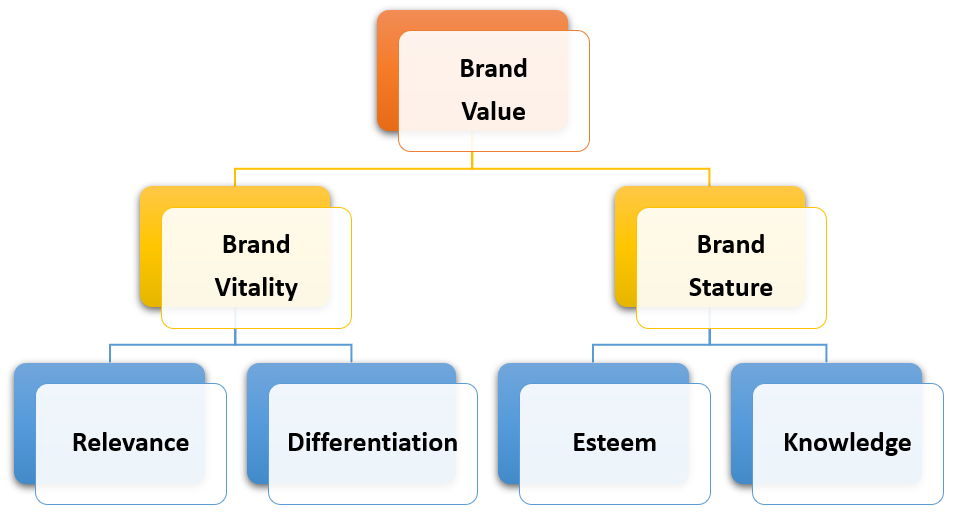
Brand Asset Valuator (BAV) is a metric applied for the measurement of brand value of an entity. Brand Asset Valuator was developed by an agency called “Young and Rubicam”. BAV measures a brand under the 2 broad heads of:

The brand asset valuator model is the result of a research program conducted by advertising agency Young & Rubicam. The agency interviewed over 100,000 consumers in 32 countries to gauge their perception of more than 13,000 brands.

The key finding of the program was that brand value emerges only once sufficient time has passed. Put differently, brand perception develops progressively in the mind of the consumer.

This progression is explained via four pillars: differentiation, relevance, esteem, and knowledge. In the next section, we’ll take a look at each pillar in more detail.

  1. Brand Vitality which refers to the current and future growth potential that a brand holds in it.
  2. Brand Stature which refers to the power of a brand.

Both of these heads can be further divided to have the following parameters for judging the brand-

  1. Differentiation: It is the ability of a brand to stand apart from its competitors. Differentiation has three constituents to it. These are

Different: Refers to how do the brand’s offering differs from its rivals.

Unique: Refers to the brand’s quality and carries the essence of its existence. It has more to do with the credibility, authenticity and originality of the idea that the brand carries.

Distinctive-refers to the worthiness of a brand.

  1. Relevance: This refers to how closely can the consumers relate to the brand’s offering and is a significant driver for a brand’s penetration.
  2. Esteem: This refers to the consumer perception about the brand. Whether a brand is popular or not, whether it delivers on its stated promises- all this contribute in building up the esteem of the brand.
  3. Knowledge: This refers to the degree of awareness about a brand in the minds of its consumers. This is very important in building a brand and making the consumers understand of what the brand actually stands for and its implicit message to the consumers.

The Brand asset valuator power grid

The BAV power grid can be used to capture the relationship between each of the four pillars. Power grids show the relative strengths and weaknesses of a brand, which clarifies strategic direction. They also help clarify the role of each element in a marketing mix.

On the vertical axis of the grid, the current strength of a brand in terms of relevance and differentiation is plotted. On the horizontal axis, esteem and knowledge are plotted. Both axes are measured from low to high, with a new brand starting its journey from the bottom left-hand corner and progressing through each pillar.

The grid is then divided into four quadrants, called pillar patterns:

New/unfocused: Describing a new brand that has recently entered the market, but occasionally an old, stagnant, unfocused, or unknown brand. Both must seek to build awareness and traction by establishing uniqueness, meaning, and personality.

Niche/unrealized: This pillar pattern includes successfully emerging or momentum brands leading with differentiation. They experience healthy and consistent growth which eventually builds relevance, esteem, and knowledge.

Leadership: At this point, brand leadership has been achieved with the organization enjoying increased revenue. Brand leaders display high levels of all four pillars. However, the BAV model acknowledges that most leading brands will decline if they fail to innovate and maintain a competitive advantage.

Eroded: These brands have high knowledge but low esteem, relevance, and differentiation. That is, consumers are aware of the brand but choose to shop elsewhere. In theory, the brand then becomes old and stagnant which returns it to the first pillar pattern.

Brand Element Meaning, Criteria for choosing Brand Elements, Types of Brand Elements

The brand is represented by the various tangible elements that create and formulate a visual, auditory, and olfactory brand identity resulting in the innate and inherent Brand Elements.

For instance, the brand logo, tagline, colour palette, all the marketing, and promotional materials, letterheads, signage, messaging and communication, and so on are all tangible representations of the brand that make up its sensory identity in the market and in the minds of the customers.

According to Kotler, a brand is a:

Name, Term, Sign symbol (or a combination of these) that identifies the maker or seller of the product.

Criteria for choosing Brand Elements

“Offensive Strategy” towards building brand equity

Likability: Brand Elements need to be inherently fun, interesting, colourful and not necessarily always directly related to the product.

A memorable, meaningful and likable brand element makes it easier to build brand recognition and brand equity, thus reducing the burden on the marketer and thereby reducing the cost of marketing communications.

Meaningfulness: Here a marketer needs to ensure that brand elements are descriptive and suggesting something about the product category of the brand. This is important to develop awareness and recognition for the brand in a particular product category.

Secondly, the brand elements also need to have a persuasive meaning and suggest something about the particular benefits and attributes of the brand. This is necessary for defining the positioning of the brand in a particular category.

Memorability: Brand elements that help achieve a high level of brand awareness or attention to the brand, in turn facilitate the recognition and recall of a brand during purchase or consumption. For Example: LG: Life is good

“Defensive strategy” towards leveraging and maintaining brand equity

Adaptability: Consumer opinions, values and views keep changing over a period of time. The more adaptable and flexible brand elements are the easier it is to keep up changing and up to date from time to time to suit the consumers liking and views.

Transferability: The extent to which brand elements can add brand equity to new products of the brand in the line extensions.  Another point, a marketer needs to keep in mind is that the brand element should be able to add brand equity across geographical boundaries and market segments.

Protectability: The final criteria in choosing a brand element is that it should be protectable legally and competitively. Brand elements need to be chosen in such a way, that they can be internationally protected legally, legally registered with legal bodies. Marketers need to voraciously defend their trademarks from unauthorized competitive infringements.

Types of Brand Elements

Brand Name:

Brand name refers to the word, phrases or words used to identify the company, product, service or concept and other core values of the brand.

On the facade, naming a brand may seem quite easy and simple. But coming up with an iconic and innovative brand name is very difficult. Ponder about the brands such as, Coca-Cola, Chevy, Häagen-Dazs, and Target.

Theme Line

A catchphrase or a tagline, such as Bounty’s “The Quicker Picker Upper” or Verizon’s “Can you hear me now?” are quite very famous.

Essentially, theme lines such as “Just do it.” for Nike or “Don’t leave home without it.” for American Express help to quickly state the brand position memorably in the minds of the customers. Great theme or taglines have a long run rather than being changed every year.

Graphics

Graphics are those Brand Elements that can also bring a brand to our attention in a fraction of a second. The dynamic ribbon is a trademarked part of Coca-Cola’s brand and Coach’s unique pattern of “C’s” emboldens the look of most of their products in the market. Louis Vuitton’s stylized flower pattern makes their luggage uniquely identifiable amongst other products in the market. The red and tan plaid lining makes Burberry coats stand out from plainer competition and are the favourite amongst the fashion lovers.

Sound:

Sound or a unique set of notes or tones can also assist in forming a brand’s identity as the crucial Brand Elements.

When a brand is mentioned, a jingle may come to the mind of the customers. For instance, any sports fan would be able to recognize ESPN’s Sports Center introduction from the first two notes of the jingle.

Smell

The smell of a brand also adds to the overall elements of the brand identity. For instance, scents, such as the rose-jasmine-musk of Chanel No. 5 is trademarked or the fresh handmade aroma of Lush Cosmetics.

Logo

To simply explain, a logo is a visual trademark that identifies the brand with its design elements. The Nike swoosh has become so well known that the word “Nike” no longer need to appear with it for recognition as a brand name.

Shape

Physical shape is like the distinctive shape of the Coca-Cola bottle or the Volkswagen Beetle that is both trademarked elements of those specific brands and can also be used as a brand identity element.

Colour:

Owens-Corning is the only brand of fiberglass insulation that can be pink in color. UPS’s unique brown trucks and uniforms have become its trademarks and are quite easily identified. Sephora cashiers wear one black glove with which they handle products before giving them to customers making it the brand’s crucial Brand Element.

Movement

Another Brand Element is the movement or how the product shifts, expands or condenses in its nature and functionality.

Lamborghini, the automobile brand has trademarked the upward motion of its car doors. Apple launched quite a revolution of screen interactions namely, the motion of two fingers moving apart, which allows its users to enlarge images on their iPhones and iPods very easily.

These brand elements include:

Visual Identity: Brand visual identity includes the recognisable and communicable brand outlook like name, logo, colour, slogan, typography, graphics, etc.

Brand Associations: These are the associations that come to the customers’ mind when they think of the brand. These can be advertisements, brand ambassadors, brand’s offering features, class, lifestyle, emotions, etc.

Brand Purpose: Brand purpose represents what the company stands for and what are its social obligations towards society, consumers, and the environment.

Brand Promise: It’s the value customers expect to get whenever they interact with the brand or buy its offerings.

Brand Identity: Brand identity is the set of all the branding activities a company indulges in order to be perceived in a particular way to the target audience.

Brand Personality: Brand personality is the association of human characteristics and traits with the brand to which the customers can relate.

Brand Voice: Brand voice is the uniformity in the selection of words, the attitude and values of the brand while addressing the target audience or others.

Brand Image: Brand image is an aggregate of beliefs, ideas, and impressions that a customer holds regarding the brand.

Brand Experience: Brand experience is awakening a holistic sensory experience to build an all-rounding relationship between customers and a brand.

Brand Equity: Brand equity is the aggregate of assets and liabilities attached to the brand name and symbol, which results in the relationship customers have with the brand.

Brand Architecture: Brand architecture is an organized structure of the company’s portfolio of brands, sub-brands, and other offerings.

Integrating Marketing Programs and Activities

Integrated marketing is the process of unifying all aspects of marketing communication such as advertising, PR, and social media and using their respective mix of media, channels, and tactics to deliver a seamless and customer-centric experience. In practice, that means having a consistent look, feel and tone to your message across all the channels you use.

They integrate a mix of marketing activities to support various stages in the sales process.

This might include direct mail, advertising, search marketing or public speaking to generate the initial leads, then the website or landing pages to convert those leads, followed up by a lead nurturing program using email, phone and personal selling.

Benefits:

  • You leave your mark. You can build better brand awareness when you’re consistent with graphics, headlines, and key phrases across different mediums and platforms. Creative consistency helps reinforce campaign themes by increasing the number of times prospects see or hear the same message.
  • You receive better results. When you combine communication tools and messaging, it bolsters marketing effectiveness. The more a customer’s journey is unified, deliberate, and focused, the higher the likelihood of a sale and brand loyalty.
  • You save money. When you focus on a single message, you don’t just cut costs on creating campaigns you’re also preventing budget-wasting that happens with inconsistent campaigns.

Cross-channel integrated marketing

Direct response creative and measurable marketing strategies with a variety of marketing channels.

These marketing activities may include:

  • Direct mail
  • Email marketing
  • Print advertising
  • Online advertising
  • Search advertising
  • Landing pages

Strategies:

Put yourself in your customers’ shoes. When it comes to business, EQ trumps IQ. Before developing any campaigns, you have to first answer, “What’s important to my customers?” Think about how you can solve their problems and make their lives easier.

Come up with a compelling idea. Successful integrated marketing campaigns have one thing in common: They center around interesting ideas. Start by figuring out what sets you apart from the competition. From there, you can begin brainstorming ways to weave a (Funny? Touching? Exhilarating?) story around your key differentiators.

Align your compelling idea with your brand values. Your compelling idea should exist in tandem with your brand values; what’s your ultimate mission? Is it to provide reasonable prices? Exceptional design? Is it a combination of both?

Leverage the advantages of different platforms. Use content that plays to the strengths of different channels, tied together by your compelling idea.

Objectives:

  • Determine most effective current activities, media, offers, formats and creative.
  • Introduce tracking and measuring strategies for all marketing activities.
  • Recommend adjustments to current program to improve results.
  • Acquire leads and customers at a desired cost-per levels.
  • Generate leads at desired quantity or quality levels.
  • Develop a consistent and persuasive lead nurturing program.
  • Introduce lead capture strategies for website.
  • Improve organization, messaging and overall image of website.
  • Collect data about customers and prospects with surveys.
  • Enhance reputation as thought leader through speaking and writing.
  • Develop strategies for each step in the sales process.

Integrated marketing campaign

  • Decide exactly who this campaign will target and how success will be determined.
  • Identify where this targeted audience is most likely to interact with your content and make those channels the focus of the campaign.
  • Bring together the marketing and sales teams that will participate in the campaign and have them set common goals.
  • Have the teams outline how they will contribute to achieving the goals.
  • Use your defined metrics to judge the success of your campaign and to understand which platforms are the most effective at bringing in these customers.
  • Use this information to guide future campaigns to be more efficient and more productive.

Leveraging Secondary Brand Associations to Build Brand Equity: Companies, Countries

There are various ways to create brand equity. Brand elements offer many alternatives style, logo unique selling proposition etc. Then there are marketing strategies aimed at product, price and distribution network. Here focus is on product and its attributes, correct and convincing price structure, and finally choice of product reaches consumer. Marketing communication is also strategic with respect to build brand equity with choice of medium (TV, radio, etc) and sales/consumer promotion. But what would be course of brand building for brand extension? Here brand has to draw some brand elements and brand knowledge from already developed brand, which has already created impression in consumer’s mind, thereby leveraging secondary brand association to create brand equity.

Marketers have various options available to them to facilitate leveraging process. These options are association with companies, countries and distribution channel. Next set of options relate to brand image and they are in form of brand ambassador, event sponsorship and other related activities. Secondary brand association has its importance when consumers are not aware of the new or upcoming brand. This leads to indifferent approach from customer towards brand. However, if consumers do not have knowledge of associating company than there could be no knowledge transfer and cannot translate into benefit for the brand. Even if the consumers have brand knowledge how much relevance it holds for the current brand also has to be ascertained.

If a company is to introduce a new brand the first step of association is with corporate brand if it exists. For example, Nokia, when it introduces mini laptop, it was referred as Nokia 3G Booklet there are creating association, as consumer are already aware Nokia mobile phones. Along with company, country of origin can also be relevant source for brand association, for example BMW and its association with Germany. Top class and renowned German engineering process gets linked to brand BMW or other car coming out of Germany. Another valuable association is through channel distribution; if company already has a strong retail level penetration, then introduction of new brand will have its benefit. But here question is raised concerning brand positioning, if retail network is catering to high end brand, that distribution network will not relevant for low end brand.

Above listed of association within current company’s infrastructure, however association can also be developed with brand from different company. This concept is called co-branding, for example branding of airlines referred to as Star Alliance consisting of 16 airlines. Benefit with this kind of association is that their definite decrease in cost of introducing of brand plus positioning becomes easier. However, companies lose charge or control to the overall brand development process as it is peg with other brands. Lost in the crowd is another problem leading from brand associations.

Another way of association is through usage of logos, characters from brands, franchise of other product category. For example, Sony’s PSP coming out with console featuring characters from Star Wars. But strategy has a drawback, sometimes popularity character may last just for a movie or a season, in that case, brand has to undergo another round of association. So, choice of right character as shown by Sony is important. Celebrity endorsement is another way of association, for example, Tiger Woods endorsing product Gatorade. However, this also has challenges if that celebrity is involved endorsement many other brands. This could lead to dilution or recall value of brand. Also, if fortunes of celebrity go turtle brand are also in for some pounding. Event sponsorship is another way for brand association but again right choice of event is very essential to make the brand relevant among consumer. Another form of endorsement is from third party for example dental association certifying toothpaste brand.

Secondary brand associations sometimes play a crucial role. For example; if the consumers aren’t aware of your brand extension. In that case, the consumers will be indifferent. However, existing knowledge of the parent brand can make them more aware and more open to your extension. This is called knowledge transfer, and every brand extension can benefit from it.

Prior Knowledge

Therefore, associating your brand extension with your corporate brand should be your first step. Take Nokia for example. As a well-known phone manufacturer, they didn’t want to miss out on transferring that knowledge when they introduced a new product category Nokia 3G Booklets.

Country of Origin

It’s important to associate your new brand extension with memorable, impactful elements like the country of origins. Here’s one example. The BMW associates their brand heavily with Germany. In the automotive world, Germany stands for reliability, effectiveness, and durability. Therefore, it’s only natural that the BMW wants to be associated with those terms.

Distribution Channels

Brand extensions can benefit from already penetrated markets. The parent companies that have a stronghold and have already breached one market segment can use that to their advantage for their brand extensions. However, this doesn’t work in every case. If your brand extension doesn’t cater to the same segment, it won’t benefit from the efforts of the parent company.

Co-Branding and Secondary Brand Associations

You can also align your brand extension with a different company. This is co-branding, and it involves joining forces with other companies within the same product category. The perfect example is the Star Alliance. This alliance consists of sixteen different airline companies.

Co-branding is beneficial because it decreases the overall cost. Introducing your new brand is much cheaper with co-branding. Furthermore, it’s much easier to position such an alliance on the market.

However, co-branding is far from perfect. The number one problem is that you lose control over the development process, at least to a certain degree. Moreover, you might also get lost in the crowd, so to say.

Brand Visuals and Partners as Secondary Brand Associations

Popular Brands

You can also use visuals like logos and symbols to your advantage. What’s more, they don’t have to be your own you can partner up with another brand. Take Sony’s console with Star Wars characters as an example. Sony’s looking to raise the awareness of their new product by using brand awareness from Star Wars.

However, like anything else, this strategy isn’t perfect. Some brands can stand the test of time others can’t. So, choose the brands you partner up with carefully, as their popularity might be fleeting (take the Twilight franchise as an example). If you choose poorly, you’ll have to do another round of brand partnering.

Celebrities

Another strategy you can implement is celebrity endorsements. With the popularity of social media celebrities on the constant rise, this method is proving itself quite successful. However, just like brands, chose the stars you partner up with very carefully. You don’t want someone who endorses everyone. That will cause the consumers to have less faith in their opinion. It will, consequently, lead to a decrease in the perceived value of your brand. Not to mention fame is fleeting.

Third-Party Endorsements

You can also partner up with a third-party brand that’s relevant to your product category.

There is no single perfect strategy. What’s more, it’s often best to use a mix of approaches and marketing strategies to achieve the desired level of brand knowledge. That’s the only way to create strong brand equity.

Characters

This type of secondary brand associations may be seen as a sub-category or co-branding, but rather than associate two brand names directly, one brand licenses the use of its characters to another brand. The most obvious and prolific character licensor is Disney. One of the many licensees of Disney characters is Lego, who has been granted permission to create sets utilizing Disney characters. Disney fans thus may begin to positively associate Lego to their interests and vice-versa.

Spokespersons

One of the most successful examples of associating a brand with a spokesperson is the partnership between Nike and Michael Jordan. Air Jordans have had such success that Jordan became a sub-brand under Nike.

Events

Brands will often sponsor events to leverage them to increase brand awareness and positive associations among the event’s attendees and viewers. The most prevalent type is the sponsorship of sporting events, often taking the shape of sponsoring the event’s parent company. One example is Enterprise Rent-a-Car’s sponsorship of the NHL. This helps build Enterprise’s positive brand image among hockey fans.

error: Content is protected !!