Responsibility Accounting, Functions, Process, Challenges, Responsibility Centers

Responsibility Accounting is a management control system that assigns accountability for financial results to specific individuals or departments within an organization. Each unit or manager is responsible for the budgetary performance of their area, enabling precise tracking of revenues, costs, and overall financial outcomes. This system helps in evaluating performance by comparing actual results with budgeted figures, identifying variances, and taking corrective actions. Responsibility accounting fosters decentralized decision-making, enhances accountability, and motivates managers to optimize their areas’ financial performance. By clearly defining financial responsibilities, it ensures better control over resources and aligns departmental activities with the organization’s overall objectives, promoting efficiency and effectiveness in achieving financial goals.

Functions of Responsibility Accounting:

  • Cost Control:

Responsibility accounting aids in controlling costs by assigning specific financial responsibilities to managers, ensuring that expenditures are kept within budgeted limits. Managers are accountable for the costs incurred in their respective departments, promoting efficient resource use.

  • Performance Evaluation:

It allows for the evaluation of managerial performance based on financial outcomes. By comparing actual results with budgeted figures, organizations can assess how well managers are controlling costs and generating revenues.

  • Budget Preparation:

Responsibility accounting facilitates detailed and accurate budget preparation. Each manager is involved in creating budgets for their department, ensuring that the overall organizational budget is comprehensive and realistic.

  • Decentralized Decision-Making:

It promotes decentralized decision-making by empowering managers to make financial decisions within their areas of responsibility. This leads to quicker and more effective responses to operational challenges and opportunities.

  • Variance Analysis:

The system provides tools for variance analysis, identifying deviations between actual and budgeted performance. Understanding these variances helps in diagnosing problems, understanding their causes, and taking corrective actions.

  • Goal Alignment:

Responsibility accounting ensures that departmental goals align with the overall organizational objectives. By setting specific financial targets for each responsibility center, it promotes coherence and unity in pursuing the company’s strategic goals.

  • Motivation and Accountability:

It enhances motivation and accountability among managers and employees. Knowing they are responsible for their department’s financial performance encourages managers to work more efficiently and make prudent financial decisions, driving overall organizational success.

Process of Responsibility Accounting:

  1. Defining Responsibility Centers

  • Types of Responsibility Centers:

Identify and establish different types of responsibility centers such as cost centers, revenue centers, profit centers, and investment centers. Each center will have specific financial responsibilities.

  • Assigning Managers:

Designate managers to each responsibility center, ensuring they are accountable for the financial performance of their respective areas.

  1. Setting Financial Targets and Budgets

  • Budget Preparation:

Involve managers in the preparation of budgets for their respective centers. This ensures realistic and achievable targets.

  • SMART Objectives:

Ensure that financial targets are Specific, Measurable, Achievable, Relevant, and Time-bound (SMART).

  1. Tracking and Recording Financial Data

  • Data Collection:

Implement systems for collecting accurate and timely financial data. This includes recording revenues, costs, and other relevant financial transactions.

  • Accounting Systems:

Use robust accounting software to facilitate precise tracking and recording of financial data.

  1. Performance Measurement

  • Variance Analysis:

Regularly compare actual financial performance against the budgeted targets. Identify variances, both favorable and unfavorable, and analyze the reasons behind these differences.

  • Key Performance Indicators (KPIs):

Establish KPIs for each responsibility center to measure financial and operational performance effectively.

  1. Reporting and Communication

  • Regular Reports:

Generate periodic financial reports for each responsibility center. These reports should detail actual performance, variances, and insights into financial activities.

  • Communication Channels:

Ensure clear and open communication channels for discussing performance reports, variances, and necessary corrective actions.

  1. Analyzing and Taking Corrective Actions

  • Variance Analysis:

Perform detailed analysis to understand the causes of significant variances between actual and budgeted performance.

  • Corrective Measures:

Implement corrective actions to address unfavorable variances. This might include cost-cutting measures, process improvements, or revenue enhancement strategies.

  1. Reviewing and Revising Budgets

  • Continuous Review:

Regularly review and update budgets based on actual performance and changing conditions. Adjust financial plans to reflect new information, opportunities, or threats.

  • Feedback Loop:

Establish a feedback loop where insights from performance analysis inform future budget preparations and strategic planning.

  1. Enhancing Accountability and Motivation

  • Performance Appraisal:

Use the information gathered from responsibility accounting to conduct performance appraisals for managers. Reward and recognize managers who meet or exceed financial targets.

  • Training and Development:

Provide training and support to managers to help them understand their financial responsibilities and improve their budgeting and financial management skills.

Challenges of Responsibility Accounting:

  • Accurate Performance Measurement:

Measuring performance accurately can be difficult, especially when indirect costs and revenues need to be allocated to specific departments. Misallocation can lead to unfair evaluations and misguided decisions.

  • Goal Congruence:

Ensuring that departmental goals align with the overall organizational objectives can be challenging. Managers may focus on optimizing their own areas at the expense of the company’s broader goals.

  • Complexity in Implementation:

Setting up a responsibility accounting system can be complex and time-consuming. It requires detailed planning, consistent data collection, and robust financial systems to track and report performance effectively.

  • Resistance to Change:

Managers and employees may resist the implementation of responsibility accounting due to fear of increased scrutiny or accountability. Overcoming this resistance requires effective change management and communication.

  • Maintaining Flexibility:

While responsibility accounting promotes control, it can sometimes lead to rigidity. Managers may become overly focused on meeting budget targets, potentially stifling innovation and flexibility in responding to unexpected opportunities or challenges.

  • Quality of Data:

The effectiveness of responsibility accounting relies heavily on the accuracy and timeliness of financial data. Poor data quality can lead to incorrect performance assessments and misguided decisions.

  • Interdepartmental Conflicts:

Responsibility accounting can sometimes lead to conflicts between departments, especially when resources are limited, or when the success of one department depends on the performance of another. These conflicts can disrupt overall organizational harmony and performance.

Responsibility Centers:

Responsibility centers are segments or units within an organization where managers are held accountable for their performance. These centers are designed to monitor performance, control costs, and ensure that goals are met in alignment with the overall business strategy. There are four main types of responsibility centers, each with specific objectives and measures of performance.

  • Cost Center

A cost center is responsible for controlling and minimizing costs, but it does not generate revenues directly. The performance of a cost center is measured based on the ability to manage expenses within budgeted limits. For example, a production department or an administrative unit may be classified as a cost center. Managers in cost centers are accountable for controlling costs and improving efficiency without concern for revenue generation.

  • Revenue Center

A revenue center is responsible for generating revenues but does not directly manage costs. The primary performance measure for a revenue center is the ability to achieve sales targets. For instance, a sales department or a retail outlet is a revenue center. Managers in revenue centers focus on increasing sales, expanding the customer base, and driving revenue growth, but they are not directly responsible for managing costs associated with the production of goods or services.

  • Profit Center

A profit center is responsible for both revenue generation and cost control, aiming to maximize profitability. It is accountable for managing both income and expenses. The performance of a profit center is typically measured based on the profit it generates, i.e., revenue minus expenses. Examples of profit centers include a branch of a retail business or a product line within a company. Profit center managers are expected to make decisions that impact both the cost and revenue sides of the business to enhance profitability.

  • Investment Center

An investment center goes a step further by being responsible for revenue, costs, and investment decisions. Managers in an investment center are accountable for generating profits as well as making decisions that affect the capital invested in the business. The performance of an investment center is often evaluated based on Return on Investment (ROI) or Economic Value Added (EVA). A division or a subsidiary of a corporation is often an investment center, where managers are responsible not only for managing revenues and costs but also for making strategic decisions regarding capital allocation.

Make or Buy Decision

Make or Buy decision is a critical strategic choice that businesses face when considering whether to manufacture a product in-house (make) or purchase it from an external supplier (buy). This decision has significant implications for cost management, quality control, production efficiency, and overall business strategy.

Factors Influencing the Make or Buy Decision:

  1. Cost Analysis:

One of the primary considerations in the make or buy decision is cost. A comprehensive cost analysis involves evaluating both direct and indirect costs associated with manufacturing in-house versus purchasing from a supplier. Key elements are:

  • Direct Costs: These include raw materials, labor, and overhead costs associated with production. Calculating the total cost of producing the item in-house helps determine if it’s more cost-effective than buying.
  • Indirect Costs: These are not directly tied to production but can affect overall costs. Examples include administrative expenses, equipment depreciation, and maintenance costs.

To compare costs effectively, businesses often use the following formula:

Total Cost of Making = Direct Costs + Indirect Costs

If the total cost of making is lower than the purchase price from suppliers, it may be beneficial to produce in-house.

  1. Quality Control:

Quality is another crucial factor in the make or buy decision. Companies must assess whether they can maintain the desired quality standards if they choose to make the product in-house.

  • Quality Assurance: In-house production allows companies to have greater control over quality assurance processes, ensuring that products meet specifications and standards.
  • Supplier Quality: If opting to buy, it’s essential to evaluate the supplier’s reputation and reliability. A supplier with a history of delivering high-quality products can mitigate quality concerns.
  1. Production Capacity:

The current production capacity of the organization plays a significant role in the make or buy decision. Factors to consider:

  • Existing Capacity: If the company has excess capacity, it may make sense to manufacture the product in-house. Conversely, if facilities are at full capacity, outsourcing may be necessary to meet demand.
  • Flexibility: In-house production offers greater flexibility to adapt to changes in demand or production specifications. This adaptability can be crucial in industries with fluctuating market conditions.
  1. Strategic Focus:

Companies should also consider their long-term strategic goals. The make or buy decision should align with the organization’s core competencies and strategic objectives. Considerations are:

  • Core Competency: If the product is central to the company’s core business and aligns with its strengths, making it in-house may be preferable. For example, a tech company may choose to manufacture its components to maintain control over innovation and quality.
  • Non-Core Activities: Conversely, if the product is not central to the company’s operations, outsourcing may allow management to focus on core activities. For example, a restaurant chain might outsource packaging supplies to concentrate on food quality and service.
  1. Supply Chain Considerations:

The reliability and efficiency of the supply chain also influence the decision. Factors to evaluate:

  • Lead Times: Consider the time required to manufacture versus the lead time for purchasing from a supplier. Long lead times may warrant in-house production to meet customer demands promptly.
  • Supplier Dependability: Assessing the supplier’s ability to deliver consistently and on time is crucial. If suppliers are unreliable, in-house production may be the safer option.

Decision-Making Process:

  • Cost-Benefit Analysis:

Conduct a thorough cost-benefit analysis, considering all relevant costs associated with both making and buying.

  • Risk Assessment:

Evaluate the risks associated with each option, including quality risks, supply chain risks, and potential impacts on operational efficiency.

  • Long-Term Implications:

Consider the long-term implications of the decision on the organization’s strategy, market position, and operational capabilities.

  • Stakeholder Involvement:

Engage relevant stakeholders, including production teams, finance, and procurement, to gather insights and perspectives on the decision.

  • Trial Period:

If feasible, consider conducting a trial period to test the viability of either option before making a long-term commitment.

Decision-Making Points

The results of the quantitative analysis may be sufficient to make a determination based on the approach that is more cost-effective. At times, qualitative analysis addresses any concerns a company cannot measure specifically.

Factors that may influence a firm’s decision to buy a part rather than produce it internally include a lack of in-house expertise, small volume requirements, a desire for multiple sourcing and the fact that the item may not be critical to the firm’s strategy. A company may give additional consideration if the firm has the opportunity to work with a company that has previously provided outsourced services successfully and can sustain a long-term relationship.

Similarly, factors that may tilt a firm toward making an item in-house include existing idle production capacity, better quality control or proprietary technology that needs to be protected. A company may also consider concerns regarding the reliability of the supplier, especially if the product in question is critical to normal business operations. The firm should also consider whether the supplier can offer the desired long-term arrangement.

topic 1

Objective of Make and Buy Decision:

  • Cost Efficiency:

One of the primary objectives is to achieve cost savings. By comparing the total cost of manufacturing a product in-house versus purchasing it from an external supplier, businesses aim to minimize expenses. The goal is to identify the option that provides the best financial outcome.

  • Quality Control:

Ensuring product quality is essential for maintaining customer satisfaction and brand reputation. Companies often choose to make products in-house to exert greater control over quality assurance processes. This objective focuses on delivering products that meet or exceed quality standards.

  • Resource Optimization:

The make or buy decision seeks to optimize the allocation of resources, including labor, materials, and production facilities. Businesses aim to use their resources efficiently, ensuring that they are directed toward the most profitable and strategic activities.

  • Flexibility and Responsiveness:

In today’s dynamic market, flexibility is crucial. The decision allows companies to assess whether in-house production can provide the agility needed to respond to changes in consumer demand or market conditions more rapidly than relying on external suppliers.

  • Strategic Focus:

Companies often evaluate whether the product is core to their business strategy. If it aligns with their strengths and competitive advantage, the objective is to make the product in-house, allowing the company to focus on its strategic priorities.

  • Supply Chain Reliability:

A key objective is to ensure a reliable supply chain. Businesses evaluate the dependability of suppliers and their ability to deliver products on time. If external suppliers are unreliable, the objective may shift toward in-house production to mitigate risks associated with delays and disruptions.

Overheads, Introduction, Meaning and Classification

Overheads refer to the indirect costs incurred in running a business that cannot be directly attributed to a specific product, service, or job. These costs are essential for operations but do not directly contribute to production. Overheads are classified into fixed (rent, salaries), variable (utilities, maintenance), and semi-variable (telephone, fuel costs). Effective overhead management helps in cost control, pricing decisions, and profitability analysis. By allocating overheads appropriately, businesses can ensure accurate cost determination and financial efficiency, making them a crucial element in cost accounting and financial planning.

Functions of Overheads

  • Supporting Core Business Operations

Overheads play a crucial role in ensuring the smooth functioning of a business by covering essential costs such as rent, utilities, and administrative salaries. These expenses help maintain an environment where core production and service delivery can take place efficiently. Without overhead costs, a business would struggle to provide the necessary infrastructure and resources for daily operations. Proper management of overheads ensures stability, efficiency, and productivity, allowing employees to focus on their primary tasks without disruptions caused by insufficient facilities or resources.

  • Cost Allocation and Budgeting

Overheads help in the accurate allocation of costs across different departments, projects, or production units. By identifying and distributing these indirect costs appropriately, businesses can prepare realistic budgets and financial plans. Proper cost allocation ensures fair pricing of goods and services, preventing overpricing or underpricing. It also helps organizations track and control expenses, ensuring that each department operates within the allocated budget while maintaining efficiency. A well-structured overhead management system contributes to long-term financial sustainability and profitability.

  • Enhancing Decision-Making

Effective overhead management aids in strategic decision-making by providing detailed insights into business expenses. By analyzing overhead costs, management can decide where to cut expenses, invest resources, or improve efficiency. For example, if administrative costs are too high, companies can implement automation or outsourcing solutions. Understanding overheads also helps businesses in pricing decisions, ensuring that indirect costs are factored into product or service pricing to maintain profitability and competitiveness in the market.

  • Ensuring Compliance with Regulations

Businesses must comply with various legal and regulatory requirements, such as tax laws, labor laws, and environmental standards. Overhead expenses include costs related to accounting, audits, legal services, and compliance measures, ensuring that the company adheres to industry and governmental regulations. Proper overhead management prevents legal penalties, fines, and reputational damage. Additionally, businesses that maintain compliance reduce the risk of operational disruptions, making them more reliable and sustainable in the long run.

  • Improving Employee Productivity and Satisfaction

Employee satisfaction and productivity are directly influenced by overhead expenses such as office facilities, training programs, and employee welfare initiatives. Providing a comfortable workspace, modern equipment, and skill development opportunities boosts morale and efficiency. Indirect costs such as human resource management, safety measures, and work-life balance programs contribute to higher job satisfaction, lower turnover rates, and better employee retention. By investing in necessary overheads, businesses create a work environment that fosters growth, motivation, and overall well-being.

  • Maintaining Business Infrastructure and Assets

Overheads include maintenance, depreciation, and repairs for physical assets such as buildings, machinery, and office equipment. Regular maintenance and upgrades ensure that business infrastructure remains operational and efficient. Neglecting these costs can lead to unexpected breakdowns, reduced productivity, and higher long-term expenses. Allocating overhead funds for infrastructure maintenance helps businesses avoid costly repairs and ensures the longevity and reliability of assets. A well-maintained business environment also enhances brand reputation and customer trust.

  • Supporting Marketing and Sales Efforts

Marketing, advertising, and sales promotion expenses fall under overhead costs but are essential for business growth and brand recognition. These expenses help attract new customers, retain existing clients, and improve market reach. Overhead costs related to sales teams, promotional activities, and digital marketing strategies contribute to revenue generation by increasing product visibility and customer engagement. Without investing in marketing overheads, businesses may struggle to compete and expand in their respective industries.

Classification of Overheads

  • Fixed Overheads

Fixed overheads are costs that remain constant regardless of production levels or business activities. These expenses include rent, depreciation, insurance, and managerial salaries. Fixed overheads do not fluctuate with production volume and must be paid even if the company produces zero units. Since these costs remain unchanged over time, businesses must carefully plan and allocate budgets to ensure that fixed overheads are covered without affecting profitability or financial stability.

  • Variable Overheads

Variable overheads change in direct proportion to the level of production or business activity. Examples include indirect materials, utilities, factory supplies, and sales commissions. As production increases, variable overheads also rise, while a decrease in output leads to lower variable costs. Proper management of variable overheads helps businesses control expenses and maintain cost efficiency. Companies must regularly analyze these costs to ensure optimal resource utilization and profitability in changing market conditions.

  • Semi-Variable Overheads

Semi-variable overheads contain both fixed and variable cost components. These costs remain fixed up to a certain level of activity but increase when production surpasses a threshold. Examples include electricity bills, telephone expenses, and vehicle maintenance costs. Businesses must monitor semi-variable overheads to determine cost behavior patterns and make informed budgeting decisions. Proper control of these costs ensures that they do not become excessive and impact overall financial performance.

  • Production Overheads

Production overheads, also known as manufacturing overheads, include indirect costs related to the manufacturing process. These expenses include indirect labor, factory rent, depreciation of machinery, and maintenance costs. Production overheads are necessary for smooth factory operations and must be allocated properly to ensure accurate cost determination. Efficient control of these expenses helps businesses maintain competitive pricing and profitability while ensuring uninterrupted production processes.

  • Administrative Overheads

Administrative overheads refer to the indirect costs incurred in managing and operating a business. These expenses include office rent, administrative salaries, stationery, legal fees, and audit charges. Although these costs do not directly contribute to production, they are essential for business operations. Effective management of administrative overheads helps maintain operational efficiency and reduces unnecessary expenses, ensuring that financial resources are allocated efficiently across all departments.

  • Selling Overheads

Selling overheads include expenses related to marketing, sales promotion, and distribution. Examples include advertising costs, sales commissions, promotional materials, and public relations expenses. These overheads help businesses attract customers, increase sales, and expand market reach. Proper allocation of selling overheads ensures that companies achieve higher revenues and maintain a competitive edge. Businesses should analyze these costs regularly to optimize marketing strategies and enhance brand visibility effectively.

  • Distribution Overheads

Distribution overheads involve expenses related to the transportation and delivery of finished goods to customers or retailers. These include warehousing costs, freight charges, packing materials, and vehicle expenses. Managing distribution overheads effectively ensures that products reach customers in a cost-efficient manner. Proper planning and optimization of logistics help reduce transportation costs, improve supply chain efficiency, and enhance customer satisfaction. Businesses must monitor these costs to avoid unnecessary expenses and delays.

  • Research and Development Overheads

Research and development (R&D) overheads include expenses incurred in product innovation, testing, and improvement. These costs cover research personnel salaries, laboratory expenses, prototype development, and technical studies. Investing in R&D overheads helps businesses create innovative products, stay competitive, and meet evolving customer needs. Proper management of R&D expenses ensures that businesses allocate resources effectively and achieve long-term growth through continuous innovation and technological advancements.

  • Maintenance Overheads

Maintenance overheads involve expenses related to the upkeep and repair of equipment, machinery, and infrastructure. These costs include routine servicing, spare parts, and periodic inspections. Proper maintenance overhead management prevents unexpected breakdowns, reduces downtime, and extends the lifespan of business assets. Companies that invest in preventive maintenance can lower long-term repair costs and ensure smooth operations. Effective planning and tracking of maintenance costs help maintain business efficiency and productivity.

  • Depreciation Overheads

Depreciation overheads represent the gradual reduction in the value of fixed assets over time due to wear and tear. These costs include depreciation on machinery, buildings, office equipment, and vehicles. Depreciation is an essential accounting expense that helps businesses allocate the cost of assets over their useful life. Managing depreciation expenses ensures accurate financial reporting and tax compliance. Companies should consider depreciation while making investment decisions to maintain asset value and operational efficiency.

  • Financial Overheads

Financial overheads include costs related to financing and capital management. These expenses cover bank charges, loan interest, credit facility fees, and investment management costs. Financial overheads impact a company’s profitability and liquidity. Effective financial overhead management helps businesses maintain optimal cash flow, reduce borrowing costs, and ensure smooth financial operations. Companies must regularly review their financial expenses to minimize risks and improve overall financial stability.

  • Utility Overheads

Utility overheads include expenses related to electricity, water, gas, and telecommunications. These costs vary depending on business operations and facility usage. Utility overheads are necessary for running office spaces, factories, and warehouses. Proper monitoring and control of these expenses help businesses improve energy efficiency, reduce wastage, and optimize utility consumption. Companies can implement energy-saving initiatives to lower utility costs and contribute to environmental sustainability while maintaining cost-effectiveness.

Key differences between Cost Accounting and Financial Accounting

Cost Accounting is a branch of accounting that focuses on recording, analyzing, and controlling costs incurred in business operations. It involves the classification, allocation, and reporting of costs related to materials, labor, and overheads to determine the total production cost. The primary objective is to help management in cost control, cost reduction, budgeting, and decision-making. Cost Accounting provides insights into profitability, pricing strategies, and efficiency improvements. Unlike financial accounting, which focuses on external reporting, cost accounting is primarily used for internal management to enhance operational efficiency and ensure better resource utilization for maximizing profits.

Characteristics of Cost Accounting:

  • Classification and Analysis of Costs

Cost accounting systematically classifies and analyzes costs into direct and indirect costs, fixed and variable costs, and controllable and uncontrollable costs. This classification helps businesses in understanding cost structures, optimizing resource allocation, and ensuring accurate cost control. By identifying the nature of costs, management can make informed decisions regarding pricing, budgeting, and production planning. Proper cost classification also helps in variance analysis, which enables companies to compare actual costs with standard costs and take corrective actions when necessary.

  • Cost Control and Cost Reduction

One of the primary objectives of cost accounting is to monitor, control, and reduce costs. It helps in identifying wastage, inefficiencies, and cost overruns in business operations. Techniques such as budgetary control, standard costing, and variance analysis are used to compare actual expenses with planned costs. Through continuous monitoring and cost analysis, businesses can implement strategies to minimize production costs, improve efficiency, and maximize profitability. Effective cost control ensures that resources are utilized optimally without unnecessary expenditures.

  • Helps in Decision-Making

Cost accounting provides crucial data that assists management in making pricing, production, investment, and budgeting decisions. By analyzing cost behavior, businesses can determine the most profitable product lines, evaluate the impact of cost changes, and decide whether to manufacture or outsource. It also helps in forecasting future expenses and formulating strategies to maintain cost efficiency. Since accurate cost data is essential for decision-making, cost accounting plays a vital role in financial planning and long-term sustainability.

  • Assists in Inventory Valuation

Cost accounting plays a critical role in determining the value of inventory, which includes raw materials, work-in-progress, and finished goods. Different inventory valuation methods such as FIFO (First-In-First-Out), LIFO (Last-In-First-Out), and Weighted Average Method are used to assess inventory costs accurately. Proper valuation ensures that financial statements reflect the correct value of stock, preventing overstatement or understatement of profits. Accurate inventory valuation is essential for determining cost of goods sold (COGS) and assessing business profitability.

  • Use of Standard Costing and Variance Analysis

Cost accounting applies standard costing techniques, where expected costs are pre-determined for materials, labor, and overheads. Actual costs are then compared with these standards, and any deviations (variances) are analyzed. Variance analysis helps in identifying inefficiencies and taking corrective measures. It ensures that managers remain proactive in cost management, improving overall operational efficiency. By regularly monitoring variances, businesses can minimize production costs and achieve financial stability through better cost control and process optimization.

  • Facilitates Cost Allocation and Apportionment

Cost accounting ensures the proper allocation and apportionment of costs across different departments, products, and services. It divides costs into direct costs (traceable to specific products) and indirect costs (shared expenses like rent and utilities). Techniques like activity-based costing (ABC) help in assigning costs based on actual resource usage. Accurate cost allocation enhances pricing decisions, profitability analysis, and budget planning. Without proper cost allocation, businesses may experience inaccurate profit margins and mismanagement of financial resources.

  • Internal Focus for Managerial Use

Unlike financial accounting, which serves external stakeholders, cost accounting is primarily used for internal decision-making. It helps management analyze operational efficiency, reduce wastage, and improve profitability. The reports generated by cost accounting are not governed by legal requirements but are customized to meet business needs. By providing detailed cost insights, it supports managers in setting financial goals and optimizing production strategies. Since it is not bound by regulatory frameworks, cost accounting offers flexibility in data presentation and usage.

  • Helps in Pricing Decisions

Cost accounting plays a significant role in determining selling prices by analyzing production and operational costs. Pricing decisions depend on factors such as cost-plus pricing, target costing, and competitive pricing strategies. Businesses can use cost data to set profitable price levels while remaining competitive in the market. Proper cost analysis ensures that products are neither underpriced (leading to losses) nor overpriced (leading to reduced demand). By understanding cost structures, businesses can maintain healthy profit margins and achieve financial growth.

Financial Accounting

Financial Accounting is a branch of accounting that focuses on recording, summarizing, and reporting a company’s financial transactions. It follows standardized principles such as Generally Accepted Accounting Principles (GAAP) or International Financial Reporting Standards (IFRS) to ensure accuracy and transparency. The primary objective is to prepare financial statements like the Balance Sheet, Income Statement, and Cash Flow Statement for external stakeholders, including investors, creditors, and regulatory authorities. Unlike cost accounting, which is used for internal decision-making, financial accounting provides a clear picture of a company’s financial health, profitability, and liquidity for external reporting and compliance purposes.

Characteristics of Financial Accounting:

  • Systematic Recording of Transactions

Financial accounting follows a structured approach to recording business transactions. It ensures that all financial activities are documented accurately and systematically using the double-entry accounting system. This method records each transaction in two accounts—debit and credit—to maintain a balanced ledger. Proper recording of transactions helps businesses track income, expenses, assets, and liabilities efficiently. A systematic approach ensures that financial statements provide an accurate reflection of the company’s financial position, facilitating decision-making and compliance with accounting standards.

  • Preparation of Financial Statements

One of the primary objectives of financial accounting is to prepare financial statements, including the Balance Sheet, Income Statement, and Cash Flow Statement. These statements provide a summary of the company’s financial performance over a specific period. The Balance Sheet shows assets and liabilities, the Income Statement reflects revenue and expenses, and the Cash Flow Statement tracks cash inflows and outflows. These financial reports are essential for investors, creditors, and regulatory authorities in assessing the company’s financial health.

  • Follows Accounting Principles and Standards

Financial accounting adheres to established accounting principles and standards, such as Generally Accepted Accounting Principles (GAAP) or International Financial Reporting Standards (IFRS). These standards ensure consistency, reliability, and transparency in financial reporting. By following standardized guidelines, businesses can maintain uniformity in financial statements, making it easier for stakeholders to compare financial performance across industries and time periods. Compliance with accounting principles also enhances credibility and reduces the risk of financial misrepresentation or fraud.

  • Historical in Nature

Financial accounting primarily deals with recording past financial transactions. It provides historical financial data that helps businesses assess their financial performance over time. While this information is useful for financial analysis and decision-making, it does not focus on future projections or budgeting. Since financial accounting records only completed transactions, it may not always reflect real-time business dynamics. However, historical data plays a crucial role in evaluating trends, preparing budgets, and making informed business decisions.

  • External Reporting for Stakeholders

Financial accounting is designed to serve external stakeholders such as investors, creditors, government authorities, and regulatory bodies. These stakeholders use financial reports to evaluate a company’s profitability, creditworthiness, and overall financial stability. Unlike cost accounting, which focuses on internal decision-making, financial accounting provides transparency in business operations to external parties. Accurate financial reporting builds trust among stakeholders and ensures compliance with legal and regulatory requirements.

  • Monetary Measurement Concept

Financial accounting records only transactions that can be expressed in monetary terms. Non-financial aspects, such as employee efficiency, customer satisfaction, or brand value, are not reflected in financial statements. This monetary measurement principle ensures uniformity in financial reporting but may sometimes limit the complete representation of a business’s overall performance. Despite this limitation, financial accounting provides quantifiable financial data that helps businesses track growth, profitability, and financial stability over time.

  • Legal and Regulatory Compliance

Financial accounting ensures compliance with legal and regulatory requirements set by governments, tax authorities, and financial institutions. Businesses must follow statutory obligations such as tax filing, financial disclosures, and corporate governance regulations. Failure to comply with these regulations can lead to penalties or legal consequences. Regulatory compliance enhances transparency and prevents financial fraud or misrepresentation. By adhering to legal standards, businesses gain credibility and maintain their reputation in the financial market.

  • Provides Basis for Taxation

Financial accounting plays a crucial role in tax calculation and reporting. Governments use financial statements to assess a company’s tax liability based on income, expenses, and profits. Proper financial accounting ensures that tax filings are accurate, preventing legal issues related to underpayment or overpayment of taxes. Businesses must maintain detailed financial records to comply with tax laws and claim deductions where applicable. Accurate financial reporting simplifies tax audits and ensures smooth business operations.

Key differences between Cost Accounting and Financial Accounting

Aspect

Cost Accounting Financial Accounting
Objective Cost Control & Reduction Financial Reporting
Users Internal Management External Stakeholders
Focus Cost Analysis Financial Position
Time Period Future & Present Past Transactions
Regulations No Legal Requirement GAAP/IFRS Compliance
Nature Detailed & Specific Summary-Oriented
Monetary/Non-Monetary Both Considered Only Monetary Values
Type of Data Estimates & Actuals Historical Data
Statements Prepared Cost Reports Financial Statements
Purpose Internal Decision-Making External Reporting
Scope Department/Product-Wise Entire Organization
Format Flexible

Standardized

Cost Centre, Working, Types, Benefits

A Cost centre is a location, department, or function within an organization where costs are collected and controlled. It represents the smallest segment of responsibility where a manager is accountable for costs incurred. Examples include the production department, maintenance section, or sales office. Cost centres may be classified as personal (related to persons), impersonal (related to places or equipment), production centres, or service centres. By maintaining cost centres, organizations can analyze efficiency, assign accountability, and exercise control over expenses. Thus, a cost centre is a vital tool for monitoring performance and ensuring effective cost management.

How a Cost Center Works?

  • Collection of Costs

A cost centre works by systematically collecting all costs incurred within a specific department, location, or function. Direct costs such as wages, raw materials, and machine expenses are directly assigned to the cost centre. Indirect costs like electricity, rent, and administrative expenses are allocated based on suitable bases such as floor area, machine hours, or labor hours. This method ensures that every expense is traced to the appropriate segment of the business. By consolidating costs at the cost centre level, management gains visibility into how resources are consumed and where financial control is required.

  • Control and Accountability

The functioning of a cost centre also involves exercising control and assigning accountability. Each cost centre is usually headed by a manager or supervisor responsible for monitoring expenses and ensuring efficiency. Reports are generated to compare actual costs against standards or budgets, highlighting variances. This allows corrective actions to be taken when costs exceed limits. By assigning responsibility, cost centres promote discipline and accountability in resource usage. Hence, cost centres not only record costs but also create a framework where managers are answerable, encouraging efficient practices and reducing wastage within the organization.

  • Production Cost Centre

A production cost centre is directly engaged in manufacturing or producing goods and services. It includes departments or sections where the actual conversion of raw materials into finished products takes place. Examples include the machining department, assembly line, and welding shop. Costs like direct materials, direct labor, and production overheads are collected here. Since production cost centres contribute directly to output, efficiency in these centres significantly affects product cost and profitability. Managers are responsible for controlling resources, minimizing wastage, and ensuring maximum productivity. Thus, production cost centres are the backbone of the manufacturing process.

  • Service Cost Centre

A service cost centre is one that provides support services to production cost centres or other departments, rather than directly producing goods. Examples include the maintenance department, power house, stores, and personnel or HR departments. Costs incurred in these centres, such as electricity, repairs, or staff welfare, are eventually apportioned or allocated to production cost centres. Their role is essential in ensuring smooth production operations by supplying necessary utilities and services. Though they do not add direct value to the product, service cost centres indirectly enhance efficiency, reduce downtime, and maintain the overall effectiveness of the production system.

Types of Cost Centers:

  • Personal Cost Centre

A personal cost centre is one where costs are collected and controlled in relation to a person or group of persons. For example, a sales manager’s office, a works manager’s department, or an administrative head’s office can be treated as personal cost centres. The responsibility for cost control is assigned to these individuals. This helps in evaluating the accountability of managers and supervisors in managing expenses. By linking costs to persons, businesses can monitor how effectively individuals utilize resources, identify inefficiencies, and promote accountability. Thus, personal cost centres ensure responsibility-based control within an organization.

  • Impersonal Cost Centre

An impersonal cost centre is one where costs are accumulated in relation to a location, equipment, or item of plant rather than a person. Examples include machine shops, power houses, maintenance workshops, or stores. Here, costs are assigned to machines or processes, and managers responsible for these centres monitor the efficiency of resource usage. This type of cost centre is particularly important in manufacturing industries where costs can be tracked to specific machines or operations. Impersonal cost centres help in understanding machine performance, allocating overheads, and ensuring that physical resources are utilized in the most cost-effective manner.

  • Production Cost Centre

A production cost centre is directly involved in manufacturing or producing goods and services. It includes departments where raw materials are processed into finished products, such as machining, assembling, or welding departments. All direct costs and related overheads are accumulated here to calculate the cost of production. These centres are responsible for converting resources into outputs efficiently. Since they directly affect production volume, quality, and profitability, control over production cost centres is vital. Managers in these centres aim to minimize waste, reduce downtime, and improve operational efficiency, thereby ensuring lower costs and higher productivity for the organization.

  • Service Cost Centre

A service cost centre supports production cost centres or other departments without being directly involved in manufacturing. Examples include the maintenance section, personnel department, power supply unit, and canteen. Costs incurred in these centres are first collected and then apportioned or allocated to production cost centres. While service centres do not directly add value to the product, they ensure smooth production operations and efficiency. For example, the maintenance centre reduces machine downtime, while the HR department manages employee welfare. Hence, service cost centres play an indirect yet crucial role in reducing costs and maintaining organizational effectiveness.

Benefits of Cost Centers:

  • Better Cost Control

Cost centres help organizations exercise better control over expenses by dividing the business into smaller responsibility areas. Each cost centre collects costs for specific activities, departments, or equipment, enabling managers to track where money is being spent. By comparing actual costs with standard or budgeted figures, variances can be identified and corrected. This process ensures resources are used efficiently, and unnecessary expenses are reduced. Cost centres also promote accountability since managers are directly responsible for controlling costs in their areas. Ultimately, this structured approach improves financial discipline and ensures operations are managed more effectively.

  • Performance Measurement

Cost centres provide a clear framework for evaluating the performance of departments, processes, and managers. By linking costs to specific centres, it becomes easier to measure efficiency and identify areas of improvement. Managers can assess whether resources are being used productively and whether operations align with organizational goals. This system promotes accountability, as individuals responsible for cost centres are directly answerable for cost control. Additionally, performance reports generated from cost centres encourage healthy competition among departments. Thus, cost centres not only measure productivity but also motivate employees and managers to achieve higher standards of efficiency and output.

  • Accurate Cost Allocation

One of the key benefits of cost centres is accurate allocation of costs to different products, services, or activities. Instead of lumping all expenses together, cost centres divide costs according to functions such as production, maintenance, or sales. This ensures that overheads are fairly distributed and the true cost of production is known. With accurate allocation, management can determine correct product pricing, assess profitability, and avoid misleading cost data. This precision also helps in decision-making, such as choosing between products or improving efficiency in costly areas. Hence, cost centres bring accuracy and fairness in cost distribution.

  • Aid in DecisionMaking

Cost centres provide detailed cost information that helps management in making rational and informed decisions. Decisions such as expanding a department, discontinuing a product line, or investing in new machinery require precise cost data. By isolating costs within specific centres, managers can evaluate the financial impact of alternatives more effectively. For instance, knowing the exact maintenance costs of a department helps decide whether outsourcing would be cheaper. This reduces guesswork and ensures choices are based on reliable figures. Hence, cost centres are an essential tool for both short-term operational and long-term strategic decision-making.

  • Facilitates Budgeting and Planning

Cost centres make budgeting more effective by providing detailed historical cost data. Budgets can be prepared for each cost centre, setting clear financial targets for departments or activities. During operations, actual expenses are compared with these budgets, and deviations are analyzed. This helps management identify cost overruns and take corrective actions. Cost centres also help forecast future costs, making planning more realistic and achievable. By breaking down budgets at a departmental level, organizations can ensure better resource allocation and avoid overspending. Thus, cost centres play a vital role in structured financial planning and control.

  • Enhances Efficiency and Accountability

By creating cost centres, organizations can assign responsibility for costs to specific managers or supervisors, enhancing accountability. Each individual knows the limits within which they must operate, encouraging careful use of resources. Regular performance reviews motivate employees to improve efficiency and reduce waste. Cost centres also highlight areas of inefficiency, allowing corrective measures such as process improvements or better training. This not only lowers costs but also boosts overall productivity. Hence, cost centres ensure both efficiency in operations and accountability at all levels of management, ultimately contributing to higher profitability and organizational success.

Cost Object vs Cost Unit vs Cost Centre

Basis of Comparison Cost Object Cost Unit Cost Centre
Meaning Anything for which cost is measured A unit of product or service for cost measurement A location, department, or person where cost is incurred
Nature Broad and flexible concept Specific and quantitative Organizational and functional
Scope Very wide Limited and definite Medium
Purpose To identify and assign costs To express cost per unit To control and accumulate costs
Focus What cost is calculated for How cost is measured Where cost is incurred
Measurement May or may not be measurable in units Always measurable in units Not measured in units
Example Type Product, service, job, activity Per unit, per kg, per km Production department, machine
Basis of Identification Managerial requirement Nature of output Organizational structure
Use in Costing Used for cost assignment Used for cost expression Used for cost collection
Role in Cost Control Indirect role No direct role Direct role
Flexibility Highly flexible Rigid Moderately flexible
Relationship with Costs Costs are traced to it Cost is divided by units Costs originate here
Time Orientation Can be short or long term Usually short term Continuous
Relevance in ABC Central concept Secondary Supporting
Practical Example Cost of a hospital patient Cost per patient per day ICU ward, OPD department

Cost concepts, Classification of Costs

Cost, as defined by various reputable sources such as the Chartered Institute of Management Accountants and Anthony and Wilsch, refers to the expenditure incurred or the measurement in monetary terms of resources used for a specific purpose. The Committee on Cost Terminology of the American Accounting Association adds to this definition by emphasizing that costs are monetary outlays incurred or potentially to be incurred in achieving management objectives, whether it be in manufacturing products or rendering services.

In essence, cost encompasses all expenses related to the production and sale of goods or services. It represents the total outgoings or changes incurred in activities associated with production and sale. These expenses are quantified in terms of monetary units.

Classification of Cost

Classification of costs implies the process of grouping costs according to their common characteristics. A proper classification of costs is absolutely necessary to mention the costs with cost centres. Usually, costs are classified according to their nature, viz., material, labour, over-head, among others. An identical cost figure may be classified in various ways according to the needs of the firms.

The above classification may be outlined as:

topic 1.1

The classification of cost may be depicted as given:

1. According to Elements

Under the circumstances, costs are classified into three broad categories Material, Labour and Overhead. Now, further subdivision may also be made for each of them. For example, Material may be subdivided into raw materials, packing materials, consumable stores etc. This classification is very useful in order to ascertain the total cost and its components. Same classification may also be made for labour and overhead.

2. According to Functions

The total costs are divided into different segments according to the purpose of the firm. That is why costs are grouped as per the requirements of the firm in order to evaluate its functions properly. In short, the total costs include all costs starting from cost of materials to the cost of packing the product.

It takes the cost of direct material, direct labour and chargeable expenses and all indirect expenses under the head Manufacturing/Production cost.

At the same time, administration cost (i.e. relating to office and administration) and Selling and Distribution expenses (i.e. relating to sales) are to be classified separately and to be added in order to find out the total cost of the product. If these functional classifications are not made properly, true cost of the product cannot accurately be ascertained.

3. According to Variability

Practically, costs are classified according to their behaviour relating to the change (increase or decrease) in their volume of activity.

These costs as per volume may be subdivided into:

(i) Fixed Cost;

(ii) Variable Cost;

(iii) Semi-variable Cost

Fixed Costs are those which do not vary with the change in output, i.e., irrespective of the quantity of output produced, it remains fixed (e.g., Salaries, Rent etc.) up to a certain limit. It is interesting to note that if more units are product, fixed cost per unit will be reduced, and, if less units are produced, obviously, fixed cost per unit will be increased.

Variable Costs, on the other hand, are those which vary proportionately with the volume of output. So the cost per unit will remain fixed irrespective of the quantity produced. That is, there is no direct effect on the cost per unit if there is a change in the volume of output (e.g. price of raw material, labour etc.,).

On the contrary, semi-variable costs are those which are partly fixed and partly variable (e.g. Repairs of building).

4. According to Controllability

Costs may, again, be subdivided into two broad categories according to the performance done by any member of the firm.

(i) Controllable Costs; and

(ii) Uncontrollable Costs.

Controllable Costs are those costs which may be influenced by the decision taken by a specified member of the administration of the firm or, it may be stated, that the costs which at least partly depend on the management and is controllable by them, e.g. all direct costs, direct material, direct labour and chargeable expenses (components of Prime Cost) are controllable by lower management level and is done accordingly.

Uncontrollable Costs are those which are not influenced by the actions taken by any specific member of the management. For example, fixed costs, viz., rent of building, payment for salaries etc.

5. According to Normality

Under this condition, costs are classified according to the normal needs for a given level of output for a normal level of activity produced for such output.

They are divided into:

(i) Normal Costs; and

(ii) Abnormal Costs.

Normal Costs are those costs which are normally required for a normal production at a given level of output and which is a part of production.

Abnormal Costs, on the other hand, are those costs which are not normally required for a given level of output to be produced normally, or which is not a part of cost of production.

6. According to Time

Costs may also be classified according to the time element in it. Accordingly, costs are classified into:

(i) Historical Costs; and

(ii) Predetermined Costs.

Historical Costs are those costs which are taken into consideration after they have been incurred. This is possible particularly when the production of a particular unit of output has already been made. They have only historical value and cannot assist in controlling costs.

Predetermined Costs, on the other hand, are the estimated costs. Such costs are computed in advanced on the basis of past experience and records. Needless to say here that it becomes standard cost if it is determined on scientific basis. When such standard costs are compared with the actual costs, the reasons of variance will come out which will help the management to take proper steps for reconciliation.

7. According to Traceability

Costs can be identified with a particular product, process, department etc. They are divided into:

(i) Direct (Traceable) Costs; and

(ii) Indirect (Non-Traceable) Costs.

Direct/Traceable Costs are those costs which can directly be traced or allocated to a product, i.e. it includes all traceable costs, viz., all expenses relating to cost of raw materials, labour and other service utilised which can be traced easily.

Indirect/Non-Traceable Costs are those costs which cannot directly be traced or allocated to a product, i.e. it includes all non-traceable costs, e.g. salary of store-keepers, general administrative expenses, i.e. which cannot properly be allocated directly to a product.

8. According to Planning and Control

Costs may also be classified into:

(i) Budgeted Costs

(ii) Standard Costs

Budgeted Costs refer to the expected cost of manufacture computed on the basis of information available in advance of actual production or purchase. Practically, budgeted costs include standard costs, both are predetermined costs and their amount may coincide but their objectives are different.

Standard Costs, on the other hand, is a predetermination of what actual costs should be under projected conditions serving as a basis of cost control and, as a measure of product efficiency, when ultimately aligned actual cost. It supplies a medium by which the effectiveness of current results can be measured and the responsibility for derivations can be placed.

Standard Costs are predetermined for each element, viz., material, labour and overhead.

Standard Costs include:

(i) The cost per unit is determined to make an estimated total output for the future period for:

(a) Material;

(b) Labour; and

(c) Overhead.

(ii) The cost must depend on the past experience and experiments and specification of the technical staff.

(iii) The cost must be expressed in terms of rupees.

9. According to Management Decisions

  • Marginal Cost:

Marginal Cost is the cost for producing additional unit or units by segregation of fixed costs (i.e., cost of capacity) from variable cost (i.e. cost of production) which helps to know the profitability. Moreover, we know, in order to increase the production, certain expenses (fixed) may not increase at all, only some expenses relating to materials, labour and variable expenses are increased. Thus, the total cost so increased by the production of one unit or more is the cost of marginal unit and the cost is known as marginal cost or incremental cost.

  • Differential Cost:

Differential Cost is that portion of the cost of a function attributable to and identifiable with an added feature, i.e. the change in costs as a result of change in the level of activity or method of production.

  • Opportunity Cost:

It is the prospective change in cost following the adoption of an alternative machine, process, raw materials, specification or operation. In other words, it is the maximum possible alternative earnings which might have been earned if the existing capacity had been changed to some other alternative way.

  • Replacement Cost:

It is the cost, at current prices, in a particular locality or market area, of replacing an item of property or a group of assets.

  • Implied Cost:

It is the cost used to indicate the presence of arbitrary or subjective elements of product cost having more than usual significance. It is also called notional cost, e.g., interest on capital —although no interest is paid. This is particularly useful while decisions are taken regarding alternative capital investment projects.

  • Sunk Cost:

It is the past cost arising out of a decision which cannot be revised now, and associated with specialised equipment’s or other facilities not readily adaptable to present or future purposes. Such cost is often regarded as constituting a minor factor in decisions affecting the future.

Elements of Cost: Material, Labour and expenses, Direct Material cost

Cost accounting classifies costs into three primary elements: Material Cost, Labor Cost, and Overhead Cost. These elements help in cost analysis, budgeting, and decision-making.

Material Cost:

Material cost refers to the cost of raw materials used in the production of goods or services. It is further classified into Direct Material Cost and Indirect Material Cost.

  • Direct Material Cost includes materials that can be directly identified with a specific product, such as wood for furniture or steel for machinery.

  • Indirect Material Cost consists of materials that support production but are not directly traceable to a single product, such as lubricants, cleaning supplies, or small tools. Proper material cost management ensures cost efficiency and minimal wastage.

Labor Cost:

Labor cost is the expense incurred for human effort in production. It is categorized into Direct Labor Cost and Indirect Labor Cost.

  • Direct Labor Cost includes wages paid to workers who are directly involved in production, such as machine operators, carpenters, and welders. Their work directly contributes to the final product.

  • Indirect Labor Cost includes wages of employees who support production but do not directly create products, such as supervisors, security guards, and maintenance staff. Efficient labor cost control enhances productivity and reduces overall production expenses.

Overhead Cost:

Overhead costs include all expenses other than direct material and direct labor. These costs are essential for production but cannot be directly linked to a specific unit. Overheads are classified into Factory Overheads, Administrative Overheads, Selling & Distribution Overheads.

  • Factory Overheads: Expenses like machine depreciation, power, and factory rent.

  • Administrative Overheads: Costs related to management, office rent, and salaries of executives.

  • Selling & Distribution Overheads: Marketing expenses, transportation, and commission on sales. Proper overhead allocation helps businesses determine product pricing and cost control.

Direct Material Cost:

Direct Material Cost refers to the expense incurred on raw materials that are directly used in the production of a specific product or service. These materials can be easily traced to a particular unit of production and significantly impact the total cost of goods manufactured.

For example, in the automobile industry, steel, tires, and engines are direct materials for car manufacturing. Similarly, in the furniture industry, wood and nails used to make chairs and tables are considered direct materials.

Characteristics of Direct Material Cost:

  1. Directly Identifiable: Materials are specifically assigned to a particular product.

  2. Variable in Nature: Costs fluctuate based on production volume.

  3. Major Cost Component: Forms a substantial part of the total product cost.

  4. Requires Proper Control: Effective procurement and inventory management help reduce material wastage and optimize costs.

Importance of Direct Material Cost:

  • Affects Product Pricing: Higher material costs increase product prices.

  • Impacts Profit Margins: Efficient material usage improves profitability.

  • Influences Production Planning: Ensures material availability for continuous operations.

Cash Volume Profit Analysis

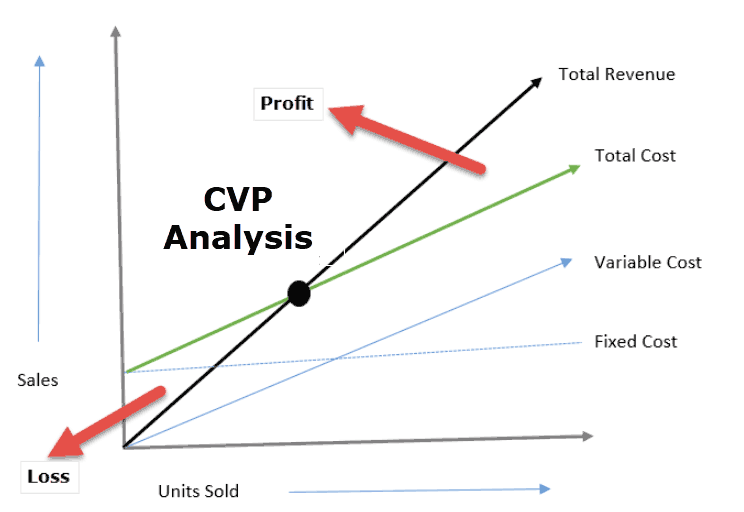
Cost-Volume-Profit (CVP) analysis is a managerial accounting tool used to study the relationship between a company’s sales volume, revenues, costs, and profits. CVP analysis helps businesses make informed decisions regarding pricing, sales mix, and other operational factors. This analysis is useful for businesses of all sizes and industries.

Components of CVP analysis are:

Sales Volume (Q):

Sales volume is the total quantity of goods or services sold within a given period.

Sales Revenue (R):

Sales revenue is the total amount of revenue generated from the sale of goods or services. It is calculated by multiplying the sales volume by the selling price per unit (P).

R = P × Q

Variable Costs (VC):

Variable costs are costs that vary with changes in sales volume or level of activity. Examples of variable costs include direct materials, direct labor, and variable overhead costs. The total variable costs (TVC) can be calculated by multiplying the variable cost per unit (VCu) by the sales volume (Q).

TVC = VCu × Q

Fixed Costs (FC):

Fixed costs are costs that do not vary with changes in sales volume or level of activity. Examples of fixed costs include rent, depreciation, salaries, and property taxes. The total fixed costs (TFC) remain constant regardless of the sales volume.

Contribution Margin (CM):

Contribution margin is the amount of revenue available to cover the fixed costs and generate a profit. It is calculated as the difference between sales revenue and total variable costs.

CM = R – TVC

Break-Even Point (BEP):

The break-even point is the level of sales volume at which the total revenues equal the total costs. At this point, the business is neither making a profit nor incurring a loss. The break-even point can be calculated by dividing the total fixed costs by the contribution margin per unit (CMu).

BEP = TFC / CMu

The above formulas can be used to perform a variety of CVP analysis calculations. Some of the most common CVP analysis applications are:

Determining the Sales Volume required to break even:

To determine the sales volume required to break even, the business must first calculate its contribution margin per unit and divide it into the total fixed costs.

BEP = TFC / CMu

Once the break-even point is calculated, the business can determine the level of sales volume required to cover all of its costs and break even.

Determining the Sales Volume required to achieve a target profit:

To determine the sales volume required to achieve a target profit, the business must first calculate its contribution margin per unit. Then, it should subtract the target profit from the total fixed costs and divide the result by the contribution margin per unit.

Target Sales Volume = (TFC + Target profit) / CMu

The business can then use this information to set sales targets and pricing strategies to achieve the desired level of profit.

Evaluating the impact of changes in sales volume on profits:

By analyzing the relationship between sales volume, costs, and profits, businesses can evaluate the impact of changes in sales volume on their profitability. For example, they can calculate the contribution margin and net profit for different levels of sales volume and determine the most profitable sales mix.

Evaluating the impact of changes in selling prices on profits:

By analyzing the relationship between selling prices, costs, and profits, businesses can evaluate the impact of changes in selling prices on their profitability. For example, they can calculate the contribution margin and net profit for different selling prices and determine the optimal pricing strategy.

Evaluating the impact of changes in variable costs on profits:

By analyzing the relationship between variable costs, selling prices, and profits, businesses can evaluate the impact of changes in variable costs on their profitability. For example, they can calculate the contribution margin and net profit for different variable costs and determine the optimal cost structure.

Evaluating the impact of changes in the sales mix on profits:

By analyzing the relationship between different products’ sales volume, selling prices, and variable costs, businesses can evaluate the impact of changes in the sales mix on their profitability. For example, they can calculate the contribution margin and net profit for different product mixes and determine the most profitable sales mix.

Evaluating the impact of changes in fixed costs on profits:

By analyzing the relationship between fixed costs, sales volume, and profits, businesses can evaluate the impact of changes in fixed costs on their profitability. For example, they can calculate the break-even point and net profit for different levels of fixed costs and determine the optimal cost structure.

Assumptions of Cash Volume Profit Analysis

Following are the assumptions of CVP Analysis:

(i) No. of Units – Only Driver for Costs and Revenues

It assumes that the total variable costs and revenues would increase or decrease only due to a change in no. of units. There are no factors that will affect it.

(ii) Costs – Either Variable or Fixed

This assumption says that all the costs are either variable or fixed. In other words, it says that there are no semi-variable or semi-fixed costs.

(iii) No Change in Price, Variable Cost, and Fixed Costs

CVP analysis assumes that there are no changes in the price and variable cost per unit irrespective of change in time period and relevant range. If we see closely, it is neglecting the chances of changes in prices due to inflation, economic conditions etc. Also, neglecting the bulk order discounts and small order premiums.

Importance of Cash Volume Profit Analysis

If you are offered a business idea wherein you sell chairs. The first thing few things that will strike your mind is

  • Required initial investment
  • Amount of sales required to breakeven
  • Assess whether you are capable of achieving that sale

This analysis is important because it answers the second most important question. This is not a one time question as well. This is a regular assessment. A businessman has to keep checking whether he is reaching the milestones set as per cost volume profit analysis. This will guide his decision-making process relating to increases in fixed costs, the speed of business operations etc.

Advantages of Cash Volume Profit Analysis

(i) Helps managers find out a breakeven point, target operating income etc.

(ii) Cost Volume Profit technique is used to evaluate investment proposals

(iii) Sets the base for planning the marketing efforts of a business

(iv) Helps in setting up the basis for budgeting activity

Disadvantages of Cash Volume Profit Analysis

(i) In a current dynamic business environment, the costs and prices can’t remain constant throughout the year. A manager is forced to react and make necessary changes in prices and costs due to change in economic conditions, customer bargaining powers, competitors etc.

(ii) All costs cannot be classified as fixed or variable. There is a significant list of costs which are neither fixed nor variable but are semi-variable or semi-fixed. Say, for example, a utility or electricity invoice contains rent as a component which remains constant irrespective of the change in usage of no. of electricity units.

(iii) No. of units cannot be the only driver of total costs and revenues. There are other factors also that impact the prices as well as costs. The raw material price reduction can reduce the variable cost and therefore the customers with knowledge of this change will demand a reduction in prices as well. Similarly, the entrance of a new big player in the market forces all the firms in the market to reduce their cost or compromise or bear loss of customers.

error: Content is protected !!