Marketing Environment in India

Marketing Environment is the combination of external and internal factors and forces which affect the company’s ability to establish a relationship and serve its customers.

The marketing environment of a business consists of an internal and an external environment. The internal environment is company-specific and includes owners, workers, machines, materials etc. The external environment is further divided into two components: micro & macro. The micro or the task environment is also specific to the business but external. It consists of factors engaged in producing, distributing, and promoting the offering. The macro or the broad environment includes larger societal forces which affect society as a whole. The broad environment is made up of six components: demographic, economic, physical, technological, political-legal, and social-cultural environment.

Importance of Environment Analysis

  1. It helps in marketing analysis.
  2. It can assess the impact of opportunities and threats on the business.
  3. It facilitates the company to increase general awareness of environmental changes.
  4. It is possible to develop effective marketing strategies on the basis of analysis.
  5. It helps to capitalize the opportunities rather than losing out to competitors.
  6. It facilitates to understand the elements of the environment.
  7. It helps to develop best strategies, in the light of analyzing “what is going around the company”.

MARKETING ENVIRONMENT IN INDIA

India is one of the largest consumer markets in the world, with its population of middle-class consumers expected to reach 200 million in 2020 and 475 million in 2030. But it is a complex and diverse consumer market, and it is vital to tailor your marketing strategies and even your products to local preferences. In addition to intense competition from both small and large local retailers and international companies, you must consider the diversity of cultural backgrounds, differing levels of wealth and sophistication, and the sheer size of both the population and land mass.

The best way to deal with the complexities of the Indian market for marketing and advertising purposes is to invest in and hire local knowledge. Both Indian and international companies specialise in marketing in India. A comprehensive marketing plan that considers core elements such as your brand, stakeholder management, public relations, media (including digital and social media), and your product/brand value proposition is critical.

Be aware, however, that you will need to continually reassess your marketing strategy and plan. The Indian socio-economic environment is constantly evolving and changing, which in turn impacts on consumer choices. You should be particularly mindful of factors.

Brand Awareness

Indian middle-class consumers place strong importance on brands, particularly luxury brands. Status is a key factor  many people will buy luxury goods not because they necessarily like them, but because they are representations of success. Make sure you have a specific strategy focusing on brand localisation, brand building and awareness creation. New entrants to the market with a recognised brand may wish to consider a product launch or media conference to announce their arrival in India.

Price Consciousness

For everyday commodities, price is an important consideration for Indian consumers, particularly at the lower-middle class and lower- income levels. As opposed to status items on which wealthier Indian consumers are willing to spend more, non-status items are likely to be chosen based on price.

Demographic Dynamics

India’s middle and upper- middle income households in larger cities are demanding quality across a wide range of products and services, especially those that focus on health and wellness, as well as education. The rural consumer market in India, comprising 700 million people, is largely underserviced at the moment for health and wellness goods and services, education and other consumer goods and services, leaving ample opportunity for growth.

Logistics

As explored earlier in this guide, India is still a developing country with a less sophisticated logistics supply chain than in Australia and many of Australia’s traditional, more developed export markets. Less-developed infrastructure in some poorer regions in particular may cause delays in getting goods to markets and consumers.

Product and Service adaptations

You may need to adapt your product to meet Indian preferences or requirements. Adapting to local regulations, tastes and cultural preferences vastly improves your chances of success.

Brand Marketing and Advertising

Language, culture and symbolism need to be considered when marketing and advertising in India. Generally, you canpreserve your English company name when trading in India. However, if you choose to adopt a name with a more local flavour, seek trusted advice before you register the name. Advertising is subject to some regulation in India. Enforcement of these regulations is not as strict as in some other countries unless an advertisement incites public outrage.

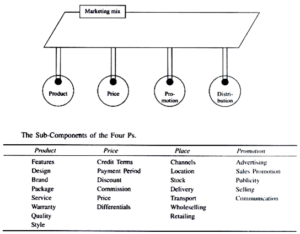
4Ps of Marketing

The four major ingredients of the marketing-mix are described below:

  1. Product

A product is any good or service that consumers want. It is a bundle of utilities or a cluster of tangible and intangible attributes. Product component of the marketing- mix involves planning, developing and producing the right type of products and services. It deals with the dimensions of product line, durability and other qualities.

Product policy of a firm also deals with proper branding, right packaging, appropriate colour and other product features. The total produce should be such that it really satisfies the needs of the target market. In short, product-mix requires decisions with regard to

  • Size and weight of the product
  • Quality of the product
  • Design of the product
  • Volume of output
  • Brand name
  • Packaging
  • Product rang
  • Product testing
  • Warranties and after sale services, etc.
  1. Price

Price is an important factor affecting the success of a firm. Pricing decisions and policies have a direct influence on sales volume and profits of business. Price is, therefore, an important element in the marketing-mix. In practice, it is very difficult to fix the right price. Right price can be determined through pricing research and test marketing.

A lot of exercise and innovation is required to determine the price that will enable the firm to sell its products successfully. Demand, cost, competition, government regulation, etc. are the vital factors that must be taken into consideration in the determination of price. Price-mix involves decisions regarding base price, discounts, allowances, freight payment, credit, etc.

  1. Promotion

Promotion component- of the marketing-mix is concerned with bringing products to the knowledge of customers and persuading them to buy. It is the function of informing and influencing the customers. Promotion-mix involves decisions with respect to advertising, personal selling and sales promotion. All these techniques help to promote the sale of products and to fight competition in the market.

Advertising is a major tool used to communicate a message (called advertising copy) through; newspapers, magazines, radio, television and other media of advertising. Advertising component of the promotion-mix requires several decisions with regard to the theme of advertising, the media to be used, the advertising budget, etc. Large firms employ advertising agencies and specialists to run advertising campaigns and to prepare individual advertisements.

Personal selling is an effective means of communication with consumers. It involves direct face-to-face contact between salesmen and consumers. Sales managers plan, direct and control the efforts of individual sales persons.

Advertising cannot aim directly at the prospect to win his patronage. Therefore, personal selling is required to complement advertising. Personal selling is particularly useful when the product is of a technical nature or where goods are to be sold to industrial and commercial establishments.

Sales promotion consists of all forms of communication with the customers except advertising and personal selling. Free samples, prize contests, premium on sale, displays, shows and exhibitions, etc. are the main techniques of sales promotion.

No single method of promotion is effective alone and, therefore, a promotional campaign usually involves a combination of two or more promotional methods. Growing competition and widening market have made simultaneous use of more than one promotional method all the more necessary.

Combination of two or more methods in a single promotional campaign requires an effective blending of promotional inputs so as to optimize the expenditure on each. There is no one ideal promotional-mix that fits all situations. While devising a promotional-mix nature of product, type of customers, the promotion budget, stage of demand, etc. should be taken into consideration.

  1. Place

This element of the marketing-mix involves choice of the place where products are to be displayed and made available to the customers. It is concerned with decisions relating to the wholesale and retail outlets or channels of distribution.

The objective of selecting and managing trade channels is to provide the products to the right customer at the right time and place on a continuing basis. In deciding where and through whom to sell, management should consider where the customer wants the goods to be available.

A manufacturer may distribute his goods through his own outlets, he may employ wholesalers and retailers for this purpose. Irrespective of the channel used, management must continuously evaluate channel performance and make changes whenever performance falls short of expected targets. In addition, management must develop a physical distribution system for handling and transporting the products through the selected channel.

In the determination of distribution-mix or marketing logistics, a firm has to make decisions with regard to the mode of transporting of goods to middlemen, use of company vehicles or a transporter, the route over which the goods are to be moved, type of warehouses where the goods are to be stored, etc.

Marketing Mix, Meaning, Characteristics and Elements of Marketing mix

Marketing Mix. refers to the combination of key elements that businesses use to promote and sell their products or services effectively. Traditionally known as the 4 Ps—Product, Price, Place, and Promotion—the marketing mix helps companies develop a strategic plan to meet consumer needs, maximize profitability, and differentiate their offerings in the market. The mix has evolved to include additional Ps such as People, Process, and Physical Evidence, especially in service industries, addressing both tangible and intangible aspects of marketing to ensure a comprehensive approach to customer satisfaction and business success.

Determining the Marketing-Mix

The purpose of determining the marketing mix is to meet the needs and wants of customers in the most efficient and cost-effective way. Since customer preferences and external factors evolve over time, the marketing mix must also change and remain flexible. As a dynamic concept, the marketing mix cannot be static. According to Philip Kotler, “Marketing mix represents the setting of the firm’s marketing decision variables at a particular point in time.”

The process of determining the marketing mix, or making marketing decisions, involves the following steps:

  • Identification

The first step is to identify the target customers to whom the company intends to sell its products or services. This involves pinpointing the market segment most likely to purchase and benefit from the offering.

  • Analysis

Once the target market is identified, the next step is to analyze the needs, desires, and behaviors of these customers. Market research is employed to gather information on the size, location, buying power, and motivations of the target audience. Additionally, an understanding of competitive forces, dealer behavior, and relevant government regulations is essential for shaping the marketing mix.

  • Design

Based on the insights gained through identification and analysis, the next step is to design an appropriate mix of the 4 Ps: Product, Price, Promotion, and Place (distribution). This step involves not only determining each element of the marketing mix but also ensuring proper integration and alignment of all components to create a cohesive strategy that reinforces one another.

  • Testing

Before full implementation, it is beneficial to test the designed marketing mix on a small scale with a select group of customers. By gauging their reactions, the company can determine whether adjustments are needed to improve the effectiveness of the mix.

  • Adoption

Once any necessary modifications are made, the marketing mix is officially adopted and implemented. The company must continuously monitor and evaluate its effectiveness, adapting to any changes in the business environment or customer preferences over time. Regular updates ensure the marketing mix remains relevant and effective.

Characteristics/Features/Nature of Marketing Mix

  • Customer-Centric

The marketing mix revolves around understanding and meeting the needs of the target customer. Each element is designed to appeal to customer preferences, ensuring satisfaction and fostering loyalty. A deep understanding of customer behavior, preferences, and expectations is essential.

  • Interdependent Elements

The components of the marketing mix are not isolated; they are interdependent and work together to create a cohesive strategy. For example, pricing decisions can impact promotion strategies, and distribution choices can influence product development.

  • Dynamic and Flexible

The marketing mix is dynamic, meaning it must evolve as market conditions, customer preferences, competition, and technology change. Companies must regularly review and adjust their marketing mix to stay competitive and relevant.

  • Adaptable to Market Conditions

The marketing mix needs to adapt to different market environments, such as economic fluctuations, political changes, and cultural shifts. For example, a company may need to modify its pricing strategy during a recession or alter its promotion methods for different cultural markets.

  • Blends Traditional and Modern Approaches

Today’s marketing mix blends traditional (product, price, place, promotion) and modern components, such as digital marketing, customer experiences, and sustainability practices. This allows businesses to reach broader and more diverse audiences through multiple channels.

  • Focus on Differentiation

One of the key characteristics of the marketing mix is the focus on differentiating the product or service from competitors. This could be through product features, pricing strategies, promotional tactics, or unique distribution methods, allowing the company to create a competitive advantage.

  • Balance Between Customer Needs and Business Objectives

While the marketing mix is centered around customer satisfaction, it also considers the company’s business goals, such as profitability, market share, and brand positioning. The marketing mix aims to find the balance between these two priorities.

  • Product-Specific

The marketing mix is tailored to specific products or services. Each product or service may require a unique combination of the marketing mix elements, depending on factors like the target market, competition, and industry trends.

  • Helps in Decision-Making

The marketing mix provides a structured framework for businesses to make marketing decisions. By breaking down the 4 Ps, managers can make informed choices about how to allocate resources, what strategies to pursue, and how to engage with customers.

  • Supports Competitive Positioning

An effective marketing mix helps a company position itself against competitors. By optimizing elements such as product features, pricing strategies, and distribution channels, businesses can position their brand and offerings in a way that distinguishes them from competitors.

  • Affects All Aspects of Marketing

The marketing mix touches every aspect of marketing—from product development to customer engagement. It influences decisions related to market research, advertising campaigns, pricing models, and distribution channels, ensuring a consistent and integrated marketing effort.

  • Emphasizes Customer Experience

Beyond the traditional focus on product and price, today’s marketing mix increasingly emphasizes the overall customer experience. This includes not just the quality of the product, but also the process of purchasing, customer service, and post-purchase support.

Elements of Marketing Mix:

  • Product

The product element refers to the tangible goods or intangible services that a business offers to meet the needs or desires of its target market. It includes decisions regarding the design, features, quality, variety, and functionality of the product or service. Effective product strategies focus on ensuring that the product provides value, meets customer expectations, and differentiates itself from competitors. Products must be continuously improved and adapted to evolving customer needs and preferences.

  • Price

Price is the amount of money customers must pay to obtain the product or service. It plays a crucial role in determining the perceived value of the product. Pricing strategies include competitive pricing, discount pricing, psychological pricing, and value-based pricing, among others. The goal is to set a price that aligns with the target market’s willingness to pay while maintaining profitability for the business. Factors such as production costs, competitor prices, and market demand influence pricing decisions.

  • Place

Place refers to the distribution channels through which the product reaches the customer. This includes the locations, intermediaries, and logistics involved in making the product available. Companies must ensure that their products are accessible to the target audience through physical stores, online platforms, or a combination of both. Effective placement strategies also consider factors such as market reach, geographic location, and convenience for customers.

  • Promotion

Promotion encompasses all the activities that communicate the product’s benefits and persuade customers to make a purchase. This element involves advertising, sales promotions, public relations, direct marketing, and digital marketing tactics. The purpose of promotion is to increase brand awareness, drive consumer interest, and encourage sales. Companies use various promotional tools, including social media, email campaigns, TV ads, and discounts, to engage customers and keep the product top of mind.

  • People

People refer to the employees, customers, and other stakeholders who interact with the product or service. In service industries, the customer experience is heavily influenced by the behavior and attitudes of employees, as they are often the face of the brand. Companies focus on training employees, maintaining strong customer relationships, and creating a positive experience for both employees and customers.

  • Process

The process element refers to the procedures, mechanisms, and flow of activities by which services are consumed. It includes the steps involved in service delivery, such as customer service interactions, payment methods, and after-sales support. Businesses must streamline processes to ensure efficiency, consistency, and customer satisfaction. A smooth process can greatly enhance customer loyalty and contribute to the overall success of the business.

  • Physical Evidence

Physical evidence is particularly important for service-based industries where the product cannot be physically touched or seen. It includes the physical environment, branding, and any tangible components that help customers evaluate the service experience. Examples include the layout of a retail store, the website interface, packaging, and brochures. Providing strong physical evidence helps customers feel more confident about the service and strengthens the brand’s credibility.

Meaning and Concepts of Marketing

Marketing can be defined as the action or business of promoting and selling products or services, including market research and advertising. According to the American Marketing Association (AMA), marketing is the activity, set of institutions, and processes for creating, communicating, delivering, and exchanging offerings that have value for customers, clients, partners, and society at large. This definition emphasizes the multi-faceted nature of marketing, highlighting its role in creating value and fostering relationships.

Concept of Marketing:

  • Production Concept

The production concept is based on the idea that “consumers will favor products that are readily available and highly affordable.” This approach is one of the oldest orientations in marketing management and guides sellers in their strategies. However, companies that adopt this perspective risk becoming too focused on their operational efficiencies, potentially losing sight of the ultimate goal: meeting consumer needs. This narrow focus can lead to marketing myopia, where management emphasizes production and distribution efficiencies without considering customer preferences or market demands.

  • Product Concept

Product concept asserts that consumers will prefer products that offer superior quality, performance, and innovative features. Under this concept, marketing strategies emphasize continuous product improvement. While product quality is crucial, an exclusive focus on enhancing the company’s offerings can also lead to marketing myopia. For instance, consider a company that manufactures high-quality floppy disks. While these disks may excel in quality, customers today may require alternatives for data storage, such as USB flash drives, SD memory cards, or portable hard drives. Therefore, the company should shift its focus from perfecting floppy disks to addressing customers’ broader data storage needs.

  • Selling Concept

Selling concept posits that “consumers will not purchase enough of a firm’s products unless significant selling and promotional efforts are undertaken.” In this framework, management prioritizes creating sales transactions over fostering long-term, profitable customer relationships. Essentially, the goal is to sell what the company produces rather than developing products that align with market demands. This aggressive selling strategy carries substantial risks, as it assumes that customers can be persuaded to buy a product, even if they initially do not like it. Often, this is a flawed and costly assumption. The selling concept is typically applied to unsought goods—products that consumers do not think about purchasing, such as insurance or blood donations. Companies in these sectors must excel at identifying prospects and effectively communicating the benefits of their offerings.

  • Marketing Concept

The marketing concept emphasizes that “achieving organizational goals depends on understanding the needs and wants of target markets and delivering the desired satisfactions more effectively than competitors.” This approach adopts a “customer-first” mentality, placing customer focus and value at the core of sales and profit generation. The marketing concept embodies a customer-centered philosophy that encourages businesses to “sense and respond” to market demands. Rather than seeking the right customers for existing products, the objective is to identify and develop the right products for the customer base. The marketing concept and the selling concept represent two opposing philosophies in marketing.

  • Societal Marketing Concept

Societal marketing concept raises important questions about whether the traditional marketing concept adequately addresses potential conflicts between short-term consumer desires and long-term societal welfare. It asserts that “marketing strategies should deliver value to customers while maintaining or improving the well-being of both consumers and society.” This concept advocates for sustainable marketing practices that are socially and environmentally responsible, meeting current consumer and business needs while preserving or enhancing the ability of future generations to meet their own. In response to urgent issues like global warming, companies are increasingly recognizing the need to implement societal marketing principles, either fully or partially, as they reassess their resource usage and impact on society.

Meaning, Nature and Scope of Managerial Economics

Managerial economics is a discipline which deals with the application of economic theory to business management. It deals with the use of economic concepts and principles of business decision making. Formerly it was known as “Business Economics” but the term has now been discarded in favour of Managerial Economics.

Managerial Economics may be defined as the study of economic theories, logic and methodology which are generally applied to seek solution to the practical problems of business. Managerial Economics is thus constituted of that part of economic knowledge or economic theories which is used as a tool of analysing business problems for rational business decisions. Managerial Economics is often called as Business Economics or Economic for Firms.

“Managerial Economics is economics applied in decision making. It is a special branch of economics bridging the gap between abstract theory and managerial practice.” – Haynes, Mote and Paul.

“Business Economics consists of the use of economic modes of thought to analyse business situations.” – McNair and Meriam

“Business Economics (Managerial Economics) is the integration of economic theory with business practice for the purpose of facilitating decision making and forward planning by management.” – Spencerand Seegelman.

“Managerial economics is concerned with application of economic concepts and economic analysis to the problems of formulating rational managerial decision.” – Mansfield

Nature of Managerial Economics

(i) The primary function of management executive in a business organization is decision making and forward planning.

(ii) Decision making and forward planning go hand in hand with each other. Decision making means the process of selecting one action from two or more alternative courses of action. Forward planning means establishing plans for the future to carry out the decision so taken.

(iii) The problem of choice arises because resources at the disposal of a business unit (land, labour, capital, and managerial capacity) are limited and the firm has to make the most profitable use of these resources.

(iv) The decision making function is that of the business executive, he takes the decision which will ensure the most efficient means of attaining a desired objective, say profit maximisation. After taking the decision about the particular output, pricing, capital, raw-materials and power etc., are prepared. Forward planning and decision-making thus go on at the same time.

(v) A business manager’s task is made difficult by the uncertainty which surrounds business decision-making. Nobody can predict the future course of business conditions. He prepares the best possible plans for the future depending on past experience and future outlook and yet he has to go on revising his plans in the light of new experience to minimise the failure. Managers are thus engaged in a continuous process of decision-making through an uncertain future and the overall problem confronting them is one of adjusting to uncertainty.

(vi) In fulfilling the function of decision-making in an uncertainty framework, economic theory can be, pressed into service with considerable advantage as it deals with a number of concepts and principles which can be used to solve or at least throw some light upon the problems of business management. E.g are profit, demand, cost, pricing, production, competition, business cycles, national income etc. The way economic analysis can be used towards solving business problems, constitutes the subject-matter of Managerial Economics.

Thus in brief we can say that Managerial Economics is both a science and an art.

Scope of Managerial Economics

The scope of managerial economics is not yet clearly laid out because it is a developing       science. Even then the following fields may be said to generally fall under Managerial Economics:

  • Demand Analysis and Forecasting
  • Cost and Production Analysis
  • Pricing Decisions, Policies and Practices
  • Profit Management
  • Capital Management

These divisions of business economics constitute its subject matter.

Recently, managerial economists have started making increased use of Operation Research methods like Linear programming, inventory models, Games theory, queuing up theory etc., have also come to be regarded as part of Managerial Economics.

  1. Demand Analysis and Forecasting

A business firm is an economic organization which is engaged in transforming productive resources into goods that are to be sold in the market. A major part of managerial decision making depends on accurate estimates of demand. A forecast of future sales serves as a guide to management for preparing production schedules and employing resources. It will help management to maintain or strengthen its market position and profit base. Demand analysis also identifies a number of other factors influencing the demand for a product. Demand analysis and forecasting occupies a strategic place in Managerial Economics.

  1. Cost and production analysis

A firm’s profitability depends much on its cost of production. A wise manager would prepare cost estimates of a range of output, identify the factors causing are cause variations in cost estimates and choose the cost-minimizing output level, taking also into consideration the degree of  uncertainty in production and cost calculations. Production processes are under the charge of engineers but the business manager is supposed to carry out the production function analysis in order to avoid wastages of materials and time. Sound pricing practices depend much on cost control. The main topics discussed under cost and production analysis are: Cost concepts, cost-output relationships, Economics and Diseconomies of scale and cost control.

  1. Pricing decisions, policies and practices

Pricing is a very important area of Managerial Economics. In fact, price is the genesis of the revenue of a firm ad as such the success of a business firm largely depends on the correctness of the price decisions taken by it. The important aspects dealt with this area are: Price determination in various market forms, pricing methods, differential pricing, product-line pricing and price forecasting.

  1. Profit management

Business firms are generally organized for earning profit and in the long period, it is profit which provides the chief measure of success of a firm. Economics tells us that profits are the reward for uncertainty bearing and risk taking. A successful business manager is one who can form more or less correct estimates of costs and revenues likely to accrue to the firm at different levels of output. The more successful a manager is in reducing uncertainty, the higher are the profits earned by him. In fact, profit-planning and profit measurement constitute the most challenging area of Managerial Economics.

  1. Capital management

The problems relating to firm’s capital investments are perhaps the most complex and troublesome. Capital management implies planning and control of capital expenditure because it involves a large sum and moreover the problems in disposing the capital assets off are so complex that they require considerable time and labour. The main topics dealt with under capital management are cost of capital, rate of return and selection of projects.

error: Content is protected !!