Insertion of Arithmetic Mean

Let A₁, A₂, …, An, n arithmetic means are inserted between two numbers ‘a’ and ‘b’ such that a, A₁, A₂, …, An, b from an AP.

Here, total number of terms are (n + 2) and common difference be d

b = (n + 2)th term = a + (n + 2 – 1) d

d = (b – a)/ (n + 1)

Insertion of Geometric Mean

Let A1, G2, G3, G4……Gn be N geometric Means between two given numbers A and B . Then A, G1, G2 ….. Gn, B will be in Geometric Progression .

So B = (N+2)th term of the Geometric progression.

Then Here R is the common ratio
B = A*RN+1
RN+1 = B/A
R = (B/A)1/(N+1)

Now we have the value of R
And also we have the value of the first term A
G1 = AR1 = A * (B/A)1/(N+1)
G2 = AR2 = A * (B/A)2/(N+1)
G3 = AR3 = A * (B/A)3/(N+1)

Third, Fourth and inverse proportion

The equality of any two ratios is called a proportion. For example, if we have any four numbers or quantities that we represent as ‘a’, ‘b’, ‘c’, and ‘d’ respectively, then we may write the proportion of these four quantities as:

16 : 9

a:b = c:d or a:b :: c:d. From this, we will now define the proportionals. Let us begin by defining the fourth proportional.

Similar to the f=definition of the fourth proportional, we define the term known as the third proportional. The third proportional of a proportion is the second term of the mean terms. For example, if we have a:b = c:d, then the term ‘c’ is the third proportional to ‘a’ and ‘b’.

Fourth Proportional

If a : b :: c:d or in other words a:b = c: d, then the quantity ‘d’ is what we call the fourth proportional to a, b and c.

For example, if we have 2, 3 and 4, 5 are in the proportion such that 2 and 5 are the extremes, then 5 is the fourth proportional to 2, 3, and 4.

Inversely Proportional

Inversely Proportional: when one value decreases at the same rate that the other increases.

Example: speed and travel time

Speed and travel time are Inversely Proportional because the faster we go the shorter the time.

  • As speed goes up, travel time goes down
  • And as speed goes down, travel time goes up

This: y is inversely proportional to x

Is the same thing as: y is directly proportional to 1/x

Which can be written:

y = k / x

Ratios and proportions

When we talk about the speed of a car or an airplane we measure it in miles per hour. This is called a rate and is a type of ratio. A ratio is a way to compare two quantities by using division as in miles per hour where we compare miles and hours.

A ratio can be written in three different ways and all are read as “the ratio of x to y”

X to Y

X : Y

X / Y

A proportion on the other hand is an equation that says that two ratios are equivalent. For instance, if one package of cookie mix results in 20 cookies than that would be the same as to say that two packages will result in 40 cookies.

20/1 = 40 2

A proportion is read as “x is to y as z is to w”

X / y= z / w

Where y, w≠0

If one number in a proportion is unknown you can find that number by solving the proportion.

Percentages

Find a percentage or work out the percentage given numbers and percent values. Use percent formulas to figure out percentages and unknowns in equations. Add or subtract a percentage from a number or solve the equations.

How to Calculate Percentages

There are many formulas for percentage problems. You can think of the most basic as X/Y = P x 100. The formulas below are all mathematical variations of this formula.

Let’s explore the three basic percentage problems. X and Y are numbers and P is the percentage:

  1. Find P percent of X
  2. Find what percent of X is Y
  3. Find X if P percent of it is Y

Read on to learn more about how to figure percentages.

How to calculate percentage of a number.

Use the percentage formula: P% * X = Y

Example: What is 10% of 150?

  • Convert the problem to an equation using the percentage formula: P% * X = Y
  • P is 10%, X is 150, so the equation is 10% * 150 = Y
  • Convert 10% to a decimal by removing the percent sign and dividing by 100: 10/100 = 0.10
  • Substitute 0.10 for 10% in the equation: 10% * 150 = Y becomes 0.10 * 150 = Y
  • Do the math: 0.10 * 150 = 15
  • Y = 15
  • So 10% of 150 is 15
  • Double check your answer with the original question: What is 10% of 150? Multiply 0.10 * 150 = 15

Duplicate, Triplicate and Sub-duplicate of a ratio

There are concepts you need to understand in duplicate ratios. One is duplicate ratios itself and the other is a sub-duplicate ratio. In duplicate ratios, when the ratio p/q is compounded with itself, the resulting ratio which is p²/q² is called as the duplicate ratio. For example, 16/9 is the duplicate ratio of 4/3.

The duplicate ratio of the ratio of a:b is also defined as the compound ratio of a:b and a:b

=> (a × a) : (b × b) => a² : b²

So, the duplicate ratio of 6:7 = 6²:7² = 36:49

Similarly, for the sub-duplicate ratio, √a/√b is the sub-duplicate ratio of a/b or a:b.

For example 3:4 is the sub-duplicate ratio of 9:16.

Triplicate ratio: The triplicate ratio is the compound ratio of three equal ratios.

The triplicate ratio of the ratio a : b is the ratio a^3: b^3

In other words,

The triplicate ratio of the ratio m : n = Compound ratio of m : n, m : n and m : n

                                                 = (m × m × m) : (n × n × n)

                                                 = m^3 : n^3

Therefore, the triplicate ratio of 4 : 7 = 4^3: 7^3 = 64 : 343.

Real Numbers, HCF & LCM

Real Numbers

The type of number we normally use, such as 1, 15.82, −0.1, 3/4, etc.

Positive or negative, large or small, whole numbers or decimal numbers are all Real Numbers.

They are called “Real Numbers” because they are not Imaginary Numbers.

HCF & LCM (Simple Problems)

LCM

The LCM of a set of two or more numbers is the smallest of their common multiples. Multiples mean the numbers which follow as the result of multiplying the number with numbers like 1,2,3 etc. To find the common multiples all we need to do is see what numbers end up to be the common multiple for all the given numbers.

For example, when we find the LCM of 9 and 12 we need to find the common multiples. The common multiples of 9 are 36,72,108 etc… The smallest of these is 36, hence 36 shall be the LCM of 9 and 12.

LCM by Prime factorization

To find the LCM using prime factorization method we need to follow the below-mentioned steps:

  • Find the prime factors of numbers individually.
  • From all the factors, identify the maximum number of times each prime factor appears.
  • The product of the prime factors occurring in maximum numbers is the LCM of the given set of numbers.

Let us use the steps in the following example: find the LCM of 8 and 24.

Step 1: First find the prime factors of the numbers 8 and 24

  • Prime factors of 8 = 2×2×2
  • Prime Factors of 24= 2×2×2×3

Step 2: Choose out the number occurring a maximum number of times. The number 2 occurs 3 times and 3 occurs 1 time. number occurring the maximum number of times is 2×2×2×3.

Step 3: The product of these numbers is 24. So the LCM of 8 and 24 is 24.

LCM by Division Method

For calculating the LCM by division method we need to follow the below mentioned steps:

  • First, write all the given numbers in a single row but separated by commas.
  • Find the least prime number that divides at least two numbers from the set of given numbers.
  • Write the quotients exactly below the respective number. The numbers which are not divisible by that prime number have to be written as they are, below the respective number.
  •  Keep repeating the step 2 till no two numbers are divisible by the same number.
  • To find the LCM, multiply the divisors and remaining quotients. The product of all is the LCM of the given set of numbers.

HCF

The HCF or Highest Common Factor of two or more numbers is the greatest common factor of the given set of numbers. In other words, HCF is the greatest number which exactly divides two or more given numbers.

HCF by Listing Method

The listing method involves the process of listing the factors of the given numbers. For example, find the HCF of 20 and 35.

  • All possible factors of 20 are 1,2,4,5,10 and 20
  • All possible factors of 60 are 1,3,4,5,6,10,12,15,20,30,60

The common factors of the given numbers are : 1,2,4,5,10,20. The greatest among all other numbers is 20, so it shall be the HCF of both the numbers.

HCF by Prime Factorization

Before finding HCF by prime factorization we need to know the concept of the same. Let’s take a number say, 45. Now the factors of 45 are 1,3,5,9,15 and 45 itself. Now, apart from 3 and 5 the other numbers 9 and 15 are composite numbers. We hence further factorize them with 9= 3×3 and 15=3×5.

So the factors of 45 shall be only 1,3,3, and 5. This is prime factorization. We now define prime factorization as the process of expressing the number as the product of its prime factors. The prime factors include only prime numbers and not composite numbers.

When we find HCF by prime factorization method, we are finding the greatest common factor among the prime factors or numbers. Steps to be followed for the method are:

  1. Find the prime factors of each of the given number.
  2. Next, we identify the common prime factors of the given numbers
  3. We then multiply the common factors. The product of these common factors is the HCF of the given numbers.

Let us use these steps in the example below: find the HCF of  36 and 48.

Step 1: Finding prime factors individually:

  • All possible factors of 36 are: 2×2×3×3×1
  • All possible factors of 48 are: 2×2×2×2×3×1

Step 2: Choose out the common factors: 2×2×3

Step 3: Multiply all the common factors to get the HCF of the given numbers:

Here the given numbers are 36 and 48. The product of the common factors: 2×2×3 = 12. So the HCF for the numbers 36 and 48 is 12.

Rational & Irrational numbers

Rational Numbers

A Rational Number can be written as a Ratio of two integers (ie a simple fraction).

Example: 1.5 is rational, because it can be written as the ratio 3/2

Example: 7 is rational, because it can be written as the ratio 7/1

Example 0.333… (3 repeating) is also rational, because it can be written as the ratio 1/3

Irrational numbers

But some numbers cannot be written as a ratio of two integers they are called Irrational Numbers.

π (Pi) is a famous irrational number

π = 3.1415926535897932384626433832795… (and more)

We cannot write down a simple fraction that equals Pi.

The popular approximation of 22/7 = 3.1428571428571… is close but not accurate.

Natural Numbers, Even Numbers, Odd Numbers

Natural Numbers

The natural numbers are the counting numbers. It goes like 1, 2, 3, 4, …, and so on. It is interesting to know that if we subtract 1 from any natural number, we get its predecessor (previous number). If we add 1 to any natural numbers, it gives its successor (next number).

The predecessor of 5 is 5 − 1 = 4. The successor of 5 is 5 + 1 = 6. Is there any natural number that has no predecessor? The predecessor of 2 is 1. What is the predecessor of 1? Does that predecessor is also a natural number? No, no natural number is the predecessor of 1.

Whole Numbers

Suppose you have 5 chocolates and you distribute them among your friends. How many chocolates do you have? Zero. Zero is denoted by the symbol 0. When we add 0 to the group of natural numbers, we get whole numbers. The predecessor of 1 is 1 − 1 = 0. 1 has the predecessor which is a whole number and not a natural number.

0 + Natural Numbers = Whole Numbers

Properties of Zero

  • Any number, when multiplied by 0, gives 0.
  • When 0 is added to any number, nothing changes.
  • When 0 is subtracted from any number, it remains the same.
  • 0 is the smallest whole number.

The whole numbers are said to consist of two types of numbers – even numbers and odd numbers.

Even Numbers

A whole number exactly divisible by 2 is called even numbers.

For example:

2, 4, 6, 8, 10, 12, 14, 16……………………..are even number. Or a number having 0, 2, 4, 6, 8 at its units place is called an even number.

246, 1894, 5468, 100 are even number.

Any two even numbers which differ from one another by 2 are called consecutive even number.

Odd Numbers

Odd numbers are the numbers which are not completely divisible by 2. The odd numbers leave 1 as a remainder when divided by 2. They have 1, 3, 5, 7, and 9 as their unit digit. 1, 3, 5, 7, 9, 11, 13, 15, etc. are odd numbers. The sets of odd number are expressed as Odd = {2n + 1: n ∈ integer (number)}.

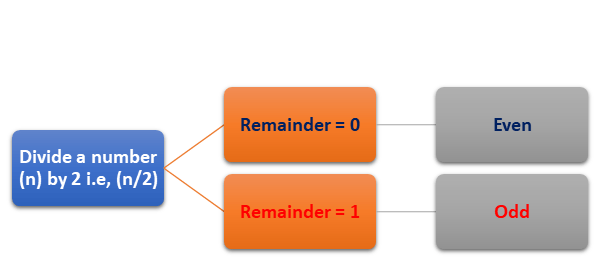
Steps to Check for Odd and Even Numbers

  • Divide the number by 2.
  • Check the remainder.
  • If the remainder is 0, it is an even number else if the remainder is 1, it is an odd number.

Check Odd & Even

Integers, Prime Numbers

Integers

Integers are like whole numbers, but they also include negative numbers … but still no fractions allowed!

So, integers can be negative {−1, −2,−3, −4, … }, positive {1, 2, 3, 4, … }, or zero {0}

We can put that all together like this:

Integers = { …, −4, −3, −2, −1, 0, 1, 2, 3, 4, … }

Examples: −16, −3, 0, 1 and 198 are all integers.

(But numbers like ½, 1.1 and 3.5 are not integers)

Prime Numbers

Number s which have only two factors namely 1 and the number itself are called prime numbers.

For example:

2, 3, 5, 7, 11, 19, 37 etc are prime numbers.

Composite Numbers

Numbers having more than two factors are called as composite numbers.

For example:

4, 6, 8, 10 etc are composite numbers.

Notes:

(a) 1 is neither prime nor composite.

(b) 2 is the lowest and the only even prime number.

(c) 9 is the lowest odd composite number.

Co-prime Numbers

Two numbers are said to be co-prime if they do not have a common factor other than 1 or two numbers whose HCF is 1 called co-prime numbers.

Co-prime numbers needs not be prime numbers.

For example:

  • 7 and 10 are co-prime.
  • 15 and 17 are co-prime.

Twin Prime Numbers

Twin prime numbers are the two prime numbers whose difference is 2.

For example:

  • 3 and 5
  • 17 and 19
  • 41 and 43
  • 29 and 31
  • 71 and 73.
error: Content is protected !!