Technology ethics

Businesses today are technology and innovation driven. There is huge competition in the sphere and therefore like other industry or business function ethics is essential here also. Specially because ethics by itself is only a tool to create and doesn’t know ethics or morals!

Every day we have innovative products and services that announce their arrival in the market place and others that go obsolete. It is this technology and innovation that leads to ethical issues, considering the competition to stay ahead by innovating is immense. Issues like data mining, invasion to privacy, data theft and workplace monitoring are common and critical.

In technology we speak of ethics in two contexts; one is whether the pace of technological innovation is benefiting the humankind or not, the other is either severely empowering people while choking others for the same. Technology, for example, has drastically replaced people at work.

In the first case we are compelled to think about the pace at which technology is progressing. There are manifold implications here, be it things like computer security or viruses, Trojans, spam’s that invade the privacy of people or the fact the technology is promoting consumerism.

Nowadays data storage is primarily on computer systems. With the advent of internet technology the world has got interconnected and data can be accessed remotely by those who are otherwise unauthorized to do the same. This is one of the pitfalls of innovation. The other one i.e. the pace of technological change also raises the question of ethics.

New products make their way and leave the existing ones obsolete. In fact technological change and innovation is at the heart of consumerism, which is bad for economy and environment in general. The recent economic downturn makes up for a very good example.

Increasingly technological products are adding up to environmental degradation. Computer screens, keyboards, the ink used in the printers are some of the ways in which technology is polluting the environment. All these produce toxins that cannot be decomposed easily.

The other major issue in technology that brings in ethics is interface between technology and the computers. Many scientists are of the opinion that the world will come to an end with a war between the humankind and the technology. Technology they say will advance to an extent beyond the control of those who have made it!

No doubt technology has replaced people at work and made certain others redundant. On the flip side many people have been raised to power while others have been severely handicapped. The latter is especially true for third world countries. New manufacturing processes that are outsourced either replace manpower there or either exploits the latter in the name of employment by engaging them cheaper prices.

Technology has also made inroads into the field of medicine and life care. New cloning techniques, genetic modifications or other life saving drugs need continuous monitoring and surveillance. Bioethics has thus emerged as ethics in the field of medical technology.

Whereas we cannot talk of controlling technology and innovation, the better way is to adapt and change. The role of ethics in technology is of managing rather controlling the same. Continuous monitoring is required to keep track of latest innovations and technological changes and for ensuring fair practices.

Impact of Corporate Culture

Corporate culture represents the professional values a company adopts that dictate how it interacts with employees, vendors, partners and clients. The mission strategy of an organization is a summary of how the company perceives its role and the beliefs it uses to achieve its goals. Because the corporate culture is a driving force in how the company does business, it has an impact on developing business strategy.

Risk

The corporate culture dictates how much risk an organization is willing to take when it comes to research and development, client interaction, investing in equipment and any other activity that involves risk. If the corporate culture is one that promotes environmental responsibility, that will impact the risks that the company will take when developing new products. Assessing risk based on boundaries established by the company’s beliefs and sense of responsibility has an impact on corporate planning.

Employee Retention

When the company develops a policy of withholding information from employees, that can start to develop a culture of distrust among the staff. The ability to retain employees can be weakened when the promises made by the company in regards to company growth and employee opportunity are compromised by a lack of trust. Allowing the atmosphere of mistrust to become a part of corporate culture makes it difficult to execute employee retention plans as employees tend to not believe what the company tells them.

Incentive Pay

Incentive pay is something that employers use to improve productivity and maintain employee morale. But incentive programs need to be monitored and administered carefully to avoid creating a culture of expectation. If an incentive pay program is set up to reward employees that do not perform, that creates a dangerous culture precedent. For example, a profit-sharing program where every employee gets a bonus check regardless of performance will diminish the motivating effect of the program and cause employees to expect the bonus without having to perform even at baseline expectations. By instituting a system of checks that forces employee to reach certain performance levels before being able to take part in an incentive program, you help to create a culture of performance expectations. This makes the investment of a profit-sharing program viable and makes it into a motivational tool.

Focus

A corporate culture that each employee subscribes to helps to create focus among the staff. When employees abide by the company’s beliefs and values, it gives a unified impression to vendors, clients and partners. The company can then create a business strategy knowing that the entire organization will apply the guidelines in a uniform manner and improve the chances that a strategy will succeed.

An Emphasis on Excellence

When staffing levels are adequate to provide quality products or services to customers, and both safety and quality feel like a top priority, employees feel they work for a great company. If excellence is part of your company’s values, deciding to relentlessly pursue that end will attract employees that share the same value.

Belonging to a Team

When employees believe there’s a spirit of cooperation and a culture of diversity, they are free to bring their best work to the table. The kinds of organizations that are great at hiring people who fit within the culture tend to have employees who have fun at work and like the people they work with.

Cross cultural issues in ethics

There are tons, but most can be resolved straight forwardly by encouraging people to share information with each other about their cultures. We used to do monthly pot luck lunches where people would each bring a native dish and take turns explaining them. In the process, you’d get a lot of non-food insight into their lifestyles. Toronto, where I worked for many years is the most mixed city and workforce in the world. In one business they hung everyone’s flags in the cafeteria – about 80. In my admin assistant’s church, some 40 languages were spoken. This mixing makes it much easier to overcome culture differences on the job, because everyone gets used to them pretty well everywhere.

The problematic issues were sometimes quite odd. A group of women from the same culture ran a lottery inside a few departments and anyone who didn’t buy a ticket was shunned and punished in various other ways a blackmail scheme really, since those who ran it kept about half the proceeds. Apparently this was common in their culture ‘back home.’

Occasionally we’d find a theft ring taking our products, usually to sell at flee markets and they’d reasonably often be based around family or culture members working in different locations, supported by others of the same from outside – gangs really.

Sometimes we’d find bosses or even work groups where promotions were given almost always to people of one culture. Of course, this is rampant all around the world with respect to the biggest culture divide of all – men versus women – where women are most often offered fewer promotions and paid less nearly everywhere and men are given the advantages. People can see and disagree with some ‘culture differences’ and can’t see or try to correct others.

Studies all prove that the best, most creative teams are mixed ones, but they take a bit more skill to manage, so you certainly find many, many bosses who assemble teams who are like themselves. In hiring it is a given that if there are two candidates the boss, if left to themselves, will almost always find a rationale for taking the one most like themselves. For that reason some companies now use hiring teams, sometimes even excluding the boss. Not sure if that fixes the problem.

Communication is one of the biggest issues in cross-cultural teams. While some people are more direct in their communication ( they say what they mean), people from some other cultures can be very indirect in their communication, especially in the presence of seniors. You need to watch out not only for what is said, but also the way it is said – the tone is as important as the words.

Time Management is another challenge in cross-cultural teams. Countries like Germany, Switzerland etc. are very time conscious and punctual, whereas Spain, Italy, India etc. are more relaxed in their attitude towards time. Long lunches, unplanned/sudden long coffee breaks are fairly common in these countries, where unplanned breaks might be frowned upon in Germany. Meetings, deadlines etc. need to be clearly communicated, and late coming needs to be appropriately dealt with early in the process.

Individual vs group cultures also clash in multi-cultural teams. While some people are comfortable saying”I will own this / I will do it” , many group cultures find the use of “I” uncomfortable, and use the plural form “we” a lot more even while addressing one-on-one messages. For example, “ we shall complete the process” is fairly common in mails from India to their British colleagues, who are left wondering who the “we” refers to, when the mail is addressed only to one individual. This can lead to problems in fixing accountability, and needs to be addressed in team meetings.

Hierarchy is a huge challenge in multi-cultural teams. In some places your value is derived from who you are, like your status, your family background, your seniority, your education etc. like India and in some others, like USA, the structure is more flat and you are valued for what you have accomplished. When such cultures interact, issues can open over openly challenging your manager, expressing opinions freely in meetings, saying ‘no’ to seniors/ clients, decision making and involvement of team members in the process etc. This can be addressed by openly discussing hierarchy in teams, and encouraging a flat operating model.

Cadbury Committee

The Cadbury Report, titled Financial Aspects of Corporate Governance, is a report issued by “The Committee on the Financial Aspects of Corporate Governance” chaired by Adrian Cadbury that sets out recommendations on the arrangement of company boards and accounting systems to mitigate corporate governance risks and failures. The report was published in draft version in May 1992. Its revised and final version was issued in December of the same year. The report’s recommendations have been used to varying degrees to establish other codes such as those of the OECD, the European Union, the United States, the World Bank etc.

Background

Sridhar Arcot and Valentina Bruno in their article called “In Letter but not in Spirit: An Analysis of Corporate Governance in the UK” explain the background to the Cadbury Committee. Although wrong on the historical facts, as Robert Maxwell died on 5 November 1991 and “The Committee on the Financial Aspects of Corporate Governance” known as “The Cadbury Committee” was set up in May 1991 for other reasons than the Maxwell case, it gives an interesting reading of the situation at the time:

Robert Maxwell’s death while cruising on the Canary Islands in 1990 shone a spotlight on his company’s affairs. A series of risky acquisitions in the mid-eighties had led Maxwell Communications into high debts, which was being financed by diverting resources from the pension funds of his companies. After his disappearance, it emerged that the Mirror Group’s debts (one of Maxwell’s companies) vastly outweighed its assets, while £440 millions (GBP) were missing from the company’s pension funds. Despite the suspicion of manipulation of the pension schemes, there was a widespread feeling in the City of London that no action was taken by UK or US regulators against the Maxwell Communications Corp. Eventually, in 1992 Maxwell’s companies filed for bankruptcy protection in the UK and US. At around the same time the Bank of Credit and Commerce International (BCCI) went bust and lost billions of dollars for its depositors, shareholders and employees. Another company, Polly Peck, reported healthy profits one year while declaring bankruptcy the next. Following the raft of governance failures, Sir Adrian Cadbury chaired a committee whose aims were to investigate the British corporate governance system and to suggest improvements to restore investor confidence in the system. The Committee was set up in May 1991 by the Financial Reporting Council, the London Stock Exchange, and the accountancy profession. The report embodied recommendations based on practical experiences and with an eye on the US experience, further elaborated after a process of consultation and widely accepted. The final report was released in December 1992 and then applied to listed companies reporting their accounts after 30th June 1993.

Summary of recommendations

The boards of all listed companies should comply with the code of best practice set out by the committee.

As many companies as possible should aim at meeting its requirements.

The listed companies reporting in respect of years ending on or after 31 December, 1992, should make a statement about their compliance with the code in the report and accounts and give reasons for any areas of non-compliance.

Companies should publish their statement of compliance only after they have been the subject of review by the auditors.

The Auditing Practices Board should consider the extent and form that an endorsement by the auditors could take.

Limitations of Corporate Governance

Corporations are separate legal entities, wholly distinct from their shareholders. Shareholders elect the board of directors which, in turn, manages the business. Usually the board employs officers and managers to run the daily operations of the corporation. However, in small corporations, all of these shareholders, board, officers and managers may be one and the same. The related governance requirements have several disadvantages.

Corporations Governed by Statutes

Corporations are governed by federal and state statutes. One major reason business owners form corporations is to limit the owners’ liability to the amount of their investments. Another reason founders form corporations is because corporations are permitted to raise capital by selling stock to investors and have a long legal and case history to support this. With this corporate structure comes certain requirements.

Fiduciary Duty of Board

Officers and the board of directors have fiduciary duties to act in the best interest of the corporation. If they breach those duties by not exercising honest and prudent care, they can be held liable. This is why companies where shareholders elect non-shareholder directors often provide directors and officers, or D&O, insurance. D&O insurance does not protect against outright fraud, but it does protect against fallout from bad business decisions.

Increased Costs

Corporations have higher administrative costs because of greater administrative requirements than those required of LLCs and limited partnerships. Corporate boards must either meet or create resolutions to enter into financial arrangements or contractual arrangements. Corporations must maintain corporate documentation, including stock purchases and sales, legal compliance and annual registration.

Maintenance of Separation

Corporations, shareholders and board directors and officers must follow all the corporate formalities, including keeping annual meeting minutes for both shareholders’ meeting and board of directors’ meetings, documenting major decisions as board-approved. Even corporations owned and governed by one shareholder in multiple director roles must adhere to all formalities. Shareholder-owners must sign all documents as their position, for example, “John Smith, President, ABC Company.” Failure to adhere to these rules could result in a creditor getting a judge to pierce the corporate veil. When a court or judge “pierces the corporate veil,” the court sets aside the corporate protection and allows the creditors to go after the personal assets of the shareholders.

Principal Agent Conflict

Conflicts arise when a corporation’s shareholders do not actively participate in the business and instead hire professional management to run the business. The manager represents the shareholders but often has different goals and perspectives. The manager acts in his best interest as an employee but not in the best interest of the shareholders. For example, a manager may make decisions that help him keep his job and a nice salary but that reduce the amount of profits that go to the shareholders. Shareholders must structure employment agreements to reduce or eliminate this conflict.

Evils of Excess or Inadequate Working Capital

When there is a redundant working capital, it may lead to unnecessary purchasing and accumulation of inventories causing more chances of theft, waste and losses.

Excessive working capital implies excessive debtors and defective credit policy which may cause higher incidence of bad debts.

Excessive Working Capital means idle funds which earn no profits for the business and hence the business cannot earn a proper rate of return on its investments.

It may result into overall inefficiency in the organisation.

When there is excessive working capital, relations with banks and other financial institutions may not be maintained.

The redundant working capital gives rise to speculative transactions.

Due to low rate of return on investments, the value of shares may also fall.

Disadvantages or Dangers of Inadequate Working Capital:

A concern which has inadequate working capital cannot pay its short-term liabilities in time. Thus, it will lose its reputation and shall not be able to get good credit facilities.

It becomes difficult for the firm to exploit favourable market conditions and undertake profitable projects due to lack of working capital.

The firm cannot pay day-to-day expenses of its operations and it creates inefficiencies, increases costs and reduces the profits of the business.

It becomes impossible to utilize efficiently the fixed assets due to non-availability of liquid funds.

It cannot buy its requirements in bulk and cannot avail of discounts, etc.

The rate of return on investments also falls with the shortage of working capital.

Capital Budgeting Techniques

Capital budgeting is set of techniques used to decide which investments to make in projects. There are a number of capital budgeting techniques available, which include the following:

Discounted cash flows. Estimate the amount of all cash inflows and outflows associated with a project through its estimated useful life, and then apply a discount rate to these cash flows to determine their present value. If the present value is positive, accept the funding proposal.

Internal rate of return. Determine the discount rate at which the cash flows from a project net to zero. The project with the highest internal rate of return is selected.

Constraint analysis. Examine the impact of a proposed project on the bottleneck operation of the business. If the proposal either increases the capacity of the bottleneck or routes work around the bottleneck, thereby increasing throughput, then accept the funding proposal.

Breakeven analysis. Determine the required sales level at which a proposal will result in positive cash flow. If the sales level is low enough to be reasonably attainable, then accept the funding proposal.

Discounted payback. Determine the amount of time it will take for the discounted cash flows from a proposal to earn back the initial investment. If the period is sufficiently short, then accept the proposal.

Accounting rate of return. This is the ratio of an investment’s average annual profits to the amount invested in it. If the outcome exceeds a threshold value, then an investment is approved.

 Real options. Focus on the range of profits and losses that may be encountered over the course of the investment period. The analysis begins with a review of the risks to which a project will be subjected, and then models for each of these risks or combinations of risks. The result may be greater care in placing large bets on a single likelihood of probability.

When analyzing a possible investment, it is useful to also analyze the system into which the investment will be inserted. If the system is unusually complex, it is likely to take longer for the new asset to function as expected within the system. The reason for the delay is that there may be unintended consequences that ripple through the system, requiring adjustments in multiple areas that must be addressed before any gains from the initial investment can be achieved.

Organization Structure of Finance Department

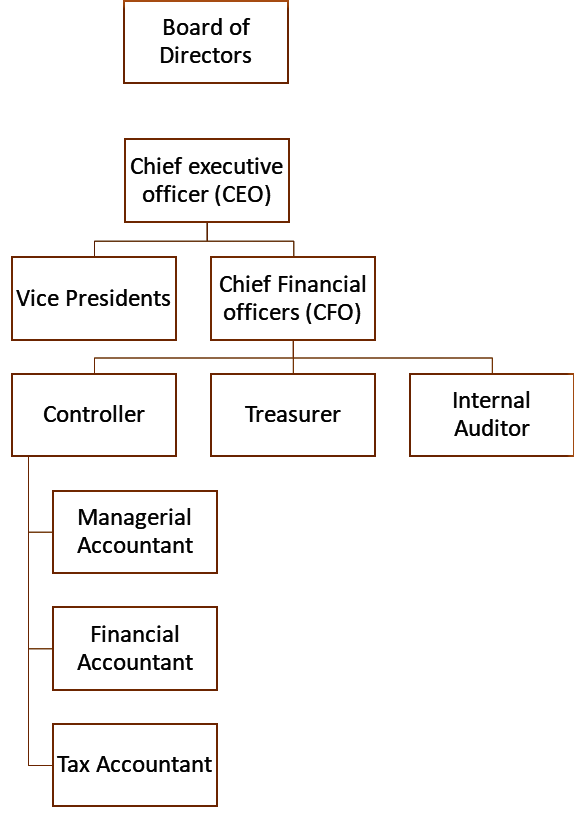
“A Typical Organization Chart” is a typical organization chart; it shows how accounting and finance personnel fit within most companies. The personnel at the bottom of the chart report to those above them. For example, the managerial accountant reports to the controller. At the top of the chart are those who control the company, typically the board of directors (who are elected by the owners or shareholders). Review Figure 1.1 “A Typical Organization Chart” before moving on to the detailed discussion of each important finance and accounting position.

Represents vice presidents of various departments outside of accounting and finance such as production, personnel, and research and development.

In addition to reporting to the chief financial officer, the internal auditor typically reports independently to the board of directors and/or the audit committee (made up of select members of the board of directors).

Chief Financial Officer

The chief financial officer (CFO) is in charge of all the organization’s finance and accounting functions and typically reports to the chief executive officer.

Controller

The controller is responsible for managing the accounting staff that provides managerial accounting information used for internal decision making, financial accounting information for external reporting purposes, and tax accounting information to meet tax filing requirements. The three accountants the controller manages are as follows:

  • Managerial accountant. The managerial accountant reports directly to the controller and assists in preparing information used for decision making within the organization. Reports prepared by managerial accountants include operational budgets, cost estimates for existing products, budgets for new product lines, and profit and loss reports by division. (Note that some people use the term cost accountant interchangeably with managerial accountant. Others consider cost accounting a specific function of managerial accounting that focuses on measuring costs. In this text, we use the term managerial accountant and assume that cost accountants focus on measuring costs.)
  • Financial accountant. The financial accountant reports directly to the controller and assists in preparing financial information, in accordance with U.S. GAAP, for those outside the company. Reports prepared by financial accountants include a quarterly report filed with the Securities and Exchange Commission (SEC) that is called a 10Q and an annual report filed with the SEC that is called a 10K.
  • Tax accountant. The tax accountant reports directly to the controller and assists in preparing tax reports for governmental agencies, including the Internal Revenue Service.

Treasurer

The treasurer reports directly to the CFO. A treasurer’s primary duties include obtaining sources of financing for the organization (e.g., from banks and shareholders), projecting cash flow needs, and managing cash and short-term investments.

Internal Auditor

An internal auditor reports to the CFO and is responsible for confirming that the company has controls that ensure accurate financial data. The internal auditor often verifies the financial information provided by the managerial, financial, and tax accountants (all of whom report to the controller and ultimately to the CFO). If conflicts arise with the CFO, an internal auditor can report directly to the board of directors or to the audit committee, which consists of select board members.

Note: Not All Organization follow the Same Hierarchy

Arithmetic Progression: Finding the “n”th term of AP and Sum to “n”th term of AP

An arithmetic progression is a sequence of numbers in which each term is derived from the preceding term by adding or subtracting a fixed number called the common difference “d”

For example, the sequence 9, 6, 3, 0,-3, …. is an arithmetic progression with -3 as the common difference. The progression -3, 0, 3, 6, 9 is an Arithmetic Progression (AP) with 3 as the common difference.

The general form of an Arithmetic Progression is a, a + d, a + 2d, a + 3d and so on. Thus nth term of an AP series is Tn = a + (n – 1) d, where Tn = nth term and a = first term. Here d = common difference = Tn – Tn-1.

Sum of first n terms of an AP: S =(n/2)[2a + (n- 1)d]

The sum of n terms is also equal to the formula S(n) = n/2(a+1) where l is the last term.

Tn = Sn – Sn-1 , where Tn = nth term

When three quantities are in AP, the middle one is called as the arithmetic mean of the other two. If a, b and c are three terms in AP then b = (a+c)/2

Geometric Progression Finding the “n”th term of GP and insertion of Geometric Mean

A geometric progression is a sequence in which each term is derived by multiplying or dividing the preceding term by a fixed number called the common ratio. For example, the sequence 4, -2, 1, – 1/2,…. is a Geometric Progression (GP) for which – 1/2 is the common ratio.

The general form of a GP is a, ar, ar2, ar3 and so on.

The nth term of a GP series is Tn = arn-1, where a = first term and r = common ratio = Tn/Tn-1) .

The formula applied to calculate sum of first n terms of a GP: S(n) = a ( r^n-1) / r-1

When three quantities are in GP, the middle one is called as the geometric mean of the other two. If a, b and c are three quantities in GP and b is the geometric mean of a and c i.e. b =√ac

The sum of infinite terms of a GP series S= a/(1-r) where 0< r<1.

If a is the first term, r is the common ratio of a finite G.P. consisting of m terms, then the nth term from the end will be = arm-n.

The nth term from the end of the G.P. with the last term l and common ratio r is l/(r(n-1)) .

error: Content is protected !!