Corporate Replenishment Policies, Components, Advantages

Corporate Replenishment policies are guidelines and strategies implemented by organizations to manage the replenishment of inventory efficiently. These policies aim to strike a balance between maintaining optimal stock levels, reducing carrying costs, and meeting customer demand. While specific policies may vary based on the industry, business model, and product characteristics, there are common principles and considerations that organizations incorporate into their corporate replenishment strategies.

Corporate replenishment policies play a vital role in optimizing inventory management, ensuring product availability, and controlling costs. These policies provide a framework for organizations to navigate the complexities of supply chain management, build efficient relationships with suppliers, and enhance overall operational effectiveness. By aligning replenishment policies with organizational goals and industry best practices, businesses can achieve a balance between meeting customer demand and maintaining a cost-effective and sustainable supply chain.

Formalized logistics policies permit the head office of a retail organization to be responsive to operational needs. Companies have invested an enormous amount of fixed capital on warehousing, vehicles and other equipment. Apart from fixed assets, the current assets in the form of inventory, accounts receivable and cash also form a substantial part of investment.

Thus, corporate replenishment has become an integral part of the corporate strategy. It is instrumental to the achievement of financial and strategic objectives.

Components

  1. Reorder Point:

Organizations set a reorder point for each product, which represents the inventory level at which a new order should be placed. The reorder point is typically determined by considering factors such as lead time, demand variability, and desired service levels.

  1. Safety Stock:

Safety stock is a buffer of inventory held to protect against uncertainties such as unexpected demand spikes or supply chain disruptions. Corporate replenishment policies define how safety stock levels are calculated and maintained.

  1. Lead Time Management:

Considering the time it takes for suppliers to deliver orders, organizations establish lead time targets. Policies may include measures to reduce lead times, such as optimizing supplier relationships or using expedited shipping options.

  1. Order Quantity (EOQ):

The Economic Order Quantity (EOQ) is the optimal order quantity that minimizes total inventory costs. Corporate replenishment policies may specify the calculation and application of EOQ to determine the most cost-effective order quantities.

  1. ABC Analysis:

Organizations often categorize products into groups based on their importance or value. The ABC analysis classifies items as A (high-value, low-quantity), B (medium-value, medium-quantity), and C (low-value, high-quantity). Replenishment policies may then be tailored to the specific needs of each category.

  1. Supplier Collaboration:

Collaborative relationships with suppliers are crucial for effective replenishment. Policies may include guidelines on communication, performance monitoring, and joint efforts to reduce lead times and improve order accuracy.

  1. Dynamic Replenishment Strategies:

Some organizations adopt dynamic replenishment strategies, adjusting reorder points and order quantities based on real-time demand fluctuations, promotions, or seasonal variations.

  1. Technology Integration:

Replenishment policies often involve the use of advanced technologies, such as inventory management systems, demand forecasting tools, and automated order generation systems. Integration with Enterprise Resource Planning (ERP) systems may also be part of the strategy.

  1. Cross-Functional Collaboration:

Collaboration between different departments, including sales, marketing, and logistics, is essential for effective replenishment. Policies may encourage cross-functional teams to share information and align strategies.

  1. Continuous Improvement:

Replenishment policies should include mechanisms for continuous improvement. Regular reviews, performance evaluations, and adjustments based on lessons learned contribute to an adaptive and responsive replenishment strategy.

  1. Sustainability Considerations:

Some organizations incorporate sustainability into their replenishment policies, considering environmentally friendly practices, such as optimizing transportation routes, reducing packaging waste, and sourcing from eco-friendly suppliers.

  1. Compliance and Governance:

Policies may include guidelines to ensure compliance with regulatory requirements and governance standards. This includes adherence to industry regulations, ethical sourcing practices, and responsible inventory management.

  1. Demand Forecasting:

Accurate demand forecasting is a key element of replenishment policies. Policies may define the methodologies used for forecasting and the frequency of updates.

  1. Financial Considerations:

Replenishment policies should align with financial goals, considering budget constraints, cost control measures, and overall financial performance.

  1. Risk Management:

Policies may include strategies for mitigating risks related to supply chain disruptions, geopolitical factors, and other external variables that can impact replenishment processes.

Corporate replenishment policy is broader in its application. It is based on the organization’s replenishment ethos related to a systems approach.

Advantages of Corporate replenishment to customers

  1. Goods are available at the point of sales where and when the customer needs them.
  2. An item advertised in the media is certainly available in stock as stock is assured through the system. This adds to customer goodwill.
  3. The economies of scale and inventory savings available to retailers are passed on to the customer. The retailer is able to forecast bulk buying requirements more accurately. Hence, the retailer is able to obtain greater discounts from suppliers. A part of the savings can be passed on to customers.

Advantages of Corporate replenishment to store management

  1. With well designed corporate replenishment, the management is relieved from the botheration of stock checking and ordering. Use of automatic stock replenishment has completely freed the store management from stock ordering worries.
  2. Store management has more time to manage resources and implement company policies. Computerized goods receipt system has saved the time spent on inventory management.
  3. With the use of automated systems, managers will not worry about stock position. But they should ensure that stock counting is accurately recorded. Stock outs occur for reasons such as unpredictable shifts in demand, product unavailability, poor data capture control, loss of information, computer failure etc. In these situations, managers should communicate major stock outs immediately to the head office.

The automatic stock replenishment system merely removes the task of physically ordering stock. It does not relieve the manager from the responsibility to ensure maximum customer satisfaction through product availability.

Advantages of Corporate replenishment to Company

  1. The company benefits from maximizing service and minimizing costs. Inventory replenishment is managed to keep the amount of stock to an acceptable level, it avoids dead stock in which capital is locked up unnecessarily.
  2. Minimum stock holding prevents capital from being locked up. Capital may be employed for the expansion and development of the business.
  3. Due to effective control over stock holding, floor space required for warehousing is reduced. This enables the store manager to divert floor space for selling activities. In a self service environment, products are displayed by making effective use of floor space.
  4. Stock will be allocated and received into stores to coincide with advertising and other sales promotional activities. If advertising products are not available in stores, it is a major fault on the part of the retailer.

Advantages of Corporate replenishment to suppliers

  1. It is easier for a supplier to cope with one order for all stores of a chain than order for each store independently.
  2. The supplier can affect delivery of goods in the most economical way.
  3. Using traditional forms of ordering is both time consuming and inaccurate. Processing orders for central distribution warehousing is quite easy for the supplier.
  4. Only expert buyers place orders on behalf of store management. From the supplier’s point of view, it is preferable to deal with buyers who have expertise in the field of buying.
Promotion and their Setting Objectives

Promotion is a type of communication between the buyer and the seller. The seller tries to persuade the buyer to purchase their goods or services through promotions. It helps in making the people aware of a product, service or a company. It also helps to improve the public image of a company. This method of marketing may also create interest in the minds of buyers and can also generate loyal customers.

It is one of the basic elements of the market mix, which includes the four P’s: price, product, promotion, and place. It is also one of the elements in the promotional mix or promotional mix or promotional plan. These are personal selling, advertising, sales promotion, direct marketing publicity and may also include event marketing, exhibitions, and trade shows.

Types of Promotion

  1. Advertising

Advertising means to advertise a product, service or a company with the help of television, radio or social media. It helps in spreading awareness about the company, product or service. Advertising is communicated through various mass media, including traditional media such as newspapers, magazines, television, radio, outdoor advertising or direct mail; and new media such as search results, blogs, social media, websites or text messages.

  1. Direct Marketing

Direct marketing is a form of advertising where organizations communicate directly to customers through a variety of media including cell phone text messaging, email, websites, online adverts, database marketing, fliers, catalog distribution, promotional letters and targeted television, newspaper and magazine advertisements as well as outdoor advertising. Among practitioners, it is also known as a direct response.

  1. Sales Promotion

Sales promotion uses both media and non-media marketing communications for a pre-determined, limited time to increase consumer demand, stimulate market demand or improve product availability.

  1. Personal Selling

The sale of a product depends on the selling of a product. Personal Selling is a method where companies send their agents to the consumer to sell the products personally. Here, the feedback is immediate and they also build a trust with the customer which is very important.

  1. Public Relation

Public relation or PR is the practice of managing the spread of information between an individual or an organization (such as a business, government agency, or a nonprofit organization) and the public. A successful PR campaign can be really beneficial to the brand of the organization.

Promotions: Setting your objectives

New and growing businesses are, in marketing terms, growth brands. Promotion acts as an investment activity for future growth and profits.

Any promotional activity will pivot around trial, although it is important to remember that trial is only temporary and repurchase, or loyalty, will depend on how the consumer perceives the product.

Repurchase levels and the consequent success of the product or service will depend on how effectively the trial is carried out as well as the customer’s perception, through trial, of the product.

If your business is an entirely new or re-launched product, it is important to manage your expectations before committing enormous budgets to promotional activity.

For example, however innovative your product is, the first into the market tends to get the biggest market share. Do not expect too much, particularly in the short-term.

Another fundamental factor is the environment in which you wish to promote. When putting together a promotional strategy, objectives can only be established in the context of the market. Foremost here are customer dynamics.

  • Who do you want to promote to?
  • What do they want?
  • Why do they buy competitors’ products or services?
  • Similarly, where do you want to pitch your product or service?
  • What about your competitors?

Other considerations may include any supply limitations, distribution issues, and the possibility of micro marketing: perhaps it is worth testing the activity on a regional basis.

Matching Techniques to objectives

Broadly speaking there are four promotional techniques that attract target customers to participate:

  • Price
  • Free Gifts
  • Prizes
  • Emotional Benefits

Each of these devices acts to entice the consumer in a slightly different manner and can be implemented in a number of ways.

Price Promotions

Price promotions are an excellent means of generating trial and loyalty as well as increasing volume of purchase and getting consumers of competitor brands to change to yours brand switch.

A word of warning prize promotions are legally complex and you should always seek professional advice. The main difference between competitions and free prize draws is that competitions may request a proof of purchase and free prize draws have to be no purchase necessary.

By definition, a competition has to incorporate an element of skill such as questions and a tiebreaker to complete. Instant win promotions are technically free prize draws, which is why the small print will always offer customers the chance to participate without purchasing the product in question.

Despite these complexities, instant win promotions are an excellent call to action and proven drivers of trial, brand switch and often, awareness. Equally competitions and free prize draws are tried and tested ways of encouraging customers to pick you product.

Emotional benefits

Promotions using emotional benefits or image are harder to define. Key emotional techniques include sponsoring an event such as the Olympics, linking up with a charity and character licensing activity.

The promoter will benefit from the transfer of the qualities associated with the chosen partner and may well gain additional media coverage.

This sort of activity is best suited to image building and brand awareness, which is why it will often run alongside another of the techniques described above such as including a competition prize linked with the promotional partner.

Recruitment and Training

Recruitment takes place from the point when a business decides that it needs to employ somebody up to the point where a pile of completed application forms has arrived in the post. Selection then involves choosing an appropriate candidate through a range of ways of sorting out suitable candidates leading to interviews and other tests. Training involves providing a range of planned activities that enable an employee to develop the skills, attitudes and knowledge required by the organization and the work required.

Recruitment

Attracting the right candidates to apply for a job can be an expensive process. It is even more expensive when done badly because when unsuitable candidates apply for a job, then the post may need to be re-advertised so it is best to get it right first time.

The starting point is to carry out job analysis to identify the sorts of skills, knowledge and essential requirements that someone needs to have to carry out a job. These details can be set out in a job specification, which is passed on to recruiters it gives them a picture of the ideal candidate.

A job description is also helpful because it sets out:

  • The title of a post
  • When and where it will be carried out
  • Principal and ancillary duties of the post holder
  • Other details.

The job description can be sent out to potential candidates along with a person specification, which sets out the desirable and essential characteristics that someone will need to have to be appointed to the post.

A variety of media will be used to attract applications e.g. national newspapers for national jobs, and local papers and media for local posts.

Job advertisements set out such details as:

  • Location of work
  • Salary
  • Closing date of application
  • How to apply
  • Experience required
  • Qualifications expected
  • Duties and responsibilities.

Selection

Selection simply involves choosing the right person for the job. Effective selection requires that the organization makes the right prediction from data available about the various candidates for a post.

Research indicates that the most valid form of selection method is the use of an assessment centre where candidates are subjected to a variety of test including interviews, group exercises, presentations, ‘in-tray’ exercises, and so on.

Psychometric (personality) tests have become increasingly popular in the UK in recent years and are often used alongside other tests.

Interviews will be most successful when they are tightly related to job analysis, job description and the person specification.

In-tray exercises can be used for candidates to respond to work-related and other problems, which are presented to them in an in-tray to be processed.

Training

Training for employment is very important. In a modern economy like our own the nature of work is constantly changing. New technologies mean that new work skills are constantly required. To succeed in business or in a career, people will need to be very flexible about where they work and how they work, and to constantly change the range of skills they use at work.

There are basically two types of training:

On-the-job training

Employees develop and improve their work skills whilst actually doing the job in question. For example, word processor operators rapidly improve their skills by constant practice. A supermarket till operator quickly learn effective practice by working alongside a more skilled mentor.

Off-the-job training

Employers will often encourage their employees to develop their skills through off-the-job training courses. For example, a trainee may be allowed to attend a day-release course at the local college. This might apply to a wide range of different skills including hairdressing, banking, insurance, electrical work and plumbing.

Compensation

Compensation is a wide range of financial and non-financial rewards to employees for their services rendered to the organization. It is paid in form of wages, salary, other benefits such as vacations, maternity leave, medical facilities etc. compensation helps in motivating the employees and reduce labor turnover.

Compensation can also be defined as follows:

  • A system of rewards that can motivate the employees to perform.
  • A tool that is used to foster values and culture.
  • An instrument that enables an organization to achieve its objectives.

The management should ensure that compensation structure is designed after taking into account certain factors such as qualification, experience, attitude and prevailing rates in the markets. Compensation means the reward that is received by an employee for the work performed in an organization. It is an important function of human resource management. Employees may receive finan­cial and non-financial compensations for the work performed by them.

Financial compensation includes salary, bonus, and all the benefits and incentives, whereas non-financial compensation includes awards, rewards, citation, praise, recognition, which can motivate the employees towards highest productivity.

Objectives of Compensation

  1. The compensation should be paid to each employee on the basis of their abilities and training.
  2. Compensation should be in the form of package.
  3. It should motivate the employees towards increasing productivity.
  4. It should be capable of taking care of employees for safety and security needs also.
  5. It should be flexible and clear.
  6. It should not be excessive.
  7. Compensation should be decided by the management as per the norms fixed by the legislations in consultation with the union.

Types of compensation

  1. Base compensation

Base compensation involves monetary benefit to the employees in the form of wages and salaries. It is giving the remuneration to the workers for doing the work. Wages are generally given to the workers based on hourly, daily, weekly or monthly basis. But salary is the compensation given to the office employees. Wages may be based on the number of units produced i.e. piece wage system or the time wage system i.e. the time spent on the job. But salary is always based on the time spent on the job. When it is difficult to judge the production of the company then the compensation is paid in form of salary.

  1. Supplementary compensation

Supplementary compensation, now days the organizations use supplementary compensation over and above the base compensation. It helps in satisfying the employees as well as retaining them for long time. It can be given in form of various services like housing, medical, educational facility. Supplementary compensation is also called fringe benefit as well as hidden payroll. The basic purpose of fringe benefit is to maintain efficient human resources in the organization and to motivate the employees.

These are the two main types of compensation.

Supplementary compensation is again divided into following types:

(i) Protection against hazards: supplementary compensation helps in protecting against the hazards of illness, injury, old age, death, permanent disability.

(ii) Employee services: some big organizations provide housing, low-cost loan, food, medical, and day care centre for children, educational facilities to their employees for their services.

(iii) Payment for time not worked: the employees are also paid for the time they are not working like wash up time, lunch period, vacations, holidays, sick leave etc.

(iv) Legal payments: payment under this category involves unemployment; layoff compensation, old age benefits etc.

Thus, there are various kinds of supplementary compensation which are given to the employees.

Characteristics of the Compensation

The main characteristics of the compensation system are as follows:

  1. A hierarchy of pay levels
  2. A hierarchy of jobs
  3. A set of rules and procedures
  4. Qualities required for movement from one level to other

An organization’s compensation system usually consists of three separate components. Each element of the compensation package has a link with an individual need hierarchy. All allowance are linked to basic pay. In order to motivate the employees when they achieve objectives, rewards and incentives are incorporated along with basic pay. To retain the employees and to get long-term commitments, stock option plan, annual increments and promotion are provided.

Bar Coding

Bar coding is an automatic identification technology that allows data to be collected rapidly and accurately from all aspects of a company’s operations, including manufacturing, inspection, transportation, and inventory elements. Because of these attributes, bar coding is used for a wide range of applications in almost every aspect of business. Indeed, it is the most commonly used tool for automated data entry worldwide, and is widely regarded as one of the most important business innovations of the twentieth century.

Bar codes provide a simple method of encoding text information that can be easily read by inexpensive electronic scanners. The code itself consists of a series of adjacent parallel bars of differing widths similarly spaced apart. This pattern of bars and spaces sometimes referred to as the Universal Product Code—represents alphabetic characters or numbers that are the unique identification for a certain product. First utilized in supermarkets and libraries, bar coding identification has grown over the years to have applications in many fields.

Today’s retail businesses use bar codes elements in complicated electronic point-of-sale (POS) systems. These systems enable businesses to capture information about inventory levels on a continuous basis. For example, a seller of health and beauty aids can scan the bar codes on merchandise as it leaves the store and transmit that data via an Electronic Data Interchange (EDI) system to its main suppliers. The supplier can then replenish the store’s inventory automatically. Internally, the retailer can study the point-of-sale data to determine more effective ways of marketing and merchandising its offerings. Manufacturers, meanwhile, utilize bar code technology in work process control, property management, job costing, maintenance, inventory control, and in tracking shipping and receiving activities. In the latter instance, for example, “scanners located at receiving and shipping areas can be used to record product movement,” remarked W. H. Weiss in Supervision. “In addition, captured information at the point of transaction permits invoices to be verified and bills of lading generated that are based on actual quantities shipped. Back orders can be immediately routed to the shipping dock.”

Users tabulate bar code information with reading devices called scanners. “Contact” scanners are handheld devices that must either touch or come into close proximity to the bar code symbol to read it; these scanners are used in situations where bar codes are difficult to get at or are attached to heavy or large items that cannot easily pass across stationary scanners. “Non-contact” readers, by contrast, are usually stationary scanners permanently installed (at checkout counters, etc.) Some handheld scanners may also use non-contact technology. Whatever the choice, a non-contact scanner does not have to come in contact with the bar code in order to register its contents. It uses reflected beams of light to read the bar code.

A small business planning to use bar codes should familiarize itself with the appropriate symbology to be used on its products. A website of the Measurement Equipment Corporation lists more than 230 national and international standards organizations able to assist the would-be user of bar codes depending on the kind of product to be coded. Examples are the Group of Terrestrial Freight Forwarders (GTF), the Chemical Industry Data Exchange (CIDX), and National Hardware Retail Organization (NHRO). Those looking for some general orientation may wish first to visit the Web site of the Uniform Code Council, (renamed GS1 U.S. on June 7, 2005 but still referred to by many as UCC) one of the leading umbrella organizations in bar coding. Part of the preparation is to ensure that the bar codes the business produces meet certain standards of print quality. “Print quality standards state the minimum levels of reflectance, contrast, and other critical measures of printed bar code symbol readability,” explained Weiss. “Information requirements covered by standards vary by industry. A serial number is important for some while a product weight is important for others.”

Today, bar coding technology stands as a ubiquitous part of nearly every industry of any size or economic significance. This state of affairs is unlikely to change any time soon, according to experts. Analysts do note that use of Optical Character Recognition (OCR) technology has grown in the field of document image processing in recent years. But bar coding technology remains superior to OCR in terms of expense, accuracy, and ease of operator use, and its users continue to find new and innovative uses for its still-developing technology.

History

In 1948 Bernard Silver, a graduate student at Drexel Institute of Technology in Philadelphia, Pennsylvania, US overheard the president of the local food chain, Food Fair, asking one of the deans to research a system to automatically read product information during checkout. Silver told his friend Norman Joseph Woodland about the request, and they started working on a variety of systems. Their first working system used ultraviolet ink, but the ink faded too easily and was expensive.

Convinced that the system was workable with further development, Woodland left Drexel, moved into his father’s apartment in Florida, and continued working on the system. His next inspiration came from Morse code, and he formed his first barcode from sand on the beach. “I just extended the dots and dashes downwards and made narrow lines and wide lines out of them.” To read them, he adapted technology from optical soundtracks in movies, using a 500-watt incandescent light bulb shining through the paper onto an RCA935 photomultiplier tube (from a movie projector) on the far side. He later decided that the system would work better if it were printed as a circle instead of a line, allowing it to be scanned in any direction.

On 20 October 1949, Woodland and Silver filed a patent application for “Classifying Apparatus and Method”, in which they described both the linear and bull’s eye printing patterns, as well as the mechanical and electronic systems needed to read the code. The patent was issued on 7 October 1952 as US Patent 2,612,994. In 1951, Woodland moved to IBM and continually tried to interest IBM in developing the system. The company eventually commissioned a report on the idea, which concluded that it was both feasible and interesting, but that processing the resulting information would require equipment that was some time off in the future.

Advantages

Error Prevention

Tracking errors make your inventory less accurate, which ultimately costs more money. Prior to barcodes, employees manually tracked individual items. Manual tracking leads to many human errors. Barcodes can track items with an error rate of about one error for every three million entries. At this rate, barcodes are nearly 10,000 times more accurate than manual entry.

Large Inventory Tracking

Without barcodes, companies that maintain inventories in the hundreds of thousands, or even millions, would have to scale back. They allow you to accurately track large stocks and also look up any single piece of merchandise in a matter of seconds.

Cost Savings

Barcodes save lots of money. Prior to their advent, employees tracked merchandise. It costs more money to employ added workers, and more money and time are spent tracking large quantities of goods. Eliminating excess employees makes companies more efficient and increases the bottom line.

Speed

The speed of a barcode tracking system is beneficial. For inventory purposes, the system’s speed allows tracking to be done quickly. At checkout lines, barcodes can be scanned to immediately identify the cost of goods, so clerks don’t have to type in prices. Customers don’t have to wait longer when someone is purchasing several items. Every time a barcode is scanned, the item is immediately logged within the appropriate inventory.

Electronic Article Surveillance

Electronic article surveillance is a technological method for preventing shoplifting from retail stores, pilferage of books from libraries or removal of properties from office buildings. Special tags are fixed to merchandise or books. These tags are removed or deactivated by the clerks when the item is properly bought or checked out. At the exits of the store, a detection system sounds an alarm or otherwise alerts the staff when it senses active tags. Some stores also have detection systems at the entrance to the restrooms that sound an alarm if someone tries to take unpaid merchandise with them into the restroom. For high-value goods that are to be manipulated by the patrons, wired alarm clips called spider wrap may be used instead of tags.

Surveillance tags that could be attached to items in stores were first invented by Arthur Minasy in 1966. Initially the concept of pilferage becoming a real concern to retailers started in 1964 when a requirement was raised by a retailer in Ohio after he faced pilferage in his store. Thereafter lots of research started happening and today it has reached a stage where visible deterrence have moved on to where a retailer does not even have to install pedestals in a store.

Types of Electronic Article Surveillance

There are several major types of electronic article surveillance systems:

  • Electro-Magnetic, also known as magneto-harmonic or Barkhausen effect
  • Acousto-magnetic, also known as magnetostrictive
  • Radio Frequency (8.2 MHz)
  • Microwave
  • Video surveillance systems (to some extent)
  • Concealed EAS Surveillance Systems
  1. Electro-magnetic systems

These tags are made of a strip of amorphous metal (metglas) which has a very low magnetic saturation value. Except for permanent tags, this strip is also lined with a strip of ferromagnetic material with a moderate coercive field (magnetic “hardness”). Detection is achieved by sensing harmonics and sum or difference signals generated by the non-linear magnetic response of the material under a mixture of low-frequency (in the 10 Hz to 1000 Hz range) magnetic fields.

When the ferromagnetic material is magnetized, it biases the amorphous metal strip into saturation, where it no longer produces harmonics. Deactivation of these tags is therefore done with magnetization. Activation requires demagnetization.

The EM systems are suitable for libraries to protect books and media. In the retail segment, unlike AM and RF, EM can protect small or round items and products with foil packaging or metal objects, like cosmetics, baby milk cans, medicines, DIY tools, homeware etc. EM systems can also detect objects placed in foil bags or in metal briefcases.

A further application is the Intellectual property (IP) protection against theft: Security paper with embedded microwires, which is used to detect confidential documents if they are removed from a building.

  1. Acousto-magnetic systems

These are similar to magnetic tags in that they are made of two strips: a strip of magnetostrictive, ferromagnetic amorphous metal and a strip of a magnetically semi-hard metallic strip, which is used as a biasing magnet (to increase signal strength) and to allow deactivation. These strips are not bound together but free to oscillate mechanically.

Amorphous metals are used in such systems due to their good magnetoelastic coupling, which implies that they can efficiently convert magnetic energy into mechanical vibrations.

The detectors for such tags emit periodic tonal bursts at about 58 kHz, the same as the resonance frequency of the amorphous strips. This causes the strip to vibrate longitudinally by magnetostriction, and it continues to oscillate after the burst is over. The vibration causes a change in magnetization in the amorphous strip, which induces an AC voltage in the receiver antenna. If this signal meets the required parameters (correct frequency, repetition, etc.), the alarm is activated.

When the semi-hard magnet is magnetized, the tag is activated. The magnetized strip makes the amorphous strip respond much more strongly to the detectors, because the DC magnetic field given off by the strip offsets the magnetic anisotropy within the amorphous metal. The tag can also be deactivated by demagnetizing the strip, making the response small enough so that it will not be detected by the detectors.

AM tags are three dimensional plastic tags, much thicker than electro-magnetic strips and are thus seldom used for books.

Called Emtag by B&G International, this type of tag is often attached to the inside of a plastic surround permanently attached to the power cords of hand tools and equipment.

  1. Radio frequency systems

These tags are essentially an LC tank circuit (L for inductor, C for capacitator) that has a resonance peak anywhere from 1.75 MHz to 9.5 MHz. The standard frequency for retail use is 8.2 MHz. Sensing is achieved by sweeping around the resonant frequency and detecting the dip.

Deactivation for 8.2 MHz label tags is typically achieved using a deactivation pad. In the absence of such a device, labels can be rendered inactive by punching a hole, or by covering the circuit with a metallic label, a “detuner”. The deactivation pad functions by partially destroying the capacitor. Though this sounds violent, in reality, both the process and the result are unnoticeable to the naked eye. The deactivator causes a micro short circuit in the label. This is done by submitting the tag to a strong electromagnetic field at the resonant frequency, which induces voltages exceeding the capacitor’s breakdown voltage.

In terms of deactivation, Radio Frequency is the most efficient of the 3 technologies (RF, EM, AM – there are no microwave labels) given that the reliable “remote” deactivation distance can be up to 30 cm (11.8 in). It also benefits the user in terms of running costs, since the RF de-activator only activates to send a pulse when a circuit is present. Both EM and AM deactivation units are on all the time and consume considerably more electricity. The reliability of “remote” deactivation (i.e. non-contact or non-proximity deactivation) capability makes for a fast and efficient throughput at the checkout.

Efficiency is an important factor when choosing an overall EAS solution given that time lost attempting to deactivate labels can be an important drag of cashier productivity as well as customer satisfaction if unwanted alarms are caused by tags that have not been effectively deactivated at the point of sale.

Deactivation of RF labels is also dependent on the size of the label and the power of the deactivation pad (the larger the label, the greater the field it generates for deactivation to take place. For this reason very small labels can cause issues for consistent deactivation). It is common to find RF deactivation built into barcode flat and vertical scanners at the POS in food retail especially in Europe and Asia where RF EAS technology has been the standard for nearly a decade. In apparel retail deactivation usually takes the form of flat pads of approx. 30×30 cm.

  1. Microwave systems

These permanent tags are made of a non-linear element (a diode) coupled to one microwave and one electrostatic antenna. At the exit, one antenna emits a low-frequency (about 100 kHz) field, and another one emits a microwave field. The tag acts as a mixer re-emitting a combination of signals from both fields. This modulated signal triggers the alarm. These tags are permanent and somewhat costly. They are mostly used in clothing stores and have practically been withdrawn from use.

  1. Video Surveillance

Video surveillance involves the act of observing a scene or scenes and looking for specific behaviors that are improper or that may indicate the emergence or existence of improper behavior.

Common uses of video surveillance include observing the public at the entry to sports events, public transportation (train platforms, airports, etc.), and around the perimeter of secure facilities, especially those that are directly bounded by community spaces.

The video surveillance process includes the identification of areas of concern and the identification of specific cameras or groups of cameras that may be able to view those areas. If it is possible to identify schedules when security trends have occurred or may be likely to occur, that is also helpful to the process. Then, by viewing the selected images at appropriate times, it is possible to determine if improper activity is occurring.

  1. Concealed EAS Systems

These new types of systems have caught on lately as there are no visible pedestals or hindrance in the store facade. These systems are installed below the floor and dropped from the ceiling, and can then protect merchandise of retailers from being stolen as the entire range of door is covered. Various studies and researches have been done into making this technology powerful and effective. There are site conditions and other parameters which enable them to be successfully installed but often it has now been noted that malls insist on concealed system as a mandate to increase the shopping experience- for example a part of Dubai Mall in United Arab Emirates do not allow any visible systems. Concealed Systems will be the way to go for the future.

Merchandise Management

In the fierce competition of retail, it is very crucial to attract new customers and to keep the existing customers happy by offering them excellent service. Merchandising helps in achieving far more than just sales can achieve.

Merchandising is critical for a retail business. The retail managers must employ their skills and tools to streamline the merchandising process as smooth as possible.

Merchandising

Merchandising is the sequence of various activities performed by the retailer such as planning, buying, and selling of products to the customers for their use. It is an integral part of handling store operations and e-commerce of retailing.

Merchandising presents the products in retail environment to influence the customer’s buying decision.

Types of Merchandise

There are two basic types of merchandise:

  1. Staple Merchandise
  • It has predictable demand
  • Fashion Merchandise
  • It provides relatively accurate forecasts
  1. Fashion Merchandise
  • It has unpredictable demand
  • Limited past sales history is available
  • It is difficult to forecast sales

Factors Influencing Merchandising

The following factors influence retail merchandising:

  1. Size of the Retail Operations

This includes issues such as how large is the retail business? What is the demographic scope of business: local, national, or international? What is the scope of operations: direct, online with multilingual option, television, telephonic? How large is the storage space? What is the daily number of customers the business is required to serve?

  1. Shopping Options

Today’s customers have various shopping channels such as in-store, via electronic media such as Internet, television, or telephone, catalogue reference, to name a few. Every option demands different sets of merchandising tasks and experts.

  1. Separation of Portfolios

Depending on the size of retail business, there are workforces for handling each stage of merchandising from planning, buying, and selling the product or service. The small retailers might employ a couple of persons to execute all duties of merchandising.

Functions of a Merchandising Manager

A merchandising manager is typically responsible to:

  • Lead the merchandising team.
  • Ensure the merchandising process is smooth and timely.
  • Coordinate and communicate with suppliers.
  • Participate in budgeting, setting and meeting sales goals.
  • Train the employees in the team.

Merchandise Planning

Merchandise planning is a strategic process in order to increase profits. This includes long-term planning of setting sales goals, margin goals, and stocks.

Step 1: Define merchandise policy

Get a bird’s eye view of existing and potential customers, retail store image, merchandise quality and customer service levels, marketing approach, and finally desired sales and profits.

Step 2: Collect historical information

Gather data about any carry-forward inventory, total merchandise purchases and sales figures.

Step 3: Identify Components of Planning

  • Customers: Loyal customers, their buying behavior and spending power.
  • Departments: What departments are there in the retail business, their subclasses?
  • Vendors: Who delivered the right product on time? Who gave discounts? Vendor’s overall performance with the business.
  • Current Trends: Finding trend information from sources including trade publications, merchandise suppliers, competition, other stores located in foreign lands, and from own experience.
  • Advertising: Pairing buying and advertising activities together, idea about last successful promotions, budget allocation for Ads.

Step 4: Create a long-term plan

Analyze historical information, predict forecast of sales, and create a long-term plan, say for six months.

Merchandise Buying

This activity includes the following:

  • Step 1 Collect Information: Gather information on consumer demand, current trends, and market requirements. It can be received internally from employees, feedback/complaint boxes, demand slips, or externally by vendors, suppliers, competitors, or via the Internet.
  • Step 2 Determine Merchandise Sources: Know who all can satisfy the demand: vendors, suppliers, and producers. Compare them on the basis of prices, timeliness, guarantee/warranty offerings, payment terms, and performance and selecting the best feasible resource(s).
  • Step 3 Evaluate the Merchandise Items: By going through sample products, or the complete lot of products, assess the products for quality.
  • Step 4 Negotiate the Prices: Realize a good deal of purchase by negotiating prices for bulk purchase.
  • Step 5 Finalize the Purchase: Finalizing the product prices and buying the merchandise by executing buying transaction.
  • Step 6 Handle and Store the Merchandise: Deciding on how the vendor will deliver the products, examining product packing, acquiring the product, and stocking a part of products in the storehouse.
  • Step 7 Record the Buying Figures: Recording details of transactions, number of unit pieces of products according to product categories and sub-classes, and respective unit prices in the inventory management system of the retail business.

Merchandise Performance

The following methods are commonly practiced to analyze merchandise performance:

ABC Analysis

It is a process of inventory classification in which the total inventory is classified into three categories:

  • Extremely Important Items: Very crucial inventory control on order scheduling, safety, prompt inspection, consumption pattern, stock balance, refill demands.
  • Moderately Important Items: Average attention is paid to them.
  • Less important Items: Inventory control is completely stress free.

This approach of segregation gives importance to each item in the inventory. For example, the telescope retailing company might be having small market share but each telescope is an expensive item in its inventory. This way, a company can decide its investment policy in particular items.

Sell-Through Analysis

In this method, the actual sales and forecast sales are compared and the difference is analyzed to determine whether to apply markdown or to place a fresh request for additional merchandise to satisfy current demand.

This method is very helpful in evaluating fashion merchandise performance.

Multi-Attribute Method

This method is based on the concept that the customers consider a retailer or a product as a set of features and attributes. It is used to analyze various alternatives available with regard to vendors and select the best one, which satisfies the store requirements.

Space Planning

Space planning is an art and practice that refers to the manner in which you utilize the space in your store, and how you place your merchandise. It is about using your space efficiently to meet your sales goals and create a great retail experience for your customers. Retail space planning is concerned with factors such as store fixture layout, product placement, and cross-merchandising.

Space planning had been in the retail structure since the time of inception of the retail business, but its applications, benefits, and dimensions keep evolving, reaching new heights with the passage of time. A well arranged store display attracts the shoppers, making them to check out the apparel merchandise, and influencing them to buy the clothing. Using the available space in a right manner will enable the retailer to accentuate his merchandise and arrange them in an optimum position.

A retailer’s goal is to drive sales and improve the customer’s shopping experience. They use a mixture of aisle navigation, product displays, and shelving to maximize sales per square meter while creating the ultimate shopping destination.

Space Planning Techniques get shoppers

  1. Enter the Decompression Zone

The first space you step into when you enter the store is designed to open your mind to the shopping experience, inviting you to browse and explore. A place designed to make you feel safe and secure. The decompression zone prepares you for what lies ahead, helping you focus.

A good decompression zone:

  • Provides a wide, open space, that’s free from clutter;
  • Allows easy entrance into the store with an overview of the merchandise;
  • Has no distracting marketing or advertising gimmicks;
  • Welcomes you by giving you a little space; and
  • Flower displays at the entrance that usually entice customers to come inside

Nordstrom, an upscale fashion retailer, rolls out a long red carpet from their decompression zone, guiding customers to their merchandise.

  1. Clockwise vs Counter-clockwise

It’s critical for retailers to make it easy for shoppers to find the products they’re looking for. Retail stores opt for space planning that goes counter-clockwise, from right to left, because most of the population is right-handed and will instinctively turn to the right.

However, recently many stores have opted for the more unfamiliar clockwise layout, left to right, hoping it may arouse shoppers’ attention and stimulate them more than the familiar counter-clockwise layout.

  1. Slow Down

Many retailers create little visual breaks, known as speed bumps, to give shoppers the opportunity to make seasonal or impulse buys. “Speed Bumps” are created using signage, specials or placing popular items halfway along a section, so people have to walk all along the aisle looking for them.

Retailers stock the items shoppers buy most frequently (staple items) at the back of the store, to maximise the amount time you spend inside the store, increasing basket size and impulse buying opportunities. This makes it difficult for shoppers to resist grabbing other items when making a quick trip to the grocery store.

Another space planning technique used to slow customers down, is by removing windows. Disconnecting you from the outside world, so you forget that time is passing, essentially keeping you in the store longer.

  1. Visual Appeal by Blocking

Retailers create a triangular composition, otherwise known as tiered formation, using style or color, blocking certain products together high at the back, tumbling to low in the front.

They start with a center feature and merchandise out symmetrically, placing best seller items in a prominent visual location, enticing you to buy through visual appeal.

  1. Shelf Spacing

Shelf space is positioned to manipulate shoppers into buying more. This is a highly debatable space planning technique amongst retailers, with some believing eye-level to be the top spot for a product while others reckon higher is better. Some retailers prefer the ‘end caps’ where products are displayed at the end of an aisle, believing those products receive the best visibility.

Benefits of Space Planning

By implementing above space planning techniques, retail stores create an aesthetically pleasing layout, allowing shoppers to find the products they’re looking for while eliminating out of stock items.

Products sell at a more even speed, creating less need for product ordering and shelf restocking.

A retail store might opt to first test these techniques by doing realograms beforehand and then once planograms have been implemented, evaluated the two against one another to determine technique effectiveness.

Of course, an increase in sales would also be an indicator of space planning success.

  1. It ensures that you use your store efficiently

If you have a small store, for instance, you need to place your merchandise strategically so as to prevent your store from feeling cluttered; if the space feels too small and overloaded with products, the customer may feel uncomfortable and leave before exploring your store. There should be enough space for your customer to browse freely, and there should be enough space for your sales assistants to walk around and assist customers.

  1. It ensures that customers feel at home:

One of the major concerns of space planning is the customer’s experience. Your goal as a retailer should be to ensure that the customer feels at home and that they are comfortable from the moment they walk into your store, to the moment they check out. Customers must be able to find what they are looking for easily and quickly.

  1. It can improve your revenue

Space planning has the potential to improve shopper spend and basket size. Strategic placement of your products will make it easy for your customers to find what they are looking for and discover something they never knew they needed!

Space planning refers to the efficient flow of used space, ensuring you’re comfortable while shopping and that the overall experience will lead you to linger longer.

Retail stores spend a lot of time creating the perfect flow across different departments and products, persuading you to spend more money.

Stores Designing

Planning the layout of your store is both an art and a science it requires creativity, psychological insights, and testing.

  1. Use the right floor plan

Your floor plan plays a critical role in managing store flow and traffic. The choice of which one is right for you will depend on a number of factors including the size of your store, the products that you sell, and more importantly, your target market.

What are your customers like? Are they shopping in a hurry or can they take their time? Do they prefer self-service features or will your associates guide them throughout the store? Do want to find exactly what they need efficiently, or are they open to discovering items along the way?

These are just some of the questions you have to ask when deciding on your floor plan.

While there are plenty of store arrangements that you can adopt, here are the most common ones in retail:

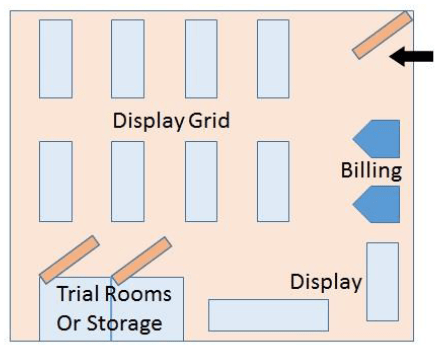
  • Straight floor plan: This floor plan involves positioning shelves or racks in straight lines to create an organized flow of traffic. It’s one of the most economical store layouts and is mostly used in large retail spaces, supermarkets, and in stores that primarily use shelving to showcase their merchandise.
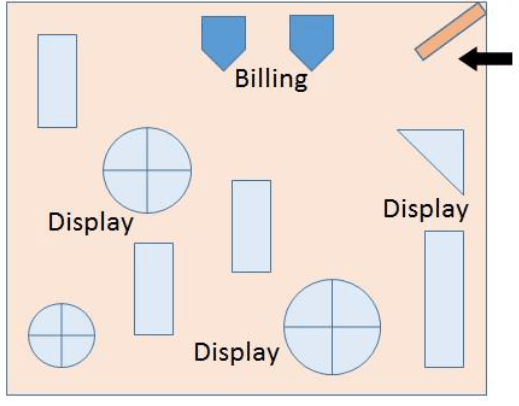
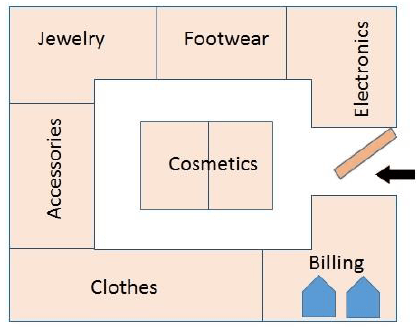
  • Racetrack or loop plan: This layout encourage customers to “loop” your store. You position your fixtures and merchandise in such a way that you create a path to guide that guides shoppers around your shop.
  • Angular floor plan: This store layout consists of curves and angles to give off a sophisticated vibe. According to the Houston Chronicle, the angular floor plan is usually adopted by high-end retailers and it “reduces the amount of display area you have but focuses instead on fewer, more popular lines.”
  • Geometric floor plan: The geometric floor plan utilizes racks and fixtures to create a unique store feel and design. Go with this layout if you’re showcasing trendy products.
  • Free flow plan: A free flow layout affords you the most creativity. You’re not limited to floor patterns or shelves that have to be placed at certain angles. And unlike the other layouts, you’re not prodding people to use a path around your store; instead, shoppers are encourage to browse and go in any direction.
  1. Be aware of where you “lead” shoppers

There’s quite a bit of debate about whether or not retailers should lead customers in a clockwise or counter-clockwise fashion inside their stores.

On one hand, some claim that since most people are right-handed, they instinctively turn to the right and explore the store in a counter-clockwise direction.

However, other studies indicate that shopper direction has more to do with their vehicle traffic patterns. Consumers in the UK and Australia for instance, drive on the left side of the road so they have a tendency to explore stores in a clockwise manner while consumers from right-hand driving countries like the US usually turn right when they enter a shop.

So which shopping direction theory should you believe? It looks like there is stronger evidence supporting the theory about driving behavior. As Herb Sorensen, author of Inside the Mind of the Shopper noted:

The pattern of movement in the supermarket is counterclockwise in the United States, but PathTracker studies in the UK, Australia, and Japan show a much greater tendency for shoppers to move in a clockwise pattern there… traffic patterns in the store may also be affected by vehicle traffic patterns outside. In these small studies, we noted that in countries with right-hand driving, where traffic circles move in a clockwise pattern, shoppers in stores may be more comfortable moving in the same direction.

  1. Ensure that your product quantities are appropriate

The question of how much merchandise to have on display is an important one and the answer is not clear-cut.

Having too much product on the sales can lead to a decline in brand perception, especially if you’re trying to position yourself as a boutique or high-end retailer.

The amount of stock to display in your store will depend on the size of your shop, the image you want to project, and the type of experience you want to create.

If you’re a discount retailer who wants to make the most out of your store space, then packing your shop with merchandise could be a good strategy for you. But if you’re a high-end boutique, then it’s best to keep your selection curated and just put a few select items up for display.

  1. Have enough space between products and fixtures

It’s ok to have shelves that are packed with merchandise (if that’s what you’re going for) as long as you still give your customers their personal space.

You want to avoid the butt-brush effect, which according to Underhill, is a phenomenon where shoppers would abandon a display or product they were looking at when they were bumped once or twice from behind.

  1. Freshen up your displays regularly

The rules around how often to change up your displays will vary depending on who you’re talking to and the type of store you run.

That said, most experts recommend changing some part of your store around once a week. You could, for example, change the outfits of your mannequins or feature a different upsell every week.

And for obvious reason, you want to switch up your merchandising whenever new products come in.

Also take into account the amount (and nature) of traffic that you’re getting in your store or shopping center. Do you get a lot of the same shoppers walking by? Are you on a busy street corner that’s on the way to people’s work locations? If so, then you’ll need to change up your displays more frequently in order to grab people’s attention on a consistent basis.

The last thing you want is for customers to get too accustomed to your store that it doesn’t even register when they pass by.

  1. Find ways to appeal to multiple senses

While the majority of a location’s design is made up of visual components, other factors including scent, touch, sound, and taste can also make an impact on a store’s look and feel. If you wish to create a truly immersive in-store experience, design your store to appeal to as many shopper senses as possible.

Here are a few ideas on what you can do:

  • Sound: Pick your playlist wisely. Determine the atmosphere that you want to create and pick songs that enhance (and not overpower) the ambiance. Volume and beat can influence behavior, depending on who you’re selling to. For instance, while loud music may work well for retailers that target younger shoppers, the same thing can’t be said for merchants catering to adults.
  • Scent: Bakeries and cafes may have a slight edge here, as they can use the smell of their products to draw customers in. But you can still cater to people’s sense of smell even if you aren’t in the food industry.
  • Touch: Having a “hands-on” vibe can enhance shopper experience. One way of doing this is to take out sample products from their boxes to encourage customers to test or play with them. Apple pioneered this approach in the electronics retail space when they launched stores that had their products out in the open instead of being inside big brown boxes (which was the norm at the time).
  • Taste: If you sell food in your store, see if you can have taste testing stations. Again, this encourages a more hands-on shopping experience and makes it less intimidating for people.
  1. Don’t forget to cross-merchandise

Grouping your merchandise into neat categories or departments is a great strategy, but see if you can find room to cross-merchandise different items. Identify products in your store that would go well together and put them in a single display.

View your merchandise from a customer’s perspective. For example, if you were a shopper looking at a particular dress, is there anything in the store that would go well with it?

  1. Make sure your employees are on point

Don’t forget that your staff also plays a role in your store’s design and layout. How they are positioned in your shop can make or break your store’s appeal. Having your employees move around on the sales floor instead of staying behind the counter is a good way to make the place more inviting.

As the Retail Doctor Bob Phibbs said on his blog, “Get your employees out from behind the counter and keep them active, especially if you have windows.”

Consumers looking into your shop will be more enticed to walk in if they see people moving about. That’s why Bob recommends that merchants instruct employees to “act as if they were customers” if a store is empty in order to make it more enticing.

  1. Track and measure your efforts

Last not but not least, always ask whether or not you’re making the right floor plan, design, or arrangement decisions. This is critical to making sure that you’re implementing the best strategies possible.

You and your staff should be very observant with how people behave in your store. Pay attention to where they go, where they linger, and what they do while they’re inside. Also ask questions on what they think of your shop and what you can do to improve.

Let’s say you’re implementing a major layout or merchandising change in your store. You want to benchmark metrics like sales, traffic, and dwell time before you make the updates, and then measure the results once the changes are implemented.

Also, consider making use of foot traffic analytics solutions such as people counters, beacons, heat sensors, and more. These tools can give you deeper analytics and insights on shopper habits and behavior, so you can make data-driven decisions.

Finally, you need to ensure that your layouts and displays are being executed correctly, so conduct store audits whenever you make changes to your store. Consider using a tool such as Compliantia to evaluate your stores.

Retail Operations Stores Layout and Visual Merchandising

Store layouts speak to the design of a store’s retail floor space and merchandising is the display of items, within the store layout, in such a way that shoppers are enticed to purchase. The layout and the merchandising of a store are both critical and connected. In this post, we will be sharing some basics on store layouts and how they are connected to merchandising.

We will also share how you can create efficient retail spaces which attract customers and encourage more purchases.

How store layouts and merchandising mix?

In retail, the speed at which you move merchandise is the name of the game. Moving merchandise effectively is dependent on several things, with the most critical being product placement how and where you place certain items. This is where store layouts and merchandising mix.

Retailers, with the help of space planners, plan out their retail space in such a way that they maximise on floor space yet give customers enough space to easily access merchandise.

Merchandising, which is the display of merchandise in an appealing manner to encourage customers to make purchases, relies on the store layout to have shoppers walk through more than just one section of a store. Smart store layouts also reduct congestion during peak shopping hours. The two are inseparable, and to maximise profit, retailers need to take both into consideration.

Optimal store layouts

To achieve an optimal store layout, there are certain key principles which must be taken into consideration, namely:

When it comes to store layouts, the physical arrangement of items must account for not just the customer who will purchase the item, but also for the “influencer” causing the purchase. For example, parents make a vast majority of purchases with their children in mind, meaning that children are influencing how they shop and what they buy.

A store’s layout and merchandising must take this into consideration and make sure children who accompany parents while shopping, influence them into making purchases ultimately increasing profit.

There are many secrets to successful retailing for retailers, and understanding how to guide customers’ movements through stores is an important one.

Traffic flow, which is the movement of customers through a store, psychologically affects the shopping behaviour of customers. A store’s layout, as well as the merchandising of items in-store, influence not just how customers move through the store, but how they shop too. For example, when grocery shopping, where do you find staples like eggs, bread or milk?

They are often deliberately placed at the back of the store, forcing customers to walk through aisles and past several other items on the way one of the most effective store layout and merchandising strategies in retail.

When it comes to store layouts, the physical arrangement of items must account for not just the customer who will purchase the item, but also for the “influencer” causing the purchase. For example, parents make a vast majority of purchases with their children in mind, meaning that children are influencing how they shop and what they buy.

A store’s layout and merchandising must take this into consideration and make sure children who accompany parents while shopping, influence them into making purchases ultimately increasing profit.

There are many secrets to successful retailing for retailers, and understanding how to guide customers’ movements through stores is an important one.

Traffic flow, which is the movement of customers through a store, psychologically affects the shopping behaviour of customers. A store’s layout, as well as the merchandising of items in-store, influence not just how customers move through the store, but how they shop too. For example, when grocery shopping, where do you find staples like eggs, bread or milk?

They are often deliberately placed at the back of the store, forcing customers to walk through aisles and past several other items on the way one of the most effective store layout and merchandising strategies in retail.

Store layout

It is the process of managing the floor space adequately to facilitate the customers and to increase the sale. Since store space is a limited resource, it needs to be used wisely.

Space management is very crucial in retail as the sales volume and gross profitability depends on the amount of space used to generate those sales.

Optimum Space Use

While allocating the space to various products, the managers need to consider the following points:

(i) Product Category

  • Profit builders: High profit margins-low sales products. Allocate quality space rather than quantity.
  • Star performers: Products exceeding sales and profit margins. Allocate large amount of quality space.
  • Space wasters: Low sales-low profit margins products. Put them at the top or bottom of shelves.
  • Traffic builders: High sales-low profit margins products. These products need to be displayed close to impulse products.

(ii) Size, shape, and weight of the product.

(iii) Product adjacencies − It means which products can coexist on display?

(iv) Product life on the shelf.

Retail Floor Space

Here are the steps to take into consideration for using floor space effectively:

  • Measure the total area of space available.
  • Divide this area into selling and non-selling areas such as aisle, storage, promotional displays, customer support cell, (trial rooms in case of clothing retail) and billing counters.
  • Create a Planogram, a pictorial diagram that depicts how and where to place specific retail products on shelves or displays in order to increase customer purchases.
  • Allocate the selling space to each product category. Determine the amount of space for a particular category by considering historical and forecasted sales data. Determine the space for billing counter by referring historical customer volume data. In case of clothing retail, allocate a separate space for trial rooms that is near the product display but away from the billing area.
  • Determine the location of the product categories within the space. This helps the customers to locate the required product easily.
  • Decide product adjacencies logically. This facilitates multiple product purchase. For example, pasta sauces and spices are kept near raw pasta packets.
  • Make use of irregular shaped corner space wisely. Some products such as domestic cleaning devices or garden furniture can stand in a corner.
  • Allocate space for promotional displays and schemes facing towards road to notify and attract the customers. Use glass walls or doors wisely for promotion.

Store Layout and Design

Customer buying behavior is an important point of consideration while designing store layout. The objectives of store layout and design are −

  • It should attract customers.
  • It should help the customers to locate the products effortlessly.
  • It should help the customers spend longer time in the store.
  • It should motivate customers to make unplanned, impulsive purchases.
  • It should influence the customers’ buying behavior.

Store Layout Formats

The retail store layouts are designed in way to use the space efficiently. There are broadly three popular layouts for retail stores

Grid Layout: Mainly used in grocery stores.

Loop Layout: Used in malls and departmental stores.

Free Layout: Followed mainly in luxury retail or fashion stores.

Design and Visual Merchandising, Atmospherics

Visual Merchandising

It is the activity of developing floor plans and three-dimensional displays in order to engage customers and boost sales. Both, products or services can be displayed to highlight their features and benefits.

It is based on the idea that good looks pay off. It requires creativity and an eye for presenting the products or services aesthetically so that the customers find it appealing and are motivated towards buying. Visual merchandising involves displaying products or services aesthetically using various objects, colors, shapes, materials, designs, and styles to attract the customers.

error: Content is protected !!