Provisions under Companies act in related to Dividends

Declaration and payment of dividend under Companies Act 2013

Dividend: Sec 2(35) provides the definition of dividend which states that dividend includes any “interim dividend”. Where in simple terms, dividend can be defined as the sum of money paid by a company, to its shareholders, out of the profits made by a company, in the proportion to the amount paid-up on the shares held by them (Sec-51).

Note: Preference shareholders are always paid dividend in preference to the equity shareholders.

Well, subject to the provisions of Companies Act, 2013, All Companies, except those companies which are registered under sec-8 (i.e. Non-profit organizations) can declare dividend.

Under Companies Act 2013, Chapter VIII containing sections, which deals with the provisions related to declaration and payment of dividend. Section 123 to 127 deals with the provisions related to the declaration and payment of dividend.

Conditions required to be satisfied for declaration of dividend

1) Depreciation: Before the declaration of dividend, a company shall provide depreciation to all its depreciable assets, in accordance with the rates or useful life, as the case may be provided in Schedule – II of Companies Act -2013.

2) Transfer to Reserves: A company may, before the declaration of any dividend in any financial year, transfer such percentage of its profits for that financial year, as it may consider appropriate to the reserves of the company.

3) Set off of previous year losses and depreciation: A company shall not declare dividend unless carried over previous losses and depreciation not provided in previous year or years, are set off against profit of the company for the current year.

4) Free Reserves: A company shall not declare or pay dividend out of its reserves, other than free reserves.

Payment of Dividend

According to the provisions of Companies Act 2013, No dividend shall be payable except by way of cash, where dividend payable in cash can also be paid through cheque, warrant or in any electronic mode, to the shareholder who is entitled to the dividend.

Condition: A company who has committed any default in compliance with the provisions of sec 73 and 74 relating to the acceptance and repayment of deposits would be barred to declare dividend.

Interim Dividend

According to the provisions of section 123(3), Board of directors of a company may declare interim dividend during any financial year, out of the profits made by the company during such financial year or out of previous year undistributed profits (subject to Companies (Declaration and Payment of Dividend) Rules, 2014).

As per Section 2(35) “dividend includes interim dividend” signifies that the provisions of Companies Act 2013, applicable to the final dividend to the extent possible, shall also applicable on interim dividend.

Unpaid Dividend Account (Sec 124)

There are some cases wherein, dividend declared by the company has not been paid or claimed and in case where such dividend remained unpaid or unclaimed within 30 days from the date of declaration; company shall take the following necessary steps:

(a) Open a special account with a scheduled bank to be called “Unpaid dividend account of …………………….(Company Limited/Company( Private) Limited

(b) Transfer the unpaid or unclaimed amount of dividend within a period of 7 days from the expiry of such 30 days, to the special account.

In case of default: If the company committed any default, in transferring such amount to the special account with in the specified time, company shall be liable to pay interest @ 12% p.a. from the date of such default.

Punishment for failure to distribute dividend (Sec 127)

According to the provisions of sec- 127 of the companies act – 2013, if a company fails to pay the dividend, within a period of 30 days from the date of its declaration, to the shareholders who are entitled to the dividend then-

Liability of Imprisonment Fine
Company NA Interest @ 18% p.a. for the period of default
Every director of Company May extend to 2 years Rs. 1000/- for every day, during which such failure continues.

Exceptions to sec- 127: Following are the situation under which, no offence shall be deemed to have been committed, namely:

(a) Where the dividend could not be paid by reason of the operation of any law;

(b) Where a shareholder has given directions to the company regarding the payment of the dividend and those directions cannot be complied with and the same has been communicated to him:

(c) Where there is a dispute regarding the right to receive the dividend

(d) Where the dividend has been lawfully adjusted by the company against any sum due to it from the shareholder

(e) Where, for any other reason, the failure to pay the dividend or to post the warrant within the period under this section was not due to any default on the part of the company.
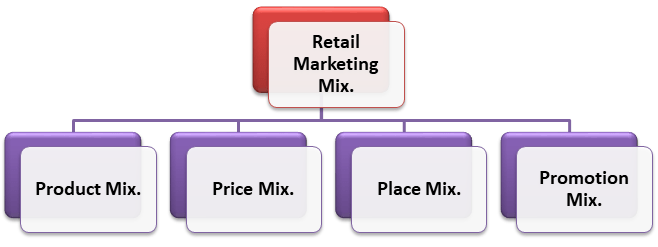
Retail Marketing Mix

The various communication devices are used to educate, inform and generate awareness about the merchandise and the services offered by the retailer. These efforts also aim at building store image. The most common modes used for promotion are advertising, sales promotion, personal selling, public relations and publicity.

Retailers usually employ a combination of various elements of promotion mix to achieve promotional and business objectives. The degree and the nature of usage of each of the promotion methods depend on the objectives of the retail firm, product, market profile and availability of resources. Small retailers generally depend on point-of-purchase material provided by the companies which provide the merchandise.

Promotion mix employed by the retailers should be compatible with the desired store image, provide scope for modification if need arises and fit within the budget allocation. Therefore, various retail promotion methods can be compared on the basis of degree of control, flexibility, credibility and cost associated with them.

The four important types of retail marketing mix are discussed below:

  1. The ‘Product’ Mix

The basic components of product mix are:

(ii) Packaging

(iii) Brand

(iv) Product Item

(v) Product line

The various product mix strategies are:

(i) Launching new products from time to time

(ii) Alteration of Existing Products

(iii) Eliminate an entire line or reduce assortment within it

(iv) Trading Up

(v) Trading Down

(vi) Product life cycle management

The retail product mix is device so as to develop an appropriate promotion strategy for the store depending on the target market to be reached. Once the target market is identified and positioning strategy defined, the retailers employ various tools of product mix to reach out to consumers. These efforts also aim at building store image.

Retailers usually employ a combination of various elements of product mix to achieve promotional and business objectives. The degree and the nature of usage of each of the promotion methods depend on the objectives of the retail firm, product, market profile, and availability of resources.

  1. The ‘Price’ Mix

Price has always been one of the most important variables in retail buying decision. It is the factor which makes or mars a retail organization. It is also the easiest and quickest element to change. Pricing helps an organization to achieve its objective. This is particularly significant for new market entrants who need to first establish a brand and then enjoy increasing profits as the brand gets market acceptability. For a customer, price is the main reason to visit a particular store.

A pricing strategy must be consistent over a period of time and consider retailer’s overall positioning, profits, sales and appropriate rate of return on investment. Lowest price does not necessarily neet be the best price, but the lowest responsible price is the best right price. The difference between price and cost is the profit, which can be very high when the salesperson wants to exploit an urgent situation.

To survive in the retail business, retailers need to seek cash flow, profitability and overall growth in order to consolidate their market position. But pricing cannot be determined in isolation. Costs and operating expenses are equally important while establishing the retail price.

Servicing pricing pursues the ‘doctrine of pricing of goods’, therefore, they are either cost-based or market based. Within this, these pricing can be profit oriented, government controlled, consumer oriented or competition oriented. Pricing needs certain considerations before actually determining it. The market position of the product, consumer perception and stage of the product life cycle, competitor’s strategy and overall marketing strategy needs to be considered.

The components of price mix are:

(i) Organizational objectives

(ii) Competition

(iii) Cost and profit

(iv) Credit terms

(v) Discount etc.

(vi) Fixed and variable costs

(vii) Pricing options

(viii) Pricing policies

(ix) Proposed positioning strategies

(x) Target group and willingness to pay

  1. The ‘Place’ Mix

The retailer should keep in mind the fact that his ‘product’ should be available near the place of consumption so that the consumers can easily buy it. If the brand preferred by the consumer is not easily available at a convenient location, he may buy some other brand in the same product category.

Hence, the retailer has to ensure that the product is available to the target consumers whenever required. There are two major components of place: marketing channels and physical distribution (logistics management). Channel decisions affect considerably the elements of marketing mix and involve a long term commitment of resources.

Intermediaries involved in channel network are independent (at times contractual) organizations hence their needs must be taken into account while evaluating channel alternatives. The success of marketing efforts, to a large extent depends on the sound distribution network.

Physical distribution involves transportation, warehousing, material handling, bulk packaging etc. Some of these activities are carried out by intermediaries. A considerable coordination is required among various channels to seek maximum results of marketing operations.

Following are the components of a retail price mix:

(i) Distribution channels

(ii) Intermediary

(iii) Distance Factor

(iv) Inventory Level

(v) Transportation

(vi) Warehousing and Storage

  1. The ‘Promotion’ Mix

After deciding upon the budget, retailer should determine the appropriate promotional mix a combination of advertising, public relations, personal selling and sales promotion. Small retailers having limited funds may use store displays, hoardings, direct mail, flyers and publicity methods to attract customer traffic, while on the other hand, retailers having no bar on finance, may use print or television media for their sales promotion activities.

The retail promotion mix varies from retailer to retailer and nation to nation depending upon technological advancement, nature of competition and availability of finance etc. Retailers design a promotional mix in compliance with store’s objectives such as positioning of the organization, attracting customers, increasing sales turnover, clear out seasonal merchandise, announcing special events and educating public about the organization and its offerings.

Retailers generally spend their promotional budget on developing advertisement campaigns and on other sales promotion activities. A retailer has a variety of sales promotion methods to promote its goods and services. Therefore, promotion mix used by the retailer should be compatible with the desired store image, budget allocation and flexible enough to modify whenever need arises.

These various promotional vehicles may by compared on the basis of following issues:

(i) Cost of the method

(ii) Its reach

(iii) Degree of flexibility

(iv) Credibility

(v) Control over media

Product: Decisions Related to Selection of Goods

A product is something that is manufactured for sale in the market. Customer needs are met by the usage of products. Product is one of the main components of marketing all marketing activities revolve around the product. Products can be tangible or intangible. Tangible products are known as goods while intangible products are called services.

The term product can be understood in narrow as well as broad sense. In a narrow sense, it is a set of tangible physical and chemical attributes assembled in an identifiable and readily recognizable form.

In a broader sense, it recognizes each separate brand as a separate product. A product can be defined as- “A good, idea, method, information, object, or service that is the end result of a process and serves as a need or want satisfier. It is usually a bundle of tangible and intangible attributes (benefits, features, functions, uses) that a seller offers to a buyer for purchase.”

Ordinarily speaking, product or goods is a word which means any commodity which can be recognised by its certain shape, quality or quantity e.g., car, book, watch, clothes etc. Actually this meaning of the product is narrow in sense. The word ‘Product’ is taken in wider perspective in marketing. Here, every brand is considered a separate product i.e., Lux and Lifebuoy both are soaps, but are treated as separate products. In narrow sense, these will be considered as merely soaps.

Every business firm undertakes the function of product selling, though it may or may not be visible. A laundry firm provides the clothes-washing service. This function is similar to product selling which a retailer performs. Firms while selling their products, sell services too which are related to their products. A consumer buys a product because he gets psychological and physical satisfaction from that product.

Thus a seller not only sells his products rather he enters into marketing of such psychological and physical satisfaction. For example, a person while purchasing a product does not bother about the inputs by which that product is manufactured. He is rather interested in the fact as to what utility or satisfaction, he will gain by using that product. In this context, the ideas of George Fisk are worth describing. According to him, “Product is a cluster of psychological satisfaction.”

Definition of product in Marketing

A product is what a seller has to sell and what a buyer has to buy it satisfies the needs of customers. Customers purchase products because they are capable of realizing some benefits to the purchaser. A marketer can satisfy the needs and wants of his customers by ‘offering something’ in exchange for money. And this ‘offering’ is basically a product. The product is one of the important elements of the 4Ps of the marketing mix. It consists of a bundle of tangible and intangible attributes that satisfies consumers.

Product is an important component in market­ing-mix. Other elements of marketing-mix i.e. price, promotion and place are complemen­tary to it. A product is central to the marketing operations in an organization. Most of the time prod­uct fails not because of poor quality but because they fail to meet the expectations of the customers.

It is not just a bundle of physical attributes, but a bundle of perceived benefits which satisfy consumer’s needs. Hence, utmost care should be taken to handle product decisions. A bad product not only generates bad name for the firm but also affects negatively the price set for the product, dissuades the channel members and reduces the believability of the promotional measures.

In a narrow sense, “A product is a set of tangible physical attributes in an identifiable form” (W.J. Stanton). But in marketing, product is used in a broader form.

According to W. Alderson “A product is a bundle of utilities consisting of various product features and accompanying services”.

According to Philip Kotler “A product is anything tangible or intangible that can be offered to a market for attention, acquisition use or consumption that might satisfy a need or want”.

According to Cravens, Hills and Woodruff “Product is anything that is potentially valued by a target market for the benefits or satisfactions it provides, including objects, services, organizations, places people and ideas”.

From the above definitions, it is clear that product has the want satisfying attributes which drive a customer to purchase the product. It is nothing but a package of problem solving devices and is something more than a physical product. This is because a product encompasses a number of social and psycho­logical attributes and other intangible factors which provide satisfaction to the consumer.

Products can be anything. It can be physical product (e.g. fan, cycle etc.), service (e.g. haircuts, property deals etc.), place (e.g. Agra, Delhi etc.), person (e.g. Late M.F. Hussain etc.), Organization (e.g. Helpage India, Rajiv Gandhi foundation etc.) and idea (e.g. Family Planning, safe driving etc.).

Alderson defines, “A product is a bundle of utilities consisting of various product features and accompanying services”.

Stanton defines, “A product is a set of tangible and intangible attributes, including packaging, colour, price, manufacturer’s and retailer’s services, which the buyer may accept as offering satisfaction or wants or needs”.

According to Philip Kotler, “A product is anything that can be offered to a market for attention, acquisition, use or consumption that might satisfy a want or need. It includes physical objects, services, persons, places, organization and ideas”.

Concept of Product

Product refers to a good or service that satisfies the needs and wants of customers. It is offered in the market by an organization to earn revenue by meeting the requirements of customers. Product is an asset of an organization and referred as the backbone of marketing mix.

According to Peter Drucker, “Suppliers and especially manufacturers have market power because they have information about a product or a service that the customer does not and cannot have, and does not need if he can trust the brand. This explains the profitability of brands.”

It is very important for an organization to understand the needs of customers. For example, some customers use mobile phones for talking; whereas, some use mobile phones for talking as well as business purposes, such as teleconferencing. Needs of the customers depend on their purchasing power.

For example, a customer whose basic need is surfing over the Internet may opt for a simple computer; whereas, a software engineer may need a high configuration computer. Therefore, when the level of need increases then the level of product also increases.

Features of a Product

(i) Tangibility

Products are tangible in nature, customers can touch, seen or feel a products. For example, car, book, computer etc.

(ii) Intangible Attributes

Service products are intangible in nature, services like, consultancy, banking, insurance etc. The product may be combination of both tangible and intangible attributes like restaurants, transportation, in case of a computer it is a tangible product, but when we will talk of its free service provided by dealer, then the product is not only a tangible item but also an intangible one.

(iii) Associated Attributes

The attributes associated with product may be, brand, packaging, warranty, guarantee, after sales services etc.

(iv) Exchange Value

Irrespective of the fact that whether the product is tangible or intangible, it should be capable of being exchanged between buyer and seller for a mutually agreed price.

(v) Customer Satisfaction

A product satisfies the customer needs and wants of customers, value of products is also determined by the level of satisfaction given by a product after purchase.

Characteristics of Product

  1. It can be a single commodity or a service; a group of commodities or a group of services; a product service combination, or even a combination of several products and services.
  2. Its meaning is determined by the needs and desires of the consumer. The purpose of a product is to satisfy some need of the consumers. The buyers purchase problem-solving and time for creativity when they purchase a computer system.
  3. It may be durable such as those that are expected to deliver a stream of satisfaction over a period of time,
  4. Products may be luxuries which might be needed as a symbol of prestige and status such as car, a well- furnished bungalow in a posh colony or necessities which are needed to keep the body and soul together, such as bread, milk, sugar, etc.
  5. It may be an agricultural, mineral, forest or semi­-manufactured or manufactured product.

Decisions Related to Delivery of Service

Running a successful service company should be synonymous with delivering excelling service. If not, then why consider running a service business at all? Yet, if all companies which perform services effectively compete on providing the service, then the key differentiator lies in the service management model and the ability to execute it. Designing the service delivery system should focus on what creates value to the core organizations and how to engage frontline employees to deliver the ultimate customer experience.

  1. Service Culture

Service Culture is built on elements of leadership principles, norms, work habits and vision, mission and values. Culture is the set of overriding principles according to which management controls, maintains and develops the social process that manifests itself as delivery of service and gives value to customers. Once a superior service delivery system and a realistic service concept have been established, there is no other component so fundamental to the long-term success of a service organization as its culture.

  1. Employee Engagement

Employee Engagement includes employee attitude activities, purpose driven leadership and HR processes. Even the best designed processes and systems will only be effective if carried out by people with higher engagement. Engagement is the moderator between the design and the execution of the service excellence model.

  1. Service Quality includes strategies

Service Quality includes strategies processes and performance management systems. The strategy and process design is fundamental to the design of the overall service management model. Helping the client fulfil their mission and supporting them in the pursuit of their organizational purpose, must be the foundation of any service provider partnership.

  1. Customer Experience

Customer Experience includes elements of customer intelligence, account management and continuous improvements. Perception is king and constantly evaluating how both customer and end-user perceive service delivery is important for continuous collaboration. Successful service delivery works on the basis that the customer is a part of the creation and delivery of the service and then designs processes built on that philosophy this is called co-creation.

Service Delivery Process

  1. Needs Analysis

To provide a service it is important to fully understand the needs of our clients. Theseus Professionals use proven and successful techniques to elicit the needs of clients.

This information gathering step can range from interviews of key staff to the development and performance of a formal survey. The objective is to determine the direction that the organization wants its program to go.

  1. Course of Action

From the information gained during the needs analysis a course of action can be developed. The course of action may include short- and long-term actions. For example, short-term objectives might require the development of a Project Plan that outlines the strategy, steps, and resources needed to achieve management’s objectives. A long-term action might include outlining the level of commitment for a

Theseus Professional to support maintaining and improving the existing management systems. It is expected that a course of action will be proposed at the end of the needs analysis and formalized in a document (e.g., plan, outline, etc.).

  1. Performance

Performance is dependent on the course of action selected. For example, performance may include periodic consulting sessions, where issues are discussed, and interpretations and recommendations are provided. Performance may involve coaching or mentoring an employee who would fill a position on issues related to standards and regulatory compliance or process improvement.

Performance may also include other consulting and training activities, such as setting up a measurement program, performing document reviews for improvement and compliance, participating in management review, conducting internal audits, or conducting training related leading to meeting an organization’s objectives.

  1. Results

A successful relationship with a customer depends on the results that the consulting firm can deliver. Theseus Professionals are results driven, whether delivered results are measurable process improvements, compliance or certification to a standard or regulation, or effective training.

Other results may evolve as the relationship continues and may include internal audits that lead to improvements and business-related recommendations that are comprehensive, unbiased, and provide sufficient information for management to make decisions.

Factors Influencing Pricing

Pricing of a product is influenced by various factors as price involves many variables. Factors can be categorized into two, depending on the variables influencing the price.

An enormous number of factors affect pricing decisions. A marketing manager should identify and study the relevant factors affecting the pricing. Some factors are internal to organization and, hence, controllable while other factors are external or environmental and are uncontrollable.

  1. Internal Factors

Internal factors are internal to organization and, hence, are controllable. These factors play vital role in pricing decisions. They are also known as organizational factors. Manager, who is responsible to set price and formulae pricing policies and strategies, is required to know adequately about these factors.

(i) Top Level Management

Top-level management has a full authority over the issues related to pricing. Marketing manager’s role is administrative. The philosophy of top-level management is reflected in forms of pricing also. How does top management perceive the price?

How far is pricing considered as a tool for earning profits, and what is importance of price for overall performance? In short, overall management philosophy and practice have a direct impact on pricing decision. Price of the product may be high or low; may be fixed or variable; or may be equal or discriminative depends on top-level management.

(ii) Elements of Marketing Mix

Price is one of the important elements of marketing mix. Therefore, it must be integrated to other elements (promotion, product, and distribution) of marketing mix. So, pricing decisions must be linked with these elements so as to consider the effect of price on promotion, product and distribution, and effect of these three elements on price.

For example, high quality product should be sold at a high price. When a company spends heavily on advertising, sales promotion, personal selling and publicity, the selling costs will go up, and consequently, price of the product will be high. In the same way, high distribution costs are also reflected in forms of high selling price.

(iii) Degree of Product Differentiation

Product differentiation is an important guideline in pricing decisions. Product differentiation can be defined as the degree to which company’s product is perceived different as against the products offered by the close competitors, or to what extent the product is superior to that of competitors’ in terms of competitive advantages. The theory is, the higher the product differentiation, the more will be freedom to set the price, and the higher the price will be.

(iv) Costs

Costs and profits are two dominant factors having direct impact on selling price. Here, costs include product development costs, production costs, and marketing costs. It is very simple that costs and price have direct positive correlation. However, production and marketing costs are more important in determining price.

(v) Objectives of Company

Company’s objectives affect price of the product. Price is set in accordance with general and marketing objectives. Pricing policies must the company’s objectives. There are many objectives, and price is set to achieve them.

(vi) Stages of Product Life Cycle

Each stage of product life cycle needs different marketing strategies, including pricing strategies. Pricing depends upon the stage in which company’s product is passing through. Price is kept high or low, allowances or discounts are allowed or not, etc., depend on the stage of product life cycle.

(vii) Product Quality

Quality affects price level. Mostly, a high-quality-product is sold at a high price and vice versa. Customers are also ready to pay high price for a quality product.

(viii) Brand Image and Reputation in Market

Price doesn’t include only costs and profits. Brand image and reputation of the company are also added in the value of product. Generally, the company with reputed and established brand charges high price for its products.

(ix) Category of Product

Over and above costs, profits, brand image, objectives and other variables, the product category must be considered. Product may be imitative, luxury, novel, perishable, fashionable, consumable, durable, etc. Similarly, product may be reflective of status, position, and prestige. Buyers pay price not only for the basic contents, but also for psychological and social implications.

(x) Market Share

Market share is the desired proportion of sales a company wants to achieve from the total sales in an industry. Market share may be absolute or relative. Relative market share can be calculated with reference to close competitors. If company is not satisfied with the current market share, price may be reduced, discounts may be offered, or credit facility may be provided to attract more buyers.

  1. External Factors

External factors are also known as environmental or uncontrollable factors. Compared to internal factors, they are more powerful.

Pricing decisions should be taken after analyzing following external factors:

(i) Demand for the Product

Demand is the single most important factor affecting price of product and pricing policies. Demand creation or demand management is the prime task of marketing management. So, price is set at a level at which there is the desired impact on the product demand. Company must set price according to purchase capacity of its buyers.

Here, there is reciprocal effect between demand and price, i.e., price affects demand and demand affects price level. However, demand is more powerful than price. So, marketer takes decision as per demand. Price is kept high when demand is high, and price is kept low when demand of the product is low. Price is constantly adjusted to create and/or maintain the expected level of demand.

(ii) Competition

A marketer has to work in a competitive situation. To face competitors, defeat them, or prevent their entry by effective marketing strategies is one of the basic objective organizations. Therefore, pricing decision is taken accordingly.

A marketer formulates pricing policies and strategies to respond competitors, or, sometimes, to misguide competitors. When all the marketing decisions are taken with reference to competition, how can price be an exception?

Sometimes, a company follows a strong competitor’s pricing policies assuming that the leader is right. Price level, allowances, discount, credit facility, and other related decisions are largely imitated.

(iii) Price of Raw Materials and other Inputs

The price of raw materials and other inputs affect pricing decisions. Change in price of needed inputs has direct positive effect on the price of finished product. For example, if price of raw materials increases, company has to raise its selling price to offset increased costs.

(iv) Buyers Behaviour

It is essential to consider buyer behaviour while taking pricing decision. Marketer should analyze consumer behaviour to set effective pricing policies. Consumer behaviour includes the study of social, cultural, personal, and economic factors related to consumers. The key characteristics of consumers provide a clue to set an appropriate price for the product.

(v) Government Rules and Restrictions

A company cannot set its pricing policies against rules and regulations prescribed by the governments. Governments have formulated at least 30 Acts to protect the interest of customers. Out of them, certain Acts are directly related to pricing aspects. Marketing manager must set pricing within limit of the legal framework to avoid unnecessary interference from the outside. Adequate knowledge of these legal provisions is considered to be very important for the manager.

(vi) Ethical Consideration or Codes of Conduct

Ethics play a vital role in price determination. Ethics may be said as moral values or ethical code that govern managerial actions. If a company wants to fulfill its social obligations and when it believes to work within limits of the ethics prescribed, it always charges reasonable price for its products. Moral values restrict managerial behaviour.

(vii) Seasonal Effect

Certain products have seasonal demand. In peak season, demand is high; while in slack season, demand reduces considerably. To balance the demand or to minimize the seasonal-demand fluctuations, the company changes its price level and pricing policies. For example, during a peak season, price may be kept high and vice versa. Discount, credit sales, and price allowances are important issues related to seasonal factor.

(viii) Economic Condition

This is an important factor affecting pricing decisions. Inflationary or deflationary condition, depression, recovery or prosperity condition influences the demand to a great extent. The overall health of economy has tremendous impact on price level and degree of variation in price of the product. For example, price is kept high during inflationary conditions. A manager should keep in mind the macro picture of economy while setting price for the product.

Approaches to Pricing

The right pricing strategy can help you attract more customers, encourage larger orders on average, and create repeat purchases. Use this guide to determine which of these 7 common approaches to pricing is best for your business.

  1. Keystone Pricing

Keystone pricing is one of the most common pricing strategies, thanks to its simplicity. The final selling price is 2X the item’s cost.

Keystone pricing is the best place to start whenever possible. However, the likelihood that it remains your only pricing strategy is low. Many of today’s products simply cannot be set at keystone due to high product costs versus the general market rate.

Consider another pricing strategy if your business competes at either ends of the spectrum from discount competitors to high-end luxury brands. Adopting keystone pricing at either end nearly guarantees a loss.

Summary: Keystone pricing is a simple and straightforward approach to pricing. However, it doesn’t account for supply and demand, a critical component of maximizing revenue

  1. Multiple Unit Pricing

Multiple unit pricing, multiple pricing, or bundle pricing offers shoppers a lower price per unit for the purchase of two or more products of the same type.

Multiple pricing is particularly useful for clearing excess inventory or introducing new products. Use this strategy sparingly or customers may think your regular items are overpriced and will eventually be discounted.

Summary: The ideal time to use multiple pricing is at the end of a season for products that have not sold well or when you need to introduce new products that customers may be hesitant to try.

TIP: Read up on your state’s regulations when considering these strategies. For example, some states will not allow you to sell products below cost or giving products away for free.

  1. Discount Pricing

Discount pricing offers price reductions to customers through sales events or special offers.

Lowering the price of a product to encourage purchases is a conventional strategy employed in every area of sales, but simply announcing your latest price drop may not be enough. It can even have adverse effects if your customers perceive the discounted price as the product’s true value. Effective discounting dispels this idea and creates a sense of urgency.

Discount offers are not a one-size-fits-all. Let your product influence your strategy specifically, gauge its relevance to the market and its sales history.

Summary: Discount pricing is an easy way to attract new customers and works best when timed for special events or holidays.

Tip: Provide a reason for every discount. Otherwise, customers will think less of your brand and product value.

  1. Loss Leader

A loss leader is a product is priced below its market cost to stimulate the sales of more profitable goods or services.

Loss leader strategies are great for traffic generation and product introduction. For example:

Magazine publishers can attract more long-term subscribers by offering the first few editions at little to no cost.

Cable service providers can offer lower pricing on a competitive feature to recruit new annual contract signups.

Hardware stores often sell larger tools for cost or below, expecting customers to buy accessories along with the new tool. Accessory items tend to have a much higher profit margin, and are often impulse buys.

The past success of loss leader pricing has led to many states passing laws that severely limit or explicitly forbid selling products below cost. For some, these limitations may actually be a blessing. Loss leader strategies can backfire, with customers purchasing only products that are priced near or below acquisition cost. Such purchasing patterns effectively foil the strategy underlying loss leader pricing.

Summary: The loss leader strategy is great for marketing efforts and acquiring new customers. However, carefully consider your loss leader product and how you intend to promote other offerings in parallel so that your loss is actually a gain. Most importantly, be aware of your state’s laws on loss leaders.

  1. Psychological Pricing

Psychological pricing relies on the nature of human psychology to make prices appear more attractive to consumers.

There are several types of psychological pricing: odd-even pricing, prestige pricing, anchor pricing, and price lining.

Odd-Even Pricing: The practice of setting prices in odd numbers just below an even price. For example, marking an item $19.99 rather than the even price of $20.00. This strategy makes the price appear considerably lower than it is.

  • Prestige Pricing: On the opposite end, prestige pricing inflates prices in order to create a sense of greater value. For example, a “limited edition” canvas print might be priced at $70 rather than $30 to give the impression that it is a better and rare product.
  • Anchor Pricing: Anchoring refers to the consumer’s tendency to heavily rely on the first piece of information offered when making decisions. To apply, place premium products and services near standard options to help create a clearer sense of value for potential customers. They will perceive the less expensive option as a bargain in comparison.
  • Price Lining: Better suited for businesses with an extensive product line, this tactic involves creating a price range for a particular line. For example, Brandless.com has built an entire business on this strategy with all items priced at $3.

Summary: Psychological pricing allows business owners to influence how consumers perceive a product’s value without actually changing the product. This makes it a cost effective way to influence consumer purchase decisions.

TIP: Research shows prices ending in “9” are more likely to drive sales.

  1. Below Competition

This pricing strategy requires retailers to list competing products at prices lower than the competition’s.

Pricing below competition can help businesses carve out a market niche, appealing to every consumer’s love for low prices. However, by guaranteeing lower prices and therefore lower profit margins, you will not make a significant return on this strategy until you can realize a large sales volume. Additionally, even with low overhead costs secured, you remain subject to your competitors’ actions, i.e. price wars.

One of the worst outcomes of below competition pricing is a “price war,” where competing businesses race to cut costs and ultimately hurt their bottom line and their brand perception. Some companies have resolved price wars while still maintaining below competition prices by redesigning their products for fast and easy manufacturing.

Summary: Pricing below the competition is a common pricing strategy because it’s easy, but it’s also dangerous if you don’t have a clear understanding of your business’s financials.

  1. Above Competition

Retailers price above the competition when they have a clear advantage on non-priced elements of their products, services, and reputation.

In order to charge an amount above the competition, you must differentiate your brand and products. For example, Apple can consistently charge consumers more because they’ve established a reputation as makers of high-quality products, ensuring the market sees its offerings as unique or innovative.

Price Sensitivity

Price sensitivity can be defined as the degree to which consumers’ behaviors are affected by the price of the product or service. Price sensitivity is also known as price elasticity of demand and this means the extent to which sale of a particular product or service is affected. Another way of explaining price sensitivity is, “the consumer demand for a product is changed by the cost of the product. It basically helps the manufacturers study the consumer behavior and assists them in making good decisions about the products. The level of price sensitivity varies depending on various products and consumers. Price sensitivity, in economics, is generally quantified through the price elasticity of demand.

Price sensitivity is the degree to which the price of a product affects consumers’ purchasing behaviors. Generally speaking, it’s how demand changes with the change in the cost of products.

In economics, price sensitivity is commonly measured using the price elasticity of demand, or the measure of the change in demand based on its price change. For example, some consumers are not willing to pay a few extra cents per gallon for gasoline, especially if a lower-priced station is nearby.

Price sensitivity can basically be defined as being the extent to which demand changes when the price of a product or service changes.

The price sensitivity of a product varies with the level of importance consumers place on price relative to other purchasing criteria. Some people may value quality over price, making them less susceptible to price sensitivity. For example, customers seeking top-quality goods are typically less price-sensitive than bargain hunters; so, they’re willing to pay more for a high-quality product.

By contrast, people who are more sensitive to price may be willing to sacrifice quality. These individuals will not spend more for something like a brand name, even if it has a higher quality over a generic store brand product.

Price sensitivity also varies from person to person, or from one consumer to the next. Some people are able and willing to pay more for goods and services than others. Companies and governments are also able to pay more compared to individuals.

Price Sensitivity and Elasticity of Demand

The law of demand states that if all other market factors remain constant, a relative price increase leads to a drop in the quantity demanded. High elasticity means consumers are more willing to buy a product even after price increases. Inelastic demand means even small price increases may significantly lower demand.

In a perfect world, businesses would set prices at the exact point where supply and demand produce as much revenue as possible. This is referred to as the equilibrium price. Although this is difficult, computer software models and real-time analysis of sales volume at given price points can help determine equilibrium prices. Even if a small price rise diminishes sales volume, the relative gains in revenue may overcome a proportionally smaller decline in consumer purchases.

Influences on Price Sensitivity

Price sensitivity places a premium on understanding the competition, the buying process, and the uniqueness of products or services in the marketplace. For example, consumers have lower price sensitivity if a product or service is unique or has few substitutes.

Consumers are less sensitive to price when the total cost is low compared to their total income. Likewise, the total expenditure compared to the total cost of the end product affects price sensitivity. For example, if registration costs for a convention are low compared to the total cost of travel, hotel, and food expenses, attendees may be less sensitive to the registration fee.

When the expense is shared, consumers have less price sensitivity. People attending the same conference may share one hotel room, making them less sensitive to the hotel room rate.

Consumers also have less price sensitivity when a product or service is used along with something they already own. For instance, once members pay to join an association, they are typically less sensitive to paying for other association services.

Consumers also have less price sensitivity when the product or service is viewed as prestigious, exclusive, or possessing high quality. For example, an association may have a premium feature of its membership delivered through its programs and services, making members less price-sensitive to changes in dues.

Pricing Strategy

There are a number of different factors that businesses use to come up with pricing strategies. These factors will separate consumers based on their sensitivity to prices. Businesses may use marketing and advertising techniques to get consumers to shift their focus from price to other factors, such as product offerings, benefits, and other values.

This is common in the travel, tourism, and hospitality industries. Airlines will generally charge more for certain flights especially on weekends or for different classes of flights. Many business travelers are less sensitive to price changes.

Formula

The standardized formula for measuring price sensitivity is:

Price Sensitivity = (Change in Quantity Purchased / Change in Price)*%

Example:

In order to observe the price sensitivity, let us consider that, when Nestle apple nectar prices increase by 60%, the juice purchases fall with the figure of 25%. Using the mentioned formula we can easily calculate the price sensitivity for nestle apple nectar:

Price Sensitivity = -25% / 60% = -0.42

Therefore, we can conclude that for every of the percentage with which the Nestle apple nectar price increases; it affects the purchase by almost more than half percentage. Likewise, all the products can be studied by taking into account the changes in price and increase or decrease in the demand.

Those products are said to be price sensitive in which the change in price is not much but the demand is affected on the large scale. This is the case usually with the convenience products or the products which have a huge range of alternatives. Those products which are not much reactive to change in price are called price inelastic. Such products are usually daily used products and are a necessity of life and consumers do not have any other option other than purchasing them. 

Value Pricing

Value-based pricing is a strategy of setting prices primarily based on a consumer’s perceived value of a product or service. Value pricing is customer-focused pricing, meaning companies base their pricing on how much the customer believes a product is worth.

Value-based pricing is different than “cost-plus” pricing, which factors the costs of production into the pricing calculation. Companies that offer unique or highly valuable features or services are better positioned to take advantage of the value pricing model than companies which chiefly sell commoditized items.

The value-based pricing principle mainly applies to markets where possessing an item enhances a customer’s self-image or facilitates unparalleled life experiences. To that end, this perceived value reflects the worth of an item that consumers are willing to assign to it, and consequently directly affects the price the consumer ultimately pays.

Although pricing value is an inexact science, the price can be determined with marketing techniques. For example, luxury automakers solicit customer feedback, that effectively quantifies customers’ perceived value of their experiences driving a particular car model. As a result, sellers can use the value-based pricing approach to establish a vehicle’s price, going forward.

Characteristics Needed for Value-based Pricing

Any company engaged in value pricing must have a product or service that differentiates itself from the competition. The product must be customer-focused, meaning any improvements and added features should be based on the customer’s wants and needs. Of course, the product or service must be of high quality if the company’s executives are looking to have a value-added pricing strategy.

The company must also have open communication channels and strong relationships with its customers. In doing so, companies can obtain feedback from its customers regarding the features they’re looking for as well as how much they’re willing to pay.

 For companies to develop a successful value-based pricing strategy, they must invest a significant amount of time with their customers to determine their wants.

Examples of Value-Based Markets

The fashion industry is one of the most heavily influenced by value-based pricing, where value price determination is standard practice. Typically, popular name-brand designers command higher prices based on consumers’ perceptions of how the brand affects their image. Also, if a designer can persuade an A-list celebrity to wear his or her look to a red-carpet event, the perceived value of the associated brand can suddenly skyrocket. On the other hand, when a brand’s image diminishes for any reason, the pricing strategy tends to re-conform to a cost-based pricing principle.

Other industries subject to value-based pricing models include name-brand pharmaceuticals, cosmetics, and personal care.

Pros of value based pricing

  1. It provides real willingness to pay data

Most companies shy away from diving into pricing, because they’re afraid of the process and end up rushing to solve other problems facing the business, because they at least know how to test different landing pages. Yet, even though there’s work involved, value based pricing provides real data that forces you into a profit generating price within your pricing strategy.

Simply put, if done correctly, value based pricing helps you generate the most profit.

  1. It helps you develop higher quality products

Value based pricing not only determines a more accurate price for the end product, but the process will also benefit your business.

Exploring your competition will help you understand the advantages of your product, which is where marketing should focus on, and its disadvantages, the parts that should be altered. Taking on a consumer perspective will also help you discover what clients are really looking for in your solution. Products and features will be driven by consumer demand, which raises perceived value, thereby resulting in a higher price.

  1. It allows you to provide phenomenal customer service

Much of the customer data in value based pricing is collected through customer surveys or interviews. The responses we’ve seen to simply bringing customers into the discussion of value have been extraordinarily positive and appreciated.

This attention to consumer opinions and wants will result in more personable and considerate services. This can be the difference between one time customers and loyal clients who develop a bond with the company and always come back, because they trust you’re providing the value you continue to claim you are in your price.

Cons of value based pricing

  1. It takes time and resources

The method can be simplified and quickened, but it’s not necessarily as quick as Googling your competitors or calculating your costs and pulling a margin number out of thin air. You can also be a bit intimidated by the method, because pricing isn’t something they teach us Businesses 101.

For this reason, many businesses shy away from the most important aspect of their business. Businesses also think only extremely large and wealthy businesses can afford to do things this way. However, there are in fact ways to find perceived value without breaking the bank.

  1. It’s a science, just not an exact science

The secret is out: Unless you’re dealing with a very saturated product where market based pricing works, there is no silver bullet for pricing. Thus, value based pricing is more of a process that requires consistent dedication, not just a “set it and forget it” mentality.

Think about it, willingness to pay differs between different customer personas, regions, and even offer. A 100% accurate prediction is impossible, but we can get pretty darn close.

SCM Principle

7 Principles of Supply Chain Management

  1. Adapt Supply Chain to Customer’s Needs

Both business people and supply chain professionals are trained to focus on the customer’s needs. In order to understand the customer better, we divide customers into a different group and we call it “segmentation”. The most primitive way to segment customers is ABC analysis (as in inventory management) that groups customers based on the sales volume or profitability. Segmentation can also be done by product, industry and trade channel.

  1. Customize Logistics Network

When you segment a customer based on the service needs, you may have to tailor the different logistics networks to serve a different segment. However, this principle doesn’t hold true in all situations.

For example, if you were a contract manufacturer in China, you might already have different logistics networks for different customers. Each customer in the US or EU might already control the source of raw materials, ask you to provide dedicated production lines, nominate 3pl companies and air/sea carriers. So, logistics network design is a kind of initiative driven mainly by the customer.

  1. Align Demand Planning Across Supply Chain

Supply chain practitioners are taught to share the demand data with trading partners so nobody has to keep the unnecessary inventory. In general, this principle holds true. But in reality, only Walmart is actively sharing the demand data with trading partners.

There is a very interesting paper “Top-Down Versus Bottom-Up Demand Forecasts: The Value of Shared Point-of-Sale Data in the Retail Supply Chain” by Williams and Waller 2011, the result of research found that,

  • If you make the demand forecast based on SKU/Customer level, using your own historical order data is more accurate than using the POS data you get from retailers.
  • If you make the demand forecast based on the SKU/Store level, using the POS data you get from retailers is more accurate than using your own historical order data.

The implication is that the absence of demand sharing is not necessarily bad. But when you got the demand data from trading partners, you MUST use it the right way.

  1. Differentiate Products Close to Customer

Dell keeps components and assembles them only after a customer places the order in order to increase the product variety. This principle is still true, but, there is another principle that you should consider.

“Standardization” is in the opposite polarity of “Differentiation”. For example, some cosmetics manufacturers formulate products and choose packaging and labeling that complies with the regulations of multiple countries in Asia. So they only make one SKU that can be sold in 15 countries instead of 1 SKU/Country. By standardizing product appropriately, they can drive the purchasing cost down drastically due to the economy of scale and improve international business operations. So standardization is something that you should also consider.

  1. Outsource Strategically

This is the principle that stands the test of time. In short, don’t ever outsource your core competency.

  1. Develop IT that Support Multilevel Decision Making

If you search Google for the term “critical success factor ERP”, you’ll find lots of information about how to implement ERP successfully. My opinion is that IT project management shouldn’t be done in the isolation, business process re-engineering is something that you have to do before implementing an IT project. This will equip you with the full understanding of process deficiencies, then you can determine what kind of technology you really need.

  1. Adopt both Service and Financial Metrics

Anderson et al. suggested that the activity-based costing (ABC) be implemented so you can determine customer’s profitability. However, there is an interesting twist on the ABC concept.

In 1987, Robert Kaplan and W Bruns defined the activity-based costing concept in his book “Accounting and Management: A Field Study Perspective”. However, in 2003 Robert Kaplan said that it’s difficult to maintain an ABC costing model to reflect the changes in activities, processes, products, and customers. Then, he introduced the refined concept called “Time Driven Activity Based Costing.”

From my understanding, practitioners are still using the traditional ABC and supply chain researchers are still citing the traditional ABC articles. My question is, does the traditional ABC really work?

Anyway, supply chain practitioners can adapt service and financial metrics from initiatives like lean manufacturing and six sigma.

Retail Logistic

The word logistics is derived from the french word “loger” which means “to quarter and supply troops”. When large number of troops and their equipment move, meticulous planning is required to move volumes of goods and ammunition in that direction. From a marketing point of view, customers are satisfied when they get right product at the right place, at the right time and in the right quantity. Retail logistics system ensures smooth flow of goods to customers through efficient movement of logistics.

Meaning of retail logistics

Retail logistics’ is the organist process of managing the flow of merchandise from the source of supply to the customer.

Large retailers deal in a wide variety of products. This has created a need for a systematic planning of movement of numerous goods until they are delivered to the customer. Retail logistics ensures that everything is in place to offer better delivery and service at lower prices by way of efficient logistics and added value.

Functions of retail logistics system

  1. The increased product variety in stores has forced the retailer to follow an effective logistics system. It takes care of the
  • Flow of merchandise from the producer or intermediary to the warehouse,
  • Arrangement of transport to the retail units till the merchandise is sold and delivered to the customers.
  1. The system satisfies the customer by taking the right product to the right customer, at the right place and at the right time. This requires a planned approach right from the starting point till the point of delivery.
  2. Profitability of the present and future are maximized by the logistics system by means of fulfillment of orders in a cost effective way.
  3. It ensures the availability of infrastructure such as warehousing, transport, inventory and administration. The inter relationship that exists between these elements are effectively coordinated.
  4. Retail logistics system strives to add value for the customer. For this purpose, the cost elements in the supply chain are brought under the direct control of the retailer. Depending on sales volume, retailers create central or regional distribution centres. They decide on major investment in property, plant and equipment with associated overheads.
  5. The functions incorporated in the retail logistics are summarized.
  • The physical movement of goods
  • The holding of the goods in stock holding points
  • The holding of goods in quantities required to meet demand from the consumers
  • The management and administration of the process in modern complex distribution system.

The Future of Retail Logistics

Retailers are facing a new reality where delivery logistics once a stable part of retail business can now be the difference between success and failure. Much of the disruption in logistics can be attributed to the ‘Amazon effect’ of consumers being able to select the products they want, at competitive prices, and receive them promptly to their doorstep, office, a nearby locker or even the trunk of their car.

The network required to support this level of service requires breadth, scale and velocity. With consumer demand for same-day or next-day delivery becoming the norm, retailers must now work out how they can optimize costs in order to better serve customers. 

Digital commerce is now a vital part of all retailers’ businesses, and speed is critical to their success. Walmart last year announced that it would soon begin offering free same-day shipping in New York and its surrounding areas. Other big box retailers are likely to have the infrastructure necessary to support increasing consumer shipping demands in urban areas, but they must find a way to balance the costs of doing so to succeed in the long run.

Larger retailers typically have two to three regional distribution centers (DCs) in locations chosen to optimize delivery times and costs, and can access nearly 80 percent of the United States in two days. However, many struggle with inventory and labor management. Increasing customer demand highlights the need for more nodes and sophisticated distribution networks.

Logistics companies are reshaping their core businesses to meet the industry’s needs. As major logistics companies invest in growing the breadth and depth of their networks, final mile delivery efficiency plagues their abilities to scale efficiently. This is essentially the last section of the delivery chain from where goods leave the warehouse, to where they arrive at a customer’s doorstep.

As logistics providers seek to increase efficiency and reduce costs, they will implement more strategic operations. For instance, goods will be delivered in a batched manner, once per day, rather than in separate deliveries; items will be delivered in reusable, sustainable containers; and products in some urban areas may even be delivered by automated robots.

Market forces are also creating opportunities for third-party logistics providers (3PLs), who are well positioned to support these emerging fulfillment capabilities. 3PLs can support multiple purchasing channels with multi-node networks and urban hubs; provide ‘final mile’ order delivery alternatives; and can support made-to-order and specialty packaging. They can also support AI, automation and analytics.

As retailers look to the future of fulfillment, there are three potential scenarios we expect to see evolve over the next few years:

  1. Free two-day standard shipping

Free two-day shipping will become the norm nationwide. Amazon Prime has already set the standard for free two-day shipping now retailers are fighting to achieve the same offering. They will ideally need two to three regional DCs in strategic locations around populated regions. Optimal locations are driven by service-level window rather than proximity to inbound freight locations.

  1. Next-day shipping standardization

Consumers will begin to expect next-day shipping in many urban areas, with two-day shipping in all other areas. Next-day shipping will be available in all key markets and digital commerce sales will increase as a percent of total retail sales. Retailers will require a more robust fulfillment network with more localized distribution centers. Optimal DC locations are close to urban areas where retailers will be able to fulfill both retail stores and online orders.

  1. Next-day-plus shipping standardization

Next-day-plus shipping will become the standard for most of the U.S., with same-day shipping available in most major metropolitan areas. For some key verticals, such as grocery and B2B home improvement, standard same-day shipping in large metropolitan areas may soon become a reality, with next-day shipping for the majority of the United States outside of major metropolitan areas. This type of wide-reaching network will require large-scale infrastructure investment from retailers, limiting the feasibility of this network for many.

A bright future for retail

The future of retail logistics is dynamic, fast, and integrated across channels and platforms. Both retailers and logistics companies will succeed in the new retail logistics marketplace by enhancing customer experience and increasing speed of delivery. To do so, they must lead with novel approaches to cost optimization and renewed investment in new services to deliver value for customers. This new mindset, called zero-based supply chain (ZBSC), drives profitability by emphasizing the future over the past, and will help retailers capture supply chain value in the rapidly changing world around them, and their customers.

error: Content is protected !!