Control of Marketing operations

In any management practice, the functions of planning, staffing, directing and controlling are very crucial. Controlling is an important element of management and measuring and correcting of activities to assure that events conform to a marketing plan. It measures performance against goals and plans, shows where negative deviations exist and by putting in motion actions to correct deviations, helps assure accomplishment of plans.

Marketing control is a crucial function of marketing management. Using suitable controls, any deviation in marketing programmes and plans could be detected and corrected to direct it towards the marketing objectives and goals. Marketing control provides the means of testing whether desired goals and results are actually being achieved or not.

During planning of marketing programmes, the marketing objectives and targets are set and controls are used to check the implementation of marketing programmes and plans will lead to the set target and if not, then corrective action must be taken to ensure that at the end of the period, the actual performance of the marketing department and its activity is close to the desired results.

Marketing control is the most important task of the marketing department of a company. It is a control tool for ensuring that the marketing activities of company get directed towards its marketing objectives. According to Kotler, “Marketing control is the process of measuring and evaluating the results of marketing strategies and plans and taking corrective action to ensure that marketing objectives are attained.”

Marketing control is a crucial part of the marketing job. It is the role for ensuring that the marketing programmes and activities of the firm are always directed toward its marketing objectives. Marketing control provides the means of testing whether the desired goals and results are being achieved or not. Inherent in the process is the assumption that the desired results are known beforehand. And knowing the desired results in advance, involves planning. In this sense, planning and control are closely interrelated.

Therefore, marketing control is defined, as the set of process that determines the deviation, if any, between the actual sales performance and the desired sales results and guides the marketing activity to the corrective action to achieve the desired marketing goals and objectives.

The actual performance may deviate from the desired performance due to many reasons including organisational factors and environmental factors. The marketing organisation will have to develop suitable strategy in terms of marketing mix programmes to counter environmental factors and necessary steps to correct any organisational factors.

Controlling may be defined as the process of analyzing actual operations and seeing that actual performance is guided towards expected performance. It involves comparing operating results with plans and taking corrective action when results deviate from plans. It is a mechanism by which someone or something is guided to follow the predetermined course. As a plan is put into operation, it becomes necessary to check results to find out whether the work is proceeding along the right lines. In case of any deviations, necessary corrective action is taken to ensure that in future the work proceeds in the desired manner.

According to Koontz and O’Donnell, “The managerial function of controlling is the measurement and correction of the performance of activities of subordinates in order to make sure that enterprise objectives and the plans devised to attain them are being accomplished.”

Concept of Control:

The essence of the concept is in determining whether the activity is achieving the desired results. In other words, the managerial function of control consists in a comparison of the actual performance with the planned performance with the object of discovering whether all is going on well according to plans.

Remedial action arising from a study of the deviations of the actual performance with the standard or planned performance will serve to correct the plans and make suitable changes in the process and structure of organisation, the staffing process and the process and techniques of direction. In this sense, the controlling function of management enables management to be self-corrective.

Nature of Control:

The main characteristics of the controlling function of management are given below:

  1. Control can be exercised only with reference to and on the basis of plans.
  2. The managerial functions cannot be completed effectively without performing the control function.
  3. Control is in fact a follow-up action to the other functions of management.
  4. It is an on-going process. That is, as long as an organisation exists, some sort of control is required.
  5. Control is forward-working because past cannot be controlled.
  6. Control is a process of measurement, comparison and verification.
  7. The essence of control is action.
  8. Control is dynamic and not static.
  9. Control aims at preventing unacceptable or incorrect performance.
  10. Control is a check-up measure. It comes in the end so as to ensure the proper implementation of plans. 

Relationship between Planning and Control:

Planning is the basis of control. Control implies the existence of certain standards against which actual results may be evaluated. Planning provides such standards. Where there is no plan there is no basis for control. Planning sets the course and control makes operations adhere to that course. Planning initiates the process of management, control completes the process. Without plans, control is blind for when one does not know where to go, one cannot judge whether one is on the right track or not.

Hicks stated that “Planning is clearly a pre-requisite for controlling. It is utterly foolish to think that controlling could be accomplished without planning. Without planning there is no pre-determined understanding of the desired performance.” Control makes planning a meaningful exercise just as planning provides the guidelines for control.

Planning is meaningless without control and control is aimless without planning. Planning and control are the inseparable, the twins of management. Unplanned actions cannot be controlled, for control involves keeping activities on course by correcting deviations from plans.

Planning is looking ahead and control is looking back. Planning is the determination of objectives, goals, strategies, policies, programmes of an organisation to give purpose and direction to the activities of the organisation over a specified period of time. It is anticipatory. It reduces confusion and uncertainty.

Control, on the other hand, is the direction of the operations of an enterprise towards pre-determined standards and monitoring the process in this regard for the purpose of correction and feed back. The purpose of control is to see that the structure and the pace of events in a business are conforming to plans.

All controls imply existence of goals and plans. No manager can ascertain whether his subordinates are operating in the desired way unless he has a plan. Control will be much better if the plans are more clear, complete and well coordinated and cover a long period. Without planning, there may be no control. Planning and controlling are inseparable functions of management. Planning and control are interrelated and interdependent.

Purpose of Control (Objectives):

A sound control system is needed for the following purposes:

  1. Control reveals deficiency in planning: thus, plans and policies can be improved.
  2. Control helps managers to discharge their responsibilities.
  3. Control consists in verifying whether everything occurs in conformity with the plan adopted, the instruction issued and the principles established.
  4. A sound control system not only reveals deviations but suggests -the corrective actions required to overcome the deficiencies.
  5. Control keeps the subordinates under check and creates discipline among them.
  6. Effective control ensures efficiency and effectiveness in the organisation.
  7. A control system ensures the achievement of objectives.

Significance of Control (Benefits):

A good control system offers the following benefits:

  1. A good control system provides timely information to management which is very useful in taking corrective actions. Control reveals deficiency in planning so that suitable action can be taken to improve plans and policies.
  2. Control facilitates delegation and decentralization of authority. It helps to expand the span of supervision.
  3. It forces the individuals to integrate their efforts and to work as a team for the achievement of standards.
  4. It measures progress towards the goal and brings to light the adjustments, if any, required in day-to-day operations.
  5. Control enables management to verify the quality of various plans. Control helps to review, revise and update the plans. Without an efficient control system even the best plans may not work out as expected.
  6. Absence of control leads to a lowering of morale among employees because they cannot predict what will happen to them. They become the victims of the bias and repression of the superior.
  7. According to Terry, “Controlling helps ensure that actions proceed according to plans, that proper direction, is taken, and that the various factors are maintained in their correct inter­relationships, so that adequate coordination is attained. “Control provides unity of direction.”
  8. In the content of predetermined goals, control keeps all activities and efforts within their fixed boundaries and makes them to move towards common goals through co-ordinated directives.
  9. An effective control system stimulates action by spotting the variations from the original plan highlighting them for the people who can set things right.
  10. A person is likely to act according to plan, if he is aware that his performance will be evaluated against the planned targets. Therefore, he is more inclined to achieve the results according to the standards fixed for him.

Limitation of Control:

  1. A firm cannot control the external factors-technological changes, changes in fashions, Government policies, social changes etc.
  2. In some cases, standards of performance cannot be defined in quantitative terms, for example, human behaviours.
  3. Control is a time-consuming and expensive process.
  4. Control may not be acceptable to employees.

The control Process:

The process of control involves the following steps:

  1. Fixation of Standard:

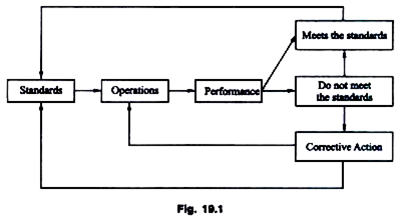
The first step in control process is the setting up of control standards. Standards represent the criteria against which actual performance is measured. Standards serve as the benchmarks because they reflect the desired results or acceptable level of performance.

  1. Measurement of Performance:

After the fixation of standards, the actual performance of various individuals is measured. This involves setting up the methods of collecting accurate and up-to-date information on the progress of work. All measurements should be clear, comparable and reliable. Measurement of performance against standards should be on a future basis so that deviations are anticipated and necessary corrective actions are taken to prevent them.

  1. Comparing Performance with Standards:

This refers to the comparison of the actual performance with the standards. It should be remembered here that appraisal of actual performance becomes quite easy if the standards are properly determined and methods of measuring performance are clearly stated. It is also important to note that while making appraisal of performance, the manager should concentrate mainly on those matters where major deviations are noticed.

  1. Analysis of Deviations:

All deviations need not be brought to the notice of top management. A range of deviations should be established and only cases beyond this range should be reported. This is known as control by exception. When the deviation between standard and actual performance is beyond the prescribed limit, an analysis of deviations is made to identify the causes of deviations. Then the deviations and causes are reported to the managers who are authorized to take action.

  1. Talking Corrective Action:

More reporting of actual performance or its comparison with pre­determined standards is not sufficient. Unless timely action is taken to adjust operations to standards, control process is incomplete. Corrective action may involve setting of new goals, change in organisation structure, and improvement in staffing and new techniques of directing.
Pre-Requisites of a good control system:

  1. The objective and target must be clear.
  2. The control system must be suitable.
  3. The system should be easy to understand and operate.
  4. Selection of tools and techniques must be proper.
  5. There must be speedy feedback system.
  6. There must be prompt reporting system of variances.
  7. It must justify the expenses involved.
  8. There must be a good system of corrective actions.
  9. It must fix individual responsibility for the poor performance.
  10. Controls, which are essential, should be given priority.

Marketing Controls:

There are several types of control available and the importance and purpose of these controls depend on the objectives for which these controls are to be used. All these controls have a common purpose, that is, monitoring the key result areas is marketing management. The key results are generally common for all marketing organisations.

Some of the important marketing controls commonly used are:

  1. Annual Plan Control:

This is the most basic of all controls used in marketing organisations. The main purpose of this control is to monitor and take corrective action to examine whether planned sales results are being achieved. The responsibility for this lies with the marketing departmental head and all others in the top management.

  1. Profitability Control:

Besides annual-plan control, companies carry on periodic research to determine the actual profitability of their different products, territories, customer groups, trade channels, order size etc. The task requires an ability to assign marketing and other costs to specific marketing entities and activities.

  1. Efficiency Control:

Suppose a profitability analysis reveals that the company is earning poor profits in connection with certain products, territories or markets. The question is whether there are more efficient ways to manage the sales force, advertising, sales promotion. Distribution etc.

  1. Strategic Control:

Organisations should examine critically their policies, objectives, marketing strategy, and competitive advantage and growth opportunities regularly so that their direction and growth and overall marketing effectiveness is not impaired or reduced. The scanning of marketing environment has become much more relevant and significant in view of uncertain’ economic conditions, fast changing technology, customer life-style, demographic changes etc.

Marketing Audit

The Marketing Audit refers to the comprehensive, systematic, analysis, evaluation and the interpretation of the business marketing environment, both internal and external, its goals, objectives, strategies, principles to ascertain the areas of problem and opportunities and to recommend a plan of action to enhance the firm’s marketing performance.

The marketing audit is generally conducted by a third person, not a member of an organization.

The firm conducting the Marketing Audit should keep the following points in mind:

  • The Audit should be Comprehensive, i.e. it should cover all the areas of marketing where the problem persists and do not take a single marketing problem under the consideration.
  • The Audit should be Systematic, i.e. an orderly analysis and evaluation of firm’s micro & macro environment, marketing principles, objectives, strategies and other operations that directly or indirectly influences the firm’s marketing performance.
  • The audit should be Independent; the marketing audit can be conducted in six ways: self-audit, audit from across, audit from above, company auditing office, company task-force audit, and outsider audit. The best audit is the outsider audit; wherein the auditor is the external party to an organization who works independently and is not partial to anyone.
  • The audit should be Periodical; generally, the companies conduct the marketing audit when some problem arises in the marketing operations. But it is recommended to have a regular marketing audit so that that problem can be rectified at its source.

Components of Marketing Audit

  1. Macro-Environment Audit: It includes all the factors outside the firm that influences the marketing performance. These factors are Demographic, Economic, Environmental, Political, and Cultural.
  2. Task Environment Audit: The factors closely associated with the firm such as Markets, Customers, Competitors, Distributors and Retailers, Facilitators and Marketing Firms, Public etc. that affects the efficiency of the marketing programs.
  3. Marketing Strategy Audit: Checking the feasibility of Business Mission, Marketing Objectives and Goals and Marketing Strategies that have a direct impact on the firm’s marketing performance.
  4. Marketing Organization Audit: Evaluating the performance of staff at different levels of hierarchy.
  5. Marketing Systems Audit: Maintaining and updating several marketing systems such as Marketing Information System, Marketing Planning System, Marketing Control System and New-Product Development System.
  6. Marketing Productivity Audit: Evaluating the performance of the Marketing activities in terms of Profitability and Cost-Effectiveness.
  7. Marketing Function Audit: Keeping a check on firm’s core competencies such as Product, Price, Distribution, Marketing Communication and Sales Force.

Thus, the marketing audit helps to determine how well a firm’s marketing department is carrying out the marketing activities. And how much it is adding to the overall performance of the organization.

Need for control, Phase of control of Marketing

Marketing control marks the last link in the chain of marketing management as it is the terminal function. Marketing planning is the Alpha and control is the Omega of management process. Plans always do not result in desired outcome.

It means that there is need for redirection of efforts. Mere plans and planning represent half the show; what is important is that the plan formulated is to be implemented and to see that they succeed in achieving what is stated.

Analysing marketing performance is the part of a continuing process of developing plans for marketing activity centres, implementing those plans, controlling the performance, and adjusting the plans when the performance gets out of line.

This chapter plans to discuss various aspects of marketing namely, the meaning, the scope, the process, the essentials of effective control, its importance and the methods of marketing control, among other things.

One knows that ‘control’ stands for ‘check’ and ‘corrective measures’. Simply stated, ‘to control’ is to ‘verify and check the actual performance’ with the planned one.

Marketing control is to do with identifying and measuring all deviations from the marketing plan as closely as possible and to identify the root of the problem and provide a mechanism for corrective action.

Succinctly, marketing control is to do with monitoring and feeding back of marketing performance and its measurement and the evaluation against the standard performance to identify the deviations so as to correct them as and when they occur and to make available inputs for plan resetting and refinement.

Marketing control is a multi-dimensional activity because, it is diagnostic and prognostic. It examines the past activities and proposes future improvements.

The Scope of Marketing Control:

The spectrum of the study of marketing control process can be seen in at least four points namely, annual plan control, profitability control, efficiency control and strategic control:

1. Annual plan control:

Annual plan control stands for all those steps taken by the management to check the ongoing performance against the marketing plan over a period of a year and to suggest corrective steps to iron-out the deviations. The heart of annual plan is the system of management by objective.

This MBO comprises of four basic elements namely:

(a) Establishment of clear goals for each responsibility centre in the marketing firm for the ensuing year.

(b) Periodic measurement of performance to trace performance gaps of abnormal nature.

(c) Casual analysis of performance gaps to see whether the standards fixed are wrong or the marketing environment has changed.

(d) Taking corrective measures to reduce and plug the gaps between the goals and the performance. The performance measurement is done by using tools like market share analysis, sales analysis, marketing expenses to sales ratio, financial analysis and customer attitude tracking.

2. Profitability control:

Periodic research is also undertaken to determine profitability of the different components of the marketing inputs. Thus, profitability is ascertained as to the firm’s products territories- customer groups’ trade channels salesmen and other marketing variables. Profitability analysis is basically the task of matching the marketing and non- marketing costs to specific marketing entities, activities and sub-activities to have fish-eye view of the performance in terms of contribution.

This profitability analysis helps the marketing executive to make decisions on suspension, maintenance or extension of a given marketing activity. The base for analysis is income statement which is broken down to marketing variables to have dissected picture.

3. Efficiency control:

Efficiency control is the outcome of profitability analysis and control. Poor profitability results pave the way for improving the efficiency of marketing activities like personal selling, advertising, sales- promotion and physical distribution.

Therefore, the marketing manager is to gauge the efficiency of these specific branches marketing operations namely, personal selling, and advertising, sales-promotion and physical distribution. Good many ratios and percentages are designed to measure such efficiency improvement.

4. Strategic control:

Strategic control is the task of ensuring that the firm’s marketing objectives, policies, strategies and systems are optimally adapted to the present and future marketing environment. There are two basic tools namely, rating review and marketing audit.

Rating review takes into account the ratings on customer philosophy integrated marketing information adequacy of marketing information strategic orientation and operational efficiency. Another is marketing audit that is designed to evaluate the overall marketing strategy, study of the components of the marketing mix.

The Marketing Control Process:

Any definition of marketing control referred earlier has directly or indirectly harped on the four stages or the elements of the control process namely, setting of performance standards appraising of performance correcting the deviations and reformulating the plan. A brief outline of each step will not be out of place.

1. Setting performance standards:

The starting point in control process is setting the performance standards for marketing operations. These performance standards are the parameters of expected performance against which the actual marketing performance is gauged and evaluated. Therefore, standards are the managerial expectations over a plan period. It is a criterion or the acknowledged measure of comparison.

These can be quantitative and qualitative. Quantitative standards define performance expectations in physical and monetized forms or terms such as sales volume, profit or expenses per product region customer audience calls per salesman inventory levels and so on.

On the other hand, the qualitative standards are those defined in intangible and behavioural values like level of consumer satisfaction dealer relations salesmen and supervisor relations change in consumer attitude brand image and so on.

The quantitative standards are difficult to define and easy to apply while qualitative standards are easy to define but difficult to apply.

2. Appraising the performance:

Fixing of performance standards is followed by the appraisal of marketing performance. Performance appraisal calls for collecting and collating the information about performance, analysing it and relating it with the standards with a view to trace deviations and lapses, if any, and the cause thereof.

This is possible only when the organisation has built-in management information system that receives stores and presents authentic, adequate and timely feed-back from the market performance of different components of marketing mix. Such appraisal may be continuous or periodic.

Naturally, latter is preferred. It is worth emphasizing at this level that performance appraisal of marketing operations is much difficult because, the analysts have to deal with good many intangibles and qualitative aspects such as consumer satisfaction, consumer attitudes, brand image where quantification is not feasible though possible.

Further, marketing efforts pay-off is generally of long-run and, therefore, one cannot correlate current input of efforts with the current output results. What is more important is that marketing performance and the results are not the outcome of only marketing efforts because, very often good many environmental forces are at work which are hard to isolate and measure their impact on marketing performance.

3. Correcting deviations:

It is the performance appraisal that reveals the deviations or variations from the standard performance or the planned course of action. These deviations can be favourable or unfavourable.

Favourable deviations are acceptable deviations where actual performance is better than the planned one and indicates the cause or causes for the better performance.

Unfavourable deviations, on the other hand, are unacceptable deviations indicating the bitter performance less than desired giving the cause or causes for such short-fall in the achievement.

Under both cases, correction is needed as actual performance is to be equated or near equated to the standard performance. Depending on the nature of appraisal continuous or periodic corrections are brought about through change in the pattern of input, re­formulation and the detouring tactics.

4. Reformulating the plan:

The final phase of marketing control process is reformulating the plan, on the basis of the inputs provided by the marketing information system on the actual marketing performance and its analysis and evaluation. For instance, if every time, there are favourable or unfavourable variances, it means that standards are too low or too high where equalization has not been brought about in terms of zero deviation.

Such feed-back of facts and analysis makes the marketing personnel much alert and wiser about relevance and effectiveness of policies, strategies, targets and resources on one hand and their practical application on the other.

Techniques of controlling Market

Philip Kotler considers four types of marketing control:

  1. Annual Plan control
  2. Profitability control
  3. Efficiency Control
  4. Strategic Control

Annual Plan Control:

In this method, annul plans are prepared for various activities. Each plan includes setting objectives (expected results or standards), allocating resources, defining time limit, and formulating rules, policies and procedures. Annual plan control relates to sales. Periodically (mostly annually) the actual results are measured and compared with standards to judge whether annual plans are being (or have been) achieved.

Depending on the degree of difference between the planned and the actual results, causes are detected and suitable corrective actions are undertaken. Thus, it contains checking ongoing performance against annual plan and taking corrective action. Figure 1 shows five measures of annual plan control.

Measures (Evaluation Tools) of Annual Plan Control:

Following five measures are used in annual plan control:

  1. Analysis of Different Sales:

Analysis of different sales contains measuring and evaluating different sales (total sales, territory- wise sales, distribution channel-wise, product-wise sales, customer-wise sales, etc.) with annual sales goals. Targets are set for different types of sales and actual sales of different categories are compared to find out how far company can achieve its sales goals.

  1. Analysis of Market Share:

Here, market share is used as base for measuring, comparing, and correcting results. Market share is a proportion of company’s sales in the total sales of the industry. It helps to know how well the company is performing relative to its close competitors. Thus, the performance is assessed against expected market share and competitors’ market share.

It involves considering three types of market shares:

  1. Overall market share
  2. Served market share
  3. Relative market share
  4. Analysis of Market Expenses-to-Sales:

This type of control checks marketing expenses. It ensures that the firm is not overspending to achieve its annual sales goals. Different marketing expenses are watched in relations to sales.

Normally, company considers five components to calculate expenses-to-sales ratios and compares them with standard ratios to find out how far expenses are under control, such as:

  1. Sales force-to-sales ratio
  2. Advertising-to- sales ratio
  3. Sales promotion-to-sales ratio
  4. Marketing research-to-sales ratio
  5. Sales administration-to-sales ratio

Marketing managers needs to monitor these expenses in relation to sales. If the expenses fall beyond permissible limits, it should be taken as a serious concern and needed steps are taken to keep them under control.

  1. Financial Analysis:

Financial control consists of evaluating sales and sales-to-expense ratios in relation to overall financial framework. It means net profits, net sales, assets, and expenses are studied to find out rate return on total assets, and rate of return on net worth.

Financial analysis determines firm’s capacity of earnings, profits, or income. Attempts are made to find out factors influencing firm’s rate of return on net worth. Here, various ratios are calculated such as profit margin ratio (net profits + net sales), asset turnover ratio (net sales + total assets), and return on assets ratio (net profits + total assets), financial leverage (total assets + net worth) and return on net worth (net profits – net worth). Profit margin can be improved either by cutting expenses and/or increasing sales.

  1. Analysis of Customer and Stakeholder Attitudes:

The measures of annual plan control discussed in former part are financial and quantitative in nature. Qualitative measures are more critical because they give early warning about what is going to happen on sales as well as profits.

Manager can initiate precautionary actions to minimize adverse impacts of forces on the future outcomes. Under this tool, customers’ attitudes are tracked to project the way they will react to the company’s offers. Alert company prefers to set up a system to monitor attitudes of customers, dealers, and other participants.

Base on their attitudes, preference and satisfaction, management can take early actions. This tool is preventive in nature as adverse impact on the future results can be prevented by advanced steps. Market- based preference scorecard analysis is used to measure (score) attitudes of customers and other participants. Such analysis reflects actual company’s performance and provides early warnings.

Measuring Customers’ Attitudes:

Here, a firm tries to measure attitudes of customers by using various methods like, complaints and suggestions, customer panels, customer survey, etc. It provides details about new customers created, existing customers lost, dissatisfied customers, relative product quality, relative service quality, target market awareness, target market preference, and other valuable information.

Measuring Stakeholders’ Attitudes:

It consists of measuring or recording stakeholders’ attitudes. It shows the pattern of stakeholders’ preference, attitudes, and overall response toward company and its offers. Stakeholders include suppliers, dealers, employees, stockholders, service providers, etc. They have critical interest and impact on company’s performance.

Without their cooperation and contribution, a company cannot realize its goals. When one or more of these stakeholders register dissatisfaction, management must take suitable actions. Methods used to track attitudes of customers can also be used for measuring attitudes of stakeholders.

Profitability Control:

In this method, the base of exercising control over marketing activities is the profitability. Certain profitability (and expenses) related standards are set and compared with actual profitability results to find out how far company is achieving profits. Profitability control calls for measuring profitability of various products, channels, territories, customer groups, order size, etc. It provides necessary information to management to determine whether products, channels, or territories should be expanded, reduced, or eliminated.

Process of Marketing-Profitability Analysis:

Systematic and logical process is used for analysis of profitability.

It involves:

  1. Identifying Functional Expenses:

It consists of determining expenses to be incurred for the marketing activities like salaries, rents, advertising, selling and distribution, packing and delivery, billing and collection, etc.

  1. Assigning Function Expenses to Marketing Entities:

Simply, expenses of particular head (for example, salary or advertising) are associated with different entities like products, channels, territories or customers groups.

  1. Preparing Profits and Loss statement:

A profit and loss statement is prepared for each type of products, channels, territories, etc., to evaluate their relative performance. Based on relative performance in form of profitability, management can decide on products, channels or territories to be expanded, reduced or eliminated.

For example, a firm has five products, like A, B, C, D, and E. If profit and loss statement shows that:

(1) Product C is more profitable, and therefore, it must be expanded;

(2) Product B is poor, and, therefore, it must be reduced;

(3) Product D is making loss, and therefore, it must be eliminated, and

(4) Product A and product E are satisfactory, and therefore they must be maintained. In the same way, it can be applied to different territories and segments.

Table 1 shows how to prepare profit and loss statement for different products.

  1. Taking Action:

On the basis of the profit and loss statement, necessary actions can be directed.

Actions include one or more of followings:

  1. Expanding product(s)
  2. Reducing product(s)
  3. Eliminating product(s)
  4. Reducing any of the expenses
  5. Increasing sales, etc.

Efficiency Control:

This control, particularly, concerns with measuring spending efficiency. While profitability control reveals the relative (in relation to different entities like products, territories, channels, etc.) profits a company is earning, the efficiency control shows the ways to improve efficiency of various marketing entities like sales force, advertising, distribution, sales promotion, and so forth.

Sometimes, a post of marketing controller is created to work out a detailed programme to measure and improve efficiency of expense-centered marketing activities. Here also, in order to evaluate efficiency level of different marketing activities, the efficiency standards (of ideal performance) are set and are compared with actual performance.

Efficiency control can improve efficiency of marketing department in two ways – one is, improving ability of various marketing activities to contribute more in reaching the goals, and the second is, reducing expenses or wastage.

Types of Efficiency Control:

Figure 2 shows major types of efficiency control. Main types of efficiency control involve controlling sales force efficiency, advertising efficiency, sales promotion efficiency, distribution efficiency, and marketing research efficiency.

  1. Sales Force Efficiency Control:

To measure efficiency of sale force (salesmen), certain key indicators/criteria are developed. A manager has to make a lot of calculations and paperwork.

Common criteria used to measure and evaluate the sales force efficiency include:

  1. Average number of sales calls per salesman in a day
  2. Average sales calls time spared per contact

iii. Average revenue generated per call

  1. Average costs incurred per call
  2. Entertainment cost per calls
  3. Percentage of orders per specific number of calls, i.e., how many orders have been received from 100 calls made
  4. Number of new customers created during specific period
  5. Number of customers lost in a given period
  6. Contribution of salesmen in total sales, revenue, and profits
  7. Sales force costs as percentage of total sales.

Questionnaire, discussion, inspection, observation, salesman’s report, etc., methods are used for the purpose. However, most companies use salesman’s report. A unique computer-based programme or software can also be developed for speedy and accurate measurement of sales forces efficiency on a regular basis. Simply, actual performance of sales force is compared with these criteria to find out deviation, and, accordingly, necessary actions are taken.

This measurement of sales force efficiency can provide satisfactory answers of following questions:

  1. What is role/contribution of sales force in selling efforts?
  2. Who are the most efficient, less efficient and inefficient sales people?
  3. Which are reasons responsible for poor efficiency of sales force?
  4. What can/should be done to improve efficiency?
  5. Advertising Efficiency Control:

Advertising is the most expensive among all the promotional tools. Major part of promotion budget is consumed by advertising alone. So, it is extremely necessary to find out efficiency level of advertising efforts. A company sets advertising goals (standards) and compared actual contribution of advertising to decide how far advertising has been capable to fulfill firm’s expectations. Advertising efficiency control mainly involves measuring cost efficiency or contribution efficiency.

Practically, it is difficult to measure the exact contribution of advertising efforts/costs. Systematic tools can be developed to measure impact of advertising qualitatively – in forms of increasing awareness, changing attitudes, and creating brand loyalty – and quantitatively – in forms of impact on sales and profits. Survey of dealers and customers can be made to collect needed data.

Common criteria used for measuring advertising efficiently include:

  1. Advertising cost per thousand target customers reached by a specific media vehicle, for example, television medium.
  2. Percentage of audience who read, noted, or saw message from print media.
  3. Customer opinion on advertising contents and effectiveness.
  4. Measurement of pre-post (before-after) advertising impact on attitudes of people toward the product.
  5. Number of inquiries generated by advertising.
  6. Cost per inquiry.
  7. Impact of advertising on personal selling, sales promotion, public relations, publicity, and distribution.
  8. Need and performance of advertising agency, etc.

Manager can compared efficiency of advertising programme with internal as well as external standards to judge comparative efficiency. He must find out causes leading to inefficiency.

One or more of following actions are initiated:

  1. To changes advertising objectives and policies.
  2. To change advertising message.
  3. To change advertising media.
  4. To change media scheduling and frequencies.
  5. To change and/or train the staff.
  6. To change advertising agency.
  7. To change advertising budget, etc.
  8. Sales Promotion Efficiency Control:

This control is exercised by sale manager. Sometimes, sales promotion manager is also appointed to deal with the issue. Sales promotion efficiency measures the impact of sales promotion efforts on sales, profits, competitiveness, and consumer satisfaction. Such efforts include offering a wide range of short-term incentives to stimulate buyer interest and consumer trial. Sales promotion is, no doubt, costly, but it seems essential. Here, manager tries to measure costs and impact of each of sales promotion tools. Normally, sales promotion tools are applied at three levels – customer level, dealer level, and sale force level.

Common criteria used for measuring sales promotion efficiency include:

  1. Percentage of total sales promotion expenses to sales.
  2. Costs of display, sample, coupons, and other tools per unit selling price.
  3. Number of inquires generated due to display, demonstration, other such incentives.
  4. Joint and individual impact of various tools on dealer interest, consumer purchase, and competitiveness.

Analysis of costs and contribution of sales promotion tools helps in selecting the most cost- effective sales promotion tools to use. A firm can reduce unnecessary costs and/or can improve contribution of each of the tools of sales promotion. It helps design suitable sales promotion strategies in term of costs, level of sales promotion, timing, and types of techniques at each of the levels.

  1. Distribution Efficiency Control:

In an average, distribution costs account for 20 to 30 per cent of selling price. By a suitable distribution network, company can improve its profitability on one end and consumer satisfaction on the other end. Therefore, it is necessary to review or assess the entire distribution system periodically. Distribution efficiency control measures how far company’s distribution system is efficient to achieve marketing goals.

Common criteria used for the purpose include:

  1. Percentage of total distribution costs per unit price.
  2. Percentage of physical distribution (warehousing, inventory, ordering, transportation, communication, insurance, etc.) costs per unit price.
  3. Percentage of channel members’ (wholesalers, retailers, agents, etc.) costs per unit price.
  4. Costs and contribution of direct v/s indirect channels.
  5. Potentials of using online marketing, network marketing, and by retailing chains.
  6. Assessing costs of marketing channels in relation to services they offer to the company as well consumers.

Distribution efficiency gives valuable information to select the most cost-effective distribution option and sub-options. Company can minimize distribution costs and/or improve profits and competitiveness. In the same way, it can increase consumer satisfaction, too.

  1. Marketing Research Efficiency Control:

Marketing research is process of gathering, analyzing, and interpreting data relating to any marketing problem. Due to dynamic nature of marketing environment, a company needs data on various relevant variables time to time. Marketing research is an expensive option. It is imperative for a firm to know how far marketing research efforts and costs are instrumental in achieving marketing goals. It provides necessary details to improve research policies and practices.

Common criteria used to measure marketing research efficiency include:

  1. Annual budget of marketing research department.
  2. Costs of research projects conducted in a year.
  3. Effectiveness of tools and methods used for collecting and analyzing data.
  4. Usefulness of findings of marketing research in decision-making.
  5. Relative advantages of company’s research department v/s professional research firms, etc.

Strategic Control:

Strategic control implies a critical review of overall marketing effectiveness in relation to broad and long-term objectives and firm’s response to marketing environment. It deals with assessing firm’s ability to define and achieve marketing goals, and response pattern to environment. Normally, strategic control verifies company’s long-term performance with reference to the close competitors. Here, entire marketing system is reviewed to judge firm’s overall strengths and weaknesses. It answers the question: How far is the firm capable to exploit emerging marketing opportunities and face challenges and threats?

Methods or Tools:

As shown in Figure 3, four tools are used for strategic control – the marketing effectiveness review, the marketing audit, the marketing excellence review, and the ethical and social responsibility review. Let’s discuss each of them.

  1. The Marketing Effectiveness Review:

It involves a review of overall marketing performance. It helps finding effectiveness of several business plans in term of sales growth, market share, and profitability. Attempts are made to detect causes for good-performing marketing department and poor-performing department.

Common criteria:

Some criteria are used to review marketing effectiveness.

They include:

  1. Company’s Customer Philosophy:

It shows company’s approach toward customers.

  1. Integrated Marketing Efforts:

It shows the way company integrates efforts of all divisions and departments for achieving marketing goals.

iii. Marketing Information:

It studies company’s policies and practices to collect, use, and disseminate critical information on a regular basis.

  1. Company’s Strategic Orientation:

It shows company’s broad and long-term plans for survival and growth. It also indicates firm’s long-term plans for profits, sales, and expansion.

  1. Operational Efficiency:

It shows how efficiently a company managing its current operations.

  1. Public Relations Practices:

It shows company’s policies and practices to establish, maintain, and improve relations with various publics, which have direct interest in the company’s operations, and whose cooperation seems critical in achieving marketing goals.

Here, we have considered only six criteria. As per need, more criteria can be developed and used for the purpose.

A special instrument can be developed by using these criteria to measure marketing effectiveness. The instrument (a type of questionnaire or form with questions and certain number of options or intensity in each of the questions) is filled by managers of marketing and various other departments.

On the basis of this instrument, controller can calculate score of each managers of each of the departments. Level of scores received by manager or department clearly indicates the effectiveness of particular manager and/or department. Accordingly, each department is awarded class like excellent, very good, good, fair, or poor. Necessary actions can be taken on the basis of performance.

  1. The Marketing Audit:

Another alternative tool for critical review of overall marketing performance is the marketing audit. Audit means to examine systematically. It is systematic examination/investigation of all critical aspects of marketing department.

Philip Kotler defines: “A marketing audit is a comprehensive, systematic, independent, and periodical examination of a company’s marketing environment, objectives, strategies, and activities with a view to determine problem areas and opportunities, and recommending a plan of action to improve the company’s marketing performance.”

Key characteristics of marketing audit have been discussed below:

  1. Comprehensive:

The marketing audit covers all the major marketing activities of a business unit.

  1. Systematic:

It is a systematic examination of all marketing operations. It is a well-planned and orderly task. All aspects are audited minutely. It indicates corrective actions to improve firm’s marketing performance.

iii. Independent:

Marketing audit is conducted objectively (bias-free) or neutrally. It includes self-audit, internal, or external audit. However, the external audit is considered as the best one.

  1. Periodical:

The marketing audit should be conducted regularly to detect problems and avoid crisis.

  1. Purposive:

Its purpose is to find out marketing problem areas and opportunities. It recommends actions to improve company’s marketing performance.

Key Issues or Decisions of Marketing Audit:

A detailed plan is prepared to conduct marketing audit.

The main decisions/issues of marketing audit include:

  1. Deciding on marketing audit objectives (why).
  2. Deciding on marketing audit responsibility (who).

iii. Deciding on data to be collected (what).

  1. Deciding on respondents (whom).
  2. Deciding on time (when and how long).
  3. Deciding on areas of marketing audit (Where).

vii. Deciding on intensity of examination (How much).

viii. Deciding on methods and tools (how)

  1. Deciding on audit report format
  2. Deciding on actions to be taken on the basis of report.

Components of Marketing Audit:

The marketing audit examines six major components of company’s marketing operations, such as:

  1. Marketing Environment Audit:

It examines impacts of micro and macro factors of marketing environment. Macro marketing environment consists of demographic, economic, environmental (ecological), technological, political and cultural factors. Micro marketing environment includes market segments, customers, competitors, dealers, suppliers, facilitators, and general public’s.

  1. Marketing Strategy Audit:

It examines company’s business mission, marketing goals and objectives, resources capacity, and marketing strategies.

  1. Marketing Organisation Audit:

It examines suitability of marketing organisation (structures) to implement marketing operations effectively. It includes level, relations, authority- responsibility, communication, facilities, organisation manual, etc.

  1. Marketing System Audit:

It examines major systems like marketing information and research system, marketing planning system, marketing control system, new product development system, etc.

  1. Marketing Productivity Audit:

It examines company’s profitability for different products, territories, and channels. It also examines cost-effectiveness for various operations.

  1. Marketing Function Audit:

It examines marketing mix elements such as product, price, promotion (advertising, sales promotion, personal selling-sales force, publicity, and public relations), and distribution. For each of the components, appropriate auditing questions are designed to examine how effectively the company is performing. All relevant respondents like customers, suppliers, managers, dealers, etc., are interviewed using these questions.

Finally, the auditor prepares marketing audit report. The audit report contains individual and joint evaluation of main audit components (marketing areas). It detects strengths and weakness, and recommends actions for improving marketing performance.

  1. The Marketing Excellence Review:

This is more or less similar to market effectiveness review. But, here, some excellently performing business units are taken as the base for evaluating firm’s performance. Here, performance is reviewed relatively.

The marketing excellence review is used to judge how excellently the company is performing with reference to high performing business units. A special instrument with adequate number of criteria and appropriate scaling can be developed to judge poor, good or excellent performance.

Criteria used for the purpose include:

  1. Market/customer orientation
  2. Market segmentation
  3. Product quality
  4. Quality of services
  5. Approach toward competition
  6. Integration and alliance
  7. Approach toward dealers
  8. Dealing with other stakeholders
  9. Social responsibility and national services, etc.

Depending on result of the marketing excellent review, necessary actions are taken. Company’s actions mainly include undertaking all possible steps to reach the level of excellently performing business units.

  1. The Ethical and Social Responsibility Review:

This review/verification decides whether firm’s marketing policies and practices are ethically and socially true. Ethics are moral principles, norms, or standards of right or wrong. Every business unit has social responsibilities toward a number of stakeholders.

In same way, marketing practices should be ethical with reference to moral norms, standards, and values. Company’s products, policies, and practices should not have adverse impact on customers, other stakeholders, and larger interest of society. Thus, here company tries to assess its ethical and social responsibility. As per need, necessary actions are taken.

Criteria used to review social and ethical responsibility include:

  1. Clear definitions of illegal, immoral, and antisocial activities.
  2. Company’s active efforts to practice, promote, and disseminate moral principles and to hold its employees fully responsible to observe them in practice.
  3. Company’s direct contribution for social welfare of people.
  4. Fulfilment of social responsibility toward various parties.
  5. The adherence to all laws and regulations in force.
  6. Use of business ethics in areas of product, price, promotion and distribution.

On the basis of ethical and social review, company can evaluate its performance in this regard and, if necessary, appropriate actions are taken.

Meaning of Strategic Management

Strategic management is the management of an organization’s resources to achieve its goals and objectives. Strategic management involves setting objectives, analyzing the competitive environment, analyzing the internal organization, evaluating strategies, and ensuring that management rolls out the strategies across the organization.

Strategic management is divided into several schools of thought. A prescriptive approach to strategic management outlines how strategies should be developed, while a descriptive approach focuses on how strategies should be put into practice. These schools differ on whether strategies are developed through an analytic process, in which all threats and opportunities are accounted for, or are more like general guiding principles to be applied.

Strategic management has been defined by various thinkers, philosophers and practitioners. Strategic management can be defined as the formal process for defining company vision & mission, assess internal & external environment, formulate strategies under resource constraints, implement strategies, and evaluate the strategies. Strategic management is the art and science of formulating, implementing and evaluating cross function decision that enable the business to achieve its objectives.

Lamb Robert (1984) – Strategic management is an on-going process that evaluates and controls the business and the industries in which the company is involved; assesses its competitors and sets goals and strategies to meet all existing and potential competitors; and then reassesses each strategy annually or quarterly [i.e., regularly] to determine how it has been implemented and whether it has succeeded or needs replacement by a new strategy to meet changed circumstances, new technology, new competitors, a new economic environment, or a new social, financial, or political environment.

Learned (1965): It is the study of the functions and responsibilities of general management and the problems which affect the character and success of the total enterprise.

Schendel and Hofer (1979): Strategic management is a process that deals with the entrepreneurial work of the organization, with organizational renewal and growth, and, more particularly, with developing and utilizing the strategy which is to guide the organization’s operations.

Bracker (1980): Strategic management entails the analysis of internal and external environments of firms to maximize the utilization of resources in relation to objectives.

Jemison (1981): Strategic management is the process by which general managers of complex organizations develop and use a strategy to co-align their organization’s competence and the opportunities and constraints in the environment.

Van Cauwenbergh and Cool (1982): Strategic management deals with the formulation aspects (policy) and the implementation aspects (organization) of calculated behaviour in new situations and is the basis for future administration when repetition of circumstances occurs.

Schendel and Cool (1988) – Strategic management is essentially work associated with the term entrepreneur and his function of starting (and given the infinite life of corporations) renewing organizations.

Fredrickson (1990) – Strategic management is concerned with those issues faced by managers who run entire organizations, or their multifunctional units.

Teece (1990): Strategic management can be defined as the formulation, implementation, and evaluation of managerial actions that enhance the value of a business enterprise.

Rumelt, Schendel, and Teece (1994): Strategic management is about the direction of organizations, most often, business firms. It includes those subjects of primary concern to senior management, or to anyone seeking reasons for success and failure among organizations.

Bowman, Singh, and Thomas (2002): The strategic management field can be conceptualized as one centred on problems relating to the creation and sustainability of competitive advantage, or the pursuit of rents.

Example of Strategic Management

For example, a for-profit technical college wishes to increase new student enrollment and enrolled student graduation rates over the next three years. The purpose is to make the college known as the best buy for a student’s money among five for-profit technical colleges in the region, with a goal of increasing revenue.

In that case, strategic management means ensuring the school has funds to create high-tech classrooms and hire the most qualified instructors. The college also invests in marketing and recruitment and implements student retention strategies. The college’s leadership assesses whether its goals have been achieved on a periodic basis.

Importance of Strategic Management

  • It guides the company to move in a specific direction. It defines organization’s goals and fixes realistic objectives, which are in alignment with the company’s vision.
  • It assists the firm in becoming proactive, rather than reactive, to make it analyse the actions of the competitors and take necessary steps to compete in the market, instead of becoming spectators.
  • It acts as a foundation for all key decisions of the firm.
  • It attempts to prepare the organization for future challenges and play the role of pioneer in exploring opportunities and also helps in identifying ways to reach those opportunities.
  • It ensures the long-term survival of the firm while coping with competition and surviving the dynamic environment.
  • It assists in the development of core competencies and competitive advantage, that helps in the business survival and growth.

The basic purpose of strategic management is to gain sustained-strategic competitiveness of the firm. It is possible by developing and implementing such strategies that create value for the company. It focuses on assessing the opportunities and threats, keeping in mind firm’s strengths and weaknesses and developing strategies for its survival, growth and expansion.

Features of Strategy

  • Strategy is Significant because it is not possible to foresee the future. Without a perfect foresight, the firms must be ready to deal with the uncertain events which constitute the business environment.
  • Strategy deals with long term developments rather than routine operations, i.e. it deals with probability of innovations or new products, new methods of productions, or new markets to be developed in future.
  • Strategy is created to take into account the probable behavior of customers and competitors. Strategies dealing with employees will predict the employee behavior.

Role of Strategic Management

Strategic management is a continuous process of decision-making that is vital to the very survival, growth and flourishment of an organization that contribute to wealth maximization. Strategic management is different from routine management in the sense that it is making of strategic decisions and implementation of those to get pre- calculated results.

These strategic issues influence the decisions as management is a decision making process. One point is to pounder that all the decisions are important; however, all the decisions are of not of equal importance; hence, they become strategic and non-strategic. As a decision-making process, strategic management is characterized by at least six distinct points.

These are:

  1. Strategic Issues Warrant Top Management Decisions

Strategic decisions have far-reaching impact on several areas of firms operations. Hence, top management involvement in decision making is imperative. These decisions must be made by top management as these are the pillars of the organization. Let us take the example of a pharmaceutical firm.

The quality of the product and the price you are charging they are most important. These decisions will not be left to business level or functional level. Only at the top level there is perfect perspective understanding, anticipating broad implications and the branching out and ramifications and the power to authorize the resource allocation that is needed for implementation of what is contemplated.

  1. Strategic Issues Involve the Allocation of Large Amounts and Resources

By very nature, strategic issues call for allocation of large amounts and resource deployment. The strategic issue is one of expansion or expanding the production capacity, or entering into new market or modernization to cut cost (technological up-gradations). All these are so vital that they eat huge amounts of funds in sunk assets; in addition they need more people, other inputs to reach the goal of expansion to reap the benefits.

This resource allocation takes place in one of the ways:

(i) By sparing the internal funds out of accumulated reserves and surplus;

(ii) By fresh issue of capital both owned and borrowed;

(iii) Any combination of the two to reach the third alternative whichever is viable. These issues need commitment to spare and spend as per the plan of expansion or modernisation. It is top management which again has upper hand.

  1. Strategic Issues are Likely to have Impact on the Long Term Prosperity of the Firm

The strategic decisions are such that their impact good or bad will be known in the long-run. When a company sticks to a particular strategic option, its competitive image and merits are tied to that strategy option only.

A firm which is spending huge amount on building company’s image which is dependent on its position in product market, capital market and labour market will be known in due course of time but not immediately.

The company’s products may be well in demand giving a larger share of market; investors are lured by constant and high rate of dividends; it might be a good pay master where every, stake- holder is happy. These need change in market mix, market-segmentation, and public-relations building and so on.

These decisions are to be taken by top level authorities. Of course, taking the business level and operation level also man power. The effects are felt over a longer period of time where the business environment has undergone a thorough change. All firms will not succeed, and even if succeed not equally.

That is why some wise person has said “There are companies that make things happen; there are companies which keep on watching things happening and there are those companies who wonder as to what happened?” A company committed to strategic management belongs to first category. In a nutshell, these strategic decisions have enduring effects on firm.

  1. Strategic Issues are Future Oriented

Whether it is dynamic business world or the ground reality living of us-what is important is—what you are? and what you will? not what were? Past is past, present is present and future is future. However, one cannot manage past; one can manage present; but managing for future is most ticklish and dare-devil activity.

Management-we mean managing the future because first function of management is foreseeing the future or planning-then rest of the functions come into picture. Strategic decisions are future oriented. Each manager worth calling is one who wants to calculate what future holds for him or his firm.

Prediction of future is almost very difficult, if not impossible. You know the mightiest nation-the USA succeeded in using all its resources to capture Osama Bin Laden and of Saddam Hussain; however, the results were not commensurate with. What they put in terms of treasure, time and talent.

However, if they are really strategic, their plans are going to be true. Business world in quite vibrant, turbulent where competitive forces are driving, one cannot have smooth sailing, strategic management teaches to be pro-active rather than reactive because, one has no control over external forces. It is situational or contingency approach that is going to solve the problems.

  1. Strategic Issues have Consequences of Multi Business

Strategic decisions are not one man show. The CEO has to invite people from all levels namely top, functional and operative. That is, these strategic decisions are coordinative or participative in nature. Top management may have wonderful plan but it should be carried out because there vast difference between promise and performance a dream and a reality.

Each one-departmental heads, divisional heads, sectional heads all are to consist and work as a team. There are many vital decisions-about marketing mix, market-segments, organizational structure, competitive emphasis that involve a firm’s strategic business units (SBUs) functions, divisions, programmes units and so on. Such segregation, segmentation, compartmentalization calls for allocation and reallocation of firm’s resources and responsibilities which have impact on final results.

  1. Strategic Issues Warrant due Weightage to the Firm’s External Environment

Each business unit is a sub-system that exists in open and supra-system which is otherwise known as environment. A firm as a sub-system has great influence of the environmental forces on it and it has its own impact on environment. However, the environmental forces are so powerful that it is very difficult to exert control on them.

To survive each firm has to adjust to these external forces in future because these forces are constantly changing. That is why, the strategic managers have to look beyond the limits of firm’s operations.

They will have to watch and act their competitors, customers, suppliers, creditors, labour force, governmental policies, technology and so on. The smooth functioning of a firm depends on how well it understands the behaviour of all these variables in future.

  1. Strategic Management is a Process

Strategic management has emerged out of management in other areas where the concept of management is taken as a process for achieving certain objectives of the organization for which it is brought into existence.

Strategic management brings in a frame-work that helps in performing various processes. The configuration strategic management embodies all general management principles and practices devoted to strategy formulation and implementation in the organization.

As a process, it has logical steps namely, formulation of objectives of the organization; keen observation and monitoring of environment-both external and internal so as to identify the opportunities and threats; evaluation of firm’s strengths and weaknesses, viz a viz the opportunities and threats, formulation of variant and matching strategies to achieve these objectives; implementation of these strategies and evaluation and monitoring of the results of these strategies to ensure the organizational objectives are being achieved.

  1. Strategic Management Stresses both Efficiency and Effectiveness

This is very important point because many people do not differentiate “efficiency” from “effectiveness.” The professors Alex Miller and George Dess have pinpointed the difference between ‘efficiency’ and effectiveness. Many a times what is efficient may not be effective but other way round not normally may not be true.

“Doing things right” is efficiency and “doing the right things” is effectiveness. Generally, a manager who takes the word in narrow sense concentrates on efficiency or improving on his efficiency level yet he may not be successful all the time because he is concentrating on his functional or divisional area than overall business.

By working so hard at trying to do ‘things right’, they forget to look up from their work occasionally to consider, whether they are working on the right things that will be effective in moving their organisation towards the final vision. A strategic manager or a strategist has right blend of ‘efficiency’ and ‘effectiveness’ in his performance. He knows not only to hit but he knows where exactly to hit.

Process of Strategic Management

Strategic management is all about identification and description of the strategies that managers can carry so as to achieve better performance and a competitive advantage for their organization. An organization is said to have competitive advantage if its profitability is higher than the average profitability for all companies in its industry.

Strategic management can also be defined as a bundle of decisions and acts which a manager undertakes and which decides the result of the firm’s performance. The manager must have a thorough knowledge and analysis of the general and competitive organizational environment so as to take right decisions.

They should conduct a SWOT analysis strengths, weaknesses, Opportunities, and Threats), i.e., they should make best possible utilization of strengths, minimize the organizational weaknesses, make use of arising opportunities from the business environment and shouldn’t ignore the threats.

Strategic management is nothing but planning for both predictable as well as unfeasible contingencies. It is applicable to both small as well as large organizations as even the smallest organization faces competition and, by formulating and implementing appropriate strategies, they can attain sustainable competitive advantage.

Strategic management is a way in which strategists set the objectives and proceed about attaining them. It deals with making and implementing decisions about future direction of an organization. It helps us to identify the direction in which an organization is moving.

Strategic management is a continuous process that evaluates and controls the business and the industries in which an organisation is involved; evaluates its competitors and sets goals and strategies to meet all existing and potential competitors; and then revaluates strategies on a regular basis to determine how these have been implemented and whether these were successful or require replacement.

Strategic Management Process

Strategic management involves certain functions or activities. The systematic way of doing these functions or activities is described as strategic management process.

It consists of:

  1. Strategy formulation

Strategy formulation is the first phase in the strategic management process. It is concerned with devising a suitable plan of action after studying the external business environment, analyzing the industry and assessing the internal capabilities of the business concern. It involves six important steps.

The steps to be followed for the formulation of a strategy are explained below:

(i) Defining the Company Mission: The first step in the formulation of a strategy is a clear definition of the mission of the company. This is necessary to formulate an ideal strategy. Otherwise, the strategy will not produce the desired results. An ideal strategy is one which reflects the mission of the company. A mission is the long-term vision of what an organization wants to be and to whom it wants to serve and what impact on the society. The mission is, thus, the basic, unique purpose that differentiates a business from others.

(ii) Analysis of the External Business Environment: The second step in the formulation of a strategy is an analysis of the external business environment. It is concerned with studying or observing what is prevailing in the external business environment and what changes have taken place. Such an assessment is necessary because every incident or change will have either positive or negative impact on the business.

It involves – (a) analysis of remote environment and (b) analysis of operating environment. The external business environment thus provides opportunities or threats to the business concerns. The business concern must formulate a suitable strategy to exploit the opportunities or manage threats depending up on its strengths or weaknesses.

(iii) Analysis of the Industry: The third step in the formulation of a strategy is an analysis of the industry. It involves the examination of certain forces operating in an industry to understand the nature and the degree of competition in that industry. The level of competition in an industry depends on five basic forces which determine the profit potential of an industry. They are (a) the threat of new entrants, (b) The bargaining power of buyers, (c) The bargaining power of suppliers, (d) The threat of substitute products, and (e) Rivalry among the existing firms.

The study of these forces indicates the trend of industry, the strength and weakness of the company in the industry. Such a study will be useful to formulate a suitable strategy to utilize the opportunities or threats.

(iv) Internal Analysis of the Firm: The fourth step in the formulation a strategy is a thorough internal analysis of the firm. It is concerned with a systematic appraisal or examination of the internal capabilities of a firm. Such an appraisal is necessary to know the strengths and weaknesses of the firm in the areas of finance, production, marketing, technology, research and development, and human resource management.

A systematic internal analysis of the firm involves (a) identification of strategic internal factors and (b) evaluation of the strategic internal factors to identify the key strategic strength and weakness. A factor is considered a strength only when a firm has a distinct competency in it than the competitors in the industry.

A factor is considered a weakness only when a firm performs it poorly than the competitors in the industry. A new strategy therefore has been formulated after considering the internal strategic strengths and weaknesses of the firm to utilize the external opportunities or minimize its activities to overcome threats.

(v) Strategic Alternatives: The fifth step in the formulation of a strategy is developing strategic alternatives. They are concerned with identifying other possible ways of achieving the same strategy formulated to utilise external business opportunities or minimise the firm’s activities to overcome threats.

For example, growth strategy may be achieved by intensive growth strategy of market penetration, market development, and product development or integrative growth strategy of horizontal integration and vertical integration or diversification strategy depending upon the internal strengths and weaknesses provided the external business environment is favorable.

(vi) Strategic Analysis and Choice: The last step in the formulation of a strategy is strategic analysis and choice. Strategic analysis involves a systematic evaluation of strategic alternatives with reference to certain criteria. Each alternative has its own merits and demerits but all alternatives cannot be equally appropriate.

  1. Strategy Implementation

Strategy implementation is the second phase in the strategic management process. It is concerned with putting the strategy into operation or translating the strategy into strategic action. It necessitates three interrelated activities of

(i) Determination of annul objectives

(ii) Development of specific functional strategies

(iii) Development of policies. For the successful implementation, the strategy must be also institutionalized through structure, leadership, and culture.

  1. Strategy Evaluation and Control

Strategy evaluation and control is the last phase in the strategic management process. Strategy evaluation is concerned with examining whether the strategy implemented is working or producing results or accomplishing its objectives or not. Strategic control is concerned with continuous monitoring and tracking the strategy— putting the strategy in the right path or direction.

Strategic management process has following five steps:

  1. Mission and Goals

The first step in the strategic management begins with senior managers evaluating their position in relation to the organization’s current mission and goals. The mission describes the organization’s values and aspirations; and indicates the direction in which senior management is going. Goals are the desired ends sought through the actual operating procedures of the organization. It typically describe short-term measurable outcomes.

  1. Environmental Scanning

Environmental scanning refers to a process of collecting, scrutinizing and providing information for strategic purposes and helps in analyzing the internal and external factors influencing an organization. After executing the process, management should evaluate it on a continuous basis and strive to improve it.

  1. Strategy Formulation

Strategy formulation is the process of deciding best course of action for achieving organizational objectives. After conducting environment scanning process, managers formulate corporate, business and functional strategies.

  1. Strategy Implementation

Strategy implementation implies putting the organization’s chosen strategy in to action and making it work as intended. Strategy implementation includes designing the organization’s structure, distributing resources, developing decision making process, and effectively managing human resources.

  1. Strategy Evaluation

Strategy evaluation which is the final step of strategy management process involves- appraising internal and external factors, measuring performance, and taking remedial/corrective actions. Evaluation assure the management that the organizational strategy as well as its implementation meets the organizational objectives.

These steps are carried by the businesses, in chronological order, when creating a new strategic management plan. Present businesses that have already created a strategic management plan will revert to these steps as per the situation’s requirement, so as to make essential changes.

Limitations of Strategic Management

Strategic management is not without limitations. While strategic management has a number of benefits as pointed out above, it is also a fact that many firms fail despite adopting strategic management and many firms which do not have strategic management are successful. In short, strategic management by itself does not ensure unconditional success.

The important limitations of strategic management are the following:

  1. Strategic management is based on certain premises and if the premises do not hold valid, the strategy or plans based on them would not be realistic or effective. These points to the need for exercising due diligence in premising and to the importance of strategic control, particularly premise control.
  2. SWOT analysis has a very important role in strategic management. Obviously, if the SWOT analysis is not right, the strategy based on it may go awry. SWOT analysis is an exercise which requires lot of expertise and information. When these two are lacking, the utility of the SWOT analysis is questionable and it could even lead to formulation of wrong or ineffective strategies.
  3. Strategic management is a means to achieve the mission and objectives of the organization. Hence, any lack of realism or other limitation of the mission/objectives would naturally get reflected in the strategy.
  4. One of the criticisms against strategic management is that it sometimes makes the organization over-ambitious and the resultant failure to reach the goals cause frustration. Unrealistic strategies may land companies in severe problems.
  5. Another criticism advanced against strategic management is that it makes the future vision tunneled that several opportunities may be overlooked. Against this criticism, it may be argued that the strategy is formulated after scanning all the opportunities. Further, a good strategic management also envisages modification of the strategy when changes in the environment call for it.
  6. Yet another criticism which is very akin to the above is that it makes the whole approach very rigid. Against this, it may be pointed out that a good strategic management system provides for required flexibility and modifications. Strategic control and contingency planning impart the plans some amount of adaptability to the unforeseen developments.
  7. An important limitation of the strategic management is that if the implementation of the strategy is not effective, even an excellent strategy would not produce expected results. Effective implementation demands many things  resource allocation, leadership implementation, right structure, and effective evaluation and control. The reason for the failure of many strategies is the implementation failure.

Organizational Mission and Vision

Along with strategic planning, mission and vision statements are among the most widely used tools, and consistently rank above average in satisfaction.

A Mission Statement defines the company’s business, its objectives and its approach to reach those objectives. A Vision Statement describes the desired future position of the company. Elements of Mission and Vision Statements are often combined to provide a statement of the company’s purposes, goals and values. However, sometimes the two terms are used interchangeably.

Typically, senior managers will write the company’s overall Mission and Vision Statements. Other managers at different levels may write statements for their particular divisions or business units. The development process requires managers to:

  • Clearly identify the corporate culture, values, strategy and view of the future by interviewing employees, suppliers and customers
  • Address the commitment the firm has to its key stakeholders, including customers, employees, shareholders and communities
  • Ensure that the objectives are measurable, the approach is actionable and the vision is achievable
  • Communicate the message in clear, simple and precise language
  • Develop buy-in and support throughout the organization

 Importance of Mission Vision in Organizational Strategy

Regardless of whether you’re running a small one-person operation or a large corporation, having a company mission and vision help to provide employees with a purpose. The mission and vision of an organization are integral to the company’s strategy because they are used to define future goals and operational tactics. While mission and vision are terms that are often interchanged, they actually refer to two separate aspects of the company.

  1. Understanding Mission Statements

The mission statement of the organization outlines the company’s business, its goals and its strategy for reaching those goals. It focuses more on where the company is at the present time and the tactical steps it wants to use to achieve its objectives. The mission statement of a company can be used to shape the culture of the organization.

When establishing a mission statement for your company, outline what it is your business does, who you serve and how you serve them. Those are the three most critical elements of a business’ mission statement. For example, Amazon’s mission statement is, “We strive to offer our customers the lowest possible prices, the best available selection, and the utmost convenience.”

If a small business sells handcrafted baby clothes, for example, its mission statement might be, “We offer new parents beautiful clothes for their babies that are handmade with love.” This includes what the business does, who their audience is and how they serve them. It provides employees with a clear goal.

  1. Understanding Vision Statements

While the mission statement focuses on more tactical aspects of the business, the vision statement looks to the future of the company. The vision statement provides the direction in the which the company wants to go. Together with the mission statement, it helps to create the organizational strategy for the business.

When drafting a vision statement for your business, answer questions about what your hopes and dreams are. What kind of future do you want to see, and how does the company play a part in making that happen? Are you aspiring to make some kind of change, and how will you make it? Amazon’s vision statement is “to be Earth’s most customer-centric company, where customers can find and discover anything they might want to buy online.” It provides a clear direction for employees.

For the small business that makes handcrafted baby clothes, a vision statement might be “to be the first choice for new parents looking to outfit their babies in artisanal handmade clothing that is designed and crafted with the utmost attention to detail.” It shows exactly where the company wants to go in the future and how it intends to attain that status. It also contains their key selling point.

  1. Applying Mission and Vision Statements to Your Organizational Strategy

The mission and vision statements of a company help direct the organizational strategy. Both provide purpose and goals, which are necessary elements of a strategy. They outline the audience for the business, and what that audience finds important. By identifying these elements, the business executives can develop a more step-by-step strategy that helps the company achieve its mission in the short term, and its vision in the long term.

Mission and vision statements help businesses to outline performance standards and metrics based on the goals they want to achieve. They also provide employees with a specific goal to attain, promoting efficiency and productivity.

Mission and vision statements aren’t only necessary for employees and business owners when it comes to the organizational strategy. They also apply to external stakeholders like customers, partners and suppliers. The mission and vision statements can be used as a public-relations tools to attract media attention, engage specific audience segments and develop business partnerships with like-minded companies.

Companies use Mission and Vision Statements to:

Internally

  • Guide management’s thinking on strategic issues, especially during times of significant change
  • Help define performance standards
  • Inspire employees to work more productively by providing focus and common goals
  • Guide employee decision making
  • Help establish a framework for ethical behavior

Externally

  • Enlist external support
  • Create closer linkages and better communication with customers, suppliers and alliance partners
  • Serve as a public relations tool

Strategic Management, Objectives, Nature, Scope, Process

Strategic Management is a comprehensive approach to planning, monitoring, analyzing, and assessing an organization’s necessary actions to achieve its objectives and long-term goals. It involves setting priorities, mobilizing resources, and aligning employees and other stakeholders around a common vision. The process begins with identifying the organization’s current position, followed by developing and implementing strategies aimed at enhancing competitive advantage. Strategic management emphasizes adapting to external environmental changes and internal shifts to maintain a firm’s strategic fit. It includes continuous assessment and feedback loops to refine strategies over time. Ultimately, strategic management helps organizations ensure their actions are aligned with their mission, optimize performance, and sustain competitive positioning in the marketplace.

Objectives of Strategic Management:

  • Defining the Mission and Vision:

Establishing clear mission and vision statements to guide the organization’s direction and decision-making processes.

  • Setting Long-Term Goals:

Developing specific, measurable, and achievable long-term objectives that align with the mission and vision of the organization.

  • Analyzing Competitive Environments:

Conducting thorough analyses of the competitive landscape using tools like SWOT (Strengths, Weaknesses, Opportunities, Threats) and PESTLE (Political, Economic, Social, Technological, Legal, and Environmental) to identify external opportunities and threats.

  • Resource Allocation:

Efficiently allocating resources including capital, personnel, and time to maximize the effectiveness of the organization’s strategies.

  • Performance Improvement:

Implementing strategies aimed at improving operational efficiency and effectiveness, thereby enhancing the overall performance of the organization.

  • Risk Management:

Identifying potential risks in strategic decisions and creating mitigation strategies to manage those risks effectively.

  • Ensuring Organizational Flexibility:

Maintaining flexibility in management practices to quickly adapt to changes in the external environment or internal operations, ensuring the organization can swiftly respond to new challenges and opportunities.

Nature of Strategic Management:

  • Dynamic Process:

Strategic management is not a one-time action but a dynamic process that involves continuous analysis, planning, and adjustment to adapt to changing external and internal conditions.

  • Integrative Framework:

It integrates various aspects of an organization, from marketing and operations to finance and human resources, ensuring that all parts work together towards achieving the organization’s objectives.

  • Long-term Orientation:

While it can involve short-term actions and tactics, strategic management primarily focuses on long-term goals and sustainability, looking ahead to future positioning and success.

  • Complex Decision Making:

Strategic management involves complex decision-making that considers both external market conditions and internal capabilities, requiring thorough analysis and foresight.

  • Multidisciplinary Approach:

It draws on various academic disciplines and practical considerations, including economics, sociology, psychology, and quantitative methods, to inform strategic decisions.

  • Top Management Involvement:

It typically involves high levels of management, especially top executives and the board of directors, reflecting its importance to the overall health and direction of the organization.

  • Goal-Oriented Process:

The entire process is centered around achieving predefined organizational goals, whether they are related to market position, innovation, profitability, or other strategic priorities.

Scope of Strategic Management:

  • Strategy Formulation:

This involves the development of strategic visions, setting objectives, assessing internal and external environments, and creating various strategic alternatives. Strategy formulation requires a deep analysis of the strengths, weaknesses, opportunities, and threats (SWOT) a company faces.

  • Strategy Implementation:

Also known as strategy execution, this involves putting the formulated strategies into action. This includes designing the organization’s structure, allocating resources, developing decision-making processes, and managing human resources to execute the strategies effectively.

  • Strategy Evaluation and Control:

Continuously monitoring the execution of strategic plans is crucial. This involves setting benchmarks, measuring performance, and making necessary adjustments to the strategies or their implementation to correct deviations and adapt to new conditions.

  • Environmental Scanning:

This refers to the process of collecting information about the external environment (market trends, economic conditions, technological changes, and socio-political factors) as well as internal performance factors. This scanning influences strategic decisions by providing critical data needed for effective planning.

  • Decision Making:

Strategic management enhances decision-making capabilities by providing a structured framework that helps managers evaluate options and predict their outcomes. This can involve high-level, complex decisions that affect the entire organization.

  • Resource Allocation:

Effective strategic management involves determining where and how an organization’s resources (capital, personnel, technology, etc.) are allocated to achieve the optimal impact and strategic goals.

  • Corporate Governance:

It encompasses the mechanisms, processes, and relations by which corporations are controlled and directed. Strategic management helps in aligning corporate governance with the long-term goals and ethical standards of the organization.

  • Balancing Operational and Strategic Demands:

Strategic management ensures that the operational pressures of the present do not overshadow the strategic goals of the future. This balance is crucial for sustainable growth and competitiveness.

  • Stakeholder Management:

Understanding and managing relationships with all stakeholders, including investors, employees, customers, and communities, to align their expectations with the strategic objectives of the organization.

  • Innovation Management:

Encourages and facilitates innovation within the organization to maintain a competitive edge. This includes managing new ideas, products, services, and processes.

Process of Strategic Management:

The process of strategic management involves a series of integrated steps that help an organization align its mission with its strategic goals by adapting to the environment and optimizing internal capabilities.

  • Setting the Mission and Objectives:

The process begins by defining the organization’s mission, which outlines its purpose or reason for existence. Alongside this, strategic objectives are set, which are specific goals that the organization aims to achieve in the long term.

  • Environmental Scanning:

This step involves the systematic analysis of the external environment (opportunities and threats) and the internal environment (strengths and weaknesses). Tools like PESTLE (Political, Economic, Social, Technological, Legal, Environmental) analysis for external factors and SWOT (Strengths, Weaknesses, Opportunities, Threats) analysis for internal factors are commonly used.

  • Strategy Formulation:

Based on the insights gained from environmental scanning, strategies are formulated to address how the organization can achieve its objectives. This involves choosing among various strategic alternatives that align the organization’s strengths with external opportunities while addressing its weaknesses and mitigating external threats.

  • Strategy Implementation:

Also known as strategy execution, this step involves the deployment of strategies across the organization. It includes establishing budgets, allocating resources, structuring the organization for optimal performance, and ensuring all team members are aligned with the strategic objectives.

  • Strategy Evaluation and Control:

The final phase of the strategic management process is the ongoing evaluation of strategy effectiveness along with monitoring internal and external factors. This step involves measuring performance against the set objectives, analyzing variances, and making adjustments to strategies or their implementation as necessary. Feedback mechanisms are crucial here to ensure that strategies remain relevant over time.

  • Feedback and Learning:

As a part of evaluation and control, feedback from the strategic management process is used to initiate necessary changes and to learn from past activities. This learning influences the future strategic planning cycles, making it an iterative process.

error: Content is protected !!