Financial Management, Introductions, Concept, Introduction, Objectives, Scope, Functions and Goals

Financial Management involves planning, organizing, directing, and controlling financial activities to achieve an organization’s objectives. It focuses on the efficient procurement and utilization of funds while balancing risk and profitability. Key aspects include capital budgeting, determining financial structure, managing working capital, and ensuring liquidity. It aims to maximize shareholder wealth by optimizing resource allocation and minimizing costs. Effective financial management supports decision-making related to investments, financing, and dividends, ensuring sustainable growth. It also involves analyzing financial risks and returns, maintaining financial stability, and complying with legal and regulatory requirements.

Financial Management is a critical function in business management, dealing with the planning, procurement, and utilization of funds to achieve organizational objectives. It ensures that adequate funds are available at the right time and are used efficiently to maximize returns while maintaining liquidity and solvency. It integrates financial planning, control, and decision-making to support business growth, stability, and profitability.

In a business, financial management plays a pivotal role in sustaining operations, investing in new opportunities, and managing risks. It acts as the backbone for decision-making in areas like capital budgeting, financing, dividend policy, and working capital management. A sound financial strategy enables organizations to achieve both short-term operational efficiency and long-term strategic goals.

Objectives of Financial Management

  • Ensuring Adequate Funds

One of the primary objectives of financial management is to ensure that a business always has adequate funds to meet its operational, investment, and contingency needs. This involves careful planning of financial requirements, estimating cash inflows and outflows, and maintaining liquidity. Adequate funds ensure smooth functioning, prevent financial crises, and help the organization fulfill its commitments to employees, suppliers, and creditors.

  • Maximizing Profitability

Financial management aims to maximize the profitability of the business by making sound investment and financing decisions. Profitable operations increase the value of the business, provide higher returns to shareholders, and create resources for growth and expansion. Decisions related to cost control, pricing, and investment appraisal are made to enhance profit while managing risks effectively.

  • Ensuring Liquidity

Maintaining liquidity is crucial for meeting short-term obligations, such as paying salaries, creditors, and taxes. Financial management focuses on balancing liquidity and profitability to avoid insolvency. Sufficient liquid resources enable the organization to handle emergencies and sustain operations without disrupting production or service delivery.

  • Optimal Utilization of Funds

Financial management ensures that the funds available are used in the most efficient manner. Resources should be allocated to the most profitable projects and departments, avoiding wastage or underutilization. This objective supports cost control, resource efficiency, and higher returns on investment, ensuring that every rupee invested contributes to business growth.

  • Minimizing Cost of Capital

Another objective is to procure funds at the lowest possible cost while balancing risk and ownership control. Financial managers strive to maintain an optimal mix of debt and equity to reduce the overall cost of capital. Efficient financing reduces interest expenses, improves profitability, and enhances the organization’s financial stability.

  • Maximizing Shareholder Wealth

Financial management aims to maximize the wealth of shareholders by ensuring a steady growth in earnings and dividends. Long-term strategies, such as profitable investments and prudent financing, contribute to increasing share value. Shareholder wealth maximization aligns financial decisions with owners’ interests, creating trust and attracting further investment.

  • Financial Planning and Forecasting

Financial management involves systematic planning and forecasting to predict future financial requirements. Proper financial planning helps in anticipating fund shortages or surpluses, reducing uncertainties, and ensuring timely availability of resources. Forecasting also supports investment decisions, risk management, and long-term business growth.

  • Ensuring Financial Stability and Risk Management

Maintaining financial stability is a key objective to protect the business from unexpected losses or economic downturns. Financial management incorporates risk assessment and mitigation strategies, such as diversification, insurance, and hedging. A stable financial position allows the organization to survive crises, maintain creditworthiness, and plan for sustainable growth.

Scope of Financial Management

  • Financial Planning

Financial planning is the first and most important area in the scope of financial management. It involves estimating the amount of funds required for starting and operating the business. The finance manager forecasts future sales, production costs, expenses and capital requirements. He prepares budgets and financial policies to avoid shortage or excess of funds. Proper financial planning ensures that the organization always has adequate funds at the right time and avoids financial uncertainty and risk.

  • Financing Decision (Capital Structure Decision)

Financing decision refers to the selection of appropriate sources of funds for the business. The finance manager decides the proportion of equity shares, preference shares, debentures and borrowed funds. This is also known as capital structure decision. The main objective is to minimize the cost of capital and maximize returns to shareholders. An improper mix of debt and equity may increase financial risk, whereas a proper financing decision helps in maintaining financial stability and control over the company.

  • Investment Decision (Capital Budgeting Decision)

Investment decision is concerned with the allocation of funds into long-term assets or projects. It includes decisions regarding purchase of machinery, expansion of plant, modernization, or starting new projects. The finance manager carefully evaluates different investment proposals by considering profitability, cost and risk. Since these decisions involve large amounts and long-term commitment of funds, wrong decisions may cause heavy losses. Therefore, proper investment decisions help in increasing productivity, profitability and overall growth of the business.

  • Dividend Decision

Dividend decision deals with the distribution of profits earned by the company. The management must decide how much profit should be distributed to shareholders as dividend and how much should be retained for future expansion. If more profit is distributed, shareholders remain satisfied but internal funds reduce. If more profit is retained, growth opportunities increase but shareholders may feel dissatisfied. Hence, financial management tries to maintain a proper balance between dividend payment and retention of earnings to maximize shareholders’ wealth.

  • Working Capital Management

Working capital management relates to the management of short-term assets and short-term liabilities. It includes management of cash, inventory, receivables and payables. The business requires sufficient working capital to carry out daily operations such as purchase of raw materials, payment of wages and meeting operating expenses. Excess working capital leads to idle funds, while inadequate working capital creates liquidity problems. Therefore, proper management ensures smooth functioning of business activities and maintains operational efficiency and financial stability.

  • Cash Management

Cash management is an important component of financial management. It involves planning and controlling cash inflows and outflows in the business. The finance manager ensures that the firm has enough cash to meet day-to-day expenses like salaries, rent and utility payments. At the same time, he avoids keeping excess idle cash because it does not earn returns. Proper cash management maintains liquidity, prevents insolvency and improves the financial position and reputation of the organization in the market.

  • Credit Management

Credit management refers to granting credit to customers and collecting payments on time. Many businesses sell goods on credit to increase sales and attract customers. The finance manager formulates credit policies, credit period and collection procedures. If credit is given without proper control, bad debts may increase and funds may get blocked. Efficient credit management helps in increasing sales while maintaining liquidity and reducing the risk of non-payment, thereby improving profitability and financial discipline in the organization.

  • Risk Management

Risk management is also a part of financial management because business activities always involve financial risk. Risks may arise due to changes in interest rates, market demand, exchange rates or business competition. The finance manager identifies possible financial risks and takes preventive measures such as insurance, diversification and hedging. The main objective is to reduce uncertainty and protect the financial resources of the firm. Effective risk management ensures stability, continuity and long-term survival of the business organization.

Functions of Financial Management

Financial management involves a wide range of activities aimed at ensuring the effective acquisition, allocation, and control of funds in an organization. Its primary functions can be classified into three broad categories: Investment, Financing, and Dividend decisions, along with supportive functions like financial planning and control.

  • Investment or Capital Budgeting Function

This function involves deciding where and how to invest the funds of the organization to generate maximum returns. It includes analyzing long-term investment proposals, evaluating risks, and choosing projects that align with the company’s objectives. Proper capital budgeting ensures efficient utilization of resources and supports growth while balancing profitability and risk.

  • Financing Function

Financing deals with raising funds from appropriate sources at the right time and cost. This includes selecting the optimal mix of debt, equity, and retained earnings to finance operations and investments. Efficient financing ensures sufficient funds are available without overburdening the company with high costs or risking financial stability.

  • Dividend Decision Function

This function focuses on deciding the portion of profits to be distributed as dividends and the portion to be retained for business growth. Dividend decisions affect shareholders’ satisfaction and the company’s ability to reinvest in expansion or meet financial obligations. A balanced dividend policy maintains investor confidence while supporting long-term financial goals.

  • Financial Planning Function

Financial planning involves forecasting future financial needs and determining strategies to meet them. It includes estimating capital requirements, projecting cash flows, and planning for contingencies. Proper financial planning ensures the availability of funds when needed, minimizes financial risk, and avoids liquidity crises.

  • Financial Control Function

Financial control focuses on monitoring and regulating financial resources to ensure they are used efficiently. It involves budgeting, cost control, auditing, and financial reporting. Effective financial control prevents misuse of funds, improves accountability, and supports strategic decision-making.

  • Working Capital Management

This function deals with managing short-term assets and liabilities to ensure smooth day-to-day operations. It includes managing cash, inventory, receivables, and payables. Efficient working capital management maintains liquidity, reduces financing costs, and ensures the company can meet its short-term obligations.

  • Risk Management Function

Financial management also involves identifying, assessing, and mitigating financial risks. This includes interest rate risk, credit risk, market risk, and operational risk. Proper risk management protects the organization from potential losses and ensures long-term financial stability.

  • Profit Planning and Management

Financial management ensures that funds are used efficiently to maximize profits. It involves cost analysis, revenue planning, and investment appraisal to achieve optimal returns. Profit planning helps in achieving business growth, enhancing shareholder wealth, and maintaining competitive advantage.

Goals of Financial Management

Financial management involves planning, acquiring, and utilizing funds to achieve organizational objectives. Its goals represent the desired outcomes that guide financial decisions and strategies. These goals ensure the business uses its resources efficiently while maintaining stability and growth. Broadly, financial management goals can be classified into primary goals and secondary goals.

  • Primary Goal: Wealth Maximization

The foremost goal of financial management is maximizing the wealth of shareholders. Wealth maximization focuses on increasing the market value of the company’s shares over the long term. This goal ensures that financial decisions, whether related to investment, financing, or dividend distribution, aim to enhance the overall value of the firm. It balances risk and return, prioritizing long-term sustainability over short-term profits.

  • Profit Maximization

Profit maximization refers to increasing the company’s earnings in the short term by efficiently managing costs and revenues. While important, this goal does not consider the time value of money, risk factors, or long-term growth. Hence, wealth maximization is often preferred as it provides a broader perspective, ensuring both profitability and sustainable growth.

  • Ensuring Liquidity

A vital goal of financial management is maintaining adequate liquidity to meet short-term obligations like salaries, taxes, and creditor payments. Without sufficient liquidity, a company may face insolvency despite being profitable on paper. Proper cash flow management ensures smooth operations, financial stability, and the ability to respond to emergencies.

  • Efficient Fund Utilization

Financial management aims to allocate resources optimally across various projects and departments. Efficient fund utilization avoids wastage, reduces costs, and ensures maximum returns from investments. Proper budgeting, cost control, and performance monitoring contribute to this goal, enhancing overall organizational efficiency.

  • Risk Management

Financial management seeks to identify, assess, and mitigate financial risks, such as market fluctuations, credit risk, and operational risk. By adopting hedging techniques, diversification, and insurance, organizations can safeguard their resources and ensure stability in uncertain economic conditions. Effective risk management protects both the company and its shareholders.

  • Ensuring Financial Stability

Maintaining a stable financial position is a key goal. Stability enables the organization to sustain operations, attract investors, and maintain creditworthiness. A stable financial environment supports long-term growth, facilitates expansion plans, and improves stakeholder confidence.

  • Optimal Capital Structure

Financial management aims to achieve an optimal mix of debt and equity to finance operations. A balanced capital structure reduces the overall cost of capital, enhances profitability, and minimizes financial risk. It ensures that funds are available when needed without overburdening the company with debt obligations.

  • Social and Ethical Goals

Modern financial management also considers social responsibility and ethical practices. This includes responsible investment, compliance with regulations, and fair treatment of stakeholders. Incorporating ethical considerations ensures sustainable growth and enhances the company’s reputation.
Scope of Financial Management

Financial Management refers to the strategic planning, organizing, directing, and controlling of financial resources to achieve an organization’s objectives efficiently. It involves financial planning, investment decisions, capital structure management, risk management, and working capital management. The primary goal is to maximize shareholder value while ensuring financial stability and profitability. Financial management also ensures effective allocation of funds, cost control, and regulatory compliance. By making informed financial decisions, businesses can optimize resources, enhance profitability, minimize risks, and achieve sustainable growth in a competitive economic environment.

Scope of Financial Management:

  • Financial Planning and Forecasting

Financial planning involves setting short-term and long-term financial goals, estimating capital requirements, and determining fund allocation. It ensures the availability of adequate funds for operational and strategic needs while maintaining financial stability. Forecasting helps predict future financial performance based on historical data, market trends, and economic conditions. Effective financial planning minimizes uncertainties, optimizes resource utilization, and aligns financial strategies with business objectives. By anticipating potential risks and opportunities, organizations can make informed decisions, enhance profitability, and ensure sustainable growth in a competitive environment.

  • Investment Decision and Capital Budgeting

Investment decisions involve selecting the best assets or projects to invest in, aiming for maximum returns with minimal risks. Capital budgeting is a key aspect of investment decision-making, evaluating long-term investments like infrastructure, machinery, or expansion projects. Techniques such as Net Present Value (NPV), Internal Rate of Return (IRR), and Payback Period help assess the feasibility and profitability of investments. Sound investment decisions ensure optimal capital utilization, business expansion, and enhanced shareholder value. By prioritizing projects with high returns and lower risks, organizations can achieve sustainable financial growth and competitive advantage.

  • Capital Structure and Financing Decisions

Capital structure management involves determining the right mix of debt and equity to finance business operations effectively. Organizations must decide whether to raise funds through equity (shares), debt (loans and bonds), or a combination of both. Financing decisions impact the cost of capital, financial risk, and overall business stability. A balanced capital structure minimizes financial risk, reduces the cost of financing, and enhances profitability. By analyzing factors like interest rates, market conditions, and business risks, financial managers ensure optimal funding sources that align with the company’s financial objectives and long-term sustainability.

  • Working Capital Management

Working capital management ensures that a company has sufficient short-term assets to cover its short-term liabilities. It involves managing cash, accounts receivable, accounts payable, and inventory to maintain liquidity and operational efficiency. Proper working capital management prevents cash shortages, reduces financial stress, and enhances business stability. Techniques such as just-in-time inventory, efficient credit management, and cash flow forecasting help optimize working capital. By maintaining the right balance between assets and liabilities, organizations can improve financial flexibility, reduce borrowing costs, and ensure smooth day-to-day operations.

  • Risk Management and Financial Control

Financial risk management involves identifying, analyzing, and mitigating risks related to market fluctuations, credit defaults, and operational uncertainties. Techniques like hedging, diversification, and insurance help organizations safeguard their financial health. Financial control mechanisms, including internal audits, compliance checks, and regulatory reporting, ensure transparency and accountability. Effective risk management minimizes financial losses, enhances investor confidence, and ensures regulatory compliance. By implementing strong financial controls, organizations can prevent fraud, improve decision-making, and strengthen their overall financial position, ensuring long-term stability and sustainable business growth.

  • Profit Allocation and Dividend Decisions

Organizations must decide how to distribute profits between reinvestment and dividend payments to shareholders. Dividend decisions impact investor confidence and market valuation. Companies may choose stable, irregular, or residual dividend policies based on financial performance, growth opportunities, and shareholder expectations. A well-structured dividend policy attracts potential investors, enhances financial stability, and maintains stock market trust. By balancing profit reinvestment and shareholder returns, businesses ensure sustained growth while keeping investors satisfied, strengthening their financial position, and achieving long-term profitability and market competitiveness.

Functional Areas of Financial Management

  1. Determining Financial Needs

A finance manager is supposed to meet financial needs of the enterprise. For this purpose, he should determine financial needs of the concern. Funds are needed to meet promotional expenses, fixed and working capital needs. The requirement of fixed assets is related to the type of industry. A manufacturing concern will require more investments in fixed assets than a trading concern. The working capital needs depend upon the scale of operations, larger the scale of operations, the higher will be the needs for working capital. A wrong assessment of financial needs may jeopardies the survival of a concern.

  1. Selecting the Sources of Funds

A number of sources may be available for raising funds. A concern may resort to issue of share capital and debentures. Financial institutions may be requested to provide long-term funds. The working capital needs may be met by getting cash credit or overdraft facilities from commercial banks. A finance manager has to be very careful and cautious in approaching different sources. The terms and conditions of banks may not be favourable to the concern. A small concern may find difficulties in raising funds for want of adequate securities or due to its reputation. The selection of a suitable source of funds will influence the profitability of the concern. This selection should be made with great caution.

  1. Financial Analysis and Interpretation

The analysis and interpretation of financial statements is an important task of a finance manager. He is expected to know about the profitability, liquidity position, short-term and long-term financial position of the concern. For this purpose, a number of ratios have to be calculated. The interpretation of various ratios is also essential to reach certain conclusions. Financial analysis and interpretation has become an important area of financial management.

  1. Cost-Volume-Profit Analysis

Cost-volume-profit analysis is an important tool of profit planning. It answers questions like, what is the behaviour of cost and volume? At what point of production a firm will be able to recover its costs? How much a firm should produce to earn a desired profit? To understand cost-volume-profit relationship, one should know the behaviour of costs. The costs may be subdivided as: fixed costs, variable costs and semi-variable costs. Fixed costs remain constant irrespective of changes in production.

An increase or decrease in volume of production will not influence fixed costs. Variable costs, on the other hand, vary in direct proportion to change in production. Semi-variable costs remain constant for a period and then become variable for a short period. These costs change with the change in output but not in the same proportion.

The first concern of a finance manager will be to recover all costs. He will aspire to achieve break-even point at the earliest. It is a point of no-profit no-loss. Any production beyond break-even point will bring profits to the concern. The volume of sales, to earn a desired profit, can also be ascertained. This analysis is very helpful in deciding the volume of output or sales. The knowledge of cost-volume profit analysis is essential for taking important decisions about production and profits.

  1. Capital Budgeting

Capital budgeting is the process of making investment decisions in capital expenditures. It is an expenditure the benefits of which are expected to be received over a period of time exceeding one year. It is an expenditure incurred for acquiring or improving the fixed assets, the benefits of which are expected to be received over a number of years in future. Capital budgeting decisions are vital to any organization. An unsound investment decision may prove to be fatal for the very existence of the concern.

The crux of capital budgeting is the allocation of available resources to various proposals. The crucial factor which influences the capital budgeting decision is the profitability of the prospective investment. For making correct capital budgeting decisions, the knowledge of its techniques is essential. A number of methods like payback period method, rate of return method, net present value method, internal rate of return method and profitability index method may be used for making capital budgeting decisions.

  1. Working Capital Management

Working capital is the life blood and nerve centre of a business. Just as circulation of blood is essential in the human body for maintaining life, working capital is essential to maintain the smooth running of business. No business can run successfully without an adequate amount of working capital. Working capital refers to that part of the firm’s capital which is required for financing short-term or current assets such as cash, receivables and inventories. It is essential to maintain a proper level of these assets. Finance manager is required to determine the quantum of such assets. Cash is required to meet day-to-day needs and purchase inventories etc.

The scarcity of cash may adversely affect the reputation of a concern. The receivables management is related to the volume of production and sales. For increasing sales, there may be a need to give more credit facilities. Though sales may go up but the risk of bad debts and cost involved in it may have to be weighed against the benefits. Inventory control is also an important factor in working capital management. The inadequacy of inventory may cause delays or stoppages of work. Excess inventory, on the other hand, may result in blocking of money in stocks, more costs in stock maintaining etc. Proper management of working capital is an important area of financial management.

  1. Profit Planning and Control

Profit planning and control is an important responsibility of the financial manager. Profit maximization is, generally, considered to be an important objective of a business. Profit is also used as a tool for evaluating the performance of management. Profit is determined by the volume of revenue and expenditure. Revenue may accrue from sales, investments in outside securities or income from other sources. The expenditures may include manufacturing costs, trading expenses, office and administrative expenses, selling and distribution expenses and financial costs.

The excess of revenue over expenditure determines the amount of profit. Profit planning and control directly influence the declaration of dividend creation of surpluses, taxation etc. Break even analysis and cost-volume profit relationship are some of the tools used in profit planning and control.

  1. Dividend Policy

Dividend is the reward of the shareholders for investments made by them in the shares of the company. The investors are interested in earning the maximum return on their investments whereas management wants to retain profits for further financing. These contradictory aims will have to be reconciled and in the interests of shareholders and the company. The company should distribute a reasonable amount as dividends to its members and retain the rest for its growth and survival.

A dividend policy is influenced by number of factors such as magnitude and trend of earnings, desire and type of shareholders, future requirements of the company, government’s economic policy, taxation policy, etc. Dividend policy is an important area of financial management because the interests of the shareholders and the needs of the company are directly related to it.

Financing Decision, Introductions, Meaning, Definitions, Objectives, Types, Factors and Importance

Financing decision is one of the most crucial areas of financial management, as it determines how a business raises funds required for its operations and growth. Every organization needs finance to start, run, and expand its activities, and acquiring these funds involves choosing the best possible sources. The financing decision focuses on determining the optimal mix of debt, equity, and other financial instruments. An efficient financing decision ensures that the cost of capital is minimized while the value of the firm is maximized.

This decision is not only about arranging funds but also about balancing risk and return. Too much debt increases financial risk but may reduce the cost of capital, while too much equity reduces risk but increases cost. Hence, the manager must decide the most appropriate capital structure that supports long-term stability and growth. In modern financial management, financing decisions also include evaluating market conditions, investor expectations, tax implications, and financial flexibility. An effective financing decision strengthens the company’s financial health and improves shareholder wealth.

Meaning of Financing Decision

Financing decision refers to the process of selecting the best sources of funds for meeting the financial needs of a business. It involves decisions related to the proportion of debt and equity, known as the capital structure. The primary aim is to choose sources that minimize the cost of capital and maximize returns for shareholders. It ensures the company has sufficient funds at the right time while maintaining an acceptable level of financial risk.

Definitions of Financing Decision

1. Howard & Upton

“A financing decision is a decision that involves the choice of sources of funds for the firm and the proportion in which the funds should be raised.”

2. Solomon

“A financing decision refers to the firm’s choice of the best financing mix or capital structure that minimizes the cost of capital and maximizes the value of the firm.”

3. James C. Van Horne

“A financing decision is concerned with determining how the firm’s assets are to be financed and what combination of debt and equity should be used.”

4. Gitman

“Financing decisions deal with the selection of external and internal sources of funds that best suit the financial objectives of the business.”

Objectives of Financing Decisions

  • Minimizing the Cost of Capital

A primary objective of financing decisions is to minimize the overall cost of raising funds. Managers evaluate different financing sources such as debt, equity, and retained earnings to choose the most cost-effective option. Lower cost of capital increases the net present value of projects, enhances profitability, and strengthens financial performance. Selecting funds at minimum cost helps the firm maintain competitiveness and achieve long-term financial efficiency.

  • Maximizing the Value of the Firm

Financing decisions aim to select a capital structure that increases the overall market value of the firm. When funds are raised through an optimal mix of debt and equity, the firm’s earnings and valuation improve. Investors prefer companies with stable and efficient financing policies, which enhances their confidence. Maximizing the firm’s value ultimately leads to increased shareholder wealth, which is the core goal of financial management.

  • Ensuring Financial Flexibility

Another important objective is to maintain adequate financial flexibility so the company can raise funds easily in the future. Flexibility helps firms respond quickly to market changes, economic downturns, or unexpected financial needs. A good financing strategy balances debt obligations and equity financing to avoid excessive financial stress. Companies with higher flexibility can seize investment opportunities, negotiate better terms, and maintain smooth business operations.

  • Maintaining an Optimal Capital Structure

Financing decisions strive to determine the most appropriate mix of debt and equity, known as the optimal capital structure. Too much debt increases the risk of insolvency, while too much equity can dilute ownership and increase cost. The objective is to strike a balance where risk is minimized and returns are maximized. Maintaining an optimal capital structure supports stability, reduces financial risk, and enhances long-term growth.

  • Minimizing Financial Risk

Effective financing decisions aim to minimize financial risk arising from excessive debt, high interest obligations, or fluctuating market conditions. Companies must evaluate their repayment capacity, cash flow strength, and profitability before choosing a financing source. Lower financial risk ensures better credit ratings, reduced borrowing costs, and improved investor trust. By managing risk effectively, firms safeguard their financial stability and avoid situations of distress or bankruptcy.

  • Ensuring Availability of Funds at the Right Time

One key objective is to secure funds when they are needed for operations, expansion, or investment. Timely availability of funds prevents delays in projects, maintains production cycles, and supports growth strategies. Financing decisions evaluate both short-term and long-term needs to ensure proper fund allocation. Having adequate finance at the right time enhances efficiency, maintains business continuity, and supports smooth organizational functioning.

  • Supporting Long-Term Strategic Goals

Financing decisions are aligned with the organization’s long-term objectives such as expansion, modernization, or diversification. Choosing the right financing source allows the company to undertake projects that support innovation and future growth. Long-term planning ensures sustainability, strengthens the company’s market position, and enables stable development. Sound financing supports strategic initiatives and helps the firm achieve its mission and vision effectively.

  • Maximizing Shareholders’ Wealth

The ultimate objective of financing decisions is to maximize shareholders’ wealth by increasing earnings, reducing cost of financing, and maintaining stability. By selecting the best financing mix, companies can increase profits and distribute higher dividends. Wealth maximization also improves stock prices and investor confidence. When financing decisions are efficient, they create long-term value for shareholders, making the company more attractive and financially strong.

Types of Financing Decisions

1. Long-Term Financing Decisions

Long-term financing decisions involve selecting sources of funds that will be used for more than one year. These funds are typically required for fixed assets, expansion, modernization, or strategic investments. Options include equity shares, preference shares, debentures, long-term loans, and retained earnings. The decision focuses on choosing a mix that minimizes cost and risk while maximizing returns. These decisions greatly influence the capital structure and long-term financial stability of the firm.

2. Short-Term Financing Decisions

Short-term financing decisions concern meeting the firm’s day-to-day operational and working capital needs. Funds are required for inventory, wages, raw materials, and overheads. Sources include trade credit, bank overdraft, short-term loans, and commercial paper. The objective is to maintain liquidity and ensure smooth operations without excessive borrowing costs. Proper short-term financing is essential to avoid cash shortages and maintain efficient working capital management.

3. Capital Structure Decisions

Capital structure decisions relate to determining the appropriate proportion of debt and equity in the firm’s financial structure. These decisions aim to maintain an optimal capital structure that minimizes the overall cost of capital and maximizes firm value. Factors such as risk, profitability, financial flexibility, and market conditions influence the choice. A well-designed capital structure ensures financial stability and supports sustainable growth.

4. Financing Mix Decisions

Financing mix decisions involve choosing the correct combination of internal and external sources of finance. Internal funds include retained earnings and reserves, while external funds consist of debt, equity, and hybrid instruments. The goal is to select the best mix that balances cost, control, and risk. Firms prefer internal financing when available, but external financing becomes necessary for large projects. A balanced financing mix improves financial performance and strategic flexibility.

5. Dividend Financing Decisions

Dividend decisions indirectly influence financing decisions because they determine how much of a firm’s earnings are distributed to shareholders and how much is retained. Retained earnings serve as an internal financing source, reducing reliance on external funds. A company must decide whether to distribute profits as dividends or reinvest them. These decisions impact shareholder satisfaction, future growth, and the availability of internal funds for financing business activities.

6. Lease or Buy Decisions

These decisions determine whether a firm should purchase an asset outright or lease it. Leasing may provide tax benefits, lower upfront costs, and greater financial flexibility. Buying increases ownership, control, and long-term financial benefits but requires substantial capital investment. The decision depends on cash flow, cost comparison, and operational needs. Choosing the right option reduces financial burden and supports efficient asset utilization.

7. Working Capital Financing Decisions

These decisions focus on financing the current assets and short-term operational needs of the business. Firms must determine how much working capital is needed and the best sources to finance it. Options include trade credit, bank loans, commercial paper, and factoring. The objective is to maintain adequate liquidity while minimizing financing cost. Effective working capital financing ensures business continuity and operational efficiency.

8. Investment Financing Decisions

These decisions involve raising funds for specific investment projects such as expansion, diversification, or new product development. The firm must assess project requirements, risks, expected returns, and financing options. Sources may include loans, equity, venture capital, or retained earnings. Investment financing aims to support growth opportunities while maintaining financial balance. Proper decisions lead to value creation and long-term profitability.

Factors Influencing Financing Decisions

  • Cost of Capital

The cost of capital is a major factor affecting financing decisions because firms aim to choose sources of finance with the lowest possible cost. Debt is generally cheaper due to tax benefits, while equity is more expensive as shareholders expect higher returns. Managers compare the costs of various sources and select the most economical option. Lower financing cost increases profitability, supports expansion, and enhances shareholder wealth in the long run.

  • Risk Associated with Sources of Finance

Each source of finance carries a different level of risk. Debt increases financial risk due to fixed interest obligations and repayment commitments, while equity poses lower financial risk but increases ownership dilution. Firms with stable cash flows may take more debt, whereas riskier businesses prefer equity. Managers must balance risk and return to maintain financial stability. The level of business risk and market uncertainty also influences these decisions significantly.

  • Availability of Funds

The availability of finance from specific sources also affects decision-making. Well-established firms with strong credit ratings can easily access loans, issue debentures, or raise equity. New firms or those with weak financials may find it difficult to obtain external funding and may rely more on internal sources. Market conditions, investor confidence, and lender preferences all influence fund availability. Firms choose sources that are accessible, reliable, and convenient to obtain.

  • Control Considerations

Financing decisions impact ownership and control of the business. Equity financing dilutes control because shareholders get voting rights, whereas debt financing allows promoters to retain ownership. Companies that want to preserve control may prefer debt despite its risk. On the other hand, businesses comfortable sharing ownership may issue equity. The decision depends on how much authority management is willing to share and the strategic importance of maintaining control.

  • Flexibility and Financial Freedom

A flexible financial structure allows firms to raise funds quickly when needed without excessive constraints. Too much debt limits borrowing capacity, whereas excessive equity may reduce financial discipline. Firms choose a financing pattern that allows future borrowing without financial strain. Flexibility ensures the company can respond to opportunities, economic changes, or sudden challenges. Thus, financing decisions consider how each source affects long-term financial freedom.

  • Cash Flow Position of the Firm

A company’s cash flow strength significantly impacts financing decisions. Firms with stable and predictable cash flows can take more debt because they can meet interest and repayment obligations. Businesses with uncertain or fluctuating cash flows tend to avoid high levels of debt and instead rely more on equity or retained earnings. Strong cash flow improves creditworthiness, reduces borrowing cost, and supports sustainable financing decisions.

  • Tax Considerations

Tax implications play an important role in choosing finance sources. Interest on debt is tax-deductible, making debt financing more attractive in high-tax environments. Equity financing does not provide such tax benefits, making it relatively more expensive. Companies analyse the tax impact before selecting the financing mix. The goal is to reduce the overall tax burden and improve after-tax profits. Effective tax planning enhances the efficiency of financing decisions.

  • Market Conditions and Economic Environment

Prevailing market conditions influence the ease and cost of raising funds. During periods of economic stability, interest rates may be low, making debt financing attractive. In volatile markets, equity may be preferred as investors seek long-term opportunities. Market sentiment, stock market performance, investor appetite, and economic policies impact financing choices. Firms track market trends to select the most favourable timing and method of raising funds.

Importance of Financing Decisions

  • Ensures Availability of Funds

Financing decisions ensure that the firm has adequate funds to meet its operational and investment needs. Whether for working capital, fixed assets, or expansion projects, proper financing guarantees liquidity. Without sufficient funds, operations may be disrupted, and growth plans may be delayed. Effective financing decisions ensure timely access to required capital, maintaining business continuity and supporting smooth operations.

  • Helps in Minimizing Cost of Capital

A primary importance of financing decisions is reducing the cost of funds. By choosing the optimal mix of debt and equity, firms can minimize the Weighted Average Cost of Capital (WACC). Lower financing costs enhance profitability and make projects more viable. Cost-effective financing ensures that the firm can achieve maximum returns on investments while maintaining financial stability.

  • Maximizes Shareholders’ Wealth

Financing decisions directly impact shareholders’ wealth by influencing profitability, dividends, and stock value. Selecting the best sources of finance allows the company to invest in projects with returns higher than the cost of capital. By maximizing net returns and maintaining financial health, firms enhance investor confidence and create long-term value for shareholders.

  • Maintains Financial Flexibility

Financing decisions help firms maintain flexibility in raising funds in the future. Proper planning balances debt and equity, allowing the firm to respond to investment opportunities or unforeseen financial needs without strain. Flexibility ensures that the company can adapt to market changes, economic fluctuations, and strategic initiatives, supporting sustainable growth and risk management.

  • Supports Capital Structure Optimization

Financing decisions are vital for determining the optimal capital structure. An optimal structure minimizes costs, balances risk, and ensures stability. Excessive debt increases financial risk, while excessive equity may increase the cost of capital. Effective decisions help maintain an appropriate mix of funding sources, improving financial performance and the firm’s overall value.

  • Guides Investment and Expansion Decisions

Sound financing decisions provide the financial backing necessary for investments, expansion, and diversification. Companies can confidently undertake projects knowing that adequate and cost-effective funds are available. Financing decisions ensure that strategic objectives are achievable and that resources are allocated efficiently to support growth initiatives.

  • Facilitates Risk Management

Financing decisions help in managing financial risk associated with debt repayment, interest obligations, and market volatility. By selecting appropriate sources and levels of financing, companies can minimize insolvency risk and maintain operational stability. Proper financing ensures a balance between risk and return, safeguarding the firm’s financial health and sustainability.

  • Improves Decision-Making and Planning

Financing decisions provide a framework for systematic financial planning and resource allocation. Managers can plan budgets, forecast cash flows, and evaluate projects effectively. This structured approach ensures better decision-making, supports long-term strategic goals, and enhances overall organizational efficiency. Well-informed financing decisions contribute to financial discipline, transparency, and sustainable growth.

Role of Chief Financial Officer (CFO)

A chief financial officer (CFO) is the senior executive responsible for managing the financial actions of a company. The CFO’s duties include tracking cash flow and financial planning as well as analyzing the company’s financial strengths and weaknesses and proposing corrective actions.

The CFO is similar to a treasurer or controller because they are responsible for managing the finance and accounting divisions and for ensuring that the company’s financial reports are accurate and completed in a timely manner. Many have a CMA designation.

The CFO reports to the chief executive officer (CEO) but has significant input in the company’s investments, capital structure and how the company manages its income and expenses. The CFO works with other senior managers and plays a key role in a company’s overall success, especially in the long run.

For example, when the marketing department wants to launch a new campaign, the CFO may help to ensure the campaign is feasible or give input on the funds available for the campaign.

 In the financial industry, a CFO is the highest-ranking financial position within a company.

The CFO may assist the CEO with forecasting, cost-benefit analysis and obtaining funding for various initiatives. In the financial industry, a CFO is the highest-ranking position, and in other industries, it is usually the third-highest position in a company. A CFO can become a CEO, chief operating officer or president of a company.

The Benefits of Being a CFO

The CFO role has emerged from focusing on compliance and quality control to business planning and process changes, and they are a strategic partner to the CEO. The CFO plays a vital role in influencing company strategy.

The United States is an international financial hub and global economic growth increases employment growth in the U.S. financial industry. Companies continue to increase profits leading to a demand for CFOs. The U.S. Bureau of Labor Statistics predicts the job outlook for financial managers to grow 7% between 2014 and 2024.

Role of Chief Financial Officer (CFO)

  1. The Strategist CFO

The first role of the CFO is to be a strategist to the CEO. The traditional definition of success for a chief financial officer was reporting the numbers, managing the financial function, and being reactive to events as they unfold. But in today’s fast paced business environment, producing financial reports and information is no longer enough.

CFO’s in the twenty-first century must be able to “peak around corners”. Therefore, they must be able to apply critical thinking skills, along with financial acumen, to the long term goals of the organization.

  1. The CFO as a Leader

The second role of the CFO hand in hand with the first one. That is one of a leader implementing the strategies of the company. As a result, it is no longer sufficient for a CFO to sit back and analyze the effort of others. The chief financial officer (CFO) of today must take ownership of the financial results of both the organization and senior management team.

The chief financial officer of today must be responsible for providing leadership to other senior management team members, including the CEO. The CFO’s role can sometimes force them to make the tough calls that others in the organization don’t or can’t make. Occasionally, this can mean the difference between success and failure.

  1. The CFO as a Team Leader

The third role of the CFO is that of a team leader to other employees both inside and outside of the financial function. Not only will a coach call plays for a team, but they are also responsible for getting the highest results out of the talent on their team.

An aspiring and successful coach will produce superior results by finding the strengths of their team members and obtaining a higher level of performance than the individuals might achieve on their own. The role of the CFO (Chief Financial Officer) is to bring together a diverse group of talented individuals to achieve superior financial performance.

  1. The CFO with Third Parties

Last, but not least, the role of the CFO is that of a diplomat to third parties. People outside of the company look to senior management team for inspiration and confidence in the company’s ability to perform. In almost every case the financial viability of the company is vouched for by the CFO.

The CFO’s role becomes that of the “face” of the company’s sustainability to customers, vendors and bankers. Often these third parties look to the CFO for the unvarnished truth regarding the financial viability of the company to deliver on it’s brand promise.

  1. Today’s Role of the CFO

In today’s fast paced environment the role of the CFO is extremely fluid. One day the CFO might be developing a compensation plan for employees. Then the next day taking their bankers on a tour of the facilities. Consequently, to be a successful CFO in the future you must be a more multi-functional executive with financial skills.

Functions of Financial Management

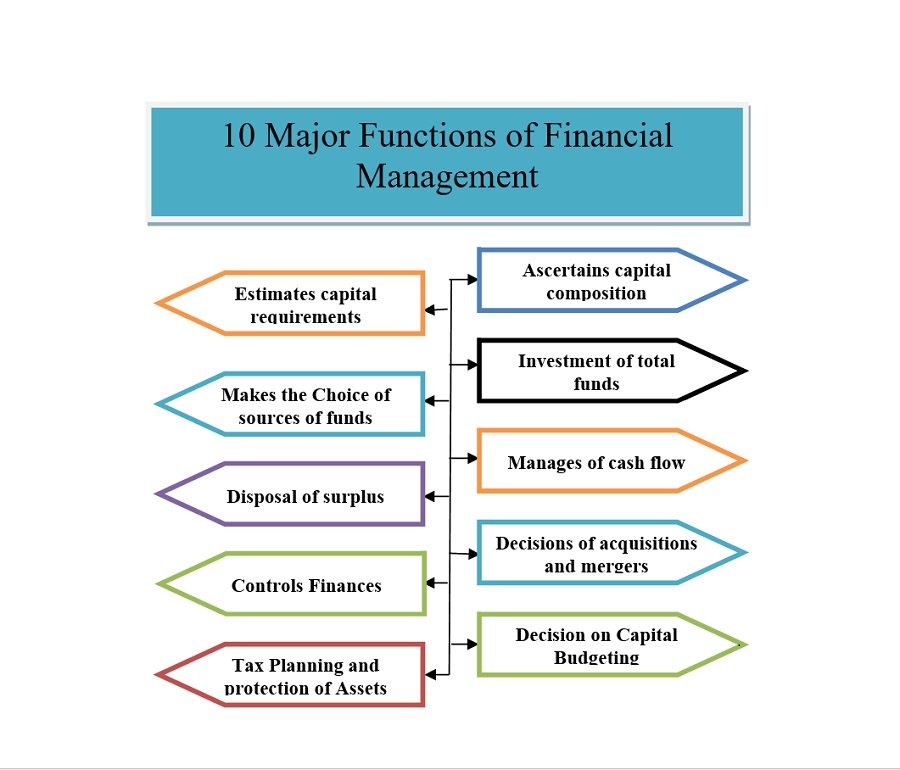
Financial management functions are vital for managing financial resources. Finance is referred to as the provision of funds at the time when it is needed for the business. Finance function involves the procurement of funds from a number of sources and their proper utilization in business concerns. The basic concept of finance comprises capital, funds, and amount. The core finance function is the process of acquiring and utilizing funds for a business. Finance functions are connected to the overall fund management of a business organization. The finance function is also concerned with the decisions such as business nature, size of the firm, type of machinery used, use of debt capital, liquidity position and so on. A brief discussion of major financial management functions is stated below:

  1. Estimates the capital requirements of business

A financial manager firstly has to make the estimation with regards to overall capital requirements of the business. This will depend on several determinants like probable costs and expected profits and upcoming programs and policies of the company. Predictions have to be made in an adequate and concern manner which increases the earning capacity of business and which ensures proper use of financial resources. Thus financial management functions guide a financial manager to estimate organizational capital requirements.

  1. Ascertains capital composition

Once the estimation of capital requirement has been made with the best effort, the capital structure of the enterprise has to be decided. This involves the analysis of short- term and long- term debt equity. This will depend on the proportion of possessed equity capital a company and other additional funds which have to be raised from outside parties through borrowing.

  1. Makes the Choice of sources of funds

A financial manager needs to evaluate different sources of funds. A company has many choices for raising additional funds to be procured in the business like loans to be taken from banks and other financial institutions, issue of company shares and debentures, public deposits to be drawn like in form of bonds. Choice of a factor depends on the relative advantages and disadvantages of each source and financing period.

  1. Investment of total funds

The finance manager has to decide how to allocate the total amount of funds into profitable ventures. He has to make sure that there is safety on investment and positive regular returns are possible. The capital should be invested in a wisely manner so that there is less possibility of losing funds or experience loses. For that, the manager can use different investment tools like portfolio analysis, net present value, internal rate of return, an average rate of return and so on.

  1. Disposal of surplus

Financial manager calculates profits of business at the end of an accounting period. Then the net profits decision has to be taken by the finance manager of the company. This decision can be made in two ways. He can declare a dividend to the shareholders of a company where the ordinary shareholders will get the profits in the form of money or share or retain profits for some purposes like expansion, diversification or innovation of the business.

  1. Manages of cash flow

Finance manager of a company has to make decisions regarding cash management. Cash is required for several purposes like payment of wages and salaries to the workers, payment to the creditors, payment of electricity and water bills, meeting current liabilities of the business, cost of maintenance of having enough stock, purchase of raw materials for daily production etc.

  1. Controls Finances

The functions of a finance manager are not only to do a financial plan, procure fund and utilize the funds but he also has to control the finances involving in the business. This function can be done by many techniques like ratio analysis, forecasting of financials, cost analysis and control and profit distribution techniques etc.

  1. Decisions regarding acquisitions and mergers

A business organization can either be expanded through acquiring other business or by entering into the business by mergers with other firms. While acquisition decision denotes a process of purchasing new or existing companies, the merger is a process where two or more companies join together in the formation of a new business. During such decision, a financial manager has to deal with many complex valuations of securities of each company.

  1. Tax Planning and protection of Assets

It is the duty of a financial manager to lessen the tax liability of the business. This task should be performed wisely. It is very important that a finance executive properly examines various schemes and invest accordingly. He should also protect the assets engaged in the business to ensure the best use of the resources.

  1. Decision on Capital Budgeting

Long-term decisions involve investing in share or bond, purchasing new equipment, building new plant etc. These decisions are called capital budgeting. In this decision making of the company financial managers faces many complicated situations. As the process requires a huge amount of capital, it is necessary that a financial manager identifies the investment opportunities and involved challenges.

The efficient use of financial management functions helps a company to maximize wealth. Financial management is a continuous and interrelated process which involves identifying the required amount of capital that is needed for running the business promptly, evaluating and selecting best alternative sources of funds, allocating the funds according to the need of business area and distributing earned profits.

Characteristic of Financial Planning

  1. Simplicity

A financial plan should be so simple that it may be easily understood even by a layman. A complicated financial structure creates complications and confusion.

  1. Based on Clear-cut Objectives

Financial planning should be done by keeping in view the overall objectives of the company. It should aim to procure funds at the lowest cost so that profitability of the business is improved.

  1. Less Dependence on Outside Sources

A long-term financial planning should aim to reduce dependence on outside sources. This can be possible by retaining a part of profits for ploughing back. The generation of own funds is the way of financial operations. In the beginning, outside funds may be a necessity but financial planning should be such that dependence on such funds may be reduced in due course of time.

  1. Flexibility

The financial plan should not be rigid. It should allow a scope for adjustments as and when new situations emerge. There may be a scope for raising additional funds if fresh opportunities occur. Similarly, idle funds, if any, may be invested in short-term and low-risk bearing securities. Flexibility in a plan will be helpful in coping with the demands of the future.

  1. Solvency and Liquidity

Financial planning should ensure solvency and liquidity of the enterprise. Solvency requires that short-term and long-term payments should be made on dates when these are due. This will ensure credit worthiness and goodwill to the concern.

Solvency will be possible when liquidity of assets is maintained. There should be sufficient funds whenever payments are to be made. Proper forecasting of future payments will be helpful in planning liquidity.

  1. Cost

The cost of raising capital is an important consideration in selecting a financial plan. The selection of various sources should be such that the cost burden should be mimimum. As and when possible interest bearing securities should be returned so that this burden is reduced.

  1. Profitability

A financial plan should adjust various securities in such a way that profitability of the enterprise is not adversely affected. The interest bearing securities and other liabilities should be so adjusted that business is able to improve its profitability.

Considerations in Formulating Financial Plan

A financial plan should be carefully determined. It has long-term impact on the working of the enterprise.

The following variables should be kept in mind while selecting a financial plan:

  1. Nature of the Industry

The needs for funds are different for various industries. The asset structure, element of seasonality, stability of earnings is not common factors for all industries. These variables will influence determining the size and structure of financial requirements.

  1. Standing of the Concern

The standing of a concern will influence a decision about financial plan. The goodwill of the concern, credit rating in the market, past performance, attitude of the management is some of the factors which will be considered in formulating a financial plan.

  1. Future Plans

The future plan of a concern should be considered while formulating a financial plan. The plans for expansion and diversification in near future will require a flexible financial plan. The sources of funds should be such which will facilitate required funds without any difficulty.

  1. Availability of Sources

There are a number of sources from which funds can be raised. The pros and cons of all available sources should be properly discussed for taking a final decision on the sources. The sources should be able to provide sufficient and regular funds to meet needs at various periods. A financial plan should be selected by keeping in view the reliability of various sources.

  1. General Economic Conditions

The prevailing economic conditions at the national level and international level will influence a decision about financial plan. These conditions should be considered before taking any decision about sources of funds. A favourable economic environment will help in raising funds without any difficulty. On the other hand, uncertain economic conditions may make it difficult for even a good concern to raise sufficient funds.

  1. Government Control

The government policies regarding issue of shares and debentures, payment of dividend and interest rate, entering into foreign collaborations, etc. will influence a financial plan. The legislative restrictions on using certain sources, limiting dividend and interest rates, etc.; will make it difficult to raise funds. So, government controls should be properly considered while selecting a financial plan.

Capitalization, Under capitalization and Over Capitalization

Capitalization is an accounting method in which a cost is included in the value of an asset and expensed over the useful life of that asset, rather than being expensed in the period the cost was originally incurred. In finance, capitalization refers to the cost of capital in the form of a corporation’s stock, long-term debt, and retained earnings. In addition, market capitalization refers to the number of outstanding shares multiplied by the share price.

Capitalization has two meanings in accounting and finance. In accounting, capitalization is an accounting rule used to recognize a cash outlay as an asset on the balance sheet, rather than an expense on the income statement. In finance, capitalization is a quantitative assessment of a firm’s capital structure.

Capitalization in Finance

Another aspect of capitalization refers to the company’s capital structure. Capitalization can refer to the book value cost of capital, which is the sum of a company’s long-term debt, stock, and retained earnings. The alternative to the book value is the market value. The market value cost of capital depends on the price of the company’s stock. It is calculated by multiplying the price of the company’s shares by the number of shares outstanding in the market.

If the total number of shares outstanding is 1 billion and the stock is currently priced at $10, the market capitalization is $10 billion. Companies with a high market capitalization are referred to as large caps (more than $10 billion); companies with medium market capitalization are referred to as mid caps ($2 – $10 billion); and companies with small capitalization are referred to as small caps ($300 million – $2 billion).

It is possible to be overcapitalized or undercapitalized. Overcapitalization occurs when earnings are not enough to cover the cost of capital, such as interest payments to bondholders or dividend payments to shareholders. Undercapitalization occurs when there’s no need for outside capital because profits are high and earnings were underestimated.

Undercapitalization

Undercapitalization occurs when a company does not have sufficient capital to conduct normal business operations and pay creditors. This can occur when the company is not generating enough cash flow or is unable to access forms of financing such as debt or equity.

Undercapitalized companies also tend to choose high-cost sources of capital, such as short-term credit, over lower-cost forms such as equity or long-term debt. Investors want to proceed with caution if a company is undercapitalized because the chance of bankruptcy increases when a company loses the ability to service its debts.

Being undercapitalized is a trait most often found in young companies that do not adequately anticipate the initial costs associated with getting a business up and running. Being undercapitalized can lead to a significant drag on growth, as the company may not have the resources required for expansion, leading to the eventual failure of the company. Undercapitalization can also occur in large companies that take on significant amounts of debt and suffer from poor operating conditions.

If undercapitalization is caught early enough, and if a company has sufficient cash flows, it can replenish its coffers by selling shares, issuing debt, or obtaining a long-term revolving credit arrangement with a lender. However, if a company is unable to produce net positive cash flow or access any forms of financing, it is likely to go bankrupt.

Undercapitalization can have a number of causes, such as:

  • Poor macroeconomic conditions that can lead to difficulty in raising funds at critical times
  • Failure to obtain a line of credit
  • Funding growth with short-term capital rather than permanent capital
  • Poor risk management, such as being uninsured or underinsured against predictable business risks

Examples of Undercapitalization in Small Business

When starting a business, entrepreneurs should conduct an assessment of their financial needs and expenses—and err on the high side. Common expenses for a new business include rent and utilities, salaries or wages, equipment and fixtures, licenses, inventory, advertising, and insurance, among others. Since startup costs can be a significant hurdle, undercapitalization is a common issue for young companies.

Because of this, small business startups should create a monthly cash flow projection for their first year of operation (at least) and balance it with projected costs. Between the equity, the entrepreneur contributes and the money they are able to raise from outside investors, the business should be able to be sufficiently capitalized.

In some cases, an undercapitalized corporation can leave an entrepreneur liable for business-related matters. This is more likely when corporate and personal assets are commingled when the corporation’s owners defraud creditors, and when adequate records are not kept.

  • Undercapitalized companies do not have enough capital to pay creditors and often need to borrow more money.
  • Young companies that do not fully understand initial costs are sometimes undercapitalized.
  • When starting, entrepreneurs must asset their financial needs and expenses then err on the high side.
  • If a company can’t generate capital over time, chances of going bankrupt increase, as it loses the ability to service its debts.

Causes of Under-Capitalization:

(1) A company which is floated during depression will find itself under-capitalized during boom period. The reason being that the assets were acquired at lower cost and the return during inflation will be high.

(2) If the company is working at a high degree of efficiency it will earn more profits which will push up the real value of the shares in the market, indicating under-capitalisation.

(3) The promoters of the company at the time of preparing financial plan may under estimate future earnings or make under-estimation of capital requirements.

If the earnings, later on, prove to be higher than the estimated figure, the company will become under-capitalized.

(4) The company may follow a conservative dividend policy (i.e., moderate rate of dividend) thereby leading to enough funds for business expansion, machinery replacement etc. This will lead to higher rates of earnings and hence under-capitalisation.

(5) The promoters of the company in a desire to keep control over the affairs of the concern may issue lesser number of shares and prefer to manage with their own capital or through cheap borrowings and retained earnings, it may lead the company to under-capitalisation after some time.

Effects of Under-Capitalization:

(1) Seeing the high rate of earning and profits of the company, the employees/workers shall start demanding high salaries.

(2) High profits of the company may encourage others to enter the same business line leading to sever competition.

(3) Customers may feel that they are being exploited by the company.

(4) Company will have to pay more taxes.

Where under-capitalization arises due to inadequacy of funds:

(5) At times, company may be compelled to raise funds at higher rates of interest.

(6) Due to inadequacy of capital, once the company runs into rough weather, it may lack working capital and hence a constant danger of failure of business.

Remedial Measures to Control Under-Capitalization:

(1) The existing shareholders may be allotted shares of higher face (par) value in exchange for the old shares. This procedure will bring down the rate of earning per rupee of share value but will not affect the amount of dividend per share.

(2) The shares may be splitted up. It has the effect of reducing the dividend per share. In other words, the par value of shares may be reduced by sub-dividing the shares.

(3) The management may issue bonus shares to equity shareholders. This measure shall capitalize the earnings/products, thus increase the capitalisation and the number of shares. Dividend per share and rate of earnings will be reduced.

(4) To remove the state of under-capitalisation, fresh (more) shares and debentures may be issued.

Overcapitalization

Overcapitalization occurs when a company has issued more debt and equity than its assets are worth. The market value of the company is less than the total capitalized value of the company. An overcapitalized company might be paying more in interest and dividend payments than it has the ability to sustain long-term. The heavy debt burden and associated interest payments might be a strain on profits and reduce the amount of retained funds the company has to invest in research and development or other projects. To escape the situation, the company may need to reduce its debt load or buy back shares to reduce the company’s dividend payments. Restructuring the company’s capital is a solution to this problem.

In the insurance market, overcapitalization takes on a different meaning. Overcapitalization occurs when the supply of policies exceeds demand for policies, creating a soft market and causing insurance premiums to decline until the market stabilizes. Policies purchased in times of low premium levels can reduce an insurance company’s profitability.

The opposite of overcapitalization is undercapitalization, which occurs when a company has neither the cash flow nor the access to credit that it needs to finance its operations. The company may not be able to issue stock on the public markets because the company doesn’t meet the requirements or the filing expenses are too high. Essentially, the company can’t raise capital to fund itself, its daily operations or expansion projects. Undercapitalization most commonly occurs in companies with high start-up costs, too much debt and insufficient cash flow. Undercapitalization can ultimately lead to bankruptcy.

Causes of Over-Capitalization:

(i) More shares and/or debentures might have been issued, resulting in availability of surplus funds that cannot be profitably employed, but dividend shall have to be paid on such excess capital also.

(ii) Rate of interest on borrowings might be higher than the rate of earnings of the company.

(iii) Wrong estimate of the earnings of the company. If future earning is over-estimated, the market value of shares will fall below the purchase price because shareholders will not get what they had been promised by the company.

(iv) Floating the company under inflationary conditions will lead to over-capitalisation because of purchase of assets at high prices.

(v) Payment of high promotional expenses, i.e., if the remuneration paid to promoters etc., is very high.

(vi) Provision of depreciation lass than justified. So company will find it difficult to replace the assets (machinery etc.) with the funds made available by depreciation provision.

(vii) Insufficient and extravagant management of the company. Liberal payment of dividend and low retention of earnings for self-financing.

(viii) Time lag between installation of machinery and starting production.

(ix) High tax rates and excessive tax payment also results in over-capitalisation.

Effects of Over-Capitalization:

(i) Less earnings of the company, leading to reduction of rate of dividend and hence decrease in market value of its shares.

(ii) Shareholders of the company get less dividends.

(iii) Employees are denied increase in salaries.

(iv) Prices of company products may go high.

(v) Company finds it difficult to raise capital, because in present situation of over-capitalisation, it finds it difficult to pay a fair rate of return to its investors.

(vi) To save their skin, directors of the company may resort to unfair practices like manipulation of the books of accounts to show artificial prosperity.

Remedial Measures to Correct Over-Capitalization:

(i) All avoidable costs should be avoided e.g., purchase of new vehicles, air-conditioners, sophisticated office furniture etc.

(ii) Wastage and extravagance should be avoided.

(iii) Earning capacity should be increased by minimizing scrap and by increasing efficiency of workers.

(iv) The par value of shares or the number of shares may be reduced (to eliminate watered stock).

(v) Debentures and cumulative preference shares carrying higher rate of interest and dividend should be redeemed or their holders may be persuaded to take new debentures at lower rate of interest.

Financial Forecasting: Meaning

‘Forecast’ means to form an opinion beforehand i.e. to make a prediction. Thus financial forecasting means a systematic projection of the expected action of finance through financial statements.

Financial forecasting is the processing, estimating, or predicting how a business will perform in the future. The most common type of financial forecast is an income statement, however, in a complete financial model, all three statements are forecasted. In this guide on how to build a financial forecast, we will complete the income statement model from revenue to operating profit or EBIT.

It is needless to mention that such forecasting needs past records, cash flow and fund-flow behaviour, the applications of financial ratios etc. along with the industrial economic condition. It is a kind of plan which will be formulated at a future date for a specified period.

The merits of the financial forecasting are noted below:

(i) It can be used as a control device in order to fix the standard of performances and evaluating the results thereof

(ii) It helps to explain the requirement of funds for the firm together with the funds of the suppliers

(iii) It also helps to explain the proper requirements of cash and their optimum utilization is possible and so surplus/excess cash, if any, invested otherwise.

Financial planning, on the other hand, is nothing but one part of a larger planning process within an organization.

“A complete planning system begins at the highest level of policy with the firm’s basic goals or purpose, usually stated in qualitative, mission-oriented, terms. From this it is derived the firm’s commercial strategy, defining the product or services it will produce and the markets it will serve. Supporting policies are developed in production, marketing, research and development, accounting and finance. The extent to which the system formalized with detailed planning and budgeting system in each area depends in part on the firm’s size and the complexity of its operation.” — E. Solomon and J. S. Pringle

Thus, in a broader sense, financial planning can be viewed as the representation of an overall plan for the firms in terms of finance and, similarly, in a narrower sense, it may refer to the process of determining the financial requirements which is needed in order to support a given set of plans in other areas.

Financial Forecasting Vs. Budgeting

When you create a budget for your business, you plan to set aside money for certain costs, taking into account your income and expenses. The budget you make may be based on info from your financial forecast, but it’s distinct from the forecast itself.

Think of financial forecasting as a prediction, and budgeting as a plan. When you make a financial forecast, you see what direction your business is headed in, based on past performance and other factors, and use that to anticipate the future.

When you make a budget, you plan how you’re going to spend money based on what you expect your finances to look like in the future (your forecast).

For instance, if your financial forecast for next year says you’ll have an extra $5,000 in revenue, you might create a budget to decide how it will be spent—$2,000 for a new website, $1,000 for Facebook ads, and so on.

Three steps to creating your financial forecast

Ready to peer into the crystal ball and see the future of your business? There are three steps you need to follow:

Step 1: Gather your records

If you’re not looking into the past to see how your business has grown, you’re not really forecasting—you’re just guessing.

You’ll need to gather past financial statements so you can see how your business has developed over time, and then project that development into the future.

Your bookkeeper or bookkeeping software should generate financial statements for you. If you don’t have either, and you don’t have financial statements, you’ll need to take care of that before you can start forecasting. You need complete bookkeeping in order to get the transaction history you base your financial statements on.

Put aside the task for financial forecasting for the moment, and learn How to Catch Up on Your Bookkeeping.

Once your books and financial statements are up to date, you’ll have everything you need to start planning for the future.

Step 2: Decide how you’ll make your forecast

Depending what resources you choose to use, the type of forecast you create will fall between two poles—historical and researched-based.

Almost every financial forecast includes a little bit of historical forecasting, and a little bit that’s research-based. The blend you choose will depend on your needs and the resources at your disposal.

Remember, the goal is to create a realistic, useful forecast—without breaking the bank or eating up all your time.

(i) Historical forecasting

When you use your financial history to plot the future, it’s historical forecasting. You’re looking at your last few annual Income Statements, Cash Flow Statements, and Balance Sheets to see how fast you’ve grown in the past. From there, you can make a guess about how fast you’ll grow this year.

The benefit of this is that it’s relatively easy to do and doesn’t take a lot of time, money, or expertise. The drawback is that you’re only using info about your own business, and not looking at broader market trends—like what your competition has been up to.

Historical forecasting is a good bet if you’re forecasting for modest growth, or else creating a quick-and-dirty forecast for your own use not putting together a presentation for potential investors.

(ii) Research-based forecasting

When you do research about broader market trends, you’re using research-based forecasting. You may look at how your industry has performed over the past ten years, investigate new technologies and consumer trends, or try to measure the progress of your competitors. You might look at how companies similar to yours have planned their own growth.

The benefit of research-based forecasting is that you get a detailed, nuanced view of how your business could grow, taking into account a lot of different factors. And it’s the kind of forecast that investors and lenders want to see.

The drawback is that researched-based forecasting can be expensive. You may find you need to hire outside consultants and researchers to handle the heavy lifting.

Research-based forecasting is a good choice if you’re courting investors, or planning on rapid, aggressive growth. It’s also good if your company is brand new, and doesn’t have a lot of financial history to draw on for making projections.

Step 3: Create pro forma statements

Once you’ve collected the information you need to build your forecast, you can create pro forma statements.

We’ll cover the three key financial statements here. Whether you use all of them is up to you.

If you’re creating a quick forecast for your own planning, you may only need to create pro forma Income Statements. If you’re presenting to lenders or investors, you’ll want to use all three.

Rule of thumb: Any form you’d use in the month-to-month operation of your business should be created pro forma. For instance, if you move a lot of cash around every month, and you rely on Cash Flow Statements to make sure you’ve got enough money on hand to pay your vendors, then it’s wise to create pro forma Cash Flow Statements as part of your forecast.

(i) Creating the pro forma Income Statement

First, set a goal—a projection—for sales in the period you’re looking at.

Let’s say you made $30,000 in sales this year. Next year, you want to make $60,000. So, your total sales will increase by $30,000.

Set a production schedule that will let you reach that goal, and map it out over the time period you’re covering. In our example, there will be 12 Income Statements in the year to come (one each month). Map out that $30,000 increase in sales over the 12 statements.

You could do this by increasing sales a fixed amount every month, or gradually increasing the amount of sales you make per month. It’s up to your instincts and experience as a business owner.

Then, it’s time for the “loss” part of “Profit and Loss.” Calculate the cost of goods sold for each month, and deduct it from your sales. Deduct any other operating expenses you have, as well.

It’s important to take every expense into account so you get an accurate projection. If part of your plan is quadrupling your online advertising, be sure to include an expense that reflects that.

Once you’re done, your pro Forma Income Statements show you how much you can expect to earn and how much you can expect to spend in the time ahead.

(ii) Creating the pro forma Cash Flow Statement

You create a pro forma Cash Flow Statement a lot like the way you’d create a regular Cash Flow Statement. That means taking info from the Income Statement, and using the Cash Flow Statement format to plot out where your money is going, and how much you’ll have on hand at any one time.

Your projected cash flow can tell you a few things. If it’s in the negative, it means you’re not going to have enough cash on-hand to run your business, according to your current trajectory. You’ll need to make plans to borrow money and pay it off.

If your net cash flow is positive, you can plan on having enough surplus cash on hand to pay off loans, or save for a big investment.

(iii) Creating the pro forma Balance Sheet

Drawing on info from the Income Statement and the Cash Flow Statement lets you create pro forma Balance Sheets. But you’ll also need previous Balance Sheets to make this useful so you can follow the story of how your business got from “Balance A” to “Balance B.”

Tools of Financial Forecasting

As a business owner, there may be nothing more important to to get a handle on your company’s future cash at hand, several tools are available to help you analyze projected income and expenses. They range from rudimentary spreadsheets to slick visualization apps. Here are five tools that can help you forecast your figures.

  1. Templates

For some, there’s nothing like rolling up their sleeves and getting their hands dirty with an Excel spreadsheet. If this is you, here are some templates you can use to get you started. Futurpreneur Canada provides a cash flow template that will cover everything from outlining startup costs through to projecting cash flow month by month for two years.

SCORE, a network of business mentors created by the U.S. Small Business Administration (SBA), has its own cash flow and financial projection

Templates to help project cash flow over a 12- month or three-year period.

  1. QuickBooks cash flow projector

The desktop version of QuickBooks offers short-term cash flow predictions via two features. The first, cash flow forecasting, uses outstanding invoices and bills in the accounting system to tell you what your cash at hand will look like over the next month or so.

Alternatively, you can use the cash flow projector tool included in some desktop versions of QuickBooks. This lets you analyze your historical accounting data and tweak it with your own manual adjustments, while also taking in accounts payable data.

QuickBooks cash flow projector will only project out for the next six weeks. If you want a longer-term view with extra goodies, you’ll need something with more power.

  1. Float

While some accounting packages might give you basic cash flow forecasting, there’s a lot to be said for a best-of-breed solution that does one thing well. Float is a dedicated cash flow forecasting system that integrates with QuickBooks and with two other popular online accounting packages, Xero and FreeAgent.

Float imports accounting data directly from those packages, using them to generate cash flow forecasts on a daily or monthly basis. Its “what if” analysis tools show you what happens to your cash on hand over time as you play with parameters, and also lets you create multiple scenario layers showing what would happen in different events, such as taking on a new employee.

The online tool includes budgeting options that let you describe how your business will spend its cash, and then tracks those budgets throughout the month.

  1. Dryrun

Dryrun also takes input from Xero and QuickBooks to let you track your forward cash flow. It lets you track partial payments, and allows you to collaborate with employees and business advisors so that they know your position.

This system includes another feature: sales forecasting. It draws data directly from web-based CRM tool Pipedrive, so that you can factor potential deals into your cash flow forecast, making it more accurate.

Sales is just one part of the cash flow puzzle. What are you spending on? Dryrun’s budget system offers the ability to define your own categories and create auto-repeating budget items that you can view in varying levels of detail.

DryRun’s what-if modelling system lets you compare multiple scenarios together at once, using multiple data points in each forecast.

  1. Pulse

Pulse lets you monitor existing cash flow on a weekly or monthly basis, and project future cash flow using tools to estimate the effect of a new project or expense on your cash at hand.

Input data from QuickBooks automatically to cut down your workload, and then use it to visualize cash flow in a series of reports. This tool also does cash flow tracking in multiple currencies for those doing business internationally.

With Pulse, you can set user accounts at multiple levels, ranging from Owner down to Read Only, with varying levels of access.

Whichever tool you use, the secret to accurate forecasting lies in accounting for costs and income as accurately as possible. Being honest about your financial expectations is a key requirement in cash flow planning. If you can pull data from your accounting system, then you’re already off to a great start.

error: Content is protected !!